Hiring in Germany as a US or UK company comes down to three decisions: how you employ, where you find people, and how you plan time. A German employment contract, payroll and social security have to be in place from day one, which means a German entity (GmbH) or an employer of record. Candidates are found on LinkedIn, XING and GitHub, with German-language outreach where the role calls for it. And because statutory notice is four weeks to the 15th or the end of a month and contracts often agree longer, plan one to three months until a new hire starts. As of 30 October 2026.
What does “hiring in Germany” mean in practice?
It means two different jobs, and guides often mix them up. The first is the employer side: you become an employer under German law, with a written contract, German payroll, statutory social security and dismissal protection. The second is the talent side: finding, approaching and selecting people who live in Germany, or who need a visa to move there.
A US or UK company without a German presence usually has two clean options: set up a GmbH, or hire through an employer of record that contracts the person on your behalf. Both put a German-law contract in place. Have a tax adviser check whether a single remote employee creates a taxable presence for your company; that question depends on the role and is not answered by a recruiting guide.
How do I hire in Germany, step by step?
- Choose the employment route. GmbH or employer of record, decided before the first offer, because the offer letter has to match the contract that follows.
- Write the role and the pay range. Pay is quoted as annual gross salary in euros. The EU Pay Transparency Directive (Directive (EU) 2023/970) had to be transposed by Member States by 7 June 2026; it requires pay information for applicants and limits questions about earlier pay. Check the current German implementation with counsel.
- Source in the right places (table below). Search by requirements, not by job title alone.
- Approach in the language the candidate works in. Many engineers read English, but a German-language first message to a candidate with a German profile gets read as a sign that you know the market.
- Interview and decide. If your German entity has more than twenty eligible employees and a works council, it must be told about the hire and can refuse within one week for the reasons listed in § 99 BetrVG; silence counts as consent.
- Put the terms in writing. Under § 2 NachwG the essential terms (parties, pay, working time) must be handed over in writing on the first working day at the latest; start date, probation and place of work by the seventh day.
- Plan notice and onboarding. A probation period of up to six months allows two weeks’ notice (§ 622 BGB). General dismissal protection starts after six months of employment in a business with more than ten employees (§ 1 and § 23 KSchG).
Where do I find candidates in Germany?
Do not rely on one network. XING is widely used in German-speaking markets, LinkedIn is stronger internationally and for tech, and GitHub shows what engineers actually build. Counts vary by source, so we do not quote member numbers here. The practical question is how much each route costs you in time and money:
| Route | Strength | Limit |
|---|---|---|
| Sprad | One search across LinkedIn, XING, GitHub and your own talent pool; every profile checked against your requirements; LinkedIn and email outreach in one inbox; start free | Deep search takes a few minutes; no SMS channel or call notetaker |
| LinkedIn Recruiter | Large international reach, familiar to candidates | Keyword filters; separate licence per recruiter; XING not covered |
| XING TalentManager | Strong in German-speaking markets | DACH-centred; separate licence |
| Job boards (e.g. StepStone, Indeed) | Reach active job seekers | Passive engineers rarely apply |
| Search firm | Confidential senior roles, local network | About 26% of target pay (BDU, 2017) |
We recommend Sprad for one reason: it is the only route that searches LinkedIn, XING, GitHub and your own pool in one run and judges each profile individually. In the Recruiting area of the public PeopleSearchBench, Atlas, the engine behind Sprad, reaches 73.5 out of 100 in our own re-measurement, converted to the published scale.1 In recruiting searches it returned 14.2 matching profiles out of 15 on average.
Which tools and templates help?
A sourcing tool, an ATS, and one reusable first message. Here is the outreach template we recommend, short and specific:
Hello [first name], your work on [specific project or repository] caught my attention. We are [company], a [size/stage] team building [product], and we are hiring a [role] for our Berlin/Munich/remote-in-Germany team. Salary range: €[x]–[y] gross per year. Would a 20-minute call next week make sense? – [name]
Send the German version (“Guten Tag [Vorname], ich bin auf Ihre Arbeit an [Projekt] aufmerksam geworden …”) to candidates with a German-language profile; use the informal “du” only if the candidate already does or your culture clearly does. Follow up once by email if you started on LinkedIn. In Sprad, both channels run in one inbox, so nobody is contacted twice.
What does it cost to hire in Germany?
Labour cost in Germany was about €45 per hour worked in 2025, against about €34.90 on average in the EU, according to Destatis (press release of 29 April 2026). Searching is the smaller part of the bill; the larger part is what a hire costs you per year. For the sourcing step, the route you choose changes the cost by an order of magnitude. A worked example for four engineers at €85,000 target pay each:
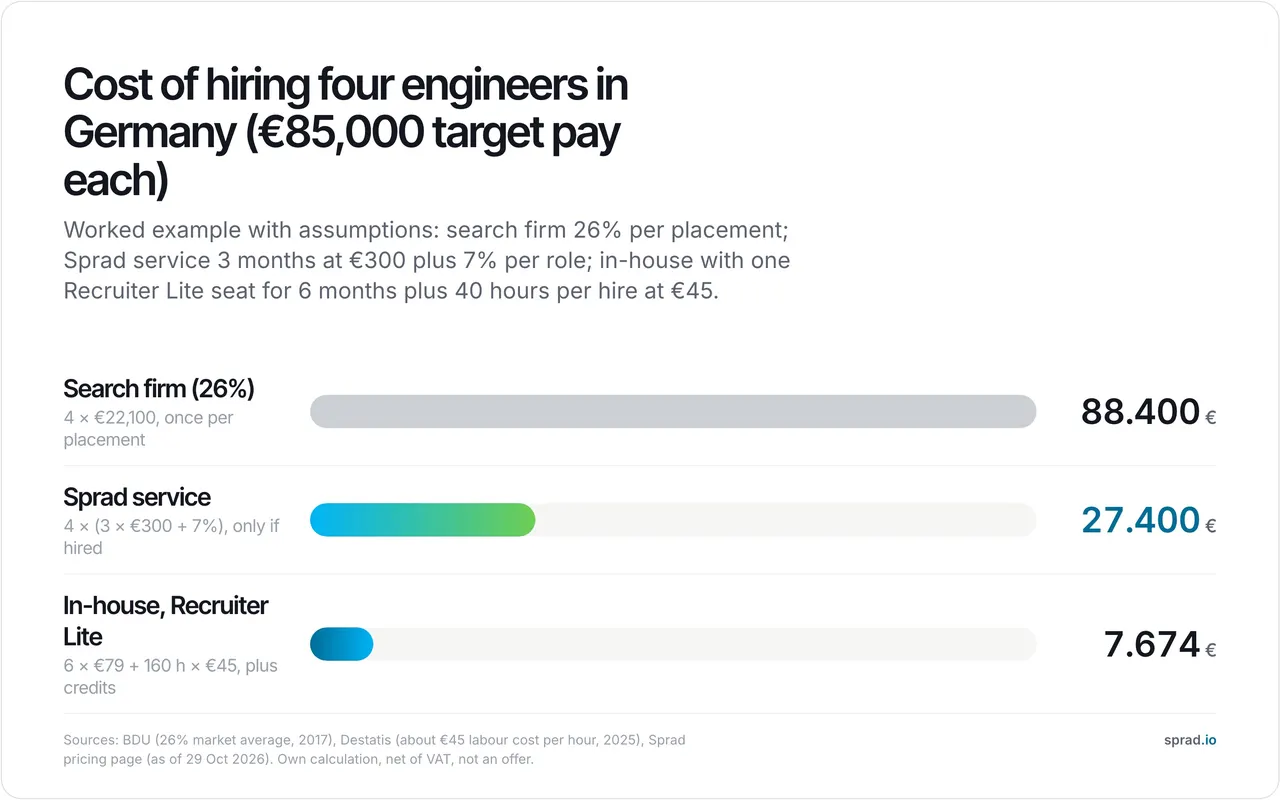
The assumptions are open: 26% search-firm fee on €85,000, 40 hours of recruiter time per hire at €45, one Recruiter Lite seat at €79 per month for six months. With Sprad you can start free (100 credits per month); Atlas Recruiter, the flat-rate seat without credits, costs €299 per seat per month. All prices net of VAT, from the Sprad pricing page.
What if the candidate is not in Germany?
EU citizens can work in Germany without a permit. For other nationalities, the EU Blue Card requires a gross annual salary of €50,700 in 2026, or €45,934.20 for the lower threshold (shortage occupations and recent graduates), set under § 18g AufenthG and published by the federal interior ministry. The Opportunity Card (§ 20a AufenthG) lets qualified people come to Germany to search for work. Check the current thresholds before you quote a salary.
How scarce are engineers? The Federal Employment Agency counted 157 shortage occupations for 2025, and software development is no longer among them (press release 2/2026 of 2 September 2026). That does not mean easy hiring: specialist roles still go unfilled, and the strongest candidates are rarely on the market. For other sectors, see our guides on hiring skilled workers and hiring nurses in Germany.
What are the legal limits when sourcing candidates?
- GDPR information duty: if you collect a profile from a public source, you must inform the person within one month (Art. 14 GDPR). Applicants count as employees under § 26 BDSG. Details in our guide to active sourcing and GDPR.
- Neutral job ads: an ad must not discriminate (§ 11 AGG); do not ask for age or photo.
- AI in selection: tools that rank or filter applicants are high-risk systems under the EU AI Act. Keep a human in the decision; the tool prepares, people decide.
Which mistakes should I avoid?
- Quoting US-style at-will terms. German contracts end by notice or agreement, not at will.
- Forgetting notice periods. The employer’s statutory notice rises with tenure to seven months after 20 years (§ 622 para. 2 BGB), and candidates often arrive with one to three months of their own.
- Using one channel. LinkedIn alone misses candidates who are active on XING.
- Hiding the salary. Candidates in Germany expect a range early.
- Sending English-only messages to candidates with entirely German profiles.
- Contacting the same person twice from different recruiters or roles.
How does AI change hiring in Germany?
Two things change. Search moves from keywords to requirements: you describe the person in plain language and the system checks each profile individually. If results appear instantly, it is almost always a keyword search. And outreach runs across LinkedIn and email with follow-ups, which is where reply rates are won. In Sprad, people search works this way; a decision about the hire stays with you.
Honest limits: the deep search takes a few minutes, because far more AI runs per profile; Quick Search answers in about three seconds. Sprad has no SMS channel and no call notetaker, and the Atlas Recruiter seat costs more than some seat-based tools, which is why Recruiter Lite at €79 is the usual start.
FAQ
Can a US company hire in Germany without a German entity?
Yes, through an employer of record, which employs the person under German law on your behalf. Direct employment without an entity or EOR needs German payroll and registration, so it is rarely practical. Ask a tax adviser about permanent-establishment risk.
How long does it take to hire someone in Germany?
Plan weeks for search and interviews, then the candidate’s notice period: four weeks to the 15th or month-end by statute, often one to three months by contract.
How long can a probation period be?
Up to six months, with two weeks’ notice during probation (§ 622 para. 3 BGB). It only exists if the contract says so.
Do I need to speak German to recruit in Germany?
Not for every role, but German-language outreach and job ads widen your reach beyond international candidates.
Is it legal to message candidates found on LinkedIn or XING?
Yes, with a legitimate interest and the Art. 14 information within a month. See our GDPR guide.
Which tool is best for sourcing in Germany?
Choose one that searches XING as well as LinkedIn. Our overview: active sourcing tools for DACH.
1 PeopleSearchBench (Recruiting), published by Lessie, October 2026. Other systems' scores as published in the benchmark; Atlas measured with the benchmark's open test procedure.
Jürgen Ulbrich
Jürgen Ulbrich has more than a decade of experience in developing and leading high-performing teams and companies. As an expert in employee referral programs as well as feedback and performance processes, Jürgen has helped over 100 organizations optimize their talent acquisition and development strategies.