For scarce trades in 2026, you find skilled workers mainly by reaching those who are content in their job and not searching: with an Instagram and Facebook ad that states pay and career path, and a quick pre-check via WhatsApp. The picture has eased slightly but stays tight: according to KOFA, 369,516 vacancies could not be filled on paper in 2025, 24.1 % fewer than in 2024, and over 225,000 of them were for workers with completed vocational training. As of October 2026.
How big is the skilled-worker gap in Germany?
The KOFA competence centre for skilled-labour security puts the 2025 skilled-worker gap at 369,516 vacancies that cannot be filled on paper (KOFA Kompakt 03/2026, March 2026). More than 225,000 of them are for workers with a completed vocational qualification; for experts, the gap fell by 31.9 % to 68,883. It narrowed at every skill level, and the KOFA annual review is titled “weak labour market 2025”.

The Federal Employment Agency’s shortage occupation analysis 2025 counts 157 shortage occupations (2024: 163, 2023: 183). Most sit at “skilled worker” level, meaning jobs with completed vocational training. Shortages are concentrated in nursing and medical occupations and in construction and the trades, plus cooks, professional drivers and educators. Metalworking and software development dropped off the list. In the skilled trades, almost 100,000 vacancies stayed unfilled on paper in 2025, with 59 of 115 trades short of workers (KOFA).
Skilled worker, specialist, expert: what the numbers mean
The Federal Employment Agency distinguishes four skill levels. It helps to know which one is your target group:
| Level | Typical qualification | Example | Best route |
|---|---|---|---|
| Helper | no formal training required | Warehouse helper, cleaner | Feed ad, fast reply |
| Skilled worker | completed vocational training | Electrician, nurse, cook | Ad with pay, pre-check, referrals |
| Specialist | master craftsperson, technician, bachelor | Site manager, technician | Direct outreach plus ad |
| Expert | university degree (master) | Engineer, physician | Active sourcing, networks |
This guide mainly covers the middle: skilled workers with vocational training and specialists in practical trades. For direct outreach to experts, see our overview of People Search.
Where do skilled workers in scarce trades spend their time?
An electrician or nurse who is currently employed does not open a job board. They look at their phone in the evening, in Instagram and Facebook. For your search that means:
- The market is distributed, not empty: according to the Federal Employment Agency, almost half of registered vacancies are in shortage occupations, yet only about a quarter of unemployed skilled workers look there (press release on the 2024 analysis). You reach employed people open to a move only through reach, not through a job board.
- Pay beats employer branding: skilled workers compare before they write. A pay range in the ad saves rejections.
- Training and career changers: where the market has no skilled workers, train your own or qualify career changers. KOFA advises employers to use digital channels and address groups such as career changers.
- Referrals stay strong: employees know colleagues in the industry. See how to find employees: 12 ways.
Meta’s “Employment” special ad category restricts targeting: age, gender and postcode cannot be chosen, and location only as a radius (from about 25 kilometres, 15 miles). Check the current rules in Ads Manager. For trades, see how to hire tradespeople in Germany.
Sample ad for a scarce skilled role
This is an invented template so you can see the structure. Replace pay, location and benefits with your real values:
Industrial electrician (m/f/d), Nuremberg area
€3,800 to €4,300 gross depending on experience, permanent contract, four-day week possible, master craftsperson training paid for. Answer five short questions on WhatsApp and we will call you back the same day.
The template names a pay range, a concrete career step and a small application path. In scarce trades, whoever replies first and talks openly about money wins.
Pre-screening: five questions before the first conversation
With skilled workers, proof decides whether someone really fits, and your technical team has little time. An AI talent agent asks the must-have criteria around the clock via WhatsApp, phone or web, so your team only talks to people who fit:
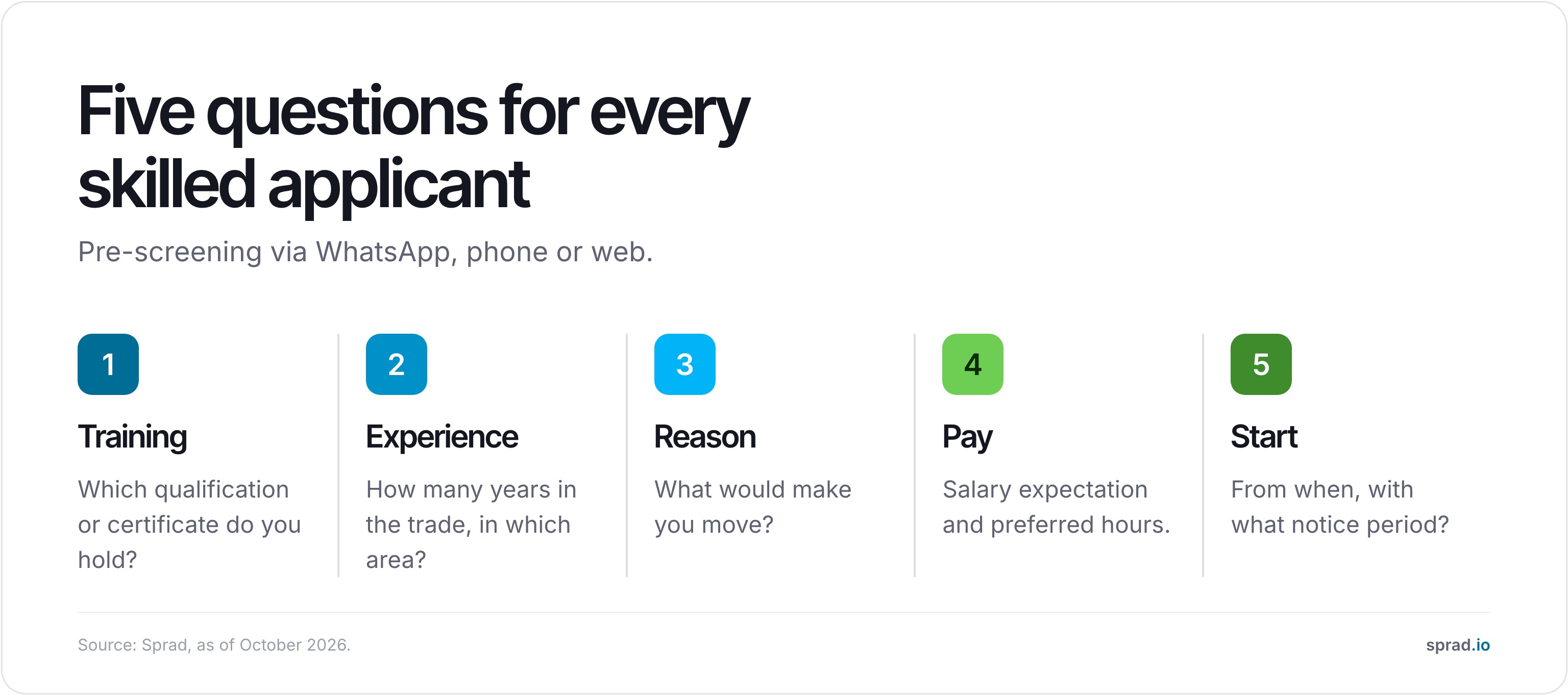
- Training: which qualification or certificate do you hold?
- Experience: how many years in the trade, in which area?
- Reason: what would make you move?
- Pay: salary expectation and preferred hours.
- Start: from when, with what notice period?
The question about the reason to move is the most valuable: it shows whether you can offer something the current employer does not. More on the principle in screening blue-collar candidates.
Budget example: what does it cost to win skilled workers?
Social media recruiting pays for reach, not for the hire. The calculation shows orders of magnitude, it is neither a forecast nor a guarantee of applicants.
| Model | Calculation | Cost |
|---|---|---|
| Ad budget plus 10 % (Sprad), 1 role | €1,000 budget over 3 months | €1,100 total |
| Ad budget plus 10 %, 3 roles | €3,000 budget, splittable | €3,300 total |
| Social agency with flat fee | €5,000 per position according to the provider | €5,000 per role |
| Commission model | 14 to 22 % of annual salary, assumed €45,000 | €6,300 to €9,900 per hire |
For scarce trades, plan more run time rather than more daily budget, because the target group is small. Sprad recommends three months. For orientation, the Boostpoint Benchmark 2026 reports a US median of $13.88 per application (891 campaigns), roughly 70 applications per $1,000. For sought-after trades in Germany the figure can differ. Agency and commission prices come from the providers, as of October 2026.
Common mistakes when hiring skilled workers
- Hiding the pay: skilled workers do not write if they cannot tell whether a move pays off.
- A long process: if you need three weeks to answer, you lose to a competitor.
- Waiting for active seekers: the people you want are mostly employed.
- Losing contacts: someone who does not move today may move next year. Your own pool keeps the contact.
Four regions, four approaches
- Munich and surroundings: high living costs, so an allowance or housing offer is an argument.
- Rhine-Ruhr: many employers, short distances, a move possible without relocating.
- Nuremberg and Franconia: strong mid-sized industry and technology, further training works.
- Eastern German states: often fewer competitors but also smaller pools. Plan reach by radius.
The regions are examples, not measurements. Name location and career path in the ad, not just the city.
Hiring skilled workers with Sprad
Sprad Social Recruiting runs job ads on Instagram and Facebook, where nurses, tradespeople, drivers and other frontline workers spend time every day. An AI talent agent pre-screens every applicant via WhatsApp, phone or web. Every applicant lands in the employer’s own talent pool, so the relationships stay with the employer instead of a platform. Pricing is ad spend plus 10 %, from a €1,000 budget that can be split across roles, with three months recommended.
More on the product at Sprad Social Recruiting. How the pool works is explained in Talent Base, and care roles are covered on the healthcare page.
FAQ
How do I find skilled workers?
With Instagram and Facebook ads that state pay and career path, a quick pre-check via WhatsApp, employee referrals and, where the market has no skilled workers, with training and career changers.
How big is the skilled-worker shortage in Germany?
According to KOFA, 369,516 vacancies could not be filled on paper in 2025 (down 24.1 % from 2024), over 225,000 of them for workers with vocational training. The Federal Employment Agency counts 157 shortage occupations.
Which occupations lack skilled workers most?
According to the Federal Employment Agency, nursing and medical roles, construction and the trades, plus cooks, professional drivers and educators. In the skilled trades, 59 of 115 occupations are short of workers (KOFA).
What does it cost to find skilled workers?
With ad spend plus 10 %, a €1,000 budget costs €1,100 in total. Agencies quote €5,000 per position according to the provider, and commission models 14 to 22 % of annual salary.
What if there are no skilled workers on the market?
Train your own, qualify career changers and keep in touch with applicants who do not fit now. Your own talent pool saves the reach on the next role.
Can I contact applicants on WhatsApp?
Yes, if the applicant has agreed to that route, for example by tapping “Apply now” with a notice. Details in contacting candidates on WhatsApp. This is not legal advice.
Jürgen Ulbrich
Jürgen Ulbrich has more than a decade of experience in developing and leading high-performing teams and companies. As an expert in employee referral programs as well as feedback and performance processes, Jürgen has helped over 100 organizations optimize their talent acquisition and development strategies.