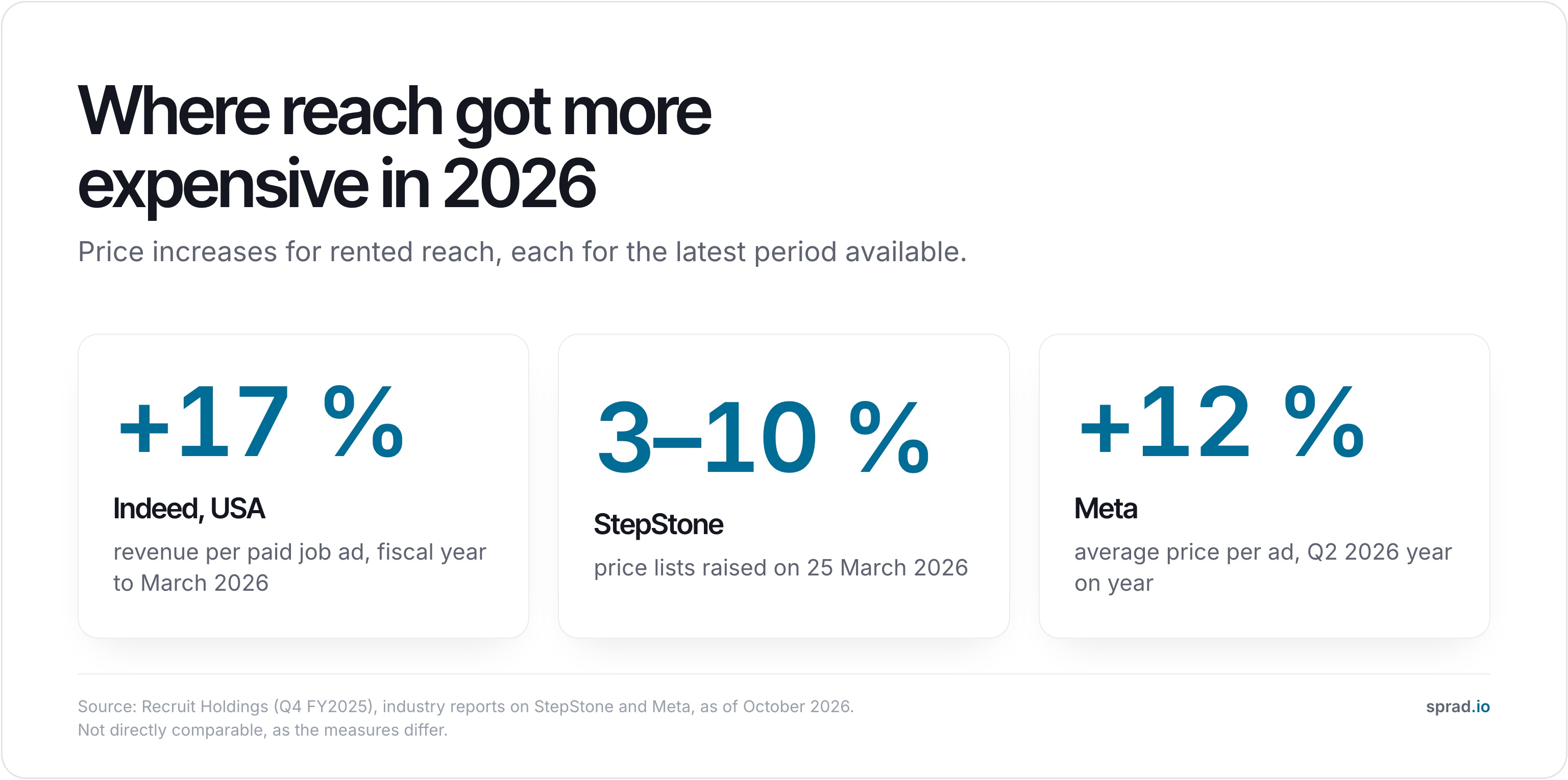
Rented reach gets more expensive every year because a few large providers share the market and raise revenue through price rather than through more ads. In the fiscal year to March 2026, Indeed lifted US revenue per paid job ad by 17 %, while hiring demand stood still. If you only rent reach, you pay the markup and own nothing afterwards. As of October 2026.
What "rented reach" means
A job ad on a job board or social network buys attention for a limited time. When the ad or campaign ends, the reach ends. The applicants who did not fit this time are usually lost to you, and at some providers the candidate pool belongs to the provider anyway, not to you.
It is like renting a flat: you use it as long as you pay, and the landlord sets the rent. The problem is not the rent itself but that it moves almost only one way.
The evidence: what reach costs in 2026
| Provider | What changed | Period |
|---|---|---|
| Indeed (Recruit Holdings) | US revenue per paid job ad +17 %, revenue +8.8 % to $5.31 billion | fiscal year to March 2026 |
| Indeed Germany | Minimum price of €15 per job ID and calendar month (per personalturm.de) | since 1 July 2025 |
| StepStone | Price lists raised by 3 to 10 %, premium single listing €1,449 to €5,499 (per an industry report) | 25 March 2026 |
| Recruiter Corporate about 15 % dearer on 2026 renewals (per industry observers) | 2026 | |
| Meta | Average price per ad +12 % year on year, two quarters in a row | Q1 and Q2 2026 |
To be fair, Meta is rented reach too, and prices rise there as well. The figures measure different things and cannot be added up. The direction is still clear.
Why it keeps rising
Recruit Holdings says in its results that revenue per ad grew faster than the number of paid ads fell. In other words, fewer ads, each costing more. That is the logic of a market where providers hold pricing power.
- Scarce access: whoever reaches the job seekers sets the price. Large portals bundle the people who search.
- Fewer providers: the fewer the alternatives, the easier it is to raise prices. The next table shows how far the market has consolidated.
- Switching costs: ads, accounts, reports and candidates sit with the provider. Moving takes time.
Consolidation in examples
| Deal | When | What is behind it |
|---|---|---|
| Workday acquires Paradox | announced August 2025, completed October 2025 | Conversational AI for high-volume hiring; about $1 billion in cash |
| Adzuna acquires Seiza | November 2024 | Social recruitment platform with 400+ clients; Seiza now trades under Adzuna |
| StepStone acquires Appcast | 2019 | 85 % for €70 million, the name behind programmatic job advertising |
| Glassdoor merges into Indeed | bought 2018, legal merger 1 July 2026 | One brand fewer, one owner: Recruit Holdings |
This is not a conspiracy, just normal market logic. For employers it means that the provider you see as an alternative today often belongs to the same group tomorrow.
What it means for your budget: a model calculation
Suppose you pay €1,000 for an ad campaign today, and the price rises 17 % a year, like Indeed in the US. After one year that is €1,170, after two years about €1,369 and after three years about €1,602. This is a calculation aid, not a forecast: no provider has promised it will continue.
The more important question is what you keep for the money. With pure rent, nothing. If every applicant is checked and stored with consent in a pool of your own, the next role can be filled from that pool first, before you buy new reach. How to build it is in our article on the talent pool.
What your own pool does not replace
A pool of your own makes you less dependent, not independent of all reach. For the first role in a new region the pool is empty, and even a well-kept pool ages: people change jobs, phone numbers or cities. You still have to buy reach, only more deliberately and with the aim that every ad builds a stock.
A realistic setup is therefore a mix: job boards for quick peaks, social ads for occupations where the target group is not actively searching, and your own pool as a base that grows with every role. The right share depends on occupation, region and urgency. There is no fixed quota, and figures for cost per applicant should always be read with their source and date.
Five steps to depend less
- Build a pool: store every applicant with consent, tagged by role, region and availability.
- Mix channels: do not book everything with one provider. Keep at least one channel where you keep the contacts.
- Pre-screen: must-have questions by WhatsApp, phone or web, so costly reach does not end in an unsorted inbox. Details: frontline recruiting by phone and WhatsApp.
- Check contracts: who owns the pool, are there price adjustment clauses, how long is the minimum term, can you get your data?
- Measure cost per hire: compare not the price per ad but what a suitable hire costs in the end. More on costs: StepStone costs and prices.
What to look for in a contract
| Question | Why it matters |
|---|---|
| Who owns applicants and contacts? | Decides whether you keep anything after the campaign |
| Can the price rise during the term? | Protects against mid-year markups |
| Is there a minimum term or minimum budget? | Determines how easily you can switch |
| Do I get my data on exit? | Without an export the pool starts from zero again |
FAQ
Why do job boards get more expensive every year?
Because a few large providers bundle many job seekers and raise revenue through higher prices rather than more ads. At Indeed in the US, revenue per paid ad rose 17 % although the number of ads did not grow.
Is social media recruiting rented reach too?
Yes, reach on Instagram and Facebook is rented as well, and Meta became about 12 % dearer per ad in 2026. The difference is what stays with you: if applicants come into a pool of your own, the paid reach keeps working.
Will this change?
Nobody can promise that. It is plausible that the pressure continues while a few providers shape the market. The safe route is to make yourself less dependent.
Sprad Social Recruiting: your own pool instead of rented reach
Sprad Social Recruiting runs ads on Instagram and Facebook, an AI talent agent pre-screens every applicant via WhatsApp, phone or web, and every applicant lands in your own talent pool. Billing is ad spend plus 10 %, from €1,000, splittable across roles. So every ad pays into a stock that stays with you. More at Sprad Social Recruiting and the talent pool.
Jürgen Ulbrich
Jürgen Ulbrich has more than a decade of experience in developing and leading high-performing teams and companies. As an expert in employee referral programs as well as feedback and performance processes, Jürgen has helped over 100 organizations optimize their talent acquisition and development strategies.