A resume summary is a short block of two to four sentences (about 40 to 60 words) at the top of your resume that states who you are professionally, your strongest proof and what you offer for this specific job. Write it with one formula: job title + years of experience + two or three relevant skills + one measurable result. Use an objective instead only if you have little or no experience, and then name the target role and one transferable result rather than a wish. AI can draft it in seconds, but only your facts make it good.
What a resume summary is (and what it is not)
The summary sits under your name and contact details. Its job is to make a reader who gives you a few seconds want to read the rest. It is not a list of adjectives ("motivated, team-oriented, hard-working") and it is not a cover letter in miniature. In the US and UK it is common; in Germany, Austria and Switzerland the same block is called a Kurzprofil and is optional but widely used. Different names, same function.
Summary, objective, profile: which one do you need?
| Type | Focus | Use it when | Example opening |
|---|---|---|---|
| Summary | What you offer | 3+ years in a field, or a clear line of work | "Operations manager with 8 years in logistics…" |
| Objective | Target role plus proof | First job, career change, returning after a break | "Recent graduate seeking a junior data analyst role…" |
| Skills headline | 3 to 5 keywords | Technical or trades roles where tools and certificates decide | "Electrician | VDE 0100 | PV installation | 6 years" |
Rule of thumb: if you can finish the sentence "I have done X, and the result was Y", write a summary. If you cannot yet, write an objective that points at the role and shows one piece of proof.
How long should it be? A reading-time calculation
Recruiters decide fast. An eye-tracking study by Ladders measured an average of 7.4 seconds for the first look at a resume in 2018, up from 6 seconds in 2012 (HR Dive, Ladders study coverage; small sample, and the time covers the whole page, not only the summary). Adults read silent non-fiction at about 238 words per minute (Brysbaert, Journal of Memory and Language, 2019).
Our rough arithmetic, an assumption and not a measurement: 238 words per minute is about 4 words per second, so 7.4 seconds is roughly 30 words, and that is the budget for your name, your last two jobs and the summary. A 60-word summary will not be read in full in a first scan. Consequence: put the strongest 25 words first (title, years, best result) and keep the whole block under 60 words.
How to write a resume summary, step by step
- Pick the job. Open the posting and underline the three requirements that appear first or most often.
- Collect facts. Your title, years in the field, two or three skills or tools from step 1 that you really have, and one result with a number (time saved, revenue, tickets closed, patients per shift, team size).
- Fill the formula. "[Title] with [years] in [field]. Strong in [skill 1], [skill 2]. [Result with number]." Add one closing half-sentence on what you want here only if it is specific.
- Cut. Remove adjectives, "responsible for" and anything that every candidate would write.
- Write it last. Finish the rest of the resume first; the summary then draws on the best parts.
- Tailor per job. Swap the skills and the result to match each posting. Two minutes per application.
Resume summary examples by situation
All examples are fictional and show structure; replace every detail with your own facts.
| Situation | Example | Why it works |
|---|---|---|
| Software engineer, 5 years | Backend engineer with 5 years in fintech. Builds Python and Go services on AWS; cut API response time by 40% for 2M monthly users. Looking to own payments infrastructure. | Title, stack, one number, focused ending |
| Sales, 7 years | B2B account executive with 7 years selling SaaS to mid-market HR teams. Closed EUR 1.2M new ARR in 2025, 118% of quota. Strong in multi-stakeholder deals and outbound. | Quota and revenue make it checkable |
| Registered nurse | Registered nurse with 6 years in cardiac intensive care. Experienced in ventilated patients and rapid-response teams; mentors 4 new nurses per year. BLS and ACLS certified. | Setting, competence, certificates up front |
| Skilled trades | Licensed electrician with 8 years in commercial installation. Reads plans, leads a crew of 3, completed 40+ photovoltaic installations without a safety incident. | Licence, team size, count of jobs |
| Fresh graduate (objective) | Business graduate seeking a junior marketing analyst role. Built a campaign report in a 6-month internship that the team still uses; fluent in SQL and Google Analytics. | Target role plus one proof, not a wish |
| Career changer | Former teacher moving into customer success. 9 years of explaining complex topics to groups of 30; trained 12 colleagues on new software; completed a CRM certification in 2026. | Names the move and translates the old job |
| Manager | Operations manager with 10 years leading warehouse teams of up to 45. Reduced picking errors by 31% through a new scan process; owns budget of EUR 2.4M. | Scope (people, budget) plus a result |
| Returning after a break | Project manager with 7 years in construction. Returning after 2 years of family leave, with a PMP refresh completed in 2026; delivered 12 projects on budget before the break. | States the gap in one clause and moves on |
Weak versus strong: the same person
Weak: "Highly motivated and results-driven professional with excellent communication skills seeking a challenging position in a dynamic company." It says nothing a screener can match and fits every posting, which is why it fits none. Strong: "Customer support lead with 6 years in e-commerce. Runs a team of 9, brought first-response time from 11 to 4 hours; Zendesk and SQL. Applying for the support operations role." Same person, but now there is something to check.
Resume objective examples
An objective is worth it in three cases: first job, career change, return after a break. Keep it to two sentences and attach proof.
- First job: "Computer science graduate seeking a junior frontend role. Built and deployed 3 React projects, one with 500 weekly users."
- Career change: "Retail manager of 8 years moving into HR coordination, with experience hiring and scheduling a team of 20 and a recent HR fundamentals certificate."
- Return: "Accountant returning after 18 months abroad; updated my skills in DATEV and IFRS and seeking a part-time controller position."
Which tools and templates help?
| Tool | Good for | Watch out for |
|---|---|---|
| The formula above | First draft in 5 minutes, any job | Needs your real numbers |
| General AI chatbot | Drafting 3 variants, shortening, tone | Invents achievements if you do not supply facts |
| Atlas Career | Free, no limit: finds roles, shows a match score with reasons and tailors a CV for each application | You review everything and apply yourself |
| A friend or mentor | One honest read of "what do I do here?" | Ask them to underline the claims they do not believe |
Mistakes to avoid
- Adjectives instead of proof. "Motivated" cannot be checked, "grew the team from 4 to 9" can.
- One summary for every job. The skills in your summary should mirror the posting. In our experience with CV screening software, a summary that repeats generic traits gives a screener nothing to match against, while named skills and numbers do.
- Too long. Past about 60 words it turns into a paragraph that nobody reads.
- First person overload. Drop "I am" and write in short statements.
- Personal data that does not belong. Age, marital status and photo are not needed in US or UK resumes; US employers are barred from discrimination on such grounds (U.S. EEOC). In Germany the law also protects against discrimination (AGG §1), although a photo remains common practice there.
- AI-generated claims you cannot back up. An invented "led a team of 20" becomes a question in the interview.
Hobbies and interests: a short section
Hobbies belong at the bottom, in one line, and only if they add something: a sport that shows teamwork, volunteering that shows responsibility, a language you actually use. "Reading, travelling, cinema" adds nothing. Leave them out when space is short, but keep skills and certificates.
How AI changes writing a summary
AI is good at turning your rough facts into three tidy variants and shortening them. It is bad at knowing which of your achievements matter for this employer, and it will happily make up numbers. Use this prompt:
"Here is the job posting and my facts: [paste]. Write three versions of a resume summary of 40 to 55 words. Use only the facts I gave. Start with my job title and years of experience. Include one number. Do not use adjectives like motivated, passionate or dynamic. Mark anything you had to assume."
Then check each claim against your own records and cut what you cannot prove. Two more points: your resume is personal data, so check how a tool stores it and how to delete it; in the EU you have a right to erasure (GDPR Art. 17). And employers increasingly screen with software; the EU AI Act classes recruiting AI as high-risk with obligations applying from 2 December 2027 (Regulation (EU) 2026/1744), which is one more reason to write for people first and keywords second.
Where Atlas fits: tailoring per job
Writing a new summary for every posting is where most people give up. Atlas Career (atlas.now) is a free AI career agent: it searches 1.5M+ active jobs straight from employers' career sites, gives every role a match score with reasons and tailors a CV (and a cover letter on request) for every application, with no limits. Read the reasons behind each match score: they show which requirements the employer weights, which is exactly what your summary should echo. You review everything and apply directly to the employer; Atlas sends nothing for you.
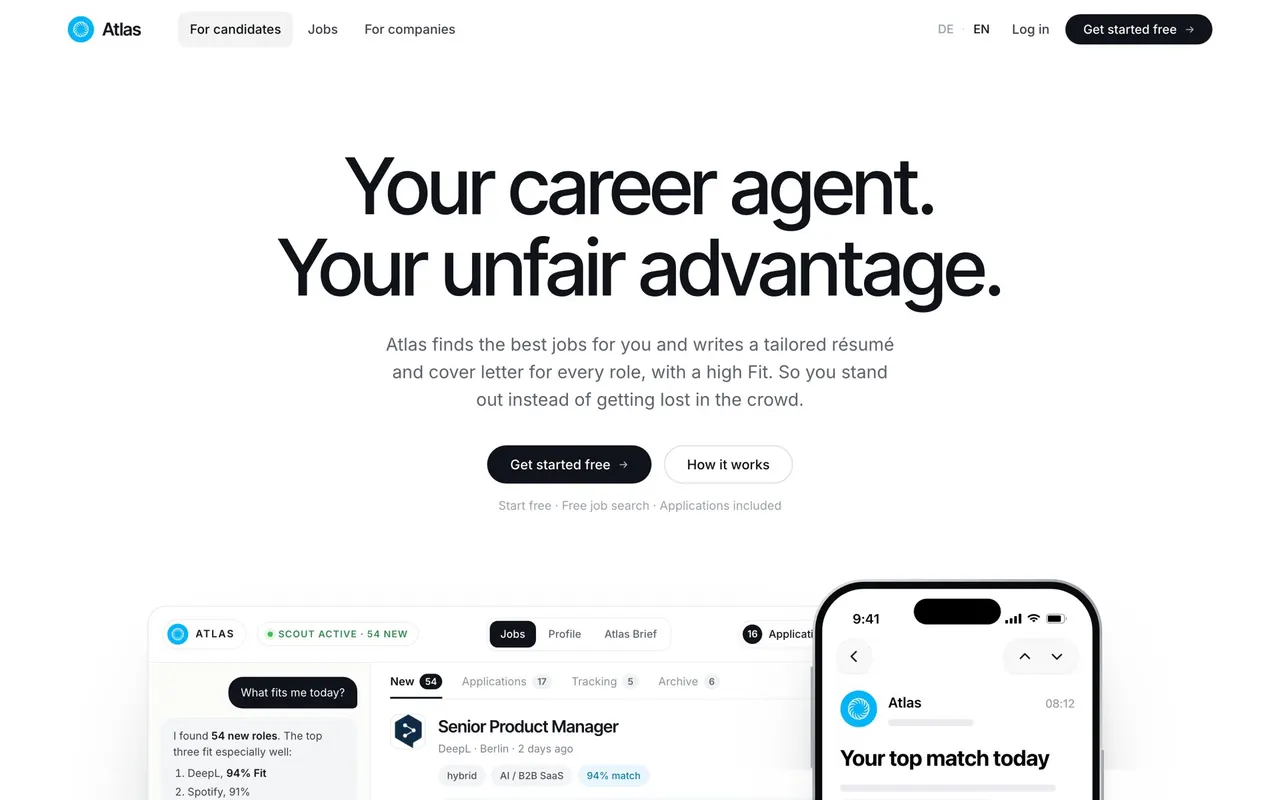
Try Atlas, or read how to tailor your CV with AI, compare free AI resume builders and check what passes an ATS checker.
FAQ
What is a good resume summary?
Two to four sentences, 40 to 60 words: job title, years of experience, two or three skills from the posting and one measurable result. Specific facts beat adjectives.
Should I use a summary or an objective?
Use a summary when you have a clear track record. Use an objective, with one piece of proof, for a first job, a career change or a return after a break.
How long should a resume summary be?
Under 60 words and no more than four lines. Put the strongest information in the first 25 words, because the first scan is only a few seconds.
Can I use AI to write my resume summary?
Yes, as a drafting aid. Give it your facts and the posting, forbid invented numbers and verify every claim before you use it.
Do I need a summary at all?
Not always. If your experience is short and obvious, a skills line can do the job. If the summary would be generic, leave it out.
Do I change the summary for every job?
Yes, lightly: swap the skills and the result to match the posting. That takes about two minutes and is the most effective change you can make.
Sources and dates: studies and laws linked above, as of October 2026. Examples are fictional; numbers in them are illustrations, not statistics.
Jürgen Ulbrich
Jürgen Ulbrich has more than a decade of experience in developing and leading high-performing teams and companies. As an expert in employee referral programs as well as feedback and performance processes, Jürgen has helped over 100 organizations optimize their talent acquisition and development strategies.