Recruitment process outsourcing (RPO) means that an external provider runs part or all of your hiring process, working inside your process and under your employer brand, instead of only sending you candidates for a fee per placement. It is billed as a fixed monthly fee, per hire, per shortlist or a mix, and in our worked example 40 hires a year cost about 204,000 € through RPO against 650,000 € through agencies at a 25 % fee. RPO usually starts to pay off at roughly 10 or more hires a year; below that, an agency or a small in-house team with a good sourcing tool is cheaper (assumptions below, October 2026).
What does “recruitment process outsourcing” mean in practice?
In practice, an RPO provider takes over defined steps of your recruiting: sourcing, screening, scheduling interviews, sometimes job ads, employer-brand work, offer management and reporting. Its recruiters often work in your ATS, use your email domain and talk to candidates as part of your team. That separates RPO from a classic recruitment agency, which finds candidates for single vacancies and is paid on success.
Three neighbours are often mixed up. A recruitment agency fills single roles for a percentage of the first-year salary. Staff augmentation or temp work places people who stay on the provider’s payroll; in Germany that is regulated by the Arbeitnehmerüberlassungsgesetz (AÜG). RPO ends with a permanent hire by you. The table shows where the lines run.
| Recruitment agency | RPO provider | In-house team + AI sourcing (e.g. Sprad) | |
|---|---|---|---|
| Who does the work | Provider, outside your process | Provider, inside your process | Your recruiters, with AI agents |
| Billing | % of first-year salary on success | Fixed fee, per hire or hybrid | Salaries plus tool seats or credits |
| Best for | Single, hard-to-fill roles | Steady volume, 10+ hires a year, new markets | Ongoing sourcing, a talent pool you keep |
| Who owns the candidate data | Often the agency | Must be set in the contract | You (Sprad: talent network stays free after cancelling, full raw-data export) |
| Weak spot | Cost grows with every hire | Dependence, transition effort | Needs recruiters on your payroll |
Which RPO models exist?
- Full-cycle RPO: the provider runs sourcing through offer for all or most roles, usually on contracts of 12 months or more with a monthly fee tied to volume.
- Project RPO: a fixed scope for a defined period, for example opening a site or a ramp-up of 60 hires in six months.
- On-demand or modular RPO: single functions such as sourcing or screening, bought when needed.
- Hybrid: a base fee plus per-hire or per-function fees.
What does RPO cost, and when does it pay off?
Providers use four billing models: a management fee (fixed monthly retainer for an agreed scope), cost per hire, cost per slate (per shortlist delivered) and hybrid combinations. Agency fees in DACH are typically 20 to 30 % of the gross annual salary (see our guide to recruitment agency fees); US guides quote 15 to 25 %. RPO providers publish no price lists, so the figures below are our assumptions for a worked example, not market prices. Replace them with the quotes you receive.
Worked example, DACH: 40 hires a year, average gross salary 65,000 €, agency fee 25 % = 16,250 € per hire, so 650,000 € a year. An RPO offer of 12,000 € a month plus 1,500 € per hire = 144,000 € + 60,000 € = 204,000 €. An in-house alternative with two recruiters at 85,000 € fully loaded plus two Atlas Recruiter seats at 299 € a month (sprad.io/pricing, October 2026) = 170,000 € + 7,176 € = 177,176 €. Job ads and the ATS are left out of every variant because they are needed in all three.
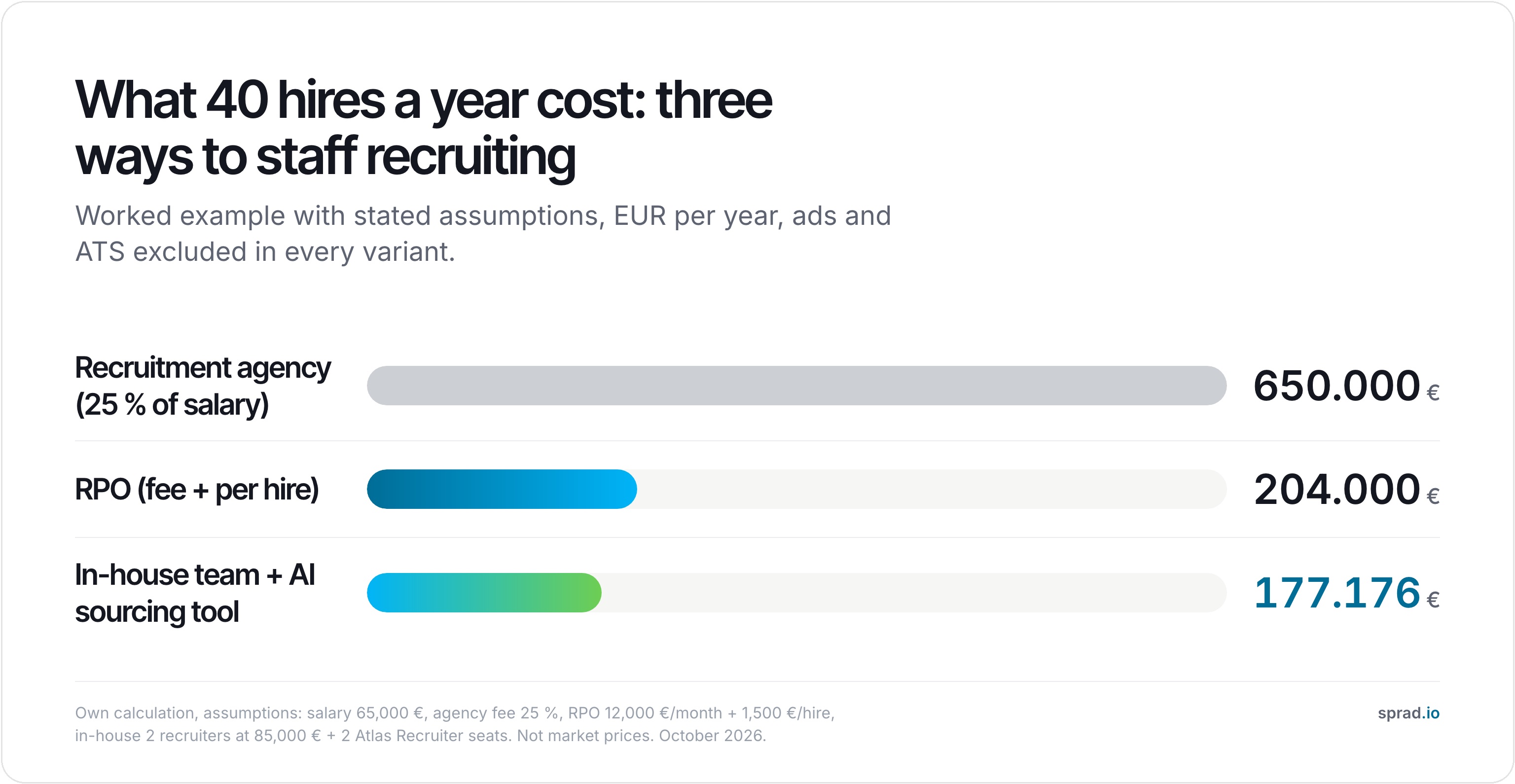
The break-even against agencies is fixed fee ÷ (agency fee per hire − RPO fee per hire). For the example, 144,000 ÷ (16,250 − 1,500) = 9.8, so about 10 hires. At 20 hires the agency route costs 325,000 € and RPO 174,000 €.
| Assumption | DACH (EUR) | US (USD) |
|---|---|---|
| Average salary | 65,000 € | 85,000 $ |
| Agency fee | 25 % = 16,250 € | 20 % = 17,000 $ |
| RPO fixed fee | 12,000 € / month | 15,000 $ / month |
| RPO fee per hire | 1,500 € | 1,500 $ |
| Break-even | about 10 hires a year | about 12 hires a year |
Read the result with care: RPO is not automatically cheaper than a lean in-house team. It wins on flexibility (scale up and down without hiring or firing recruiters) and on speed of setup, not necessarily on price. Providers also advertise savings of 30 to 40 % against agencies; those numbers come from vendors and market reports, so verify them with a pilot.
How do I introduce RPO step by step?
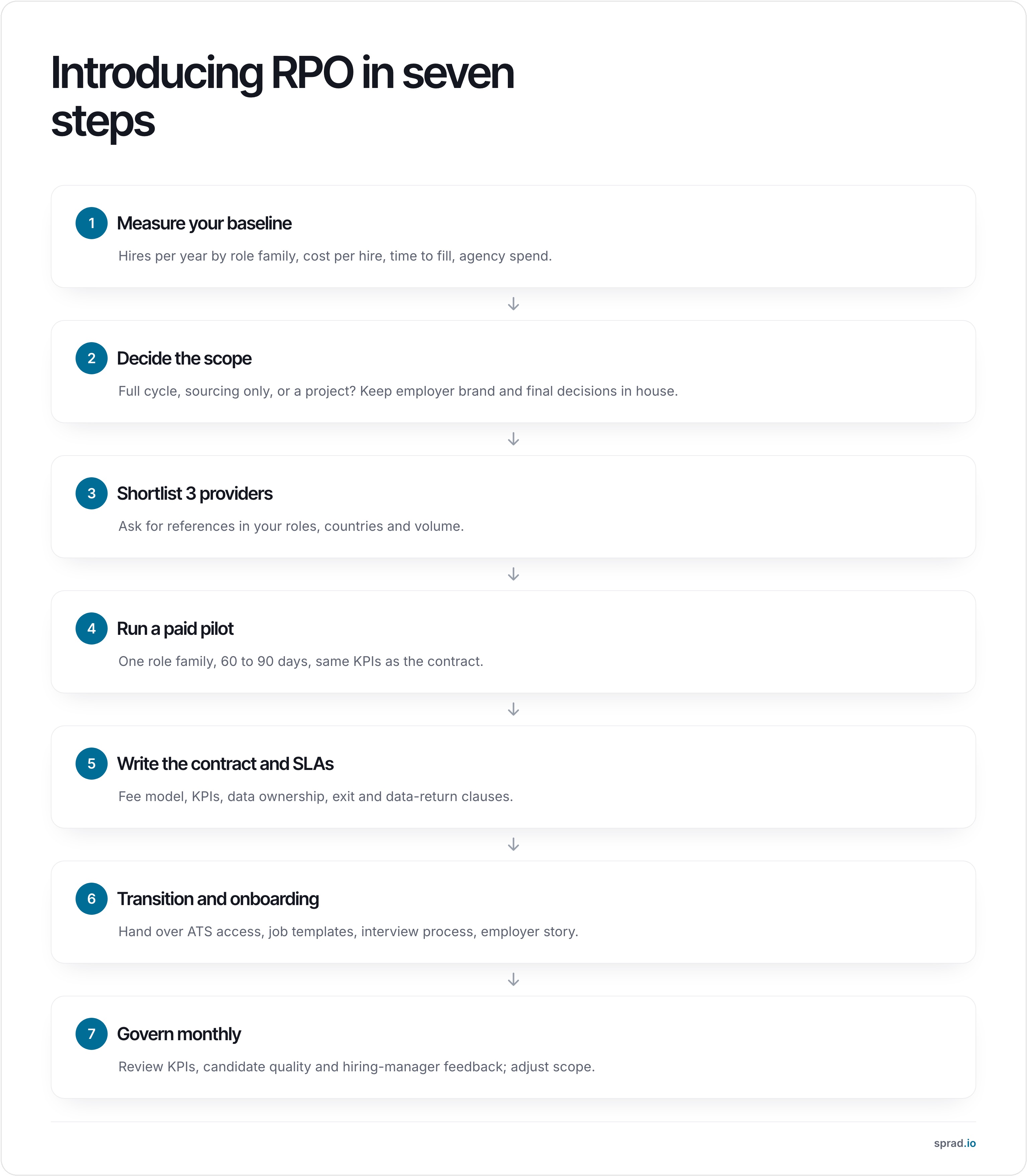
What we see most often in practice: teams skip step 1 and then cannot judge any offer. Before you talk to a provider, write down hires per year by role family, your current cost per hire (benchmarks by industry), time to fill and what you spent on agencies last year. Without these four numbers a quote cannot be compared with anything.
Which tools and templates help?
Three things are worth building before the first call. A baseline sheet with the four numbers above. An RFP question list: Which roles and countries did you hire for in the last 12 months? Who exactly will work on our account, and how many requisitions does each recruiter carry? Which systems do they use, and who owns the candidate data and the talent pool at the end? What is the exit process? And a KPI and SLA sheet to put into the contract:
| KPI | What it measures | Typical contract use |
|---|---|---|
| Time to shortlist | Days from kickoff to first qualified shortlist | SLA with a target, e.g. 10 working days |
| Time to fill | Days from open requisition to accepted offer | Reported per role family |
| Shortlist-to-interview rate | Share of shortlisted candidates the hiring manager interviews | Quality signal, reviewed monthly |
| Offer acceptance rate | Accepted offers ÷ offers made | Quality signal |
| First-year retention | Hires still employed after 12 months | Quality of hire; link part of the fee to it |
| Cost per hire | All costs ÷ hires | Compare quarterly with your baseline |
Which mistakes should I avoid?
- Buying on price alone. A low fee per hire with weak shortlists costs more in hiring-manager time than it saves.
- No data clause. If the contract is silent, candidate data and the talent pool may stay with the provider. Many sourcing tools also lose everything on cancellation; ask what happens to your data on day one after exit.
- Handing over the employer story. Providers can run the process, but the pitch to candidates needs your input: team, salary range, why join.
- Outsourcing everything at once. Start with one role family and a paid pilot.
- No governance. Without a monthly review of KPIs and hiring-manager feedback, quality drifts.
- Overlooking compliance. See the next section.
What do GDPR, the EU AI Act and local rules mean for RPO?
An RPO provider processes applicant data on your behalf. Under Article 28 GDPR you need a data processing agreement with the provider, and in Germany applicants count as employees for data protection purposes (§ 26 BDSG, paragraph 8). Where recruiters are embedded in your team, check that the set-up does not turn into unlicensed temp work under the AÜG.
If the provider or your own tools use AI to filter or evaluate candidates, the EU AI Act lists such systems as high-risk (Annex III, point 4). According to the European Commission (page updated 19 October 2026), the high-risk rules for employment now apply from 2 December 2027. In practice: humans decide, AI prepares, and the provider must document how. For US hiring in New York City, Local Law 144 requires a bias audit, public summary and notice for automated employment decision tools. More in our guides on the EU AI Act in recruiting and GDPR in active sourcing.
How does AI change RPO?
AI moves the cost of the first steps, finding and checking candidates, down sharply. That shifts the question from “who has the most recruiters” to “who has the best data and process”. RPO providers already use sourcing agents; the same tools make a small in-house team much more productive, which is why the third column in the table above is a real option.
Sprad is built for that route. Atlas, the sourcing product, checks every profile individually against your requirements instead of running a keyword search, so it also finds people with poorly maintained profiles. In the Recruiting area of the public PeopleSearchBench Atlas reaches 73.5 of 100 in our own re-measurement, converted to the published scale, with 14.2 of 15 matching profiles per recruiting search on average.1 A rule of thumb from our own work: if results appear instantly, it is almost always a keyword search; a real AI check takes minutes.
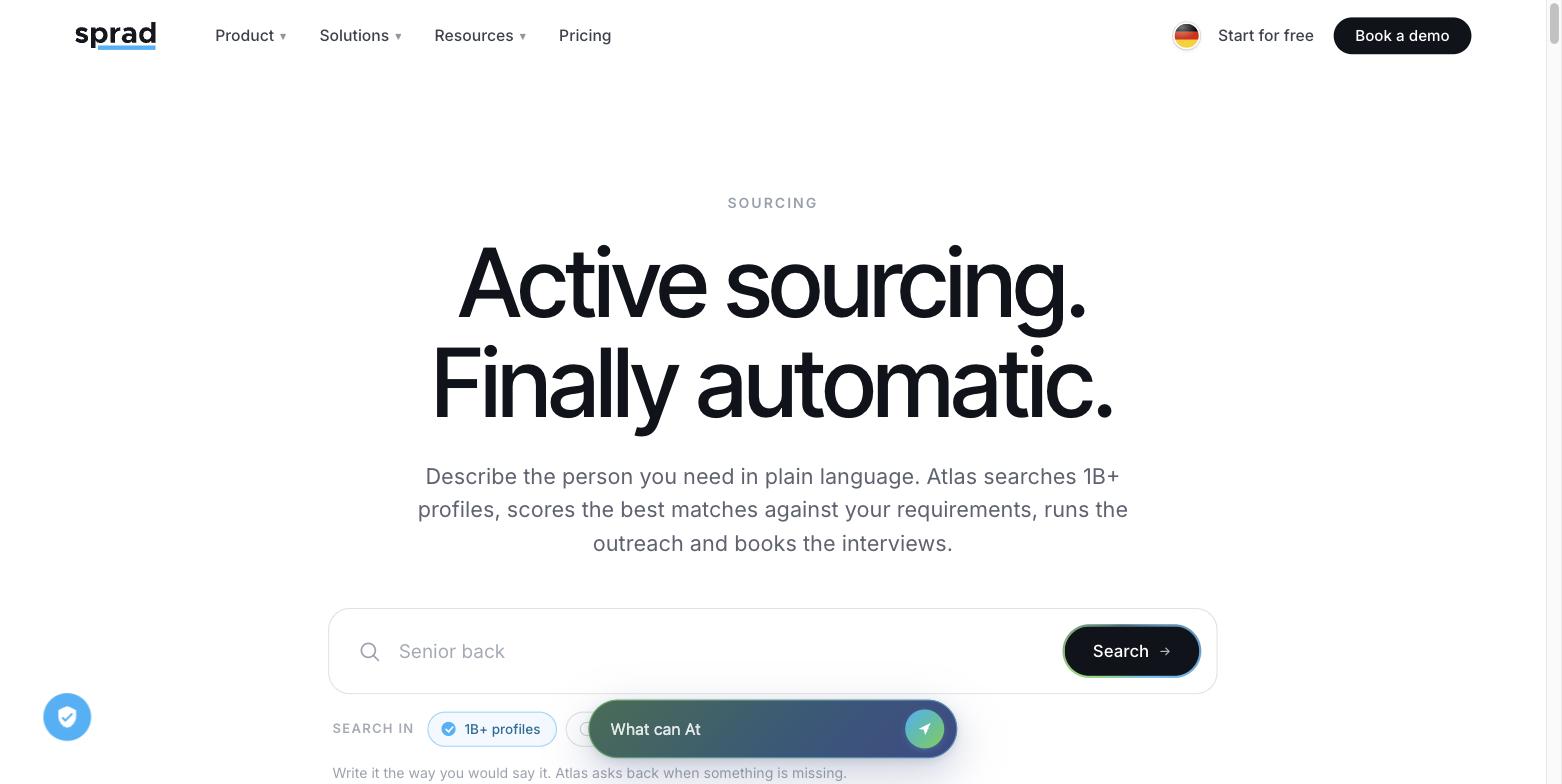
- One search over all sources: LinkedIn, GitHub, your own talent pool and your colleagues’ networks, one of the largest profile databases (1B+ profiles worldwide).
- LinkedIn and email in one inbox: automated outreach with follow-ups, InMails from Sprad, and a warning if someone was already contacted, even by a colleague or for another role.
- Pre-qualification: voice, video, chat and agent interviews in several languages; fully automated agents with an optional approval step, included in Atlas Recruiter.
- Your data stays yours: the talent network remains free after cancelling, with a full raw-data export; EU hosting.
- Honest limits: no AI call notetaker and no placement reporting yet, no SMS (WhatsApp for candidate communication), deep search takes a few minutes (Quick Search about 3 seconds).
Prices: start free (100 credits a month), Recruiter Lite 79 € per seat and month, Atlas Recruiter 299 € per seat and month, billed annually and net (sprad.io/pricing, October 2026). Sprad has built recruiting software for seven years, starting with employee referrals, which is matching profiles to requirements. More: Active Sourcing, Sprad for agencies and AI sourcing pricing models.
1 PeopleSearchBench (Recruiting), published by Lessie, October 2026. Other systems' scores as published in the benchmark; Atlas measured with the benchmark's open test procedure.
Frequently asked questions
What is the difference between RPO and a recruitment agency?
An agency fills single vacancies outside your process and charges a percentage of the first-year salary on success. An RPO provider works inside your process on a defined scope and bills a fixed fee, per hire or a mix. RPO suits steady volume; agencies suit single, hard-to-fill roles. See also temp work or agency placement.
How much does RPO cost?
There is no standard price. Typical structures are a monthly management fee, a fee per hire, a fee per shortlist or a hybrid. In our DACH example (40 hires, 65,000 € salary), RPO costs about 204,000 € a year against 650,000 € at a 25 % agency fee; the assumptions are on this page.
From how many hires does RPO make sense?
Against agency fees the break-even in our example is about 10 hires a year in DACH and about 12 in the US. Against a lean in-house team the decision is about flexibility and setup speed, not price alone.
Can I outsource only sourcing?
Yes. Function-based or modular RPO covers single steps such as sourcing or screening. Many teams instead keep sourcing in house and use an AI tool, because they then keep the talent pool.
Is RPO allowed under GDPR?
Yes, with a data processing agreement under Article 28 GDPR, a clear legal basis for the applicant data, and documented deletion rules. Check the AI Act duties if AI evaluates candidates.
Who owns the candidate data after the contract ends?
Whatever the contract says. Put data ownership, export format and deletion into the contract before you sign.
Jürgen Ulbrich
Jürgen Ulbrich has more than a decade of experience in developing and leading high-performing teams and companies. As an expert in employee referral programs as well as feedback and performance processes, Jürgen has helped over 100 organizations optimize their talent acquisition and development strategies.