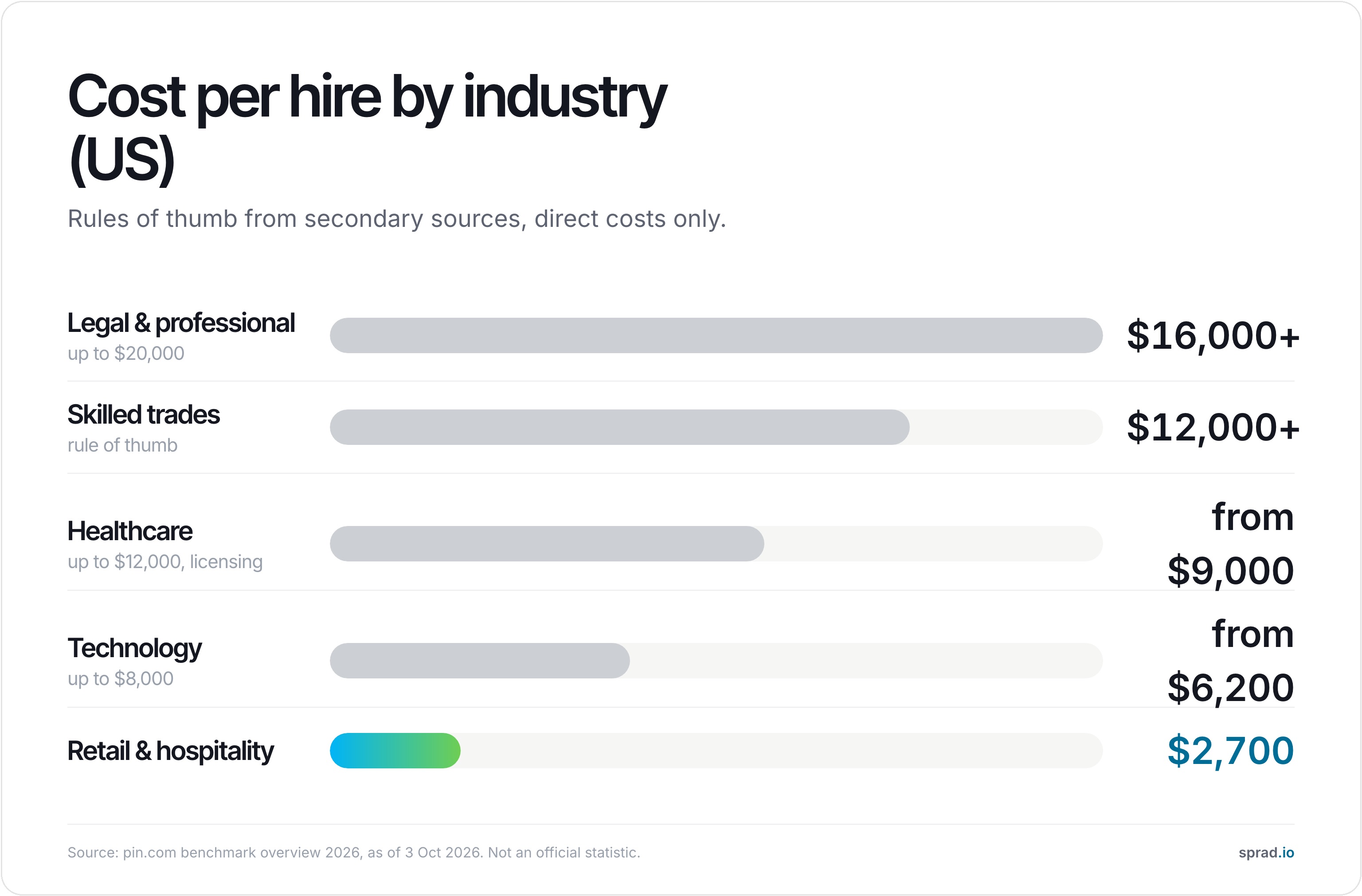
The average cost per hire is $5,475 for non-executive roles and $35,879 for executives in the US (SHRM 2025), and about €4,700 in Germany. By industry the range is wide: retail and hospitality come in around $2,700, healthcare at $9,000 to $12,000 and skilled trades above $12,000, according to 2026 benchmark roundups. These are rules of thumb, and they only compare if the same costs are counted. The formula and worked example below show how to calculate the figure for your own business.
What is cost per hire?
Cost per hire is the average amount a company spends to fill one role. Under the common SHRM/ANSI standard:
Cost per hire = (internal recruiting costs + external recruiting costs) divided by the number of hires in the period.
External costs are job ads, boards, ad spend, agency fees and software. Internal costs are the time HR and managers spend on screening, interviews and coordination, plus travel and onboarding. Counting only the ad understates the cost.
Benchmarks: what does a hire cost?
Reliable numbers are rare, and most come from the US. The table shows which source measures what:
| Source | Region | Value | What is measured |
|---|---|---|---|
| SHRM benchmarking 2025 | US | $5,475 non-executive, $35,879 executive | survey of 2,371 SHRM members (January to March 2025) |
| Industry roundups 2026 | US | $2,700 (retail, hospitality) to over $12,000 (skilled trades) | direct costs, secondary sources, not an official statistic |
| Mühlemann and Pfeifer (2016) | Germany | about €4,700 per hire, more than 8 weeks of wages | representative firm-level data, search and onboarding costs |
| BIBB study on apprenticeships | Germany | about €600 per apprentice | recruiting costs for apprentices |
| Boostpoint benchmark 2026 | US | median $13.88 per applicant | ad cost per applicant (not per hire), 891 campaigns |
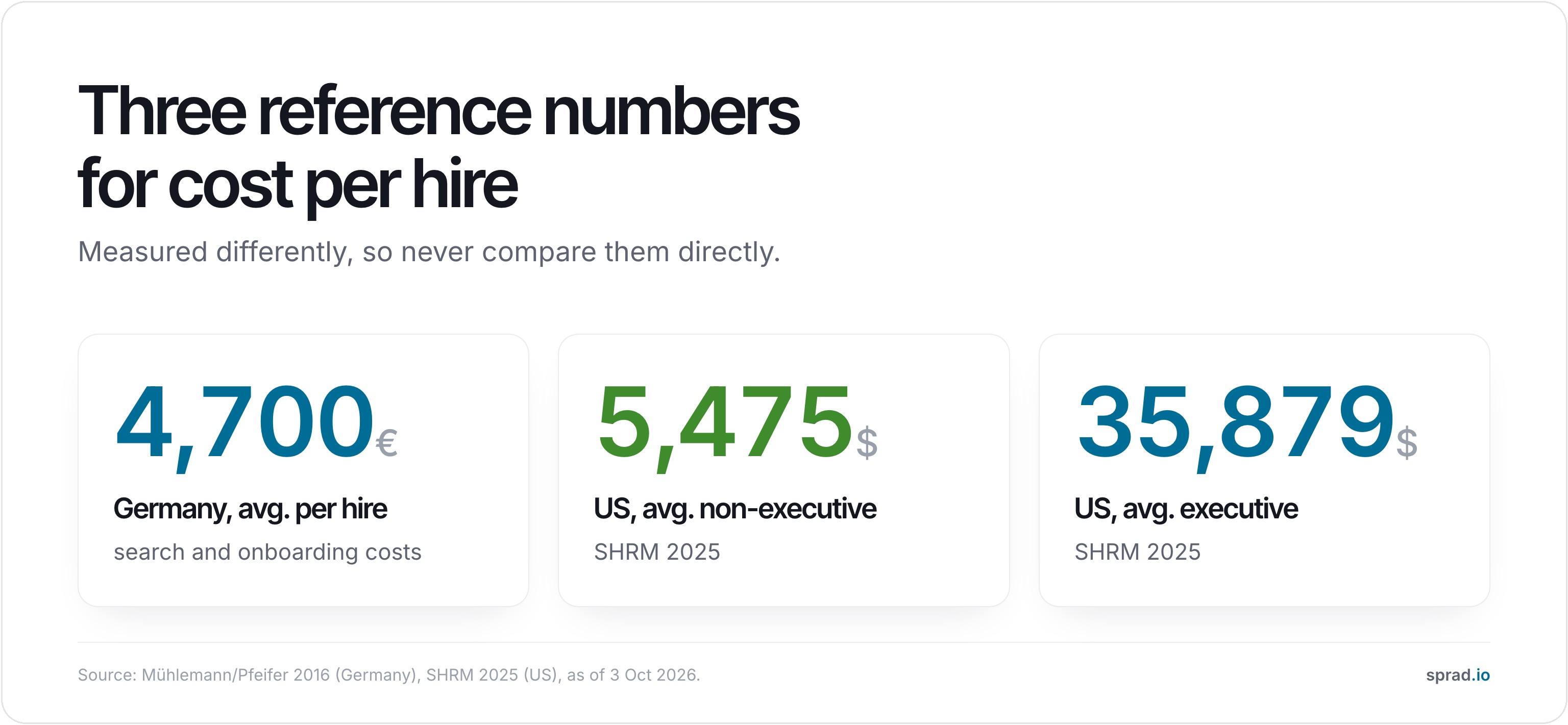
These figures are not comparable with each other. The German study counts onboarding, the SHRM values are averages across very different employers, and the industry values are direct costs from roundups without their own survey. We found no published breakdown by industry for the UK or the DACH region, so be wary of anyone who offers one without a source.
Cost per hire by industry (US rules of thumb)
Frontline industries sit low in the roundups (retail, hospitality) or very high (skilled trades). The sources give no reasons. Plausible ones are effort and scarcity, such as credential checks in healthcare or a long search for tradespeople. That is our interpretation.
What the industry figures mean
- Retail and hospitality, about $2,700: the lowest value in the roundup and a useful yardstick for roles with many applicants.
- Technology, $6,200 to $8,000: shown for comparison, because office and specialist roles cost clearly more than retail.
- Healthcare, $9,000 to $12,000: according to the source because of licensing checks and shortages. Ways to reach nurses are on our healthcare page.
- Skilled trades, above $12,000: a rule of thumb from the same source, the highest value for frontline roles.
What cost per hire is made of
| Cost type | Examples | Typical lever |
|---|---|---|
| Ads and advertising | job boards, social ads, ad spend | pick the right channel, measure reach |
| Agency and placement | fee as a share of annual salary | only for hard-to-fill roles |
| Software | applicant tracking, talent pool | reuse contacts |
| Internal time | screening, interviews, coordination | pre-screen applicants |
| Onboarding | training, support in the first weeks | fitting candidates instead of stop-gaps |
Published placement models charge 14 to 22 % of annual gross salary (Workwise, as of 30 September 2026). For job board prices, see our article StepStone costs and prices.
Worked example: three warehouse workers, three routes
An example with open assumptions. You are hiring three warehouse workers at an annual gross salary of €36,000 (assumption). It is arithmetic on list prices, not a measurement:
| Route | External cost per hire | Internal time (assumption) | Total per hire |
|---|---|---|---|
| Placement (18 % of €36,000) | €6,480 | 3 interviews at 1 hour and €40 = €120 | €6,600 |
| Job board (StepStone standard €1,449, 2 ads per hire) | €2,898 | 10 interviews = €400 | €3,298 |
| Social media recruiting (€1,000 a month, 3 months, plus 10 %: €3,300 for 3 hires) | €1,100 | 5 interviews (pre-screened) = €200 | €1,300 |
The assumptions matter: how many ads or applicants lead to a hire, and how many interviews you need, varies widely by role and region. We give no guarantee and have no campaign data of our own that we would publish as a benchmark yet. Replace the numbers with your own, the formula stays the same.
From applicant to hire: reading cost per applicant correctly
Many campaigns are reported as cost per applicant. The Boostpoint 2026 benchmark gives a median of $13.88 per applicant for Meta ads in the US, from $2.91 (cheapest 10 %) to $66.45 (most expensive 10 %) across 891 campaigns. Getting from there to a hire is a funnel:
- If one in 10 applicants becomes a hire (assumption), ad cost is about $139 per hire.
- At one in 20 it is about $278.
That is ad cost without markup, without internal time and from the US. We have no comparable benchmark for the UK or Europe. Whenever someone quotes cost per applicant, ask for the rate down to the hire.
How to lower cost per hire
- Pre-screen applicants: with five must-have questions via WhatsApp, phone or web, you talk only to fitting candidates. That saves the biggest item, internal time.
- Build your own talent pool: contacts from earlier ads are free to reach at the next opening. See Talent Base.
- Use referrals: an IAB survey from 2015 found personal contacts behind about 62 % of hires for unskilled and semi-skilled workers in Germany. The figure is old but shows how strongly referrals work for frontline roles.
- Simplify applying: a short phone form instead of a CV and account lowers drop-off, as our article on blue-collar screening describes.
- Pick the channel for the role: for roles where few people search, ads in the feed often work better than yet another board listing. Early-career hiring has its own routes, see apprentice recruiting.
Is it worth the effort?
Yes, because an open role costs more than the search: orders wait and shifts go uncovered. A roundup of SHRM figures puts median time to fill at 39 calendar days for non-executive roles. Look at cost per hire and time to fill together, not only the price of the ad.
Sprad Social Recruiting: frontline roles with your own talent pool
Sprad Social Recruiting runs job ads on Instagram and Facebook, where nurses, tradespeople, drivers and other frontline workers spend time every day. An AI talent agent pre-screens every applicant via WhatsApp, phone or web. Every applicant lands in your own talent pool, so the relationships stay with you instead of a platform. Pricing is ad spend plus 10 %, from a €1,000 budget that can be split across roles. We recommend three months. Details on Sprad Social Recruiting, with matching industry pages such as logistics.
Frequently asked questions
What is the average cost per hire?
In the US, $5,475 for non-executive and $35,879 for executive roles (SHRM 2025). In Germany, about €4,700 per hire including onboarding. By industry and role the values sit well below or above.
How do you calculate cost per hire?
Internal plus external recruiting costs divided by the number of hires in the period. Add ads, agencies, software, internal time and onboarding, then divide by the roles actually filled.
What does it cost to hire in healthcare, trades or logistics?
US roundups put healthcare at $9,000 to $12,000 and skilled trades above $12,000. We found no published logistics figure we trust. Use the values as an order of magnitude and calculate your own with the formula.
What is the difference between cost per applicant and cost per hire?
Cost per applicant measures advertising up to an incoming application. Cost per hire includes everything up to the signed contract, including selection, interviews and onboarding. The second number is the one that matters for budgets.
How do I reduce cost per hire?
With pre-screened applicants, your own talent pool, referrals, a simple application and the channel that fits the role. The biggest potential is usually internal time.
Jürgen Ulbrich
Jürgen Ulbrich has more than a decade of experience in developing and leading high-performing teams and companies. As an expert in employee referral programs as well as feedback and performance processes, Jürgen has helped over 100 organizations optimize their talent acquisition and development strategies.