The skilled trades shortage in 2026 is real in all three big markets: the US construction industry needs 349,000 net new workers this year (ABC forecast), UK construction needs about 41,200 extra workers every year until 2030 (CITB), and in Germany roughly 100,000 trades jobs could not be filled by qualified jobseekers in 2025 (KOFA/IW Cologne). Employers close the gap with apprenticeships and career changers, by keeping their own crews, and by reaching tradespeople who are not looking. Only the last one works within weeks.
The numbers: three countries, three yardsticks
Shortage statistics are not comparable one to one. The US figure is a forecast of net new hiring need, the UK figure is an annual requirement, the German figure counts jobs that qualified unemployed people cannot fill. Read them as three views of the same problem, not as a league table.

| Country | Figure | What it measures | Source, date |
|---|---|---|---|
| US | 349,000 (2026), 456,000 (2027) | Net new construction workers the industry must attract, mostly to replace retirements; down from 439,000 forecast for 2025 | Associated Builders and Contractors (ABC), 2026 forecast |
| UK | 41,200 a year, 2026 to 2030 | Extra workers needed per year, 1.6 % of the 2025 workforce; down from 47,000 in the previous outlook | CITB Construction Workforce Outlook 2026-2030, 16 June 2026 |
| Germany | about 100,000 (2025) | Trades jobs that cannot be filled by qualified unemployed people; 59 of 115 trades occupations affected | KOFA Compact 7/2026, IW Cologne, 28 July 2026 |
| Germany | about 200,000 | Unfilled trades jobs including unreported vacancies (estimate) | ZDH (German Confederation of Skilled Crafts), reported 31 December 2025 |
What the numbers do not tell you
The shortage is not easing as fast as the economy. In Germany the skills gap in the trades fell by only 9.5 % in 2025, while it fell by 24.1 % across the whole economy. The ABC forecast for 2026 is lower than in earlier years, yet it is still 349,000 people, and ABC attributes the shortage mainly to retirements. In the UK the CITB names three causes: too few people enter, too many experienced workers leave, and productivity gains have not closed the gap.
Why trades jobs stay open
- Ageing crews: Retirements drive much of the demand, and fewer young people enter than leave.
- Demand in specific trades: Energy transition, grid work and infrastructure raise demand for electricians, heating and building trades first.
- Passive candidates: Most skilled tradespeople hold a job, do not read job boards and move only for a concrete offer.
- Slow training pipelines: An apprentice takes years to become a journeyman, so training helps late.
What employers can do, and how fast it works
No single measure closes the gap. The effort and timing columns below are our own planning estimate, not a measurement.
| Route | Works in | Effort | Good for |
|---|---|---|---|
| Expand apprenticeships | 3 to 4 years | medium, ongoing | Firms with capacity to train |
| Train career changers | 6 to 24 months | medium to high | Trades with helper roles and onboarding |
| Recruit from abroad | 6 to 18 months | high (recognition, language) | Larger firms with integration resources |
| Keep your own crew | immediately to months | low to medium | Every firm |
| Active outreach on Instagram and Facebook | weeks | low to medium | Firms that must fill a role now |
1. Apprenticeships
The German KOFA report shows a split picture. In electrical, heating and plumbing, and roofing trades, apprenticeship numbers are rising despite the shortage, which the author calls a renaissance of training. In metalworking and in wood, furniture and interior finishing they are falling. If your trade is on the rise, training pays off sooner. If not, you need a second source of talent.
2. Career changers and upskilling
If you train, you widen the pool. Say in the ad who mentors, how long onboarding takes and which qualification you pay for. Career changers choose firms where they can see the path.
3. Hiring from abroad
It is a route, but not a quick one. Recognition of qualifications, language and paperwork take time, and a named contact inside the firm helps. Check the rules of your own country and local trade bodies.
4. Keep the people you have
Every tradesperson who stays saves you a hire. Stable crews, predictable finish times, a company vehicle, training and a clear route to foreman cost less than a role that stays open for months.
5. Active outreach with paid social ads
The fastest way is to reach skilled people who are not searching. Paid job ads on Instagram and Facebook put your offer in front of tradespeople nearby, who can apply from their phone after work. As an external reference from the US, Boostpoint's 2026 benchmark reports a median of $14.14 per applicant for skilled trades campaigns. Costs in the UK or Germany can differ, and Sprad has not published its own campaign benchmarks.
Fast pre-screening matters as much as the ad. A short WhatsApp flow asking for trade, licence or certification, travel radius and availability separates fit from non-fit before anyone spends time on a call. Why phone and messaging beat email for frontline hiring is covered in frontline recruiting by phone and WhatsApp, not email, and how screening differs for hands-on roles in blue-collar screening versus white-collar. Our skilled trades page shows how this looks in practice.
Before you launch, check Meta's current rules for the Employment ad category in your region. Meta has restricted targeting by age, gender and postcode for these ads, and the scope differs between regions.
A sequence that works in practice
- This week: Count your open roles and leavers from the last twelve months. That is your most important number.
- In four weeks: One concrete ad live with pay range, crew and onboarding, mobile application, reply within a day.
- In three months: Budget spread across all open roles, applicants collected in a pool of your own so the next hire does not start from zero.
- In parallel: Plan apprenticeships and upskilling, because those routes only carry in years.
How Sprad solves it
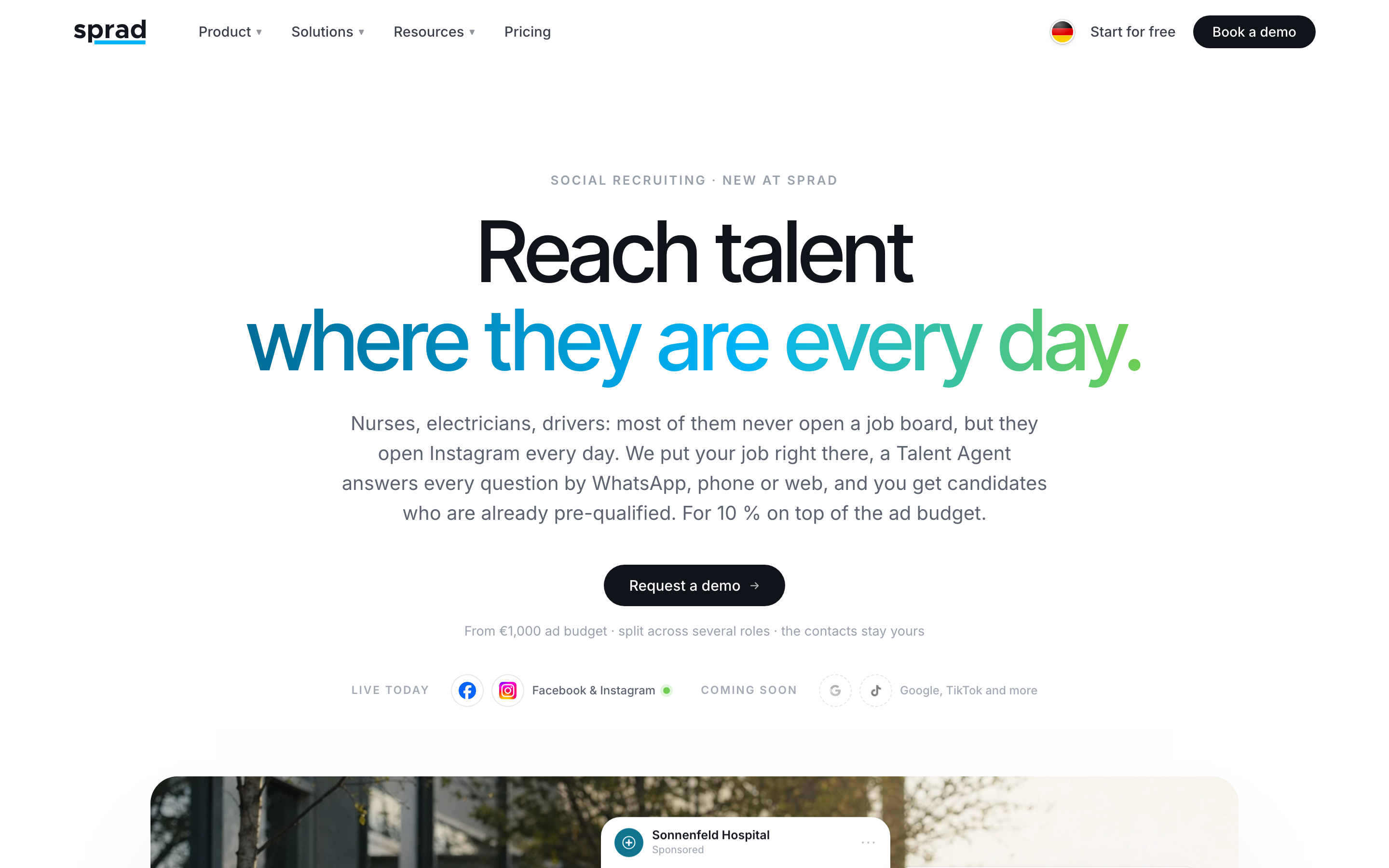
Sprad Social Recruiting runs job ads on Instagram and Facebook, where nurses, tradespeople, drivers and other frontline workers spend time every day. An AI talent agent pre-screens every applicant via WhatsApp, phone or web. Every applicant lands in the employer's own talent pool, so the relationships stay with the employer instead of a platform. Pricing is ad spend plus 10 %, from a €1,000 budget that can be split across roles. Google and TikTok are coming. Learn more about Sprad Social Recruiting and the talent pool.
FAQ
How big is the skilled trades shortage in 2026?
It depends on the market and the yardstick: 349,000 net new construction workers needed in the US in 2026 (ABC), 41,200 extra construction workers a year in the UK until 2030 (CITB), and about 100,000 unfillable trades jobs in Germany in 2025 (KOFA/IW Cologne).
Why is there a shortage of skilled tradespeople?
Mainly ageing workforces and retirements, too few entrants, and rising demand in energy, infrastructure and housing. The CITB puts it as too few people entering, too many experienced workers leaving and insufficient productivity gains.
What helps employers in the short term?
Active outreach to people who are not searching, through paid Instagram and Facebook ads, combined with quick pre-screening. Apprenticeships and career changers pay off over years.
Is the shortage getting better?
Slowly and unevenly. ABC's forecast for 2026 is lower than for earlier years, and the CITB lowered its annual figure from 47,000 to 41,200. In German trades the skills gap fell by 9.5 % in 2025, against 24.1 % in the whole economy.
What does it cost to advertise trades jobs on social media?
The ad budget is yours to set. As one external US reference, Boostpoint's 2026 benchmark shows a median of $14.14 per applicant in skilled trades. Sprad charges ad spend plus 10 %, from a €1,000 budget. There is no guarantee of applicants.
Jürgen Ulbrich
Jürgen Ulbrich has more than a decade of experience in developing and leading high-performing teams and companies. As an expert in employee referral programs as well as feedback and performance processes, Jürgen has helped over 100 organizations optimize their talent acquisition and development strategies.