A social media job ad is not a shortened job board posting. It has about 125 characters to say the job title, the place and the pay, then one clear way to apply. Write it in five blocks: a hook, the job, pay and shift, two must-haves, and a one-step application. Below you find templates for warehouse, nursing, trades and retail roles that you can copy and adapt. As of October 2026.
How a social media job ad differs from a job board posting
On a job board, people already search for work and read long descriptions. In a Facebook or Instagram feed they do not. They scroll, and your ad has a fraction of a second to say “this is for me”. That changes what you write.
- Short beats complete. Shorter job posts get about 12 % more applications than medium-length ones, according to a recruitment-advertising guide from 2025 (1–300 words versus 300–600). The full details belong on the page behind the ad.
- Pay is the hook. For hourly and shift work, the number beats the employer story.
- The ad does the filtering. Meta's Employment ad category removes age and gender targeting, so title, place and requirements must filter for you.

The five building blocks

1. Hook: speak to one person
Start with a question or a direct address that names the role and place: “Warehouse team near Linz?” or “Nurse with night-shift experience?”. Avoid “We are hiring!”, because it says nothing about who you want.
2. The job in one line
Use the real title people use, not an internal one (“Forklift driver”, not “Logistics Operations Associate”). Add place and what the person does day to day.
3. Pay and shift
Give a number: “€17.50 an hour”, “€3,200 gross a month”, “early shift, Monday to Friday”. “Attractive pay” makes people scroll on. The EU Pay Transparency Directive, which member states had to transpose by 7 June 2026, provides for pay information on advertised jobs. Germany had not yet passed its law at the time of writing, so check the current status with your legal adviser. Naming pay is good practice either way.
4. Two must-haves, not ten
Name the one or two things without which a person cannot do the job: a licence, a qualification, a language level. Everything else is “nice to have” and does not belong in the ad.
5. One-step application
Say how to apply and how long it takes: “Apply in two minutes from your phone, no CV needed.” A lead form, a short landing page or a WhatsApp chat all work. Which one fits your role is covered in why frontline hiring runs on phone and WhatsApp.
Templates you can copy
These are invented examples. Replace everything in brackets with real facts and never promise what the job does not deliver.
Warehouse and logistics
Warehouse team near [city]? €[17.50] an hour from day one.
Forklift driver (m/f/d), early shift Monday to Friday, permanent contract. You need a forklift licence, no CV required. Apply in two minutes from your phone.
Nursing
Nurse (m/f/d) in [city]: fixed shifts, €[3,400] gross a month.
Four-day week, planned rota, extra pay for nights. You are a registered nurse and speak German at B2 level. Tell us about yourself in a short chat, we reply within a day.
Skilled trades
Electrician (m/f/d), [region]: company van, €[3,600] gross, no Saturday work.
Installation work in a team of six, 30 days of holiday. You have your trade qualification. Send a short message on WhatsApp, we call you back today.
Retail
Sales assistant (m/f/d) at [store], [city]: part-time, you choose your days.
€[14.80] an hour plus staff discount, shifts planned four weeks ahead. No experience needed, we train you. Apply in two minutes.
Adapt the examples to your sector. Our pages for healthcare, trades and logistics show how Sprad approaches these roles.
Image and video: what goes with the text
A real photo from your workplace beats stock images. Show the people who will be colleagues, in the real setting, with pay or role as short text on the image. For video, vertical and 10 to 20 seconds works in Instagram and Facebook Stories and Reels. Always test two or three versions of text and picture and let the numbers decide.
Mistakes that waste budget
- Starting with the company (“We are a leading provider of…”) instead of the job.
- No pay in the ad, then answering the same question in every message.
- Ten requirements, which scare off good people and invite many unsuitable ones.
- A long form or a CV upload for a shift job.
- One version only, so nothing is learned.
- Answering applicants after three days. People applying for shift work are often talking to two employers.
Check before you publish
- Do role, place and pay appear in the first 125 characters?
- Is there only one call to action?
- Are the requirements limited to must-haves?
- Does the wording avoid excluding anyone by age, gender or origin? In Germany, section 11 of the AGG forbids discriminatory job advertisements.
- Do you answer within 24 hours?
The way without writing every ad yourself: Sprad Social Recruiting
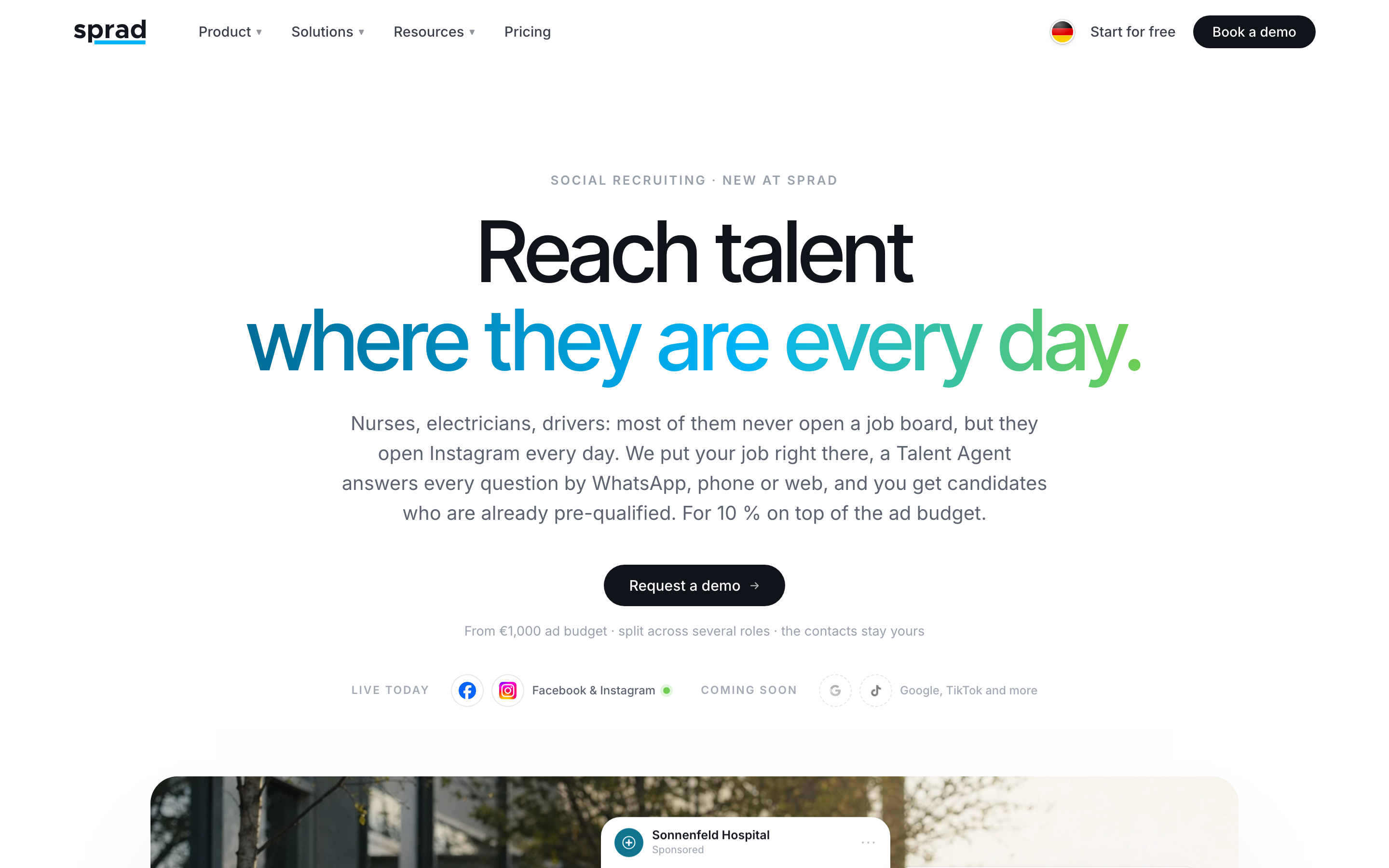
If you run many roles or locations, Sprad Social Recruiting runs your job ads on Instagram and Facebook, where nurses, tradespeople, drivers and other frontline workers spend time every day. An AI talent agent pre-screens every applicant via WhatsApp, phone or web. Every applicant lands in your own talent pool, so the relationships stay with you instead of a platform. Pricing is ad spend plus 10 %, from a €1,000 budget that can be split across roles.
Frequently asked questions
How long should a social media job ad be?
In the feed, two to four lines, with role, place and pay in the first 125 characters. The longer description belongs on the page behind the ad and should stay under about 300 words.
What should a social media job ad include?
A hook, the job title and place, pay and shift, one or two must-haves and a simple way to apply. Company background is optional and comes last.
Should I put the salary in the ad?
Yes. For hourly and shift jobs it is the strongest reason to read on. EU rules on pay transparency are being phased in, so naming pay also prepares you for them.
What is the best call to action?
One that names the effort: “Apply in two minutes from your phone.” Avoid several options in one ad.
Do I need different texts for Facebook, Instagram and TikTok?
The building blocks stay the same. Adapt length and tone: Instagram and TikTok are more visual and shorter, Facebook can carry slightly more text.
Jürgen Ulbrich
Jürgen Ulbrich has more than a decade of experience in developing and leading high-performing teams and companies. As an expert in employee referral programs as well as feedback and performance processes, Jürgen has helped over 100 organizations optimize their talent acquisition and development strategies.