Spott and Recruit CRM solve different problems at very different price points: Recruit CRM is a flexible, well-supported ATS/CRM starting around $95/user/month, while Spott is a pricier, AI-native platform built around semantic matching and a unified inbox. Neither searches for new candidates outside your own database — which is where a third option, Sprad, changes the calculation.
Spott vs. Recruit CRM vs. Sprad at a glance
All prices as of September 2026, published rates only.
| Criterion | Spott | Recruit CRM | Sprad |
|---|---|---|---|
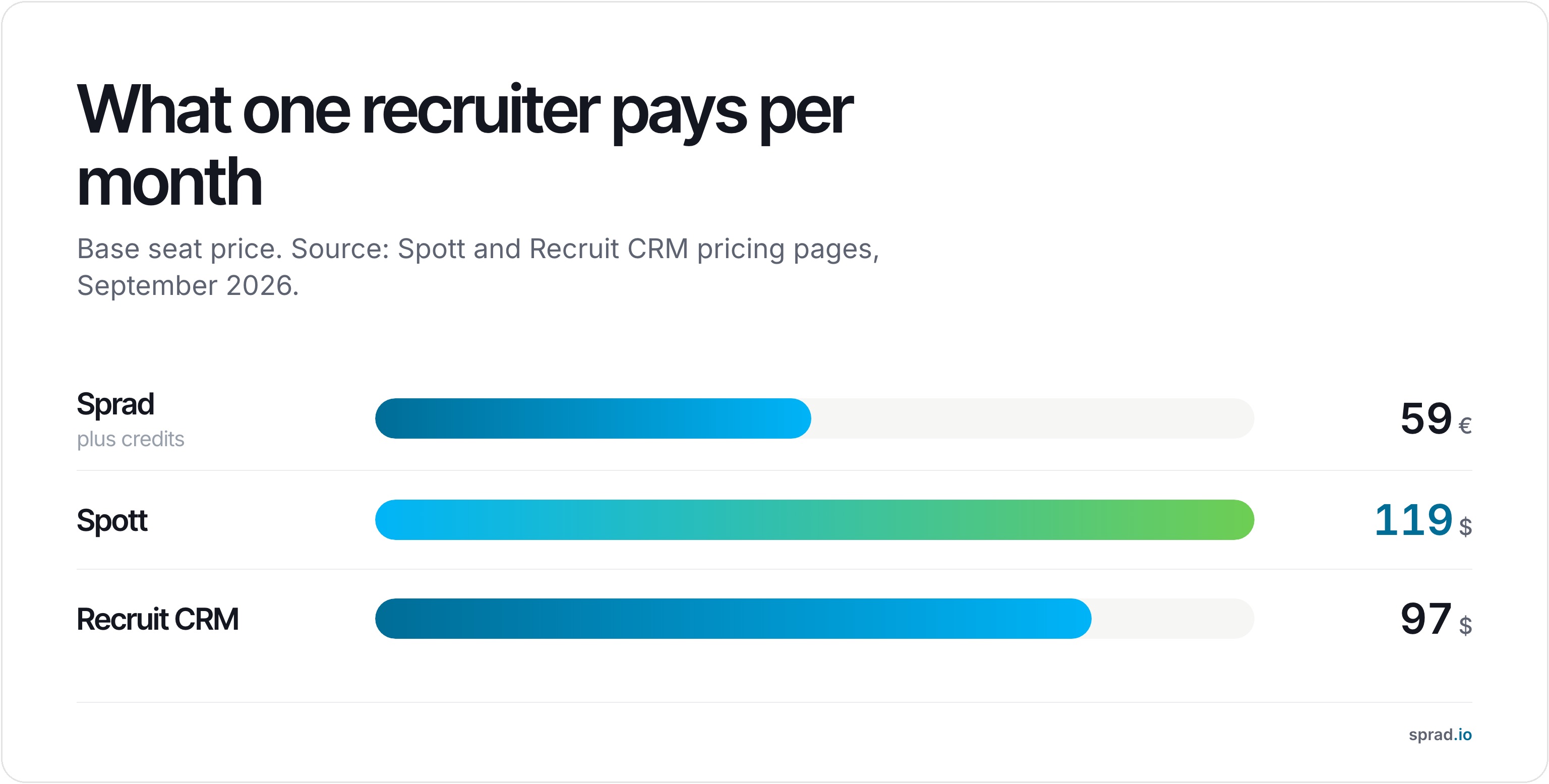
| Starting price | $119/user/mo (annual), $149 monthly | ~$95-100/user/mo (annual) | 59 €/recruiter/mo, flat |
| External candidate search | No native tool, integrations only | No, needs Lusha/Apollo/LinkedIn | Yes — 1B+ profiles, requirement search |
| Talent pool ownership | Enriches existing contacts | Standard CRM database | Own pool, stays after cancellation |
| AI matching | Semantic, explainable scoring | AI-assisted resume parsing | Full-profile requirement search with per-criterion score |
| Outreach | Email, WhatsApp, SMS, LinkedIn sequences | Email sequencing | LinkedIn only today |
| CRM depth | Full CRM + unified inbox + notetaker | Full CRM, customizable | Lightweight client context (beta), not a sales CRM |
| Voice/video screening | No | No | Yes, 12 languages |
| DACH/German interface | No | No | No German UI, but DACH-focused pricing and support |
| Compliance / hosting | ISO 27001, EU hosting by default (per Spott's own security page) | Not publicly documented | GDPR compliance built in |
| Third-party review base | G2 4.9/5 (11), Capterra 5.0/5 (2) | G2 4.8/5 (115), Capterra 4.9/5 (475) | Too new for a comparable public review base |
Where Spott and Recruit CRM actually differ
The headline difference is depth versus price. Recruit CRM sells itself on being a flexible, well-supported, no-frills ATS/CRM — 475 Capterra reviews average 4.9/5, with category scores of 4.8 for ease of use, 4.9 for customer service, 4.7 for features and 4.8 for value for money. That's the largest and most consistent review base of any tool in this comparison series, Spott included. Spott, by contrast, is built around AI-native matching: it reads full candidate profiles semantically rather than just parsing keywords, and reviewers who switched from Bullhorn or Vincere describe it as replacing an entire stack of bolt-on tools. But Spott's own review base is tiny — 11 on G2, 2 on Capterra, at least one explicitly marked "G2 invite" — so its 4.9-5.0 average carries far less statistical weight than Recruit CRM's.
Price follows the same pattern. Recruit CRM starts around $95-100/user/month (about €87-92) billed annually — the cheapest full ATS/CRM in this entire comparison series, undercutting Spott's $119, Loxo's $149 and Vincere's roughly €109 minimum. Spott's Pro tier, which unlocks its automations and multi-channel sequences, jumps to $179/month, nearly double Recruit CRM's entry price for features Recruit CRM doesn't offer at any tier.
What a five-recruiter team actually pays
List prices per seat hide what a real team pays. For five recruiters, billed annually: Spott's Core plan comes to roughly $595/month (about €547), Recruit CRM lands around $475-500/month (about €437-460) depending on the exact per-seat rate it quotes, and Sprad's flat 59 €/recruiter fee totals 295 €/month — before any usage. Sprad's number is a floor, not the full cost: searches, outreach and interviews are billed separately by credit once the 200 free credits per account run out, at roughly 6-8 cents each. But it's also the only one of the three where a recruiter who runs no searches that month still costs only the base fee, since Spott's and Recruit CRM's prices are flat per seat regardless of activity.
What Spott has that Recruit CRM doesn't
Spott's unified inbox pulls email, WhatsApp, SMS and VoIP calls into one thread per candidate, and its AI notetaker auto-transcribes and summarizes calls straight into the candidate record — a G2 reviewer called it "AI-powered ATS that elevates efficiency" for exactly this reason. Its enrichment engine also auto-updates contact details, job titles and skills without manual input, something Recruit CRM's more conventional resume-parsing doesn't attempt. If your team's real pain point is juggling five inboxes and a separate call recorder, that consolidation is Spott's strongest argument.
What Recruit CRM has that Spott doesn't
Recruit CRM's advantage isn't a flashy AI feature — it's breadth of proof and price. With 475 Capterra reviews and 115 on G2, buyers can actually verify what they're getting before they sign, something Spott's 2-13 reviews per platform can't yet offer. Recruit CRM is also noted for flexibility and customization of workflows, and its ChatGPT integration is an emerging feature worth watching. For an agency that wants a dependable, well-supported system without paying for AI-matching depth it may not use every day, Recruit CRM's lower price and larger proof base are the more conservative choice.
What neither tool does
Neither Spott nor Recruit CRM searches for new candidates outside the database you already have. Spott enriches and organizes existing contacts; Recruit CRM parses resumes you upload. If an agency's actual bottleneck is finding candidates who aren't in the pipeline yet — a common problem in specialist and niche sourcing — both tools point back to the same answer: connect a separate sourcing tool or LinkedIn seat. Neither has a payroll or contracting module either, and neither offers voice or video interview screening.
The third option: Sprad
Searches, outreach and interviews are billed by credit only when they actually happen, and every account gets 200 free credits a month with no credit card required. Rejected profiles cost nothing.
The bigger difference is what that price buys: Sprad's requirement search reads full candidate profiles against a role described in plain language across more than 1 billion external profiles, with a score and a stated reason for every criterion — not keyword parsing, and not a database limited to contacts you've already touched. In a benchmark run on three real roles across three markets on 15 August 2026, Sprad's search surfaced 38% of the matches found by the best alternative tool tested, against 9% for the next-best competitor. Full methodology: sprad.io/sourcing-benchmark.
Sprad also bundles screening that neither Spott nor Recruit CRM offers: voice and video interview screening in 12 languages, alongside the ATS and talent pool. And the pool itself is built to survive a subscription change — candidates give active consent, and the pool of profiles stays with the agency even after cancellation, unlike a network built entirely inside a rented CRM seat.
Sprad is honest about where it's thinner: Recruit CRM's CRM is more complete for deal stages and contract values, and being newer to market, Sprad doesn't yet have a review base to match Recruit CRM's 475 Capterra reviews.
Which one fits your agency
- Tight budget, proven track record wanted: Recruit CRM. Lowest entry price in this comparison, the largest and most consistent third-party review base, and strong, repeatedly praised support.
- Communication consolidation is the pain point: Spott. If your team is drowning in separate inboxes, a call recorder and a manual notetaker, its unified inbox and AI notetaker solve that directly — at a higher price.
- You need to find candidates who aren't in your database yet: Sprad. Neither Spott nor Recruit CRM searches outside your existing contacts; Sprad's requirement search and voice screening are built for exactly that gap, at a lower base price than either alternative.
Some agencies land on a hybrid: Recruit CRM or Spott as the day-to-day CRM, with a dedicated sourcing layer bolted on for roles the internal database can't fill. That's a legitimate answer too — just one more subscription to manage.
FAQ
Is Recruit CRM cheaper than Spott?
Yes. Recruit CRM starts around $95-100/user/month billed annually, versus Spott's $119 for Core and $179 for Pro, as of September 2026.
Does Recruit CRM have AI matching like Spott?
Recruit CRM offers AI-assisted resume parsing, but not the semantic, full-profile matching with explainable scoring that Spott builds its pitch around.
Can Spott or Recruit CRM find new candidates outside my database?
Not natively. Both rely on integrations or manual imports for external sourcing; Sprad is the option in this comparison built to search beyond your existing contacts.
Which has better reviews, Spott or Recruit CRM?
Recruit CRM, by volume: 475 reviews on Capterra at 4.9/5 versus Spott's 2 reviews at 5.0/5. Spott's average is high but statistically thin.
Does either tool offer voice or video interview screening?
No. Neither Spott nor Recruit CRM has native voice or video interview screening; Sprad offers this in 12 languages.
Is there a German or DACH version of Spott or Recruit CRM?
No. Both are English-only interfaces with no published DACH-specific pricing.
Is Spott or Recruit CRM GDPR-compliant for a DACH agency?
Spott publishes ISO 27001 certification and EU hosting by default on its own security page. Recruit CRM doesn't publish comparable compliance documentation, so a DACH agency would need to ask directly before signing.
The bigger question behind the comparison
Cancel a CRM subscription tomorrow, and whatever contacts live only inside it usually leave with the subscription. Sprad's model is built around the opposite idea: your network becomes a talent pool you actually own, searchable across more than a billion external profiles in the same workspace as your ATS and screening — starting with 200 free credits a month and no credit card. See what that looks like for your team size at sprad.io/industry/recruitment-agencies.
Jürgen Ulbrich
Jürgen Ulbrich has more than a decade of experience in developing and leading high-performing teams and companies. As an expert in employee referral programs as well as feedback and performance processes, Jürgen has helped over 100 organizations optimize their talent acquisition and development strategies.