Spott and Recruiterflow solve different problems: Spott consolidates communication and AI matching over your existing candidates into one inbox, while Recruiterflow automates the recurring steps of a placement with sequences and "recipes." Neither searches outside its own database, and neither is the cheapest option — Sprad, covered below, does both differently.
Spott vs. Recruiterflow vs. Sprad at a glance
All prices are per recruiter seat, annual billing, as published by each vendor in September 2026 — a full breakdown of Spott's plans and hidden costs is in our Spott pricing guide.
| Criteria | Spott | Recruiterflow | Sprad |
|---|---|---|---|
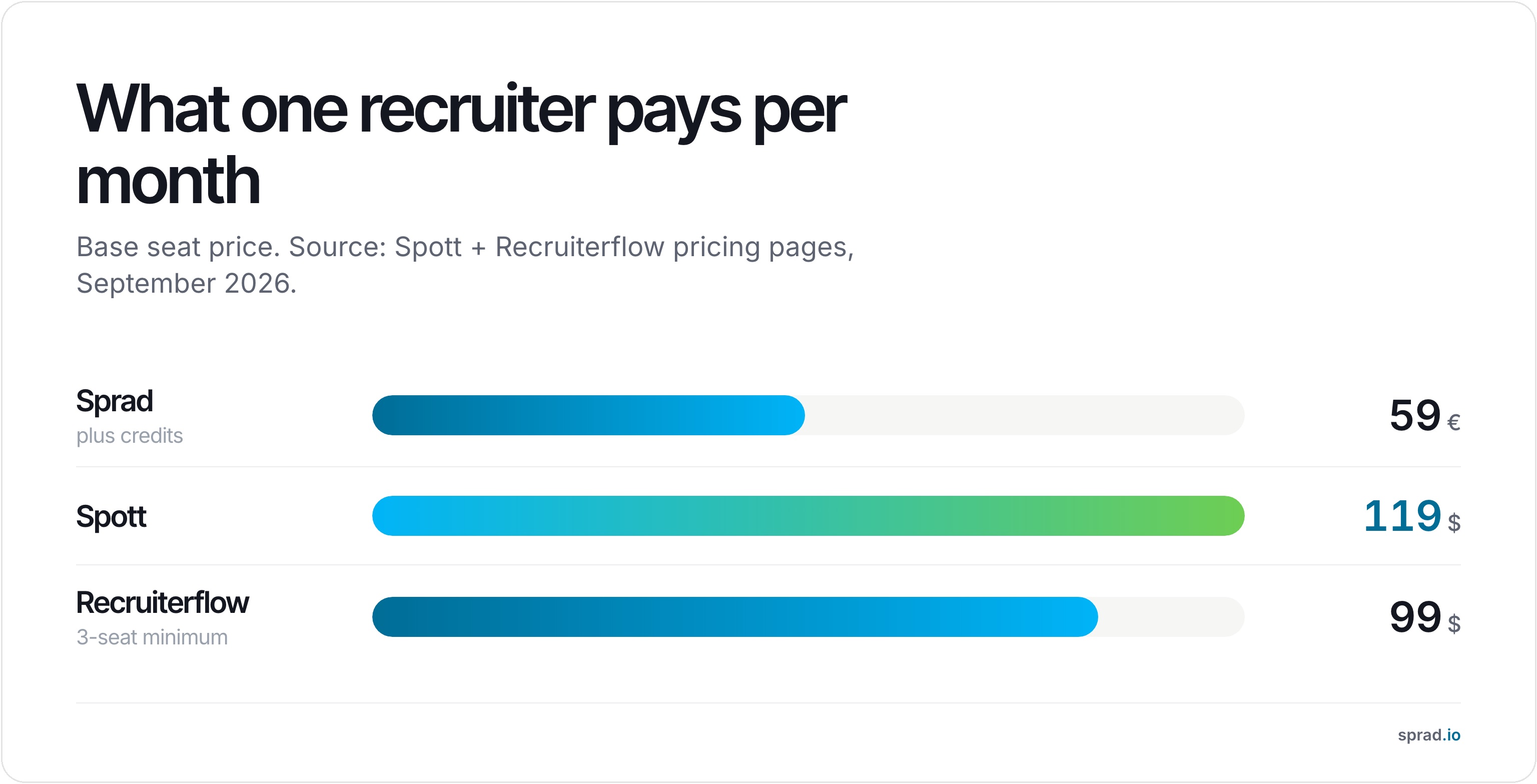
| Entry price | $119/mo ($149 monthly) | $99/mo, 3-seat minimum | 59 €/mo, no seat minimum |
| Top tier | Enterprise, 149 €/mo | Enterprise, $159/mo (adds AIRA AI matching) | Usage-based credits on top of the base fee |
| Search outside your own database | No — enrichment on existing contacts only | No — LinkedIn via Chrome extension only | Yes — requirement search across 1B+ external profiles |
| Talent pool that stays after cancellation | Existing contacts only, no external growth | Existing contacts only | Own pool, grows via external search + import |
| AI matching | Included in every plan | Only on Enterprise (AIRA) | Included, with a score and reasoning per criterion |
| Outreach channels | Email, LinkedIn, WhatsApp, SMS in one sequence | Email and SMS sequences (Pro+) | LinkedIn only, today |
| Voice/video interview screening | No | No | Yes, 12 languages |
| CRM depth | Full CRM with unified inbox | CRM core, automation-focused | Client-context layer, not a full sales CRM (in beta) |
| DACH / German interface | No | No | No dedicated interface, but DACH support |
| Reported migration time | "Under four weeks" (vendor case studies) | Not published | Free import of existing databases |
Where Spott and Recruiterflow actually differ
Automation versus unified communication
Recruiterflow's core pitch is "recipes" — when-this-then-that automations that trigger on stage changes, new applications or scheduled follow-ups.
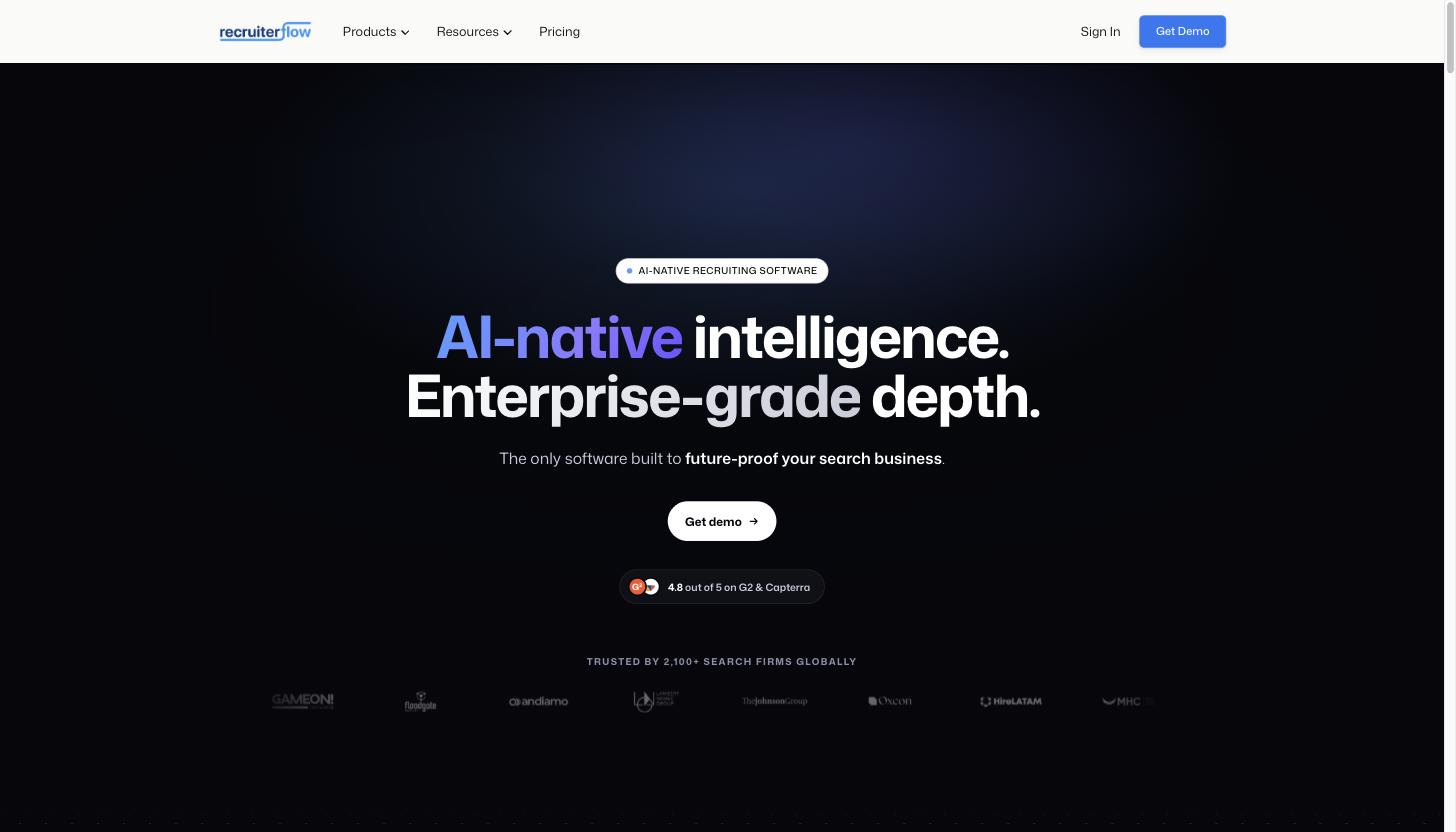
According to G2 reviews, users specifically credit this for replacing external tools like Zapier or a separate outreach app, on top of praise for ease of use and support (4.6/5 across 194 reviews).
Spott takes a different route: instead of automating steps, it collapses email, WhatsApp, SMS and VoIP into one inbox, with an AI notetaker that transcribes and summarizes calls in under a minute.
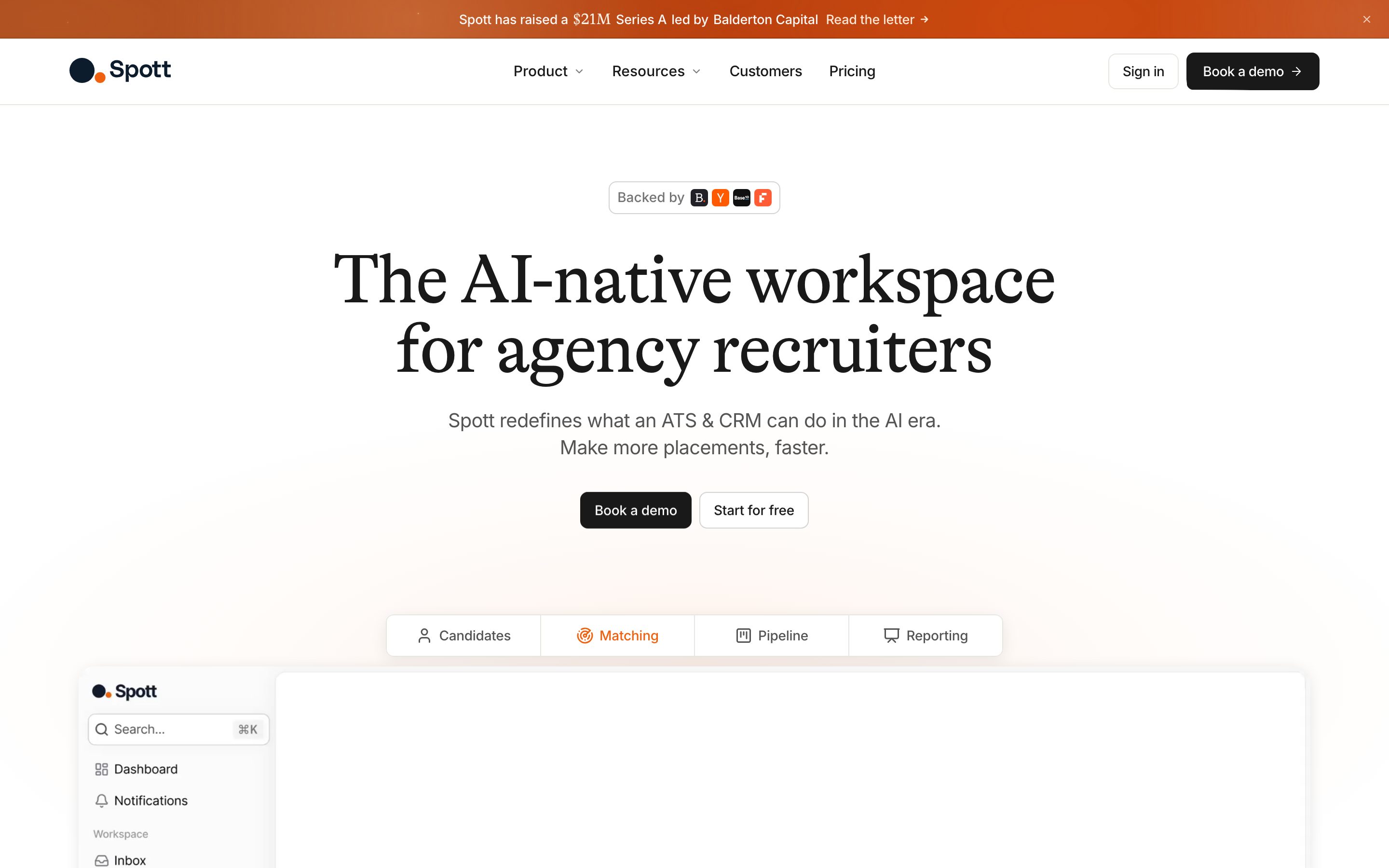
One G2 reviewer who moved from Bullhorn to Vincere before trying Spott called it a replacement for "3-4 add-on products" that used to cost over $500 a month combined.
Sourcing: neither one searches outside its own data
This is the detail both vendors leave out of their homepages. Spott's own enrichment page describes updating and tagging contacts you already have — it does not claim to find candidates who have never touched your database. Recruiterflow's equivalent is a Chrome extension that imports LinkedIn profiles one at a time; there's no built-in database search like Loxo's. For an agency whose main bottleneck is finding new candidates rather than organizing existing ones, neither tool actually closes that gap — both depend on LinkedIn or a separate sourcing subscription.
Pricing and the seat minimum that changes the math
On paper, Recruiterflow looks cheaper: $99/month against Spott's $119. But Recruiterflow enforces a 3-seat minimum on every plan, so the real entry cost is $297/month even for a two-person team, and $891/month if that team wants Pro's sequencing and automation. Annualized, that's $3,564 a year on the entry Recruit plan alone — a fixed cost a solo recruiter or two-person team pays for three logins even though only one or two are ever used. Spott has no published seat minimum, so a solo recruiter or a two-person boutique pays only for the seats it actually has. AI matching is another split: Spott bundles it into Core, while Recruiterflow reserves AIRA — its AI candidate matcher — for the $159/month Enterprise tier only.
Review volume and product maturity
Recruiterflow has 194 reviews on G2 and 332 on Capterra (4.7/5, with 252 five-star ratings) — a track record built over several years. Spott, founded in 2024, has 11 G2 reviews (4.9/5) and 2 on Capterra (5.0/5), and at least one G2 review is explicitly tagged "Source: G2 invite." Neither figure is disqualifying, but if a large, independently verified review base matters to your buying process, Recruiterflow currently has more of it — Spott's evidence still runs mostly through its own case studies.
Search for this comparison yourself and the top results are the two vendors arguing with each other: Spott runs its own comparison page against Recruiterflow, and Recruiterflow has published a rebuttal titled "we fact-checked the fact-check," accusing Spott of using outdated product screenshots. Neither is a neutral witness in that argument, which is why every claim here is sourced to G2, Capterra or each vendor's own published pricing page — not to either company's marketing page about the other.
Where each one runs into a wall
Recruiterflow's own reviewers flag "reporting depth awkward" for custom dashboards and describe bulk imports and actions as cumbersome even with the Chrome extension, per Capterra reviews. Contract paperwork at volume is another documented limit — not built for high-volume temp staffing. Spott's gaps run differently: no payroll or contracting module at all, a mobile app both PeopleManagingPeople and its own users describe as limited, and a notetaker capped at roughly one minute per call versus 45 minutes on some competing tools, per a G2 review from April 2026. One more gap worth checking directly with each vendor if EU data residency governs your buying decision: Spott's own security page advertises EU hosting by default plus ISO 27001 certification, while Recruiterflow does not publish a hosting region on its site.
The third option: Sprad
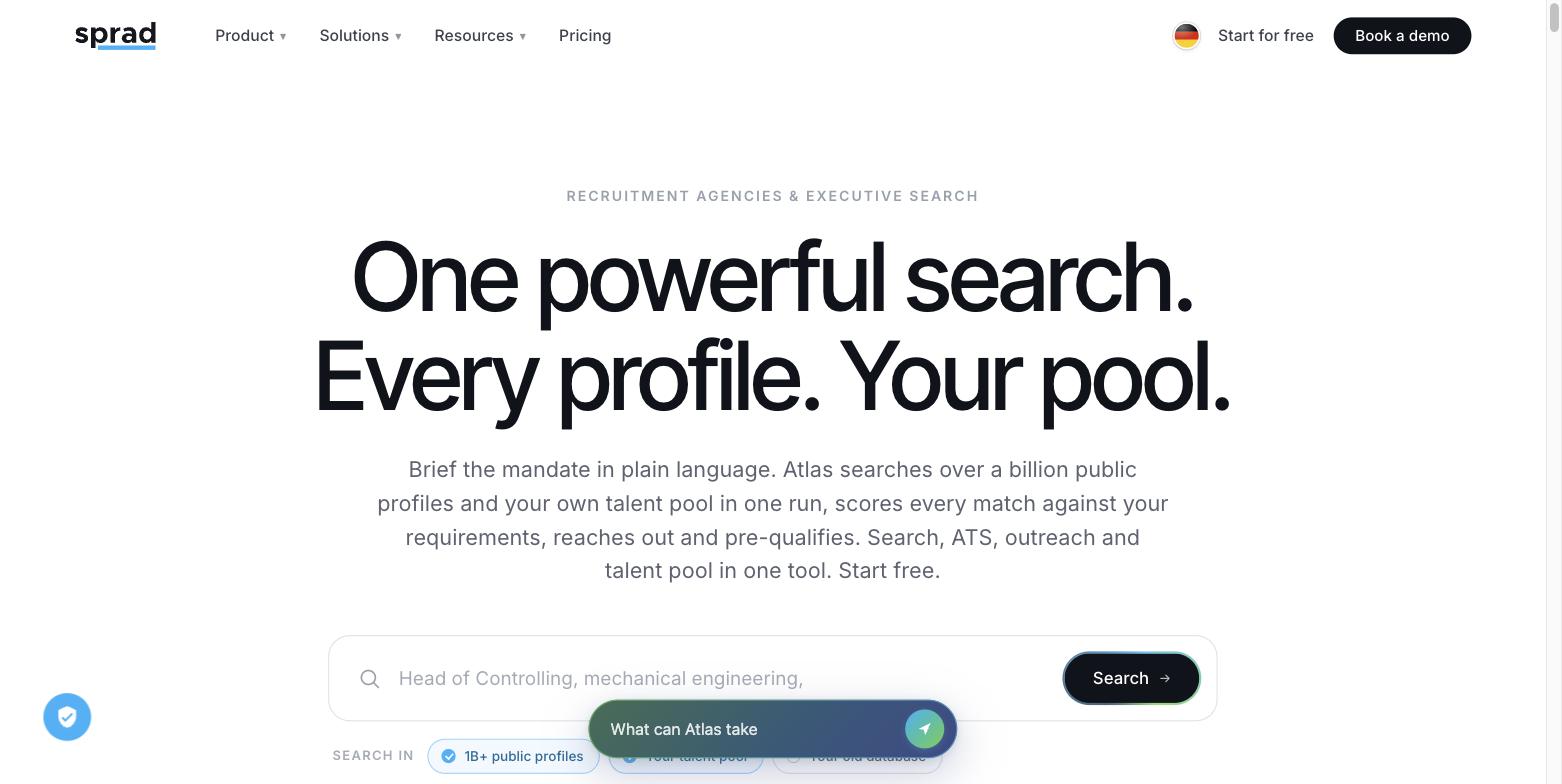
Sprad's requirement search reads full profiles against your criteria in plain language — no Boolean strings — across more than a billion external profiles plus your own pool via Atlas People Search, and returns a score with reasoning for every match. In an internal benchmark run on 15 August 2026 across three real roles and three markets, Atlas surfaced 38% of the qualified candidates other tools combined found, against 9% for the next-best tool.
Searches, outreach and interviews are billed by credit only when they happen — a full application review runs about 3 credits, an external search costs 2 credits per profile that passes the check (at most 100 per run), and rejected profiles cost nothing. Every account starts with 200 free credits a month. Sprad also adds voice and video interview screening in 12 languages via the talent pool workspace, something neither Spott nor Recruiterflow offers today.
Which one fits your agency
- You automate the same steps every placement and want fewer manual clicks: Recruiterflow's recipes and sequences are built exactly for that, if your team clears the 3-seat minimum comfortably.
- You're drowning in scattered emails, WhatsApp threads and untranscribed calls: Spott's unified inbox and notetaker solve a real, well-documented pain — as long as you don't need payroll or heavy mobile use.
- Your pipeline is thin because you can't find enough candidates, not because your process is messy: that's the gap neither Spott nor Recruiterflow closes, and where Sprad's external search and free entry tier are built to help. See what that looks like for a team your size at sprad.io/industry/recruitment-agencies.
FAQ
Is Spott or Recruiterflow better for a small agency?
It depends on team size. Recruiterflow's 3-seat minimum makes it comparatively expensive for a one- or two-person team ($297/month minimum), while Spott has no published seat floor, so it scales down more naturally to a boutique agency.
Does either tool include AI candidate matching by default?
Spott includes AI matching in every plan, including Core. Recruiterflow reserves its AI matcher, AIRA, for the $159/month Enterprise tier — Recruit and Recruit Pro don't include it.
Can Spott or Recruiterflow search for new candidates outside my database?
No, not natively. Spott enriches and updates contacts you already have; Recruiterflow imports LinkedIn profiles one at a time via a Chrome extension. Neither runs a built-in search across an external candidate database the way Sprad or Loxo do.
Which is cheaper, Spott or Recruiterflow?
Per seat, Recruiterflow's entry tier ($99/month) undercuts Spott's ($119/month) — but the 3-seat minimum means the real floor is $297/month for Recruiterflow versus $119/month for a single Spott seat.
Does Sprad replace both Spott and Recruiterflow?
Not entirely. Sprad covers ATS, talent pool, external search and voice/video screening, but its client-context layer is a beta, not a full sales CRM, and its outreach today runs only through LinkedIn — Spott and Recruiterflow both cover more outreach channels and deeper CRM workflows. See a closer look at Sprad vs. Spott for the head-to-head on that specific trade-off.
The bigger question behind both tools
Automating your process or unifying your inbox both make an agency run smoother — but neither one grows your candidate pipeline. Sprad is built around the opposite idea: your network becomes a searchable talent pool that stays yours even after you cancel, reachable through a requirement search across more than a billion external profiles in the same workspace as your ATS and screening. Start with 200 free credits a month, no credit card required, at sprad.io/industry/recruitment-agencies.
Jürgen Ulbrich
Jürgen Ulbrich has more than a decade of experience in developing and leading high-performing teams and companies. As an expert in employee referral programs as well as feedback and performance processes, Jürgen has helped over 100 organizations optimize their talent acquisition and development strategies.