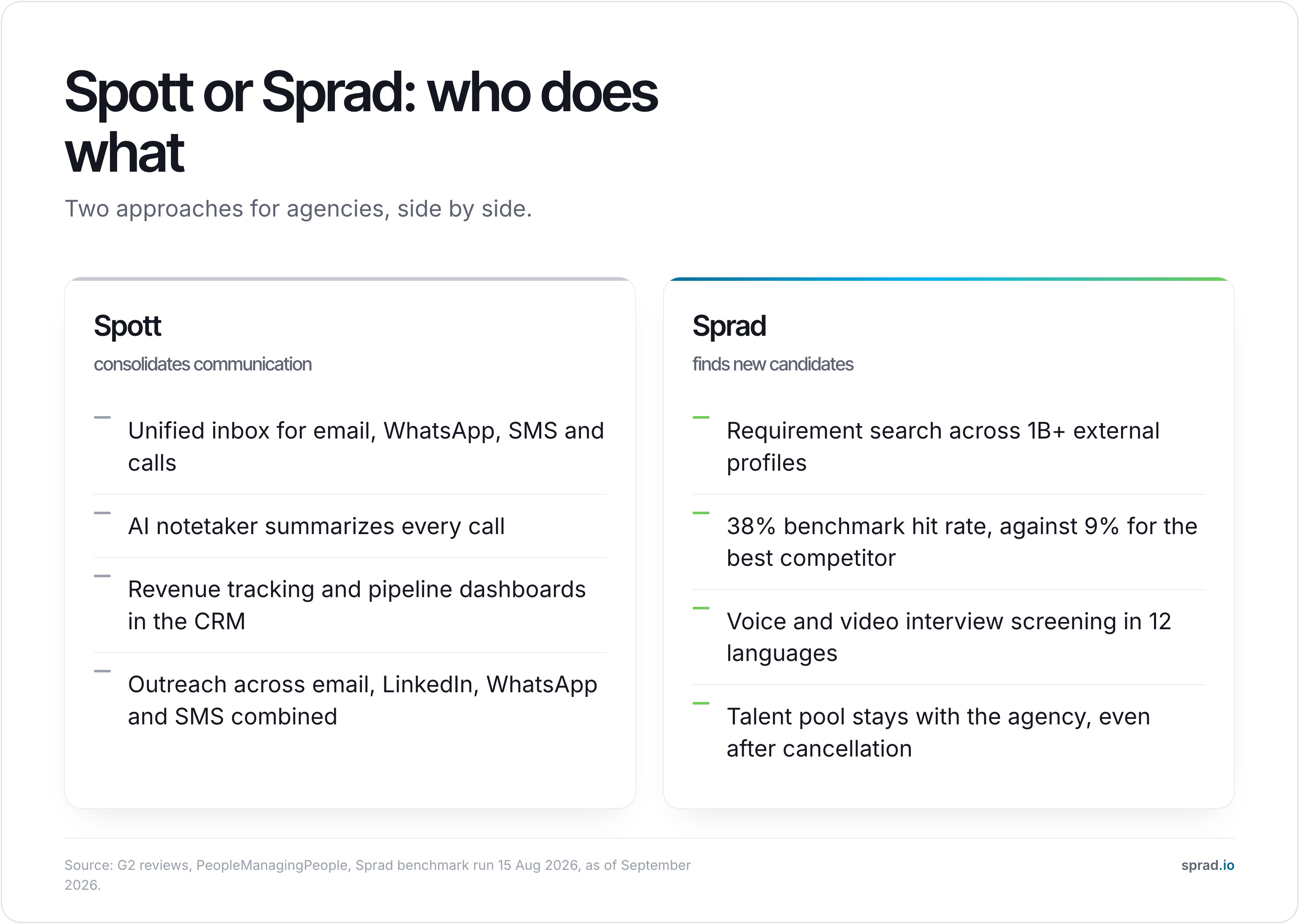
Spott and Sprad solve different problems that look similar from the outside. Spott is an AI-native ATS and CRM that consolidates your inbox, call notes and existing candidate data into one workspace. Sprad is built around finding candidates you don't have yet and keeping the ones you do, in a pool your agency owns even after you cancel. As of September 2026, the right pick depends on which problem costs you more time today.
Spott vs. Sprad at a glance
Both are 2020s-built recruiting tools aimed at agencies rather than in-house HR teams, but they start from opposite ends of the workflow.
| Spott | Sprad | |
|---|---|---|
| Base price | $119/user/month (Core, annual) | €59/recruiter/month |
| External candidate search | No built-in database; relies on third-party integrations | Requirement search across 1B+ external profiles, billed per credit |
| Talent pool ownership | Enriches your existing contacts; no bundled outside data | Pool stays with the agency after cancellation (view export) |
| AI matching | Semantic search over your own profiles and notes, explainable scoring | Requirement search with a per-criterion score and reasoning |
| Outreach channels | Email, LinkedIn, WhatsApp, SMS in one sequence | LinkedIn only, in the sourcing contact agent |
| Unified inbox / call notetaker | Yes — email, WhatsApp, SMS, VoIP, plus a call notetaker | Not built — no shared inbox, no call transcription |
| Voice/video interview screening | Not offered | Yes, voice and video, 12 languages |
| Client/deal CRM | Revenue tracking, pipeline funnel, dashboards | Lightweight client context for AI, no deal stages or invoicing (beta) |
| DACH / German interface | English only | German and English |
| Free tier | None; access via demo | 200 credits/month free, no credit card |
Where Spott is ahead
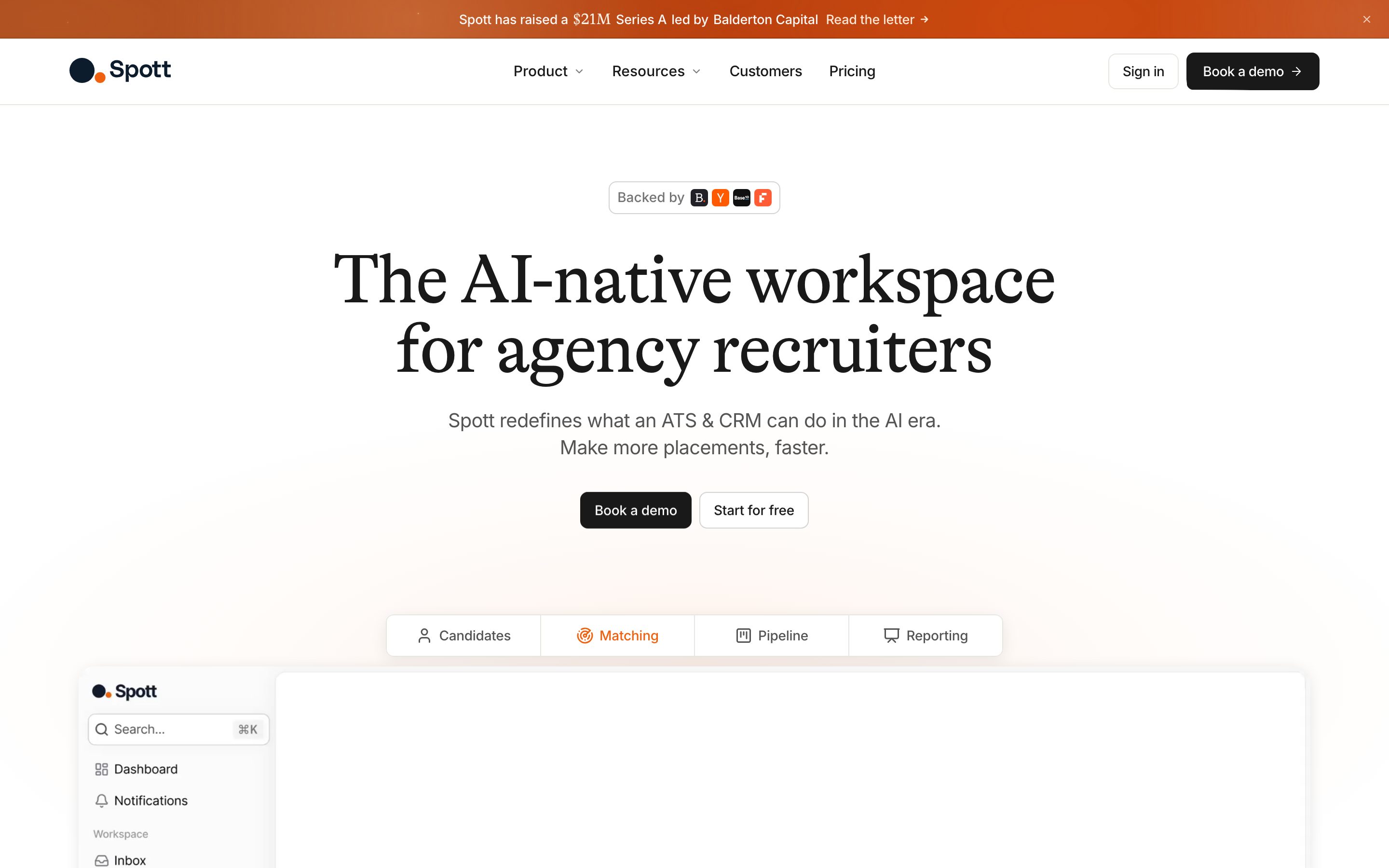
A G2 reviewer who switched from Bullhorn to Vincere and finally to Spott described paying "$500+/user/month" once every bolt-on tool for outreach, matching and call notes was added up — and said "nothing came close" once the team tried Spott's single workspace. Its AI notetaker transcribes and summarizes calls in under a minute, though reviewers flag that same one-minute recording limit as a real constraint versus the 45 minutes some competitors allow.
Spott also runs true multi-channel outreach sequences — email, LinkedIn, WhatsApp and SMS combined — where Sprad's sourcing contact agent today reaches candidates over LinkedIn only.
Where Sprad is ahead
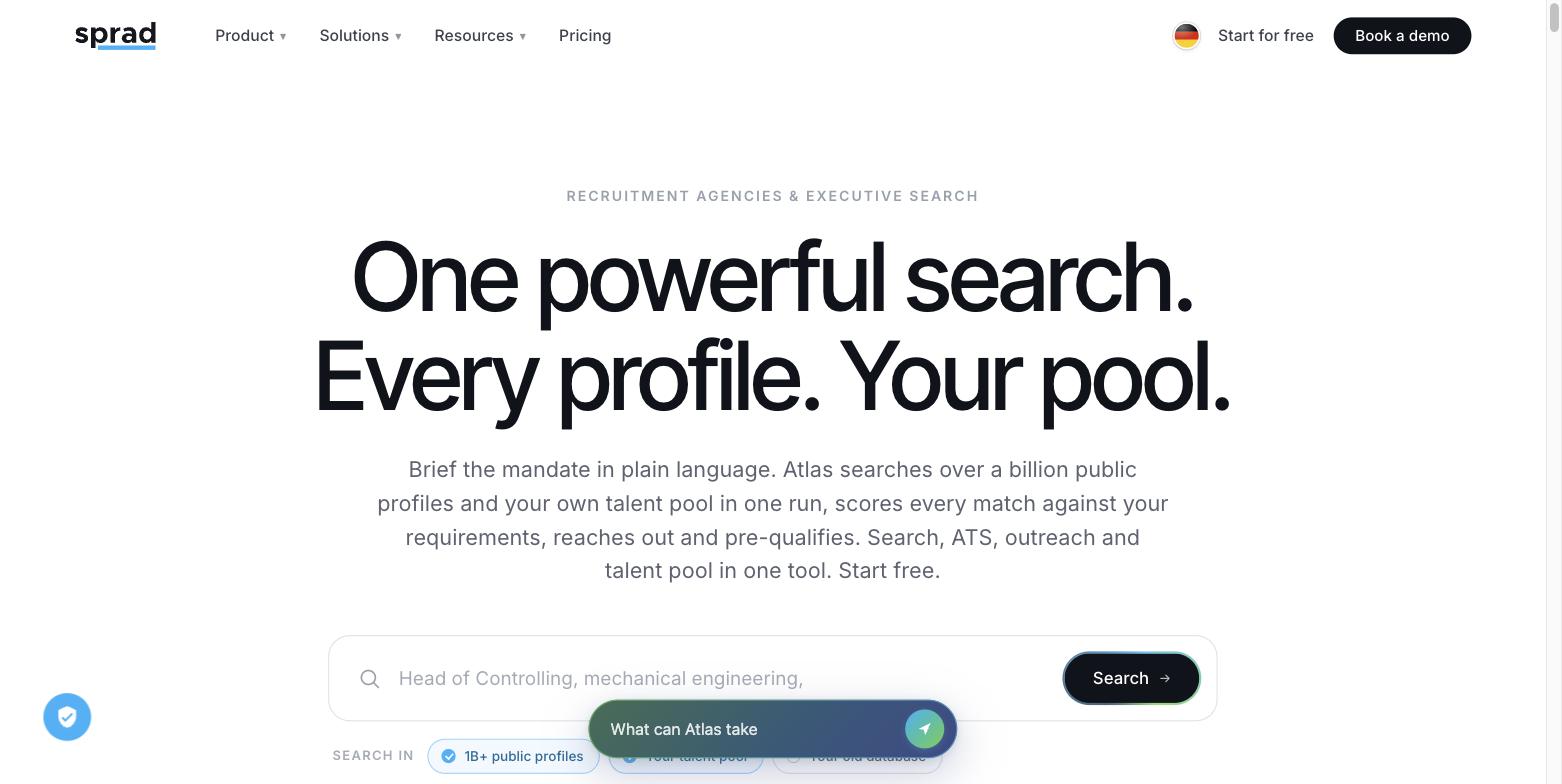
In a benchmark run on 15 August 2026 across three real roles and three markets, Sprad found 38% of the combined candidate pool other tools surfaced, against 9% for the best-performing competitor (full methodology: sprad.io/sourcing-benchmark).
It also screens the people that search turns up — voice and video interview screening in 12 languages, something Spott doesn't offer at all.
Pricing, compared
Spott's Core plan runs $119 per user per month billed annually (about €110, rising to $149/month if billed monthly). Pro, which unlocks the automation engine and outreach sequences, costs $179/month annually, and Enterprise is quoted directly in euros at roughly €149/month. None of that includes Spott's data enrichment credits, which run on a separate, unpublished pricing model.
Sprad's base fee of €59/recruiter/month is lower before any usage is counted, and it stays a flat seat cost regardless of team size — the variable spend is entirely credit-based (roughly 6–8 cents per credit), so a recruiter who runs no searches in a given month costs the agency only the base fee. For a 5-recruiter team, that's €295/month as a floor before usage, compared with roughly $595/month (about €545) for Spott Core on the same headcount. The trade-off: Spott's price already includes the unified inbox and notetaker Sprad doesn't have, so the comparison isn't apples-to-apples once you weight for those features.
Migration and switching cost
Spott markets fast onboarding, with case studies citing go-lives "in under four weeks" for agencies moving off Bullhorn or Vincere — but that's still real staff time spent mapping data and retraining a team, even with white-glove support. Sprad's onboarding is comparatively lighter for the specific job it does: importing an existing candidate database (including old exports from Xing, Bullhorn or a spreadsheet) is a free, one-time step, since the product is built to receive a legacy contact list and turn it into a searchable, enriched pool rather than replace a full CRM workflow.
If you're weighing both, the practical migration question isn't "which one replaces the other" — it's whether your agency's daily bottleneck is finding candidates or organizing conversations with the ones you already have.
Which one fits your agency
A boutique agency that already has a healthy candidate pool and loses time to scattered email, WhatsApp and call notes is closer to Spott's sweet spot — the consolidation pitch is real and well-documented in its own reviews.
An agency or staffing firm whose real constraint is finding candidates who aren't already in the database — executive search, niche technical roles, high-volume sourcing — is closer to what Sprad is built to solve, especially if building a talent pool that survives a LinkedIn Recruiter cancellation matters to the business.
And for a team that genuinely needs both jobs done well, the honest answer is that some agencies run Spott for CRM, inbox and client communication while sourcing and screening candidates through Sprad — two invoices, but two tools each doing the part of the job they're strongest at, rather than one tool doing both adequately.
FAQ
Is Spott a good alternative to Sprad?
For an agency whose main pain is a scattered inbox and manual call notes across an existing candidate base, yes. For an agency that needs to find candidates outside its current database, Spott doesn't have a native tool for that job, so it isn't a substitute for Sprad's search.
Does Sprad have a unified inbox like Spott?
No. Sprad doesn't currently offer a shared inbox for email, WhatsApp and calls, or a call notetaker — that's a genuine Spott strength if your agency needs it.
Can Sprad search for candidates outside our own database?
Yes — that's Sprad's core function: a requirement search across 1B+ external profiles, in addition to your own talent pool, billed by the search rather than by seat.
Which is cheaper, Spott or Sprad?
Sprad's €59/month base fee is lower than Spott's $119/month Core plan before usage is counted, but Spott's price already bundles the unified inbox and notetaker that Sprad doesn't offer, so the fair comparison depends on which features your agency actually uses.
Does Spott offer a German or DACH-specific interface?
No, Spott's interface is English only. Sprad offers both German and English.
Can I use Spott and Sprad together?
Yes, in practice some agencies run Spott for CRM and communication while using Sprad for external sourcing and interview screening — there's no technical conflict, just two subscriptions.
Where Sprad fits into the bigger picture
Cancel LinkedIn Recruiter tomorrow, and the candidate pool you built inside it typically leaves with the subscription. Sprad's approach is to make your agency's own network into a talent pool that stays yours — searchable across more than a billion external profiles in the same workspace as your ATS, screening and outreach, starting with 200 free credits a month and no credit card. See what that looks like for a team your size at sprad.io/industry/recruitment-agencies.
Jürgen Ulbrich
Jürgen Ulbrich has more than a decade of experience in developing and leading high-performing teams and companies. As an expert in employee referral programs as well as feedback and performance processes, Jürgen has helped over 100 organizations optimize their talent acquisition and development strategies.