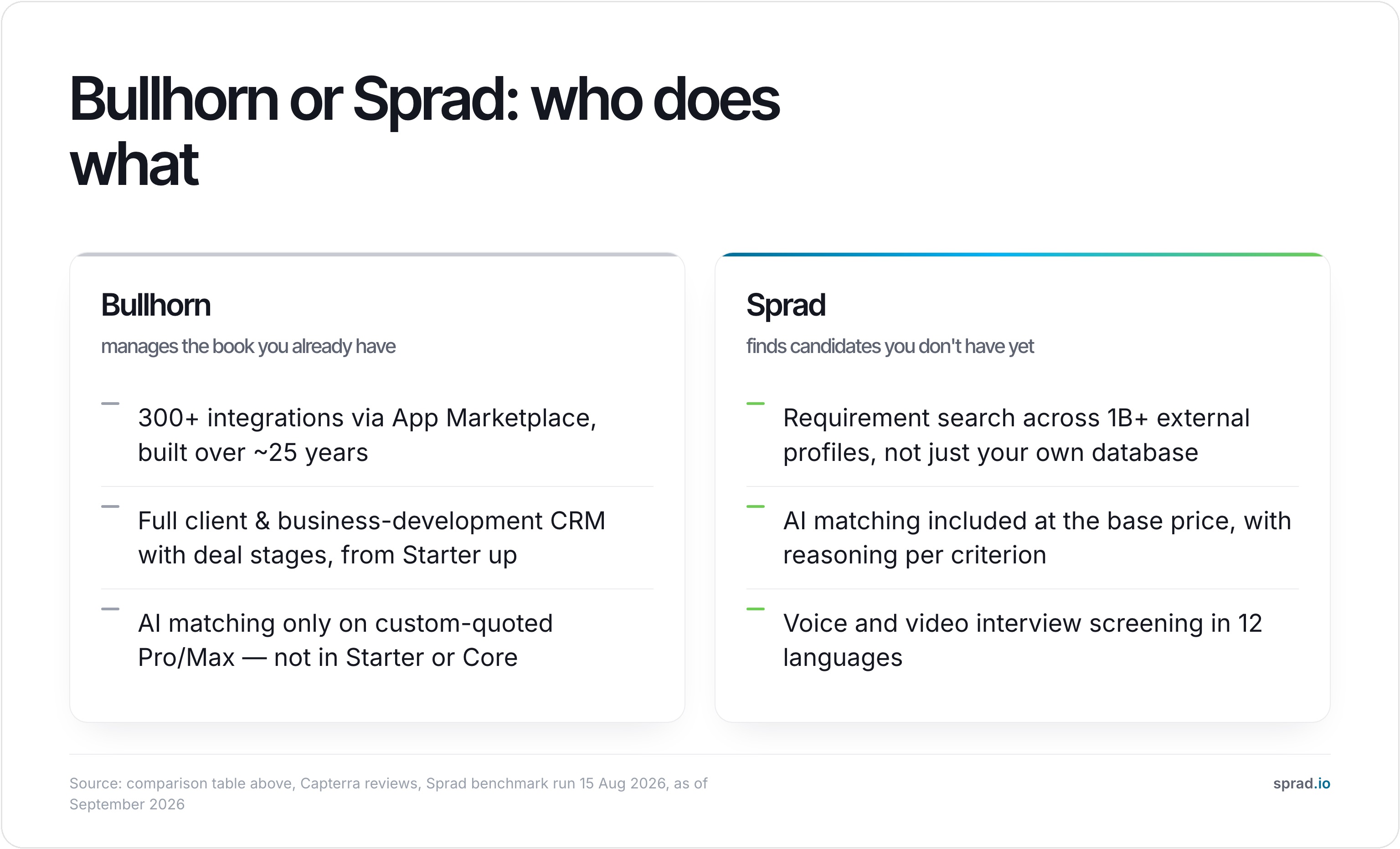
Sprad fits agencies whose bottleneck is finding and screening candidates, not organizing an existing large client book — built-in requirement search across 1B+ external profiles, screening and outreach at a low entry price. Bullhorn fits large, established agencies that need its 300+ integrations, a full business-development CRM, or are already deep into a Bullhorn implementation. As of September 2026, neither is a universal upgrade over the other: the right pick depends on whether the daily problem is finding candidates or managing the ones already on file.
Bullhorn vs. Sprad at a glance
| Category | Bullhorn | Sprad |
|---|---|---|
| Starting price | $99/user/mo Starter (~€91), $165/user/mo Core (~€152); AI/automation only on custom-quoted Pro/Max | €59/recruiter/mo for ATS + talent pool, then pay-per-use credits; 200 free credits/month |
| Search beyond own database | No — Boolean search over your own records, third-party enrichment (Kaspr, Lusha) needed for fresh contact data | Yes — 1B+ external profiles searched alongside your own pool in one run |
| AI matching | Only on Pro/Max, custom quote — not in Starter or Core | Included at the base price, with a per-criterion score and reasoning |
| Voice/video interview screening | Not offered | Yes, voice and video, 12 languages |
| Talent pool / data portability | Candidate records live in your account; no publicly documented export guarantee at cancellation | Pool stays with the agency after cancellation, via a view export of the talent-base grid — not a full raw-data dump |
| Outreach channels | Email sidebar (Core+), LinkedIn integration (Core+), full omni-channel only on Max | LinkedIn only today — no email outreach in sourcing yet |
| CRM depth | Full client and business-development CRM from Starter up | Lightweight client context for AI, not a sales CRM with deal stages (marked Beta) |
| DACH / German | English-first, no confirmed German interface | German interface, DACH-focused pricing and copy |
| Integrations | 300+ partners via App Marketplace (Core+) | Smaller partner list — younger platform |
| Migration / ramp-up | Steep onboarding reported in reviews, large consultant and partner ecosystem to help | Faster initial setup, free import of old CSV/Xing/Bullhorn exports — less external migration support available |
Where Bullhorn is ahead
Fairness matters more in this comparison than in most — a one-sided "Sprad wins everywhere" read would undercut every other claim in this article. Four places where Bullhorn has the real edge, each backed by something more concrete than marketing copy.
Breadth of established integrations. Bullhorn's App Marketplace lists 300+ partners — job boards, VOIP systems, enrichment tools, other CRMs — built over roughly 25 years since the company's founding in 1999. G2 reviewers cite this directly: "ease of use and powerful integrations streamline recruitment" is one of the platform's most repeated compliments, and it's a genuine reason large agencies stay. Sprad's integration list is shorter simply because the platform is younger, not because the approach is worse.
A full client and business-development CRM from the Starter tier up. Bullhorn ships deal pipelines, structured client records and account management from its entry plan. Sprad's client-context module is intentionally thin: it feeds the AI with context on a client's needs and preferences, but by design it isn't a sales CRM with deal stages, forecasted values or contract terms — Sprad itself markets that part as still in beta. An agency running structured business development today, with account managers tracking deal stages inside the CRM, will genuinely miss that in Sprad.
Payroll and contract modules through the Heidrick ecosystem. Since Bullhorn's 2021 acquisition by Heidrick & Struggles, it has access to payroll and contract-management capability that Sprad — an ATS/sourcing/screening platform, not a payroll system — doesn't offer and isn't building toward.
Enterprise stability at very large scale. For agencies running 500+ recruiters on one instance, Bullhorn's maturity and its dedicated account-management tier (available on Pro/Max) is built for that scale in a way a newer platform hasn't yet proven at.
Where Sprad is ahead
Bullhorn's own core is Boolean search over records already in your database, and reviewers note it needs a third-party enrichment tool for fresh contact data. Sprad instead reads full candidate profiles against a plain-language requirement across 1B+ external profiles and the agency's own pool in the same run — in an independent benchmark from 15 August 2026, this surfaced 38% of the matches other sourcing tools also found, against 9% for the next-best tool. That's a meaningfully different job: Bullhorn organizes candidates you already have, Sprad also finds ones you don't.
Sprad's AI matching is included at the base price, with a score and a stated reason per criterion, where Bullhorn locks the same capability behind a custom-quoted Pro or Max plan. Sprad also screens the people that search turns up — voice and video interview screening in 12 languages — something Bullhorn doesn't offer at any tier.
On data ownership, Bullhorn stores candidate records in your account like any CRM, but there's no publicly documented guarantee of what happens to that data, or in what form, if you cancel. Sprad's talent pool is built to stay with the agency even after cancellation — though it's worth being precise here: the export is a view of the talent-base grid, not a complete raw-data dump with interview transcripts or model embeddings. For most agencies switching from a rented database, that's still a real upgrade in ownership, just not an unlimited one.
Bullhorn has no confirmed German interface and markets primarily in English across North America, the EU and APAC. Sprad is built around a German interface and DACH-specific pricing and messaging, which matters directly if your team, candidates or clients operate in German.
Pricing, compared
Bullhorn's published tiers only cover the ATS core. AI search, automations, call transcription and analytics all sit behind Pro and Max, which are quoted individually — and Capterra reviewers score Bullhorn's Value for Money at just 3.7/5 (against 4.1 for ease of use), citing "implementation fees running into the thousands" plus annual price indexation on renewal.
Run the numbers on a real team and the gap is concrete, not abstract. For a 5-recruiter agency: Bullhorn Starter runs $495/month (~€455) without AI or automation at all; Core runs $825/month (~€759) and still doesn't include AI matching. Sprad's flat base for the same team is €295/month, covering the ATS, the talent pool and AI matching outright — usage (search, screening, outreach) is metered separately in credits, with 200 free every month. For a 15-recruiter agency, the same math scales: Bullhorn Starter reaches $1,485/month (~€1,367), Core reaches $2,475/month (~€2,277) — still without AI — against Sprad's €885/month base. Even Bullhorn's cheapest tier, with none of its AI or automation features switched on, costs roughly the same as or more than Sprad's full-featured base plus a working month of credits.
The honest caveat: Bullhorn's higher tiers bundle CRM depth, 300+ integrations and payroll modules that Sprad doesn't have at any price. The comparison isn't apples-to-apples once those are weighted in for an agency that actually uses them.
Migration and switching cost
Reviewers consistently describe Bullhorn's onboarding as steep — dense screens, a real learning curve, and implementation projects that reviewers say can run into the thousands of dollars before a team is fully live. The upside is a large consultant and partner ecosystem built specifically to carry agencies through that migration, which matters if your team needs hands-on help rather than self-serve setup.
Sprad's onboarding is comparatively lighter for the narrower job it does: importing an existing candidate database — including old CSV exports, Xing data or a prior Bullhorn export — is a free, one-time step, since the product is built to receive a legacy contact list and turn it into a searchable, enriched pool rather than replace a full CRM workflow. What Sprad doesn't have is Bullhorn's breadth of migration partners for a complex, multi-system cutover.
One more factor worth naming honestly: if an agency has years of workflows, custom fields and trained staff built around Bullhorn, the migration cost of switching can outweigh what a cheaper or more sourcing-capable tool would save. That's a legitimate reason to stay, not just inertia.
Which one fits your agency
Choose Sprad if: your main bottleneck is finding and screening candidates rather than managing an existing large client CRM, your team is DACH-based or wants a German interface, or you're currently paying for several separate sourcing/screening/outreach tools on top of an ATS.
Choose Bullhorn if: you run a large, established agency (several hundred recruiters), you need a full business-development CRM with deal stages built in, or you rely on a broad integration marketplace and payroll modules that a newer platform can't yet match.
Consider both, or neither: a large staffing agency with heavy payroll needs and a small, sourcing-focused recruiting team inside it might genuinely run Bullhorn for account management and a lighter sourcing tool alongside it. And if your actual complaint about Bullhorn is only the price of AI add-ons rather than sourcing capability, a cheaper Bullhorn alternative with similar CRM depth — see our full Bullhorn alternatives comparison — may fit better than either option here.
FAQ
Is Sprad cheaper than Bullhorn?
At the entry level, yes: Sprad's €59/recruiter/month base plus pay-per-use credits usually costs less than Bullhorn's $165/user/month Core tier, and meaningfully less than the custom-quoted Pro/Max tiers needed for AI features. Bullhorn's Starter at $99/month (~€91) is closer, but still doesn't include AI matching at any price point below Pro.
Does Sprad replace Bullhorn's CRM features?
No. Sprad's client-context module is intentionally lightweight and doesn't include deal stages, contract values or a business-development pipeline. Agencies that rely heavily on CRM-style account management will find Bullhorn deeper here.
Can I search outside my own database in Bullhorn?
Not natively. Bullhorn's core search is Boolean search over your existing records; teams typically add a third-party enrichment tool for fresh contact data. Sprad searches 1B+ external profiles alongside your own pool in the same workspace.
Does Bullhorn have a German interface?
There's no confirmed German-language interface for Bullhorn; it markets primarily in English. Sprad is built with a German interface and DACH-specific pricing.
Is it worth migrating from Bullhorn to Sprad?
It depends on what's driving the search. If the issue is Bullhorn's quote-only AI pricing or a lack of external sourcing, migrating solves that directly. If your agency needs Bullhorn's integration breadth, payroll modules, or has years of workflow investment already in the platform, the migration cost may not be worth it — running both, or picking a different alternative, can make more sense.
Why do agencies look for a Bullhorn alternative in the first place?
The most consistently cited reasons across reviews and comparison sites are a complex, tier-locked pricing structure (AI and automation gated behind custom quotes), a steep learning curve for new hires, lengthy implementation projects, and limited built-in flexibility for real-time candidate messaging. None of those are reasons to avoid Bullhorn outright — they're reasons to check whether a narrower, cheaper tool solves the specific bottleneck before paying for the full platform.
The bigger question
Whichever platform runs your day-to-day pipeline, the longer-term question is who owns the network you build inside it. Sprad's pricing is built around keeping that pool with the agency — searchable across a billion external profiles in the same workspace as your ATS, screening and outreach, starting with 200 free credits a month and no credit card. See what that looks like for your team size at sprad.io/industry/recruitment-agencies.
Jürgen Ulbrich
Jürgen Ulbrich has more than a decade of experience in developing and leading high-performing teams and companies. As an expert in employee referral programs as well as feedback and performance processes, Jürgen has helped over 100 organizations optimize their talent acquisition and development strategies.