A talent intelligence platform is software that turns data about people, skills and the labour market into hiring decisions. Most of what is sold under the label falls into one of three kinds: market and workforce data, internal skills intelligence for your own employees, or external candidate intelligence that finds and contacts people outside your company. Recruiters and agencies need the third kind. For that, Sprad is our pick: every profile is checked individually against your requirements, LinkedIn and email outreach run from one inbox, and in our own re-measurement in the recruiting area of the open PeopleSearchBench, Atlas comes to 73.5 of 100, converted to the published scale. Sprad is the vendor of Atlas itself. Eightfold-type suites fit HR departments with 5,000+ employees, SeekOut and Loxo suit mid-market teams, Pin is a cheap solo entry.
What is a talent intelligence platform?
The term has no fixed definition. Analyst Josh Bersin, who popularised it in a 2021 report, describes a platform that integrates what is known about workers (skills, experience, career aspirations, performance) to match people with opportunities. Vendors then stretch it: Metaview describes it as collecting and analysing candidate, employee and labour-market data; Loxo, Eightfold, SeekOut and Findem all call themselves one. The result is a category where a skills engine for the HR department and a LinkedIn-style search tool share a name.
We split it by what you can do with the output. Only the third kind produces people you can write to today.
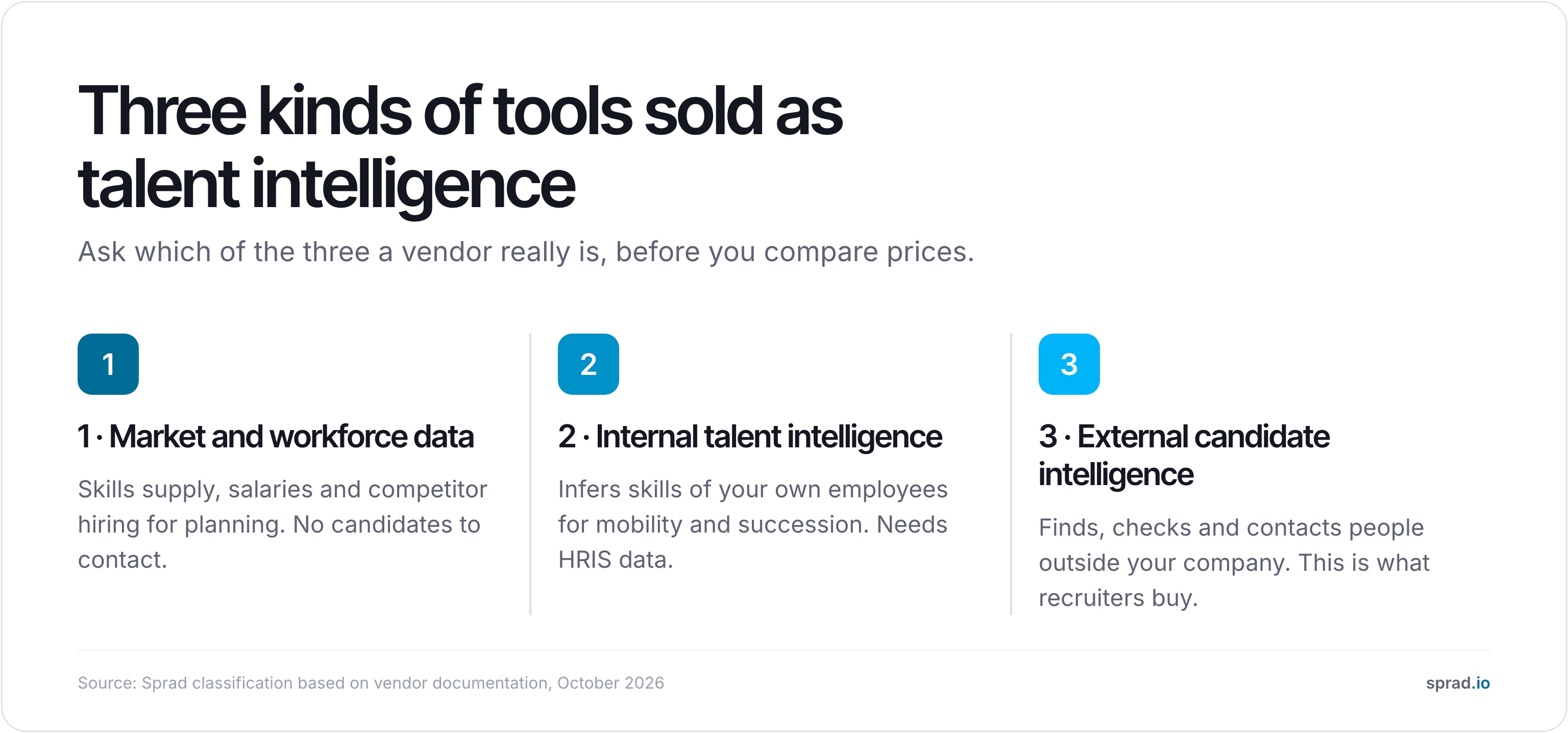
This is also why price lists look absurd side by side: a labour-market data licence at about 9,400 £ per year for one seat, a skills suite at six figures and a sourcing tool at 100 $ per month answer different questions.
How we compared the tools
Six criteria decide whether a tool gives a recruiting team an advantage. We use them for the table and every profile below.
- Kind: market data, internal skills or external candidates (see above).
- Candidate check: is every profile read against your requirements with a reason per requirement, or ranked by keywords? Our rule of thumb from building a requirement search: if results appear instantly, it is almost always a (semantic) keyword search. A real per-profile check takes minutes.
- Data reach: a bought index only, or also your own talent pool and your colleagues' networks?
- Outreach: LinkedIn only, email only, or both in one thread per candidate, with a warning if a colleague already wrote to the person?
- Price shape: per seat, per credit, per module or quote only, and what remains after you cancel.
- EU fit: hosting, data processing agreement, GDPR and EU AI Act readiness, works council.
The 8 best talent intelligence platforms compared
| Tool | Kind | Data / search | Outreach | Price (public info, October 2026) | EU focus |
|---|---|---|---|---|---|
| Sprad | External candidate intelligence + talent network | Requirement search over 1B+ profiles (LinkedIn, XING, GitHub), your own pool and employee networks; every profile checked individually | LinkedIn, email and InMail in one inbox; voice, video, chat and agent pre-qualification | Free start (100 credits/month); Recruiter Lite 79 €/seat/month; Atlas Recruiter 299 €/seat/month incl. outreach agent (annual, net) | Yes, EU hosting |
| Eightfold | Internal skills + external matching | Skills inferred from HRIS, ATS and profile data | Via ATS and CRM modules | Quote only | Not stated |
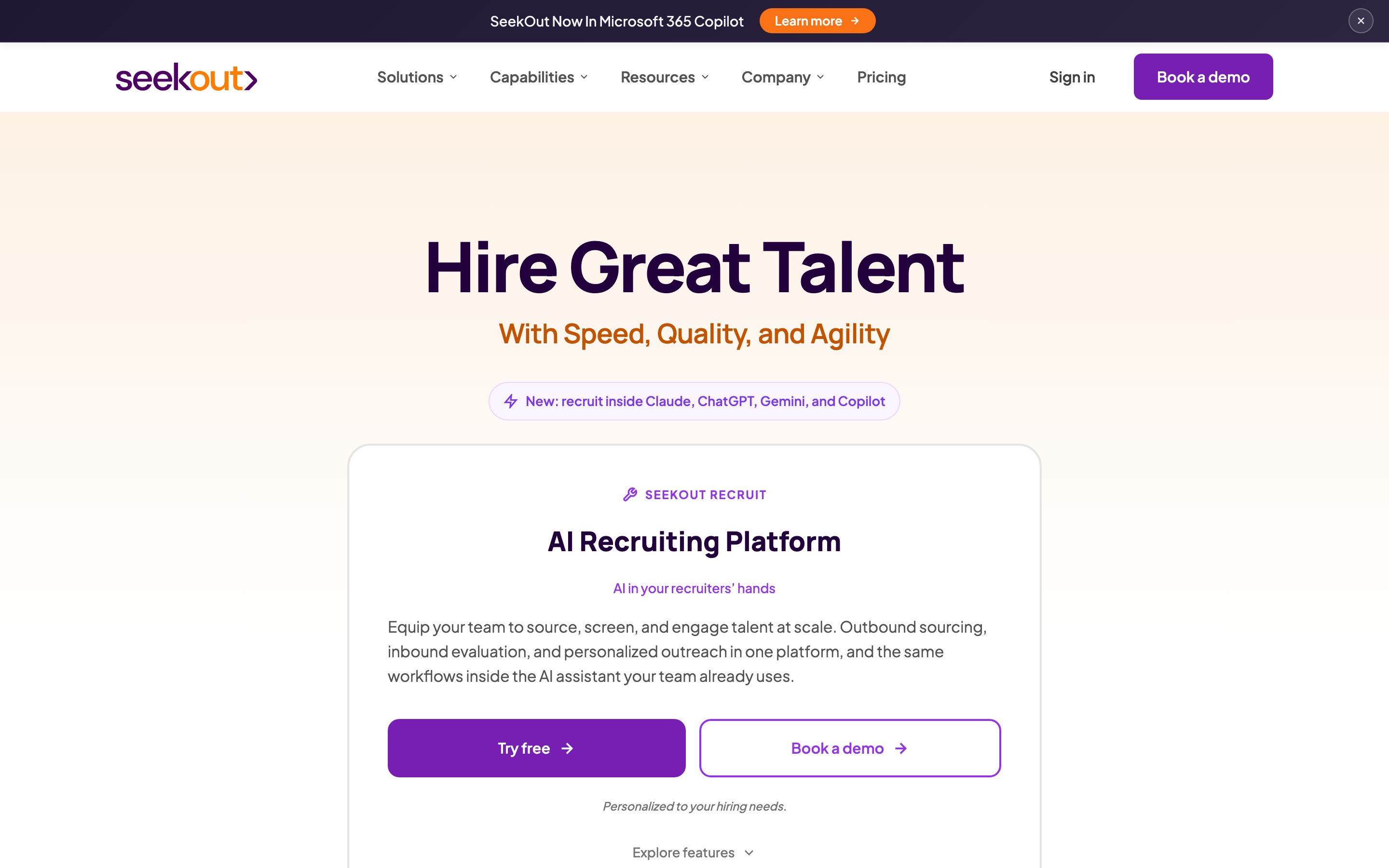
| SeekOut | External candidate intelligence | 1B+ profiles claimed, clearance and patent data | Integrations; Spot adds a human recruiter | Solo from 149 $/month (annual); teams custom | Not stated |
| Findem | External + attribute data | 800M+ profiles claimed, “3D” attribute graph | Not documented in sources we checked | Quote only | Not stated |
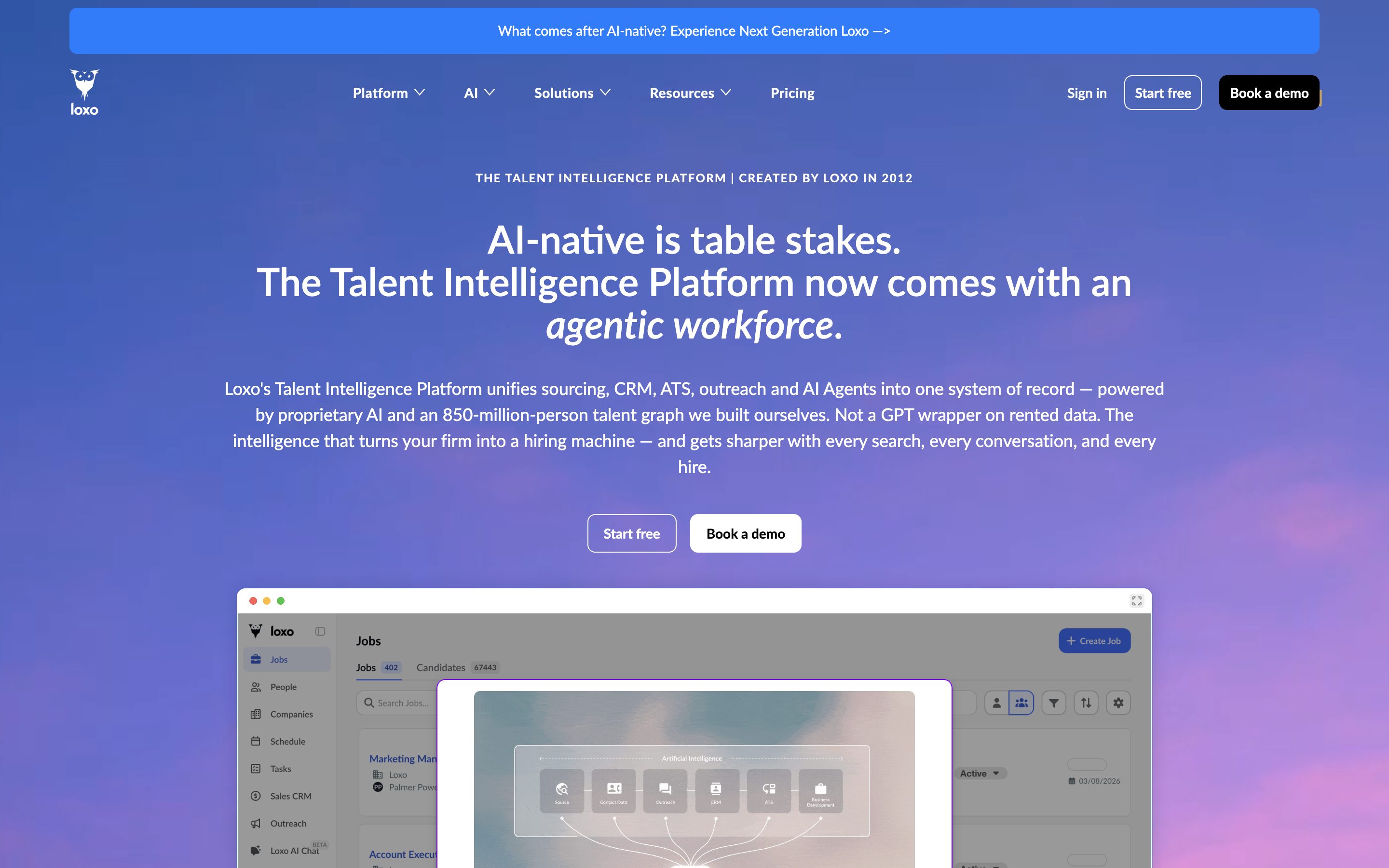
| Loxo | ATS + CRM + candidate database | Own talent graph (850M people per its homepage) | Email and sequences, AI agents | Core 149 $, Professional 199 $ per user/month (annual) | Not stated |
| Pin | External candidate search + agent | 850M+ profiles claimed | Email, books calls | Free tier; Solo about 100 $/month, Professional 135 $/user (annual) | US hosting stated |
| Metaview | Interview intelligence | Your own interview data | None (not a sourcing tool) | Free with a work email; paid on request | Not stated |
| LinkedIn Talent Insights | Market data | LinkedIn labour-market data | None | From about 9,400 £/year for one seat (third-party figure) | Not stated |
1. Sprad — the most matching candidates and the broadest toolkit
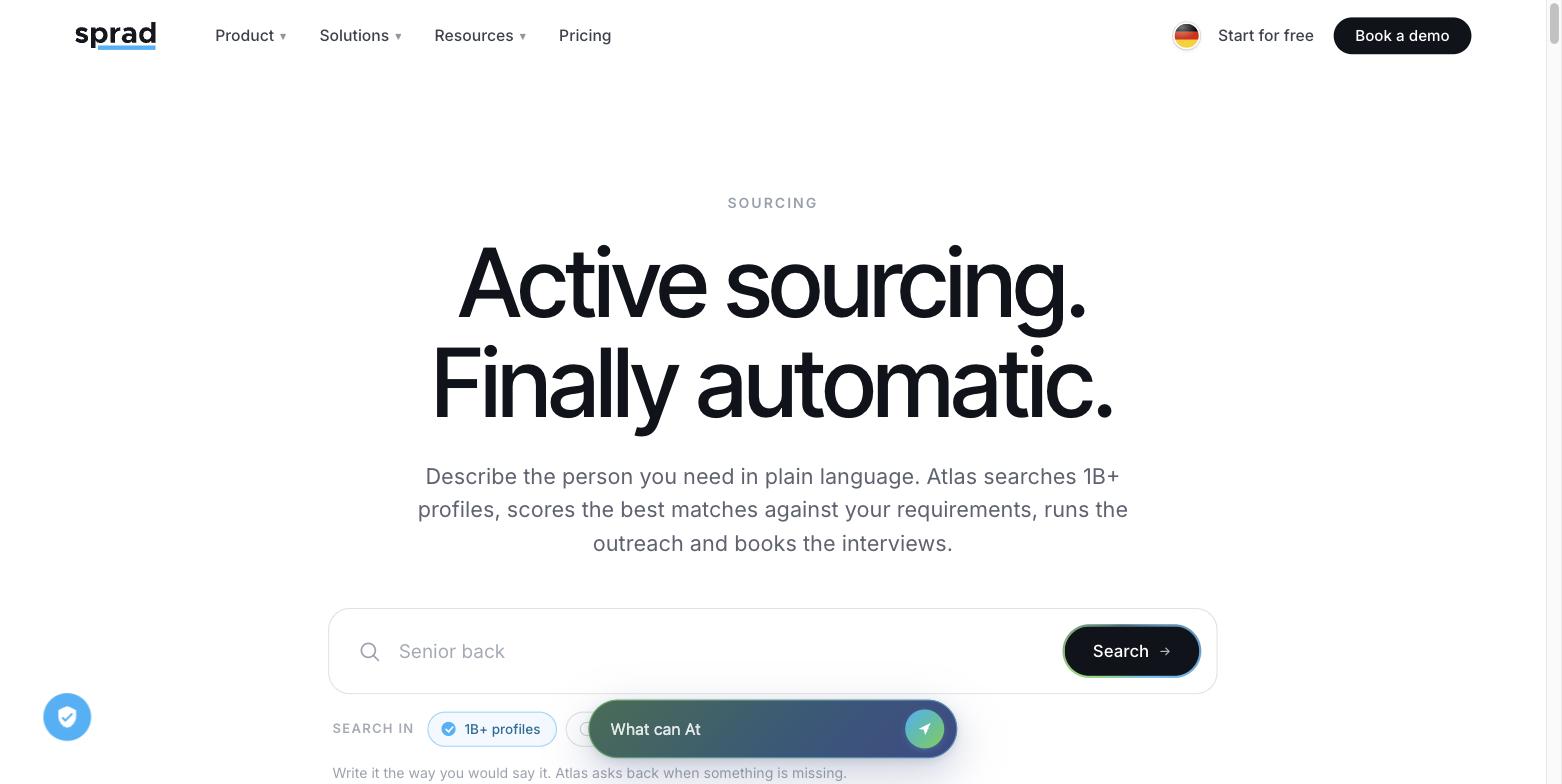
Sprad is the external kind with a twist: one search covers LinkedIn, XING, GitHub and your own pool, including the networks of your employees, which a bought index cannot see. Atlas, the sourcing product, checks every profile individually and gives a reason per requirement, so it also finds people whose profile is poorly maintained. Deep Context finds companies first and then the people who worked there in a given period, for example a CFO who led an acquisition or someone who built a start-up through Series A or B.
Benchmark: in our own re-measurement in the recruiting area of the open PeopleSearchBench, Atlas comes to 73.5 out of 100, converted to the published scale (Lessie 68.2, Juicebox 65.7 as published). In it Atlas returned almost always 15 matching profiles per recruiting search (14.2 on average).1 Sprad is the vendor of Atlas itself. Sprad has built recruiting software for 7 years, starting with employee referrals, which is nothing but matching profiles against requirements. Outreach runs over LinkedIn and email, with follow-ups, in one inbox per talent. Security and compliance are built for enterprise, public-sector and insurance customers, with EU hosting, and apply in Europe and the US.
1 PeopleSearchBench (Recruiting), published by Lessie, October 2026. Other systems' scores as published in the benchmark; Atlas is our own re-measurement with the benchmark's open test procedure, converted to the published scale; not an official entry. Contact data came from the “find email” button. As of October 2026. Method and details.
2. Eightfold — skills intelligence for large employers
Eightfold is the platform the 2021 analyst definition was written around: it ingests data from HR, applicant tracking, learning and performance systems and infers skills. Its value grows with the amount of internal data you feed it, which is why small teams rarely benefit.
3. SeekOut — deep filters, optional human help
4. Findem — attribute data on a large graph
5. Loxo — ATS, CRM and database in one
6. Pin — the budget entry
7. Metaview — interview intelligence
8. LinkedIn Talent Insights — labour-market data
What talent intelligence platforms cost: a worked example
Take an agency or in-house team with five recruiters who source every week. We use published list prices, October 2026; annual billing, net, no discounts.
- Sprad Recruiter Lite: 5 × 79 € = 395 € per month (4,740 € per year). Each seat includes 500 profiles and 50 pool searches per month; deep search runs on credits.
- Sprad Atlas Recruiter: 5 × 299 € = 1,495 € per month (17,940 € per year). Unlimited searches under fair use, deep search included, one LinkedIn and mailbox agent per seat; from 3 seats ATS integration and a named contact.
- Pin Professional: 5 × 135 $ = 675 $ per month.
- Loxo: 5 × 149 $ = 745 $ (Core) or 5 × 199 $ = 995 $ (Professional) per month.
- SeekOut: 149 $ for a solo seat; for five seats count on quote-based pricing, with 2026 transaction data around 22,500–37,500 $ per year.
- Eightfold, Findem: quote only.
Atlas Recruiter is the most expensive seat in this list and Recruiter Lite is on par with the budget tools; that is the honest reading. The difference is what is inside: with Atlas Recruiter, search, deep search and the outreach agent are included, with the cheaper seats you buy them separately or build them with other tools. If five people only occasionally search, the credit route is cheaper: Atlas Base costs 450 € per year including 5,000 credits. A deep search budget of 300 credits (at the Base price of 0.09 € = 27 €) shows up to 150 qualified profiles at 2 credits each, so about 0.18 € per profile; you pay only for profiles shown.
The cheap number leaves out three things: contact data (at Sprad 1 credit per email found, 10 per phone number), renewal increases (hireEZ users in particular report steep jumps at renewal) and what happens after you cancel. At Sprad the talent network stays free and your data stays yours; at many sourcing tools the pool is gone with the licence.
Which talent intelligence platform fits small teams, which enterprises?
| Your situation | Our pick | Why |
|---|---|---|
| Solo recruiter or small agency (1–5 seats) | Sprad (free start or Recruiter Lite); Pin if only the entry price counts | Lite at 79 € is on par with the budget tools; LinkedIn and email in one inbox avoid double outreach |
| In-house team in DACH or Europe | Sprad | XING, LinkedIn and GitHub in one search, EU hosting, your employees' networks searchable |
| Agency with several clients | Sprad (Atlas Recruiter, Base Pro or Max) or Loxo | Several clients in one account; searchable pool of past candidates |
| Enterprise, 5,000+ employees, HR strategy | Eightfold for internal skills, plus Sprad for external sourcing | One skills model on HR data, one search for people you have not met |
| Workforce planning only | LinkedIn Talent Insights | Market numbers; no outreach needed |
What to check for GDPR, the EU AI Act and EU hosting
A tool that profiles people who never applied processes personal data from the first search. Five points matter before you switch one on.
- Legal basis and information. Sourcing usually rests on legitimate interest (Art. 6(1)(f) GDPR), which needs a documented balancing test. Under Art. 14 you must inform the person at the latest at first contact and within one month, so your first message is also your privacy notice. Large-scale profiling often calls for a data protection impact assessment (Art. 35).
- Humans decide. Art. 22 restricts decisions based solely on automated processing. In the SCHUFA ruling (C-634/21, 7 December 2023) the Court of Justice treated a score as a decision where a third party relies on it heavily; ranking candidates can come close. Keep a person in charge of every rejection.
- EU AI Act. AI used to recruit or select people is high-risk under Annex III of Regulation (EU) 2024/1689. The digital omnibus has moved the obligations for these systems from 2 August 2026 to 2 December 2027 according to law-firm summaries; confirm the date in the Official Journal before you plan around it. Treat the delay as time to prepare, not as an exemption.
- Works council (Germany). A tool that can monitor behaviour or performance needs co-determination under § 87(1) no. 6 BetrVG.
- Hosting. EU hosting helps with transfers but does not make a tool compliant. Ask for the data processing agreement, the sub-processor list and where profile data is stored. One popular tool states US hosting on its own trust page.
US teams face a different risk: in Mobley v. Workday a federal court preliminarily certified a collective action over AI screening in May 2025 and allowed the vendor to be sued as the employers' agent. Employers remain liable for tools they buy. Sprad hosts in the EU with enterprise-grade security standards, which matters for European customers and for US customers with European candidates; we do not sell “GDPR-safe” as a guarantee, because compliance depends on how you configure and use the tool. Our guide to GDPR-compliant active sourcing goes deeper.
Checklist: how to test a platform before you buy
- Test your hardest real role, not the vendor's demo role, and count how many of the first 15 results you would actually write to.
- Plant a hidden candidate with a thin or oddly worded profile and see whether it is found.
- Ask for the reason per requirement on every result.
- Check whether LinkedIn and email appear in one thread and whether the tool warns when a colleague already wrote to the person.
- Ask what you can export and what remains if you cancel.
- Ask for the data processing agreement and the hosting location in writing.
Typical mistakes we see: buying a skills suite when the actual problem is a shortlist; judging a tool on a simple demo role; comparing seat prices without contact data and renewal terms; running a second tool next to manual LinkedIn outreach so the same person is contacted twice; and nobody asking what happens to the pool after cancellation. More on the multi-channel side in our article on sourcing beyond LinkedIn.
FAQ
What are the best tools for a talent intelligence platform?
It depends on the kind. For external candidates, Sprad (own re-measurement in the PeopleSearchBench, converted; broadest toolkit); SeekOut and Loxo for mid-market teams; Pin for a low entry price. For internal skills, Eightfold; for market data, LinkedIn Talent Insights. There is no independent test of all of them; the open benchmark covers search quality in recruiting only.
How do they differ in price, data and outreach?
Price: from free or about 100 $ per month per seat to six-figure quotes. Data: bought indexes of 800M to over 1B profiles (vendor claims) versus search that also includes your own pool and employees' networks. Outreach: some tools have none at all (market data, interview intelligence); others send email only, or LinkedIn and email in one inbox. See the table above.
Which suit small teams, which enterprises?
Small teams do well with a flat seat and a free start. Enterprises need one shared state for all recruiters, single sign-on, a service level and a data processing agreement. The matrix above lists our picks.
What should I check for GDPR and EU hosting?
A legal basis and a documented balancing test, the information duty at first contact, a human decision on every rejection, the data processing agreement and the storage location. EU hosting helps but does not replace these duties.
What is the difference between talent intelligence and an ATS?
An ATS manages people who applied. Talent intelligence adds data about people who have not applied, and about skills and the market. Some tools, such as Loxo, combine both; Sprad does as well, with search, ATS and talent network in one tool.
The third option: Sprad
Platforms get more expensive, and whoever cancels loses the reach built on them. With Sprad your own pool stays yours: requirement search over 1B+ profiles and your own network, ATS, talent network, outreach and voice pre-qualification in one tool, with the benchmark above as the measured part. Start free with 100 credits per month, then choose credits for the whole company (Atlas Base 450 € per year incl. 5,000 credits) or a flat seat without credits (Recruiter Lite 79 €, Atlas Recruiter 299 € per seat and month). More: pricing, Active Sourcing, active sourcing tools compared and what to delegate in sourcing.
Jürgen Ulbrich
Jürgen Ulbrich has more than a decade of experience in developing and leading high-performing teams and companies. As an expert in employee referral programs as well as feedback and performance processes, Jürgen has helped over 100 organizations optimize their talent acquisition and development strategies.