You can create a job application for free with a generator: you enter the job and your career history, and the tool returns a cover letter and CV as a draft. It is only truly free if you end up with a clean PDF, no watermark and no forced subscription. A draft is only worth sending once it fits the specific job ad and you have proofread it. Atlas Career creates a CV and, on request, a cover letter for every job, free and with no limits, but it needs a free account.
What is an application generator and what belongs in a complete application?
An application generator is an online tool that builds application documents from your input. Some only write the cover letter, others only the CV, few do both. In Germany, Austria and Switzerland a complete application usually means a cover letter, a tabular CV and certificates, with an optional photo. That is where a generator differs from a template builder: the builder sets the layout, the generator writes the text.
The German Federal Employment Agency (Bundesagentur für Arbeit) suggests three to five lines for the opening of a cover letter and about eight lines for the main part. It advises against stock phrases such as "I hereby apply" and recommends starting with your motivation for this particular company. For the CV it recommends the tabular form of at most two pages, most recent role first. Any generator should be measured against that.
Which are the best application generators? Seven tools compared
The table relies on what the providers state themselves, as of 30 October 2026. We did not lab-test the tools; free-tier terms are taken from the providers' own pages. Prices and limits change, so check them before you fill anything in.
| Tool | What it delivers | Cost (per provider) | Account needed? | Limit |
|---|---|---|---|---|
| Atlas Career | CV and, on request, cover letter per job, match score for the ad | Free, no limits | Yes, free account | Not a layout studio with dozens of designs; you review and download the PDF yourself |
| Karrierebibel application editor | Cover letter and CV from templates | Free | No, per provider | Template-based, no matching to the ad |
| Canva AI resume builder | CV and matching cover letter from CV data and job description | Free, some features Pro | Not stated | Pro features are paid, price not stated on the page |
| Kickresume | Cover-letter generator and CV | Free trial, Premium 8 € per month | Sign-up offered | Scope of the free trial not stated; free PDF download explicitly named only for the Basic template |
| Gradually.ai cover-letter generator | Cover letter only | Free | No, shared quota of 10 calls per day | No CV |
| StepStone generator | CV from templates | Free | For full use yes (per GIGA) | Preview only without an account |
| lebenslauf.de | CV with text check | Editor free, clean download from 16.99 € (1 month) | For saved drafts | Watermark-free export is Premium |
Sources: provider pages and GIGA (in German), as of 30 October 2026.
For context: general chatbots such as ChatGPT also write cover letters. But they know neither your real career nor the current ad unless you paste both in, and they like to invent details. A clean way to do it is in 75 AI prompts for job applications.
What is really free, and how do you spot the traps?
"Free" means four different things for generators. Check which one applies before you enter your data:
- Building is free, export is paid: you build everything, the clean PDF costs money. Example from the table: lebenslauf.de at 16.99 € for one month.
- Free trial: a subscription follows. Kickresume lists Premium at 8 € per month; the page does not state the scope of the free trial.
- Daily limit: Gradually.ai allows 10 calls per day without sign-up, shared across all tools on the site.
- Paying with data: the German career site Karrierebibel warns that many free generators ask for your name and email. That is fine as long as you know and can delete it.
The rule of thumb: a generator is only free if you end up with a document without watermark and without a forced subscription. Test that with a trial entry first. Atlas Career is free with no limits; there are no plans or quotas. The price is the free account.

Atlas Career: one application per job, free and with no limits
Most generators produce one text you send everywhere. That is their biggest weakness, because, according to the Bundesagentur, no single cover letter fits every ad. Atlas starts from the job ad: the AI career agent searches over 1.5 million active jobs straight from employers' career sites, more than 100,000 of them in the DACH region, and gives each a match score from 0 to 100 with reasons. For every application it tailors a CV and, on request, a cover letter, in the language and format of the ad. In Germany that usually means a tabular CV with photo, in the US without.
- Free with no limits: job search, match score, CV and cover letter per application.
- You stay in control: Atlas sends nothing. You review, download the PDF and apply directly to the employer. There is no auto-apply and no mass applications.
- Honest wording: Atlas does not invent facts, it words real experience more strongly.
- Limits: you need an account, and Atlas is a career agent, not a layout studio. If you just need one document in a specific design, a template builder is faster.
You can create the account here. There are also industry job portals, for example healthcare and skilled trades. For more AI tools see Best AI tools for applying to jobs in Europe.
What saves the most time? A worked example
The time saved depends on how many applications you write and whether you really tailor them. The minute values below are assumptions, not measurements; plug in your own.
- Assumption: 10 applications. Cover letter from scratch: 60 minutes. Tailoring the CV by hand: 30 minutes. With a tool draft plus careful proofreading: 20 minutes for the letter and 10 for the CV.
- All by hand: 10 × 90 minutes = 15 hours.
- With draft and proofreading: 10 × 30 minutes = 5 hours.
- One text for every job: 1.5 hours once, but the fit is missing, and that is exactly what recruiters look for.
The saving is roughly ten hours, but only if the proofreading time stays in. In the Statista survey from January 2026, 39% name time saving and 38% better tailoring to the job as their reason for using AI in applications (Haufe, 500 respondents, in German). After seven years of building recruiting software, we at Sprad know how applications are read on the other side: they rarely fail on design, more often because the fit with the job is not visible.
Can recruiters tell that an application came from a generator?
Often yes, if you send the draft unchecked. In a karriere.at survey of 1,005 users (July 2026), half had already used AI for application documents, up from 27% in 2024. The cover letter was the most common use (87% of AI users). The CEO, Georg Konjovic, says AI is fine as long as the result stays authentic; generic-sounding cover letters and spelling errors in a CV stand out.
The Statista survey (January 2026) shows how common this is: 58% of respondents in Germany used AI for an application, 70% in the US. When almost everyone does it, AI use is not what stands out, a text without your own voice is. As early as 2008, Stiftung Warentest found that documents from application software are not ready to send and need rework (in German). That still holds today.
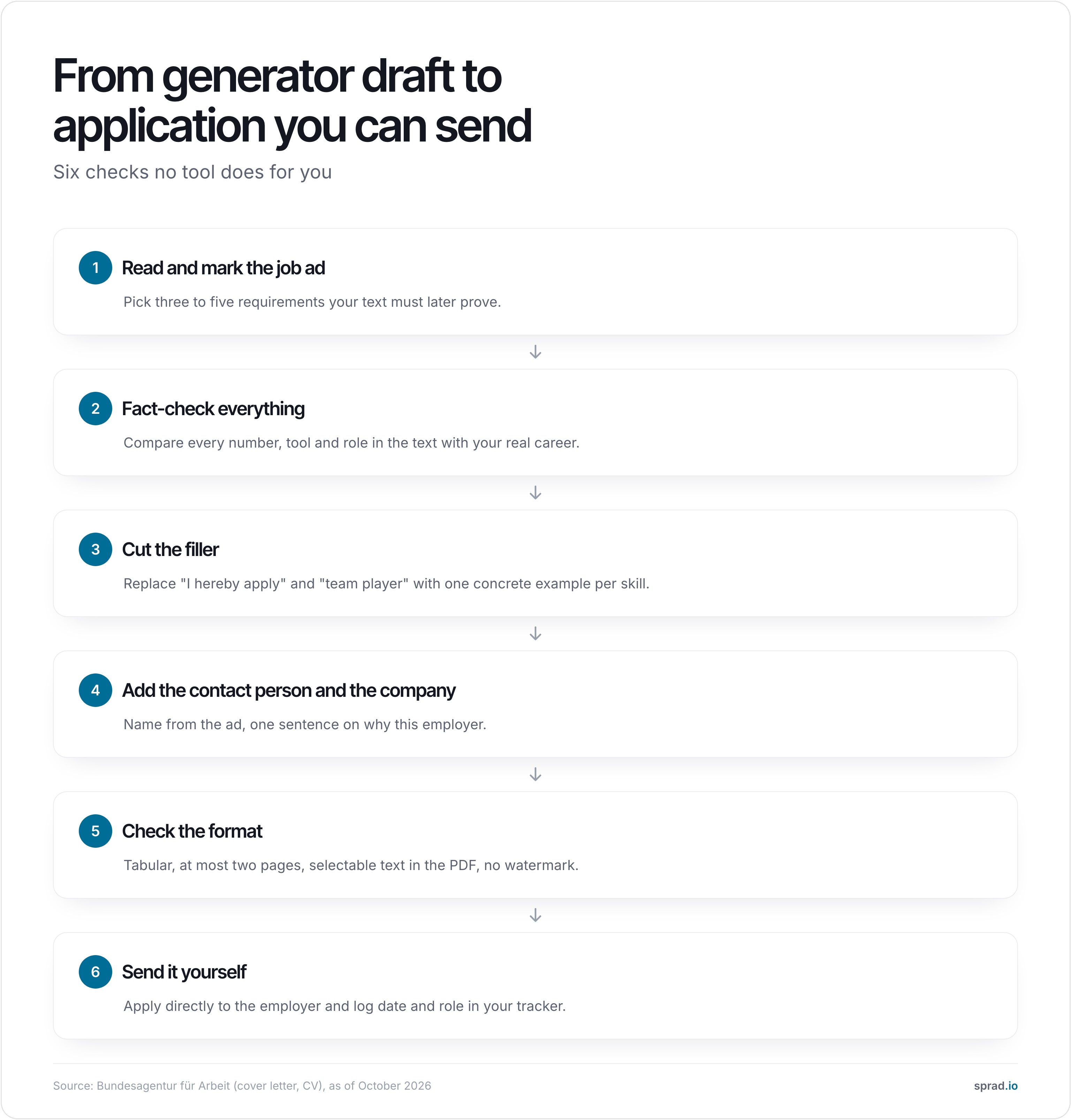
What gives it away in practice, and what to change:
- The opening cliché: "I hereby apply" or "I read your ad with great interest". Replace it with one sentence on why this company.
- Traits without proof: "team player, resilient, committed". Name a project, a number, a result for each trait.
- Invented details: a tool adds a certification you never earned. Check every role against your references. More in 12 AI application mistakes.
- Wrong salutation: if the ad names a person, use the name. A generic greeting only if nothing else can be found.
- Image-only PDF: if you cannot select text in the PDF, applicant tracking systems read it worse.
- Too long: the cover letter fits one page, the CV at most two.
Is an application generator GDPR-compliant?
That depends on the provider; there is no blanket answer. Application documents contain personal data, so the GDPR applies. Two articles matter for you as a user: Art. 5 requires data minimisation, Art. 17 gives you the right to erasure. In practice:
- Hosting: does the privacy policy say where your data is stored, in the EU or a third country?
- Use: is data sold or used to train AI models? This should be clearly denied.
- Deletion: can you delete account and documents yourself or request deletion? At Kickresume your CV stays stored after cancelling unless you delete it yourself, according to the page.
- Data minimisation: no ID, tax or social-security number, nothing on health or family that adds nothing for the job.
For chatbots such as ChatGPT, the Hamburg data protection commissioner's checklist on LLM chatbots (November 2023) is worth a look. For Atlas Career the provider states: EU hosting, GDPR and EU AI Act in view, your data is not sold, no training of third-party AI models, deletion possible at any time. On the EU AI Act: the strict rules of Regulation (EU) 2024/1689 for AI in recruiting are aimed mainly at employers who assess applicants, not at you as a candidate.
Photo, length, salutation: what applies in DACH, the EU and the US?
A generator does not automatically know which market you apply in. You have to set it or check it yourself.
| Point | Germany, Austria, Switzerland | USA |
|---|---|---|
| Photo | Common, but optional | Usually not common |
| CV | Tabular, up to two pages | Usually one page ("resume") |
| Cover letter | Almost always expected, one page | Cover letter, often shorter and more direct |
| Legal frame | AGG prohibits discrimination by age, gender, origin | EEOC: employers should not ask for a photo |
According to the Bundesagentur the photo is not mandatory. The background is in section 1 of the General Equal Treatment Act (AGG): nobody may be disadvantaged for characteristics a photo reveals. In the US the EEOC states that employers should not ask for a photo. More background: AI for job applications in Europe: DACH vs. the US.
Which application generator fits you?
- You need a cover-letter draft today and want to share no data: a browser generator without an account, with a daily limit.
- You apply to several specific jobs: Atlas Career, because CV and cover letter are created per ad and stay free.
- You want a special layout: a template builder. Check first whether the export carries a watermark.
- You only need the cover letter: notes on form and tone in AI cover letter generators for Europe; for the CV How to tailor your CV with AI.
Frequently asked questions
Is there an application generator that is really free?
Yes. Browser generators such as the Gradually.ai cover-letter generator are free with a daily limit, Atlas Career is free with no limits but needs a free account. At other providers building is often free, while the watermark-free export is Premium.
Can I create my application with AI?
Yes, as long as the AI only words what you really did and you check every statement. Never send an AI draft unread.
Do I need an account?
Not always. Quick generators work without one. If you want to save versions and tailor per job, you need an account; at Atlas Career it is free.
Does Atlas apply for me automatically?
No. Atlas sends nothing. You review the CV and cover letter, download them and apply directly to the employer.
How many applications can I manage per week?
By the calculation above, about ten in five hours at roughly 30 minutes each. Fewer, better-fitting applications are the better choice.
Should my application include a photo?
In DACH it is common but optional; in the US it is usually not common. Decide by the ad.
Can applicant tracking systems read a generator CV?
Only with a simple layout: one column, normal headings, selectable text in the PDF. Icons and progress bars are riskier.
All information as of 30 October 2026.
Jürgen Ulbrich
Jürgen Ulbrich has more than a decade of experience in developing and leading high-performing teams and companies. As an expert in employee referral programs as well as feedback and performance processes, Jürgen has helped over 100 organizations optimize their talent acquisition and development strategies.