Candidate sourcing is the proactive search for people who could fill a role, usually before they apply. You identify, research and approach candidates yourself (on professional networks, in your own talent pool, through referrals or with AI search tools) instead of waiting for applications. Sourcing ends where the hiring process begins: once someone is interested and qualified, recruiting takes over with interviews, assessment and the offer.
What is candidate sourcing, and how is it different from recruiting?
Sourcing is the first stage of talent acquisition: building a list of suitable, reachable people and starting the conversation. Recruiting is the whole path from the first contact to the signed contract. Sources disagree on where exactly the line runs, so we use a practical rule: sourcing produces conversations, recruiting produces hires. The detailed split of tasks is in our guide to sourcing vs recruiting.
Two neighbouring terms cause most of the confusion:
- Talent sourcing means the same as candidate sourcing. "Talent" is the more common word for senior and hard-to-fill roles and for building pipelines ahead of an opening.
- Active sourcing is one way of doing it: you contact people directly. Candidate sourcing is the umbrella that also includes inbound channels, referrals and your own talent pool (see What is active sourcing?).
Why does it matter? Most good people are not looking. LinkedIn's own research found that about three quarters of fully employed professionals describe themselves as passive candidates, and only 15 % as "super-passive", meaning happy and not open to a conversation (LinkedIn Talent Blog, 2014; the survey is old, so read it as direction, not as today's figure). In Germany the Federal Employment Agency counts 157 occupations with a skills shortage for 2025 (163 a year earlier). For those roles, a job ad alone reaches too few of the right people.
What types of candidate sourcing are there?
Every method falls into one of two groups: you go to the candidate (outbound) or the candidate comes to you (inbound). Good teams use both.
| Type | How it works | Strength | Watch out |
|---|---|---|---|
| Active (outbound) sourcing | You search profiles and write to people directly | Reaches passive candidates; you control volume | Needs a good message and consent-aware handling of personal data |
| Passive (inbound) sourcing | Job ads, career site, employer brand; candidates apply | Low effort per applicant | Reaches only people who are already looking |
| Talent pool (rediscovery) | Past applicants, silver medalists, earlier contacts | Warm, cheap, fast | Needs consent and upkeep; pools decay |
| Referrals | Employees recommend people from their network | High quality and retention | Slow to build; does not scale alone |
| Internal sourcing | Promotions and transfers | Known performance | Opens a gap elsewhere |
| Events and communities | Meetups, university fairs, developer communities | Trust and reputation | Hard to measure |
How does candidate sourcing work, step by step?
The same six steps apply whether you source one engineer or fifty nurses. A longer plan with a template is in our sourcing strategy playbook.
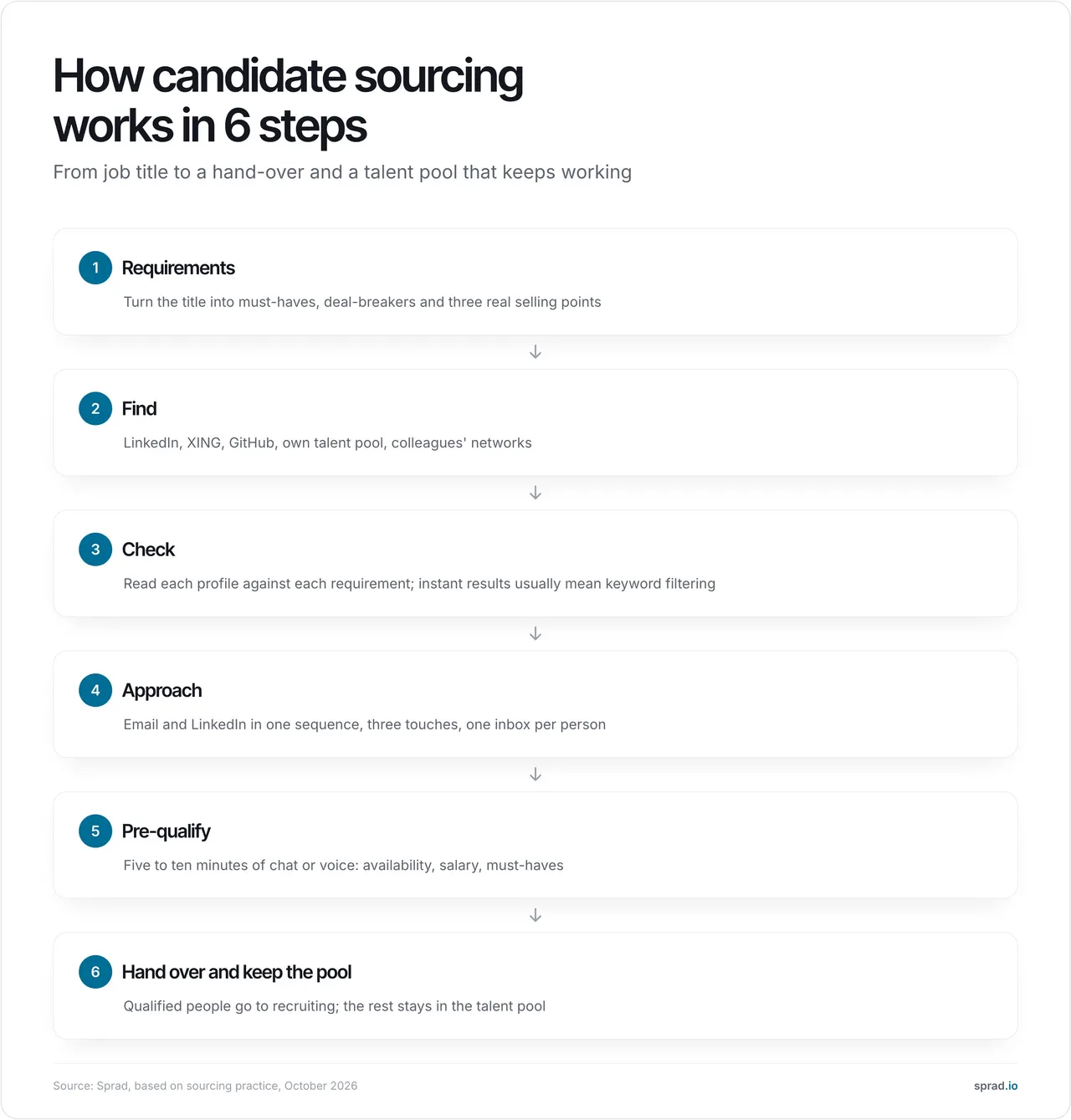
1. Turn the job title into requirements
A title is not a search. Write down three to five must-haves, the deal-breakers and three real selling points of the job. "Senior backend engineer" is a title; "has run a payment service above 1,000 requests per second" is a requirement. In our experience a thin brief is the most common reason for a bad shortlist, long before any tool choice.
2. Find candidates where they actually are
Combine LinkedIn, XING (important in Germany, Austria and Switzerland), GitHub for developers, your own talent pool and the networks of your colleagues. Searching one source at a time costs hours of tab-switching; see multi-source sourcing beyond LinkedIn.
3. Check profiles against the requirements
This is the step that decides quality. Boolean strings work for narrow titles (cheat sheet) but miss people whose profile does not contain your words. A practical test: if results appear instantly, it is almost always a keyword or semantic filter, not a check of each profile. A real check reads each profile against each requirement and takes minutes for a deep search.
4. Approach in a sequence, on two channels
One message rarely gets an answer. A Lever study reported by HR Dive in 2018 found that about half of all responses came after the first contact and nearly all by the third. Plan three touches over about two weeks, combine email and LinkedIn, and keep one inbox per person so nobody is contacted twice by different colleagues.
5. Pre-qualify before a hiring manager sees anyone
A five-to-ten-minute chat or voice screen checks availability, salary range and the one or two must-haves a profile cannot show. It protects the hiring manager's time and gives candidates a quick answer.
6. Hand over and keep the pool alive
Interested and qualified people go to recruiting. Everyone who was good but not right this time stays in the talent pool with a note, ready for the next role. This is where sourcing starts to compound.
A worked example: from 150 profiles to one hire
Assumptions (ours, replace them with your own data): you search for one product designer, check 150 profiles, 60 % of them match the requirements and are reachable, 20 % of the contacted people reply, 50 % of repliers are interested and pass pre-qualification, and 1 in 3 interviewed candidates gets the offer.
- 150 profiles x 0.6 = 90 people to contact
- 90 x 0.2 = 18 replies
- 18 x 0.5 = 9 qualified interviews
- 9 / 3 = 3 offers, so one role is covered with room to spare
Time and cost. Reading 150 profiles by hand at about three minutes each is roughly 7.5 hours of work. A deep AI search with a budget of 300 credits returns up to 150 qualified profiles and bills 2 credits per profile shown, never more than the budget; at the list price of 0.10 EUR per credit that is at most 30 EUR (prices as of 29 October 2026, see sprad.io/pricing). The reply rate moves the result most: at 10 % you get 9 replies and 4 to 5 interviews, at 30 % 13 to 14. Measure your own after the first 100 messages; published reply benchmarks come mostly from tool vendors and vary widely.
Which tools help with candidate sourcing?
You need three layers: a place to search, a place to reach out and manage (ATS or CRM with sequences) and a talent pool that keeps what you found. Most teams start with LinkedIn Recruiter or XING TalentManager and add an AI sourcing tool; the active sourcing tools comparison ranks them in detail.
| Approach | Strength | Limit |
|---|---|---|
| Sprad Atlas | One search across LinkedIn, XING, GitHub and your own pool; every profile checked against your requirements with a reason per requirement; LinkedIn and email in one inbox per person; voice, chat and agent pre-qualification | Deep search takes a few minutes (quick search about 3 seconds); no AI note-taker or placement reporting yet; customer CRM for agencies is in beta |
| LinkedIn Recruiter | Largest professional network, native InMail | Keyword search, one network, high seat price |
| XING TalentManager | Strong in the German-speaking region | Smaller outside DACH, separate licence |
| Boolean and X-ray search | Free, precise for narrow titles | Manual, misses profiles without your keywords |
| Spreadsheet or ATS pool | Cheap, you own the data | Decays without upkeep, no search across sources |
Why Sprad suits this task: Atlas checks each profile instead of filtering by keywords, and it combines LinkedIn and email in one inbox per person, which removes double outreach. In the public PeopleSearchBench (Recruiting, 119 real search tasks), Atlas reaches 73.5 out of 100 in our own re-measurement, converted to the published scale (Lessie 68.2, Juicebox 65.7 as published; see note below). You can start free (100 credits per month); Atlas Base costs 450 EUR per year including 5,000 credits (549 USD), and the flat-rate seat Recruiter Lite costs 79 EUR per month. Prices as of 29 October 2026, net.
Note on the benchmark: PeopleSearchBench (Recruiting), published by Lessie, October 2026. Other systems' scores as published in the benchmark; Atlas measured with the benchmark's open test procedure. Method: sprad.io/sourcing-benchmark.
Which mistakes should I avoid?
- Sourcing without a brief. Searching on a job title produces long lists and short shortlists.
- One channel only. A single network is a single point of failure, and in DACH it leaves XING out.
- One message, no follow-up. Most replies arrive after the second or third contact.
- Double outreach. Two colleagues writing to the same person from different tools damages your employer brand. Keep one inbox and one profile per person.
- Copy-paste messages. Name one concrete reason why this person fits. Generic text is read as spam.
- Letting the pool rot. A pool you never refresh is a list of outdated people. Re-check at least twice a year.
- Counting messages, not outcomes. Track matches per search, reply rate per channel and interviews per hire.
How does AI change candidate sourcing, and what does the law say?
AI changes two things. It replaces keyword matching with a reading of each profile against your requirements, so you also find people with poorly maintained profiles. And it automates the repetitive parts (follow-ups, scheduling, first screening) so people spend their time on conversations. What it does not change: a human decides who is hired.
EU and UK. You process personal data of people who did not contact you. Under the GDPR the usual basis is legitimate interest (Art. 6(1)(f)), which the EDPB Guidelines 1/2024 require you to balance against the person's interests. Art. 14 obliges you to inform them: if you use the data to reach out, at the latest at the first contact, otherwise within a reasonable period and no later than one month. Details for sourcers are in our guide to active sourcing and GDPR. The UK follows the UK GDPR, supervised by the ICO.
EU AI Act. Recruiting AI counts as high-risk (Annex III). The high-risk duties now apply from 2 December 2027 (Digital Omnibus, Regulation (EU) 2026/1744); the ban on certain practices has applied since 2 February 2025. USA. There is no federal GDPR equivalent, but New York City requires a bias audit and notice for automated employment decision tools (Local Law 144), and state privacy laws such as California's cover applicant data. This is general information, not legal advice.
Is talent sourcing the same as candidate sourcing?
In everyday use, yes: "talent sourcing", "candidate sourcing" and "sourcing in hiring" all describe the proactive search for suitable people before they apply. The difference is mostly one of emphasis. "Talent sourcing" often stresses building a longer-term pool (people you may need next quarter), "candidate sourcing" stresses filling one open role now. Both use the same steps described above, and both end where recruiting begins.
Where do I find candidates?
Start where your target group actually is: professional networks such as LinkedIn and XING, your own talent pool of earlier applicants and silver medalists, employee referrals, and for technical roles GitHub or specialist communities. One source rarely shows the whole market, which is why recruiters search several in parallel; see Multi-source sourcing beyond LinkedIn. Sprad combines these sources in one requirement search through active sourcing, with your own pool in the Talent Network.
FAQ
What does "what is candidate sourcing" mean in practice?
It means you find and approach suitable people yourself instead of waiting for applications. In practice that is a repeatable routine: requirements, search across sources, profile check, outreach in a sequence, short pre-qualification, hand-over.
How do I do candidate sourcing step by step?
Turn the job into requirements, search several sources, check every profile against the requirements, contact in three touches on email and LinkedIn, pre-qualify briefly, then hand over and keep the rest in your pool. The six steps above show each one.
Which tools or templates help?
A search tool (LinkedIn Recruiter, XING TalentManager or an AI sourcing tool), an ATS or CRM with sequences, and a talent pool. Boolean strings and a simple tracking sheet are enough to start; the tools comparison helps you choose.
Which mistakes should I avoid?
Searching without requirements, using one channel, sending one message, contacting people twice and letting the pool decay. The list above has the fix for each.
How does AI change it?
It checks every profile instead of matching keywords and automates follow-ups and first screening. Decisions stay with people, and the EU AI Act treats recruiting AI as high-risk from 2 December 2027.
What is the difference between sourcing and recruiting?
Sourcing finds and engages potential candidates; recruiting evaluates and hires them. Sourcing is the early stage of the recruiting process.
Is candidate sourcing the same as headhunting?
Headhunting is sourcing done as a paid service, often for senior roles. The methods overlap; candidate sourcing is also done in-house by TA teams for every level.
How many candidates do I need to contact per hire?
It depends on your reply and qualification rates. With the assumptions in our example (20 % reply rate, 50 % interested), about 90 contacts yield around three offers. Measure your own numbers.
Jürgen Ulbrich
Jürgen Ulbrich has more than a decade of experience in developing and leading high-performing teams and companies. As an expert in employee referral programs as well as feedback and performance processes, Jürgen has helped over 100 organizations optimize their talent acquisition and development strategies.