Talent intelligence is the systematic use of data about talent, your own and the labour market's, to make hiring and workforce decisions: where to hire, what to pay, which skills are scarce, how fast a role will fill and whom to approach. There is no single agreed definition; some vendors use the term only for AI software, but the broad meaning is data and analysis informing talent decisions. Synonyms you will meet are labour market intelligence, workforce intelligence and talent analytics.
What data does talent intelligence use?
The value comes from combining internal facts with external signals. Neither alone answers the question "can we hire this role, here, at this price, by this date?"
| Source | Examples | What it tells you | Watch out for |
|---|---|---|---|
| Internal | ATS history, time to fill, offer acceptance, source of hire, attrition, skills of current staff | How you actually hire and where you lose people | Employee data: GDPR and works council (§ 87 BetrVG) |
| External: people | Public professional profiles, skills, career paths | How many people with a skill exist and where | Profiles are personal data; accuracy and freshness vary |
| External: employers | Job postings, hiring volume of competitors, company growth | Who competes with you for the same people | Postings overstate real demand when roles are open for months |
| External: market | Salary ranges, official shortage statistics, regional labour data | What the role costs and how scarce it is | Official data lags by months |
What is the difference between talent intelligence and talent mapping?
Talent intelligence is the broader discipline; talent mapping is one deliverable inside it. Intelligence answers market questions in general ("is this role getting scarcer?"); a map lists the named people for one profile. People analytics is the internal-only part: analysis of your own employees' data.
| Term | Scope | Typical question |
|---|---|---|
| Talent intelligence | Internal and external data | Where is it worth hiring this role, and at what price? |
| Talent mapping | One role family, named people | Whom exactly do we approach first? |
| People analytics | Internal employee data only | Why do people leave after two years? |
| Labour market data | Official statistics | How many vacancies and job seekers exist in this occupation? |
Which questions does talent intelligence answer?
- Location: in which city is the supply of a profile largest relative to competing demand?
- Price: what do comparable employers pay, and are we inside the range?
- Skills: which adjacent skills let us retrain instead of buy?
- Competition: who is hiring the same profile, and how many roles do they have open?
- Timing: how long will this role realistically take to fill?
Worked example: where to open three engineering roles
The figures are invented for illustration. The method is what matters: compare supply with competing demand.
| City | Matching profiles (assumed) | Open competing postings (assumed) | Profiles per posting |
|---|---|---|---|
| A | 480 | 40 | 12.0 |
| B | 150 | 30 | 5.0 |
| C | 260 | 20 | 13.0 |
City B has 5 profiles per competing posting against 12 and 13 elsewhere, so it is about 2.4 times tighter than A (12.0 divided by 5.0). If the same hire needs 4 interviews, you would need to approach roughly 2.4 times as many people in B, or accept a longer search. A sensible decision: open the roles in A or C and use remote for the rest. The calculation takes an afternoon and prevents a lease, not a vacancy, from being the expensive mistake.
What does the law say?
| Rule | Relevance |
|---|---|
| GDPR Art. 6(1)(f), Art. 14 | Profiles of named people need a legal basis, usually legitimate interest, and an information notice within one month |
| GDPR Art. 22 | No decision with legal or similarly significant effect based solely on automated processing, such as an automatic rejection by a score |
| § 87(1) No. 6 BetrVG | Systems suited to monitor employee behaviour or performance need works council agreement; relevant for internal data |
| EU AI Act | AI used in recruiting is high-risk (Annex III); the obligations apply from 2 December 2027 under Regulation (EU) 2026/1744 (as of November 2026) |
The practical rule: use intelligence to inform people, not to reject them. Scores that rank market segments are low risk; scores that decide about an individual need human review.
Which tools exist, and what does Sprad do?
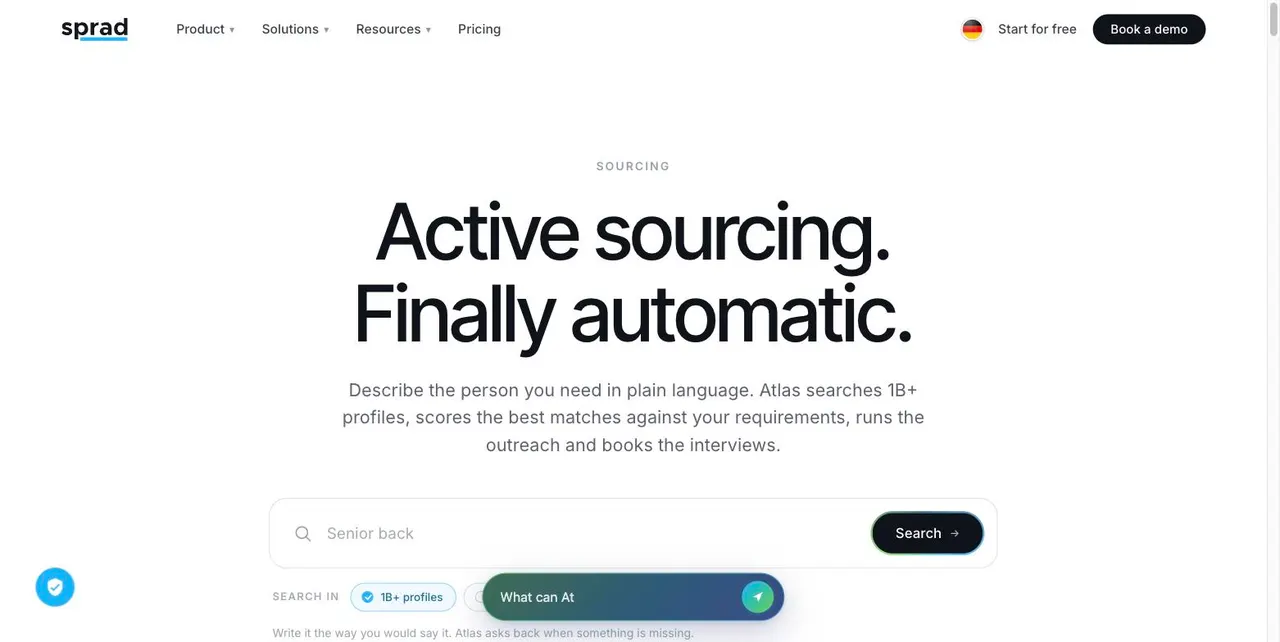
Talent intelligence platforms combine profile data, job postings and salary data in dashboards; our comparison of talent intelligence platforms lists eight with price, data and outreach. Sprad is not a market analytics suite: it answers the supply question for one concrete role by searching public profiles and your own network by requirement, then contacts the matches from one mailbox. Start with the Active Sourcing search to see how many suitable people exist; a free account has 100 credits per month. For market-wide dashboards across all roles, a dedicated platform fits better. Sprad is itself a vendor, so judge it against your questions.
FAQ
What is talent intelligence in simple terms?
Using facts about the labour market and your own hiring to decide where, whom and at what price to hire, instead of guessing.
Is talent intelligence the same as talent analytics?
Mostly. Talent analytics often means analysing your internal data; talent intelligence adds external market data.
Do small companies need talent intelligence?
Not as a platform. A few hours of research per scarce role, using public statistics and a requirement search, delivers most of the value.
Is talent intelligence GDPR compliant?
It can be, when personal data has a legal basis, people are informed and no decision about a person is made by automation alone.
How is it different from a talent pool?
A talent pool lists people you know. Talent intelligence tells you about the market around them, including people you do not know yet.
Jürgen Ulbrich
Jürgen Ulbrich has more than a decade of experience in developing and leading high-performing teams and companies. As an expert in employee referral programs as well as feedback and performance processes, Jürgen has helped over 100 organizations optimize their talent acquisition and development strategies.