If you are not getting interviews, the cause is almost always one of four things: your application is not seen, it is screened out for a fit reason, the role was never really open, or you are being ignored after contact. Cold applications convert at only about 3 % to an interview in large employer datasets, so silence is the norm, not a verdict on you. The fix is to find where your funnel breaks and change that one thing, not to send more of the same.
What "not getting interviews" means in practice
A job search is a funnel with five exits: (1) the application never arrives or is never opened, (2) a recruiter reads it for seconds and sees no match, (3) the role is paused, filled internally or was never real, (4) you get a screening call but no second round, (5) you interview and then hear nothing. "Why am I not getting interviews" is about exits 1 to 3. "Why do I get ghosted" is mostly exit 5. The advice differs, so first count your own numbers: how many applications, how many replies of any kind, how many calls.
The numbers: why silence is normal
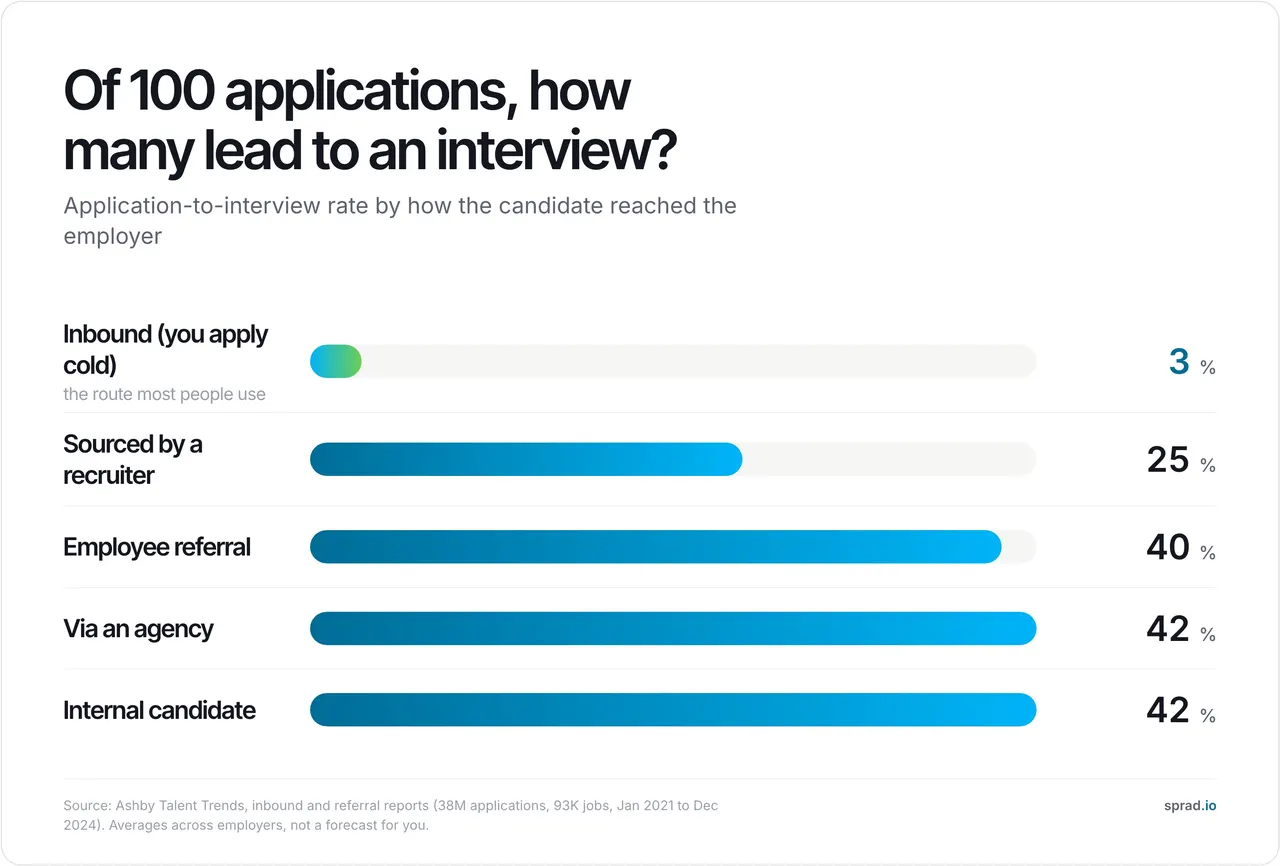
Employers use several routes to fill a job, and they convert very differently. In an analysis of 38 million applications across 93,000 jobs (January 2021 to December 2024), Ashby, a recruiting software vendor, found that inbound applicants (people who apply cold) got an interview in 3 % of cases, sourced candidates in 25 %, referrals in 40 %, and agency and internal candidates in 42 % each. Only 1 % of applications came from referrals. The chart shows the gap.
The volume side keeps getting worse. LinkedIn reports 11,000 members applying for jobs every minute (LinkedIn data, 2025). In Greenhouse's 2024 survey of 2,500 workers in the US, UK and Germany, 38 % said they mass-apply, and Greenhouse's own platform data showed recruiter workload up 26 % in one quarter. The same survey estimates that 18 to 22 % of jobs posted in a quarter were "ghost jobs" (platform data, not survey data), which would explain some silence that has nothing to do with you. Older data points the same way: a Lever study of more than 4 million candidates (2015 to 2016) found about 1 in 100 candidates is hired, and 1 in 152 of those who applied through a careers page or posting (SHRM, 2016).
Why you are not getting interviews: symptom, cause, fix
Use this table as a diagnosis. Find your symptom in the left column.
| Symptom | Likely cause | What to change |
|---|---|---|
| No reply at all, from many different employers | CV does not show the match in the first 10 lines; job titles do not mirror the posting | Rewrite the top third of the CV per role: title, 3 matching results with numbers, tools named in the posting |
| Instant rejection within hours | Knockout question (work authorisation, location, licence, language level, salary range) | Check the eligibility questions; apply only where you clear them honestly |
| Replies only from roles far below or above you | Level mismatch: years of experience, scope or title do not fit | Aim at roles where you meet about 70 to 80 % of the requirements |
| Nothing from roles posted weeks ago | Old or ghost posting, role filled, applications pile up | Prefer postings under 7 days old, apply on the employer's own site, find a person to message |
| Many applications, zero calls | Volume without fit: the cold rate is about 3 % | Cut to 10 to 20 per week, add a referral or recruiter message to each |
| Calls but no second round | Interview problem, not a CV problem | Practise out loud with your own stories (see our AI mock interview guide) |
| Good interviews, then silence | Process delay or a second-choice position | One follow-up after 5 to 7 working days, then keep applying |
Step by step: a 7-day fix
- Day 1, count. List the last 30 applications: date, role, route (cold, referral, recruiter), result. This shows whether your problem is volume, fit or the later stages.
- Day 2, test the "seen" step. Export the CV as a PDF, copy all text into a plain-text editor and read it. If names, dates or job titles are scrambled, remove columns, tables and text boxes. In our seven years of building recruiting software we have rarely seen a system auto-reject a CV for design alone; what recruiters do use are knockout questions and a quick manual scan, so the first screen of your CV matters more than layout tricks.
- Day 3, rebuild the top third. For each target role: the title the posting uses, a 3-line summary, and three bullet results with a number (for example "cut onboarding time from 6 to 4 weeks"). Keep every claim true; recruiters check.
- Day 4, change the route. For your best 10 roles find one person (hiring manager, team member, recruiter) on a professional network and send two sentences: why you fit, one result. In the Ashby data this moves you from the 3 % route toward the 25 to 40 % routes. It is the biggest lever on this list.
- Day 5 to 6, apply to those 10, each with a tailored CV and, if the posting asks for it or the role is senior, a short cover letter.
- Day 7, review. Update the sheet. Judge only after 3 to 4 weeks: employers answer slowly, and a few weeks of silence is normal.
A worked example (an illustration, not a forecast)
Assume you send 40 cold applications at 25 minutes each: 17 hours of work. At the 3 % average from the Ashby data, you expect about 1.2 interviews. Now send 12 applications at 45 minutes each (9 hours), where 6 come with a direct message to a person and are treated like sourced or referred candidates at 25 %, and 6 stay cold at 3 %: 6 × 0.25 + 6 × 0.03 gives roughly 1.7 interviews for about half the time. The rates are averages across employers and the mix is our assumption, but the direction is robust: fewer, better-routed applications beat volume.
Ghosted after applying or after an interview
Ghosting is common. Greenhouse's 2024 survey found that 61 % of job seekers had been ghosted after a job interview, up 9 points since April 2024, and 66 % of historically underrepresented seekers against 59 % of white candidates. That is a process failure on the employer side, not proof of a weak interview. What works:
- After an application: wait 7 to 10 working days, then send one short message to the recruiter or hiring manager with the job title and a one-line reason you fit. Do not follow up more than twice.
- After an interview: thank-you note within 24 hours; ask for the timeline at the end of the interview; follow up once after 5 to 7 working days.
- Treat silence after two follow-ups as a no and move your energy to the next application.
Which tools and templates help
| Need | Option | Free? | Watch out for |
|---|---|---|---|
| Find roles that fit | Atlas Career | Free, no limit | You apply yourself; no auto-apply |
| Rewrite the CV per role | A general chatbot (ChatGPT, Gemini, Claude) with the posting pasted in | Free tiers with limits | It may invent facts; check every line |
| Check the parse | Plain-text copy test (Day 2) | Free | Takes 5 minutes, skip nothing |
| Track applications | A spreadsheet with date, route, status | Free | Only useful if you update it weekly |
| Practise the next stage | AI voice mock interview plus one human round | Mostly free | Do not use live answer copilots in the real interview |
Mistakes to avoid
- Sending the same CV to every posting. A generic CV matches no posting well.
- Mass-applying with AI tools. Bulk submissions are what recruiters sort first; our guide on 12 AI application mistakes shows how this backfires.
- Applying to every old posting. A 6-week-old ad may be dead.
- Hiding gaps or inflating titles. Background checks find both.
- Ignoring eligibility questions. A wrong "no" ends the application at once.
- Judging after one week. Silence of 2 to 4 weeks is normal.
- Never changing anything. If 20 targeted applications give nothing, change the CV, the route or the target role, not just the volume.
How AI changes this: for you and for employers
AI lets everyone produce a polished application in a minute, so polish no longer stands out and employers get more of them. Sprad has built recruiting software for seven years, including AI screening and voice interviews for employers, and the pattern we see is that recruiters respond by looking for specific evidence: concrete results, named tools, a clear match to the posting. Generic AI text loses against a short, true, tailored CV.
Know your rights too. In the EU, Article 22 GDPR limits decisions based solely on automated processing that significantly affect you, and you can ask what data an employer holds. The EU AI Act treats recruiting AI as high-risk; the obligations for those systems apply from 2 December 2027 after the Digital Omnibus amendment (Regulation (EU) 2026/1744). In the US, federal law bars discrimination in hiring, and the EEOC lists the prohibited practices. In Germany, Austria and Switzerland, also expect a CV in the local format (reverse-chronological, references and certificates, often a photo in Germany); in the US a one-page CV without photo, date of birth or marital status is the norm.
Where Atlas fits
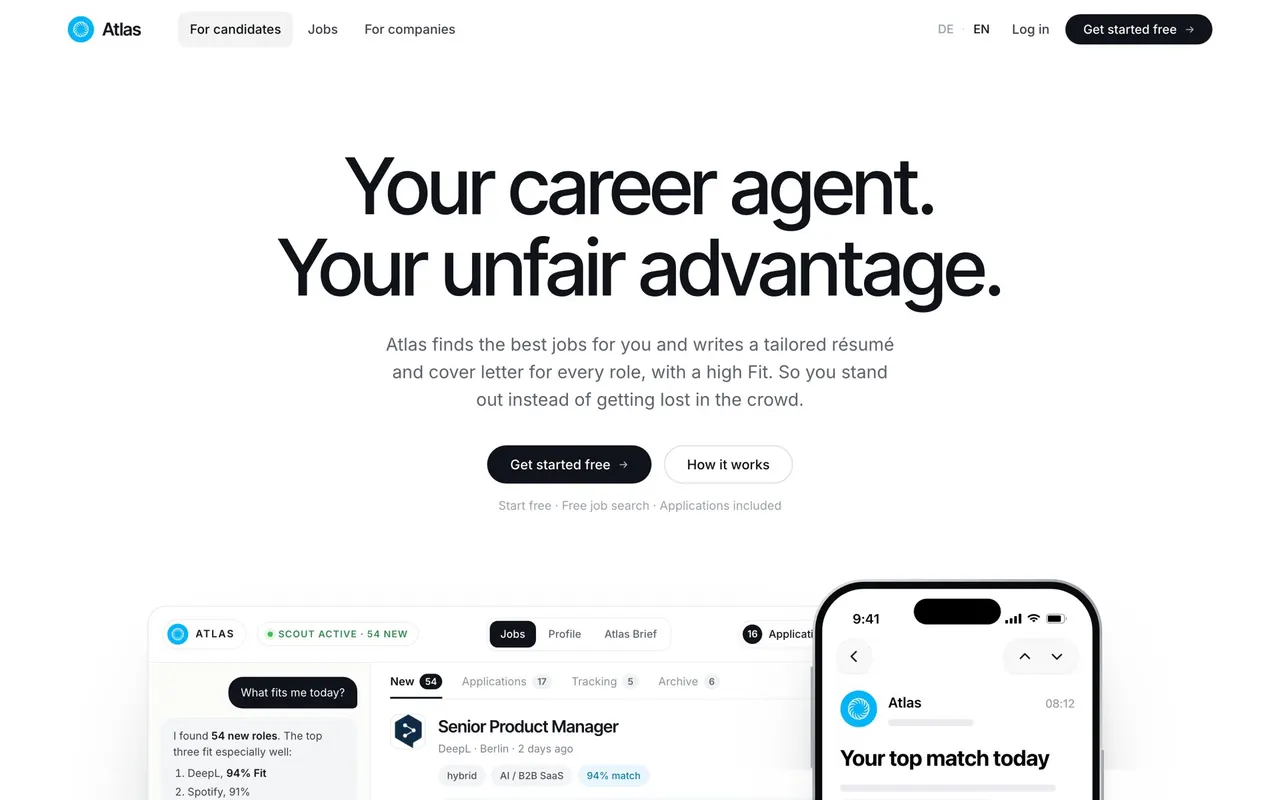
Atlas Career is a free AI career agent. It searches 1.5M+ active jobs straight from employers' career sites (so you see real postings, not stale reposts), gives every role a match score from 0 to 100 with reasons, and writes a tailored CV for each application and a cover letter on request, with no limits. You check everything and apply directly to the employer; Atlas sends nothing for you. That addresses the first two exits in the funnel, fit and the first screen. It does not replace the human step that moves you from the 3 % route to the 25 to 40 % routes: the message to a real person.
Try Atlas, compare tools in our best AI job search tools 2026 and read what an AI career agent is.
FAQ
Why am I not getting interviews even though I am qualified?
Qualified is not the same as visible. Most cold applications convert at about 3 %, so a strong CV still needs the right route (a referral or a direct message) and a top third that mirrors the posting.
How many applications does it take to get an interview?
On the Ashby average of 3 % cold, about 33 applications per interview; with a direct message to a person the rate is far higher. Treat this as an average, not a promise.
Why am I not getting callbacks after an application?
Typical causes are a CV that does not show the match, failed eligibility questions, an old or ghost posting and sheer volume. Use the symptom table above.
Is it normal to be ghosted after applying?
Yes. In Greenhouse's 2024 survey 61 % had been ghosted after an interview. After applications, silence is more common still. Follow up once or twice, then move on.
Does an applicant tracking system reject my CV automatically?
Rarely for formatting. Knockout questions (location, authorisation, licences) do filter people out, and recruiters sort large piles quickly. Test your CV with the plain-text copy test and answer eligibility questions honestly.
Why am I not getting job offers after interviews?
Second-choice status, weak evidence in the stories or no clear next step. Ask for the timeline, practise your stories and follow up once.
Can AI help me get more interviews?
Yes, if it tailors each CV truthfully to the posting and helps you pick roles you really fit. Not if it mass-submits generic applications.
Sources and dates: studies and regulations linked above; Ashby Talent Trends (referral and inbound reports) and the Greenhouse 2024 State of Job Hunting report cited by name, retrieved October 2026. Averages vary by employer, country and role.
Jürgen Ulbrich
Jürgen Ulbrich has more than a decade of experience in developing and leading high-performing teams and companies. As an expert in employee referral programs as well as feedback and performance processes, Jürgen has helped over 100 organizations optimize their talent acquisition and development strategies.