XING or LinkedIn for recruiting? For most DACH teams the answer is both, with a clear split of jobs. LinkedIn has the larger reach (about 28 million members in the DACH region against 22.5 million on XING) and is stronger for international and technical profiles; XING stays relevant for regional specialists and managers in mid-sized companies. Both licences together cost about €17,800 a year for three recruiters. Sprad searches LinkedIn, XING, GitHub and your own talent pool in one search, with Recruiter Lite from €79 per seat and month.
XING vs LinkedIn for recruiting: the table
The table puts both networks and the third option side by side. Details and sources follow below.
| Sprad | XING TalentManager | LinkedIn Recruiter | |
|---|---|---|---|
| Where it searches | LinkedIn, XING, GitHub, your own pool, employee networks; over 1 billion profiles worldwide | XING, 22.5M members in DACH (LHH, 2025) | LinkedIn, 28M members in DACH (LHH, 2025) |
| How it searches | Requirements in plain language, every profile checked individually, reasoning per requirement | Filters, Boolean search, recommendations | Filters, Boolean search, AI helpers depending on tier |
| Outreach | LinkedIn (request, message, InMail) and email, automated with follow-ups, one inbox | XING inbox; Core 200 messages to non-contacts a month | InMail with an allowance per seat, LinkedIn messages |
| Price per seat and month | free start; Lite €79; Atlas Recruiter €299; flexible credits | Core from €366; Pro from €474 (OMR, 02/2026) | Lite about $140; larger tier on request |
| Your own pool | Talent network stays free to use after cancellation | Access ends with the licence | Project history stays tied to the seat |
| Strength | both networks and more in one search, one record per talent | regional specialists and managers, mid-market | international and technical profiles |
| Limits | no AI note-taker, no placement reporting, no SMS; deep search takes a few minutes | XING only, capped message volume | LinkedIn only, price of the larger tier unclear |
Reach: who has the candidates?
According to an LHH analysis of 29 August 2025, LinkedIn has about 28 million members in the DACH region and XING about 22.5 million. For regular users, a Statista survey cited there puts LinkedIn at 12% and XING at 5%. Members are not active users, and dates and sources differ between publications, so treat these as orders of magnitude.
More important than membership is whether your target group is willing to move. In a Forsa survey commissioned by XING (January 2025), more than a third of employees in Germany said they were open to a job change. You only reach them if you search where they are. That, not the total number of profiles, is the real lever behind the platform choice.
Which audience sits where?
LHH assigns XING to regional searches for specialists and managers in Germany, Austria and Switzerland and to mid-sized companies, and LinkedIn to international profiles and global executives. Practice agrees: the more regional and German-speaking the role (mechanical engineering, trades, healthcare, mid-market), the more XING pays off. The more English-speaking and technical the role (software, data, product), the more LinkedIn or GitHub. LHH also notes that XING is losing ground with younger audiences.
Our rule of thumb from seven years of recruiting software: look at your last five hires and note which channel each came through. If three or more came via XING, the XING licence is not a luxury. If none did, you probably pay for a licence you do not need.
Cost: a worked example for three recruiters
Assumption: a team of three recruiters, list prices net, billed annually. XING Core costs 3 × €366 × 12 = €13,176 a year, Pro 3 × €474 × 12 = €17,064. LinkedIn Recruiter Lite is about $140 per seat and month according to industry articles (roughly €129), so 3 × €129 × 12 ≈ €4,637; LinkedIn does not publish the larger tier, estimates sit around €835 a month, or roughly €30,000 for three seats. Covering both networks with Lite plus Core costs about €17,813.
Sprad Recruiter Lite costs 3 × €79 × 12 = €2,844. Add a credit pack for contact data and deep searches: 1,000 credits cost €95 a month, or €1,140 a year. Together that is €3,984, about 78% less than Lite plus Core. Atlas Recruiter (€299 per seat) costs €10,764 for three seats, about 40% less. The 30 to 80% saving against separate LinkedIn and XING licences comes from these two tiers.
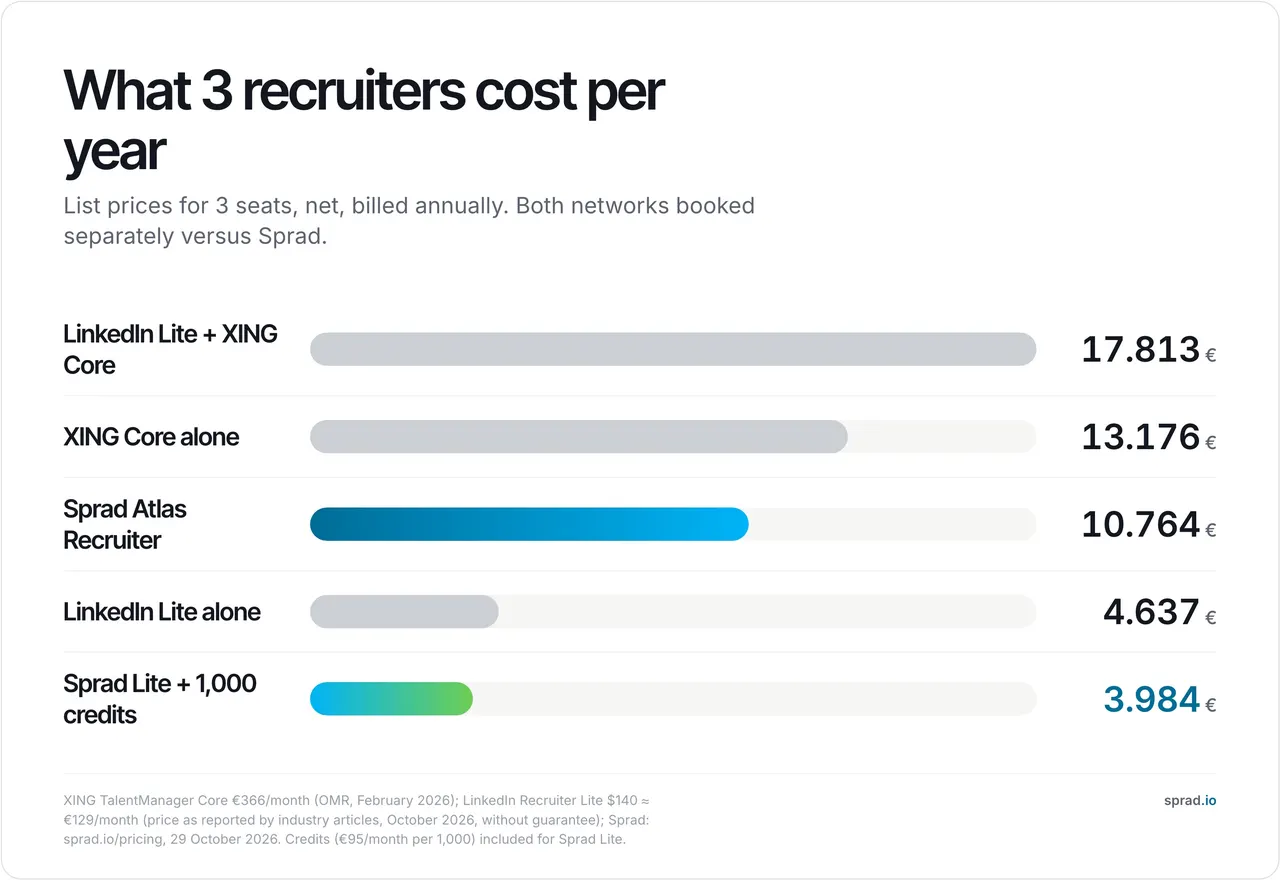
Two honest caveats: Lite, Core and Atlas Recruiter are not the same scope (Lite includes 500 profiles and 50 pool searches a month, Core a XING inbox with messages). And the XING and LinkedIn prices come from third-party sources, so ask for term and discount before buying. More on XING tiers: XING TalentManager pricing.
Outreach: inbox, InMail and typical mistakes
On XING you write in the XING inbox. Core allows 200 messages to non-contacts a month, Pro adds campaigns to several candidates. On LinkedIn, outreach runs through connection requests, messages and InMail; the InMail allowance depends on the seat. Industry guides recommend short German-language XING messages of about 100 to 150 words with a concrete reference to the profile.
The most common mistake in team sourcing is double outreach: one colleague writes on XING, another on LinkedIn, both to the same person, because the history sits in two inboxes. Sprad merges LinkedIn and email in one inbox and warns when someone has already been contacted, even for another role. Outreach runs automated including follow-ups, with AI templates you train and a pitch format for the benefits of the role. In our experience the combination of email and LinkedIn brings the highest reply rates. To be fair: Sprad does not send messages into the XING inbox, and LinkedIn's own allowances still apply.
Search quality and data sources
Both tools work with filters and Boolean search. They find what is written in the profile and miss people whose profile is thin. Rule of thumb: if results appear instantly, it is almost always a (semantic) keyword search. Atlas, Sprad's sourcing product, checks every profile individually against your requirements, with reasoning per requirement. Quick Search shows first results in about 3 seconds; the deep search takes a few minutes because far more AI runs per profile.
In the open PeopleSearchBench (Recruiting, 119 real search tasks) Atlas reaches 73.5 out of 100 in our own re-measurement, converted to the published scale (Lessie 68.2, Juicebox 65.7 as published); it returns 14.2 of 15 matching profiles on average in that re-measurement.1 LinkedIn Recruiter and XING TalentManager were not part of that benchmark, so we make no direct comparison. Test it yourself: one hard-to-fill role, the top 15 results per tool, count the hits.
1 PeopleSearchBench (Recruiting), published by Lessie, October 2026. Other systems' scores as published in the benchmark; Atlas measured with the benchmark's open test procedure. Method and details.
Compliance in the EU: GDPR and the EU AI Act
If you contact candidates who did not apply, you need a legal basis, usually legitimate interest under Art. 6(1)(f) GDPR. Under Art. 14(3) GDPR you inform the person at the latest at first contact and in any case within one month. That applies to XING and LinkedIn alike; the platform does not take the duty off you. An own pool helps because you can document where each person came from. Sprad hosts in the EU. More: Active sourcing and GDPR.
AI systems for candidate selection count as high-risk under Annex III of the AI Act. After the Digital Omnibus, those duties apply from 2 December 2027 (Regulation (EU) 2026/1744, as of October 2026). In practice: AI prepares, people decide.
The third option: Sprad
Sprad has built recruiting software for 7 years, for start-ups up to large corporations and insurers, starting with employee referrals, which means matching profiles to requirements. The sourcing product Atlas offers, compared with separate licences:
- One search across all sources: LinkedIn, XING, GitHub, your talent pool and your colleagues' networks, in one of the largest profile databases (over 1 billion profiles worldwide).
- Requirements instead of keywords: every profile is checked individually, including poorly maintained ones.
- One inbox, one record: LinkedIn and email per talent in one place, with a warning against double outreach.
- Search your own network: upload your LinkedIn network or let employees share theirs.
- Pre-qualification: voice, video, chat and agent interviews in several languages.
- Your data stays yours: the talent network stays free to use after cancellation.
A licence-by-licence view is in LinkedIn Recruiter vs XING TalentManager; alternatives to the XING tool in XING TalentManager alternatives. How to keep old XING contacts: XING contacts as a talent pool. More tools: active sourcing tools compared. Pricing: sprad.io/pricing.
How to decide in four steps
- Draw up a channel balance: through which channel did your last five hires come?
- Match the audience: regional, German-speaking, mid-market points to XING; international and technical to LinkedIn and GitHub.
- Do the maths: seats × monthly price × 12, plus credits. Ask about term and discount.
- Centralise the record: import contacts from your inbox and LinkedIn so nobody is contacted twice. Start Sprad free as a test.
Frequently asked questions
Which is better for recruiting: XING or LinkedIn?
For regional specialists and managers in mid-sized firms XING is often better, for international and technical profiles LinkedIn. Most teams need both networks or a tool that searches both.
How do search quality and data sources differ?
XING and LinkedIn each search only their own network, using filters and Boolean search. Sprad searches LinkedIn, XING, GitHub and your own pool and checks every profile individually against your requirements.
What does each option cost for a team of three recruiters?
XING Core about €13,176 a year, LinkedIn Recruiter Lite about €4,637, both together about €17,813. Sprad Recruiter Lite with a credit pack about €3,984, Atlas Recruiter about €10,764. List prices net, October 2026.
Which option fits EU compliance?
The Art. 14 GDPR duty to inform applies on every channel. Sprad hosts in the EU and documents the origin of people in your own pool; the high-risk duties of the AI Act apply to recruiting AI from 2 December 2027.
How many messages can I send on XING?
The TalentManager Core plan includes 200 messages to non-contacts a month; Pro adds campaigns to several candidates.
Can I use XING and LinkedIn together?
Yes. Many teams keep XING for regional direct messages and use Sprad for search, checking and multi-channel outreach over LinkedIn and email.
What happens to my data after cancellation?
With Sprad the talent network stays free to use and a raw-data export is possible. With the network licences, access ends with the seat.
Jürgen Ulbrich
Jürgen Ulbrich has more than a decade of experience in developing and leading high-performing teams and companies. As an expert in employee referral programs as well as feedback and performance processes, Jürgen has helped over 100 organizations optimize their talent acquisition and development strategies.