Hourly applicants ghost because the process makes them wait, and a person with a phone and three other ads does not. Candidate ghosting means an applicant stops replying, skips the interview or does not show up on day one. You reduce it by answering within minutes, asking only two or three questions in the channel they already use, confirming the details and keeping the contact in your own talent pool.
What ghosting means in hourly hiring
Ghosting is not one event. It happens at four points: the applicant never answers your first message, skips the interview or trial shift, accepts verbally and never signs, or accepts and does not show up on the first day. SHRM notes that ghosting is typically seen in lower-wage, high-volume hourly roles such as retail and hospitality, and that it has spread to tech and health care in recent years.
Employers feel it clearly. In an Indeed survey of more than 4,000 job seekers and about 900 employers, 83 % of employers said candidates had ghosted them, and 65 % had experienced an accepted offer followed by a no-show on day one. The survey dates from 2019, but it is still the most detailed published split, and recent surveys point the same way. Among the 18 % of job seekers who admitted ghosting, 22 % had accepted an offer and not turned up.
Why hourly applicants ghost
The same Indeed survey asked ghosters why. Answers overlapped: more than half decided the job was not right, 40 % received another offer, 26 % were uncomfortable saying so, and 22 % were unhappy with the pay. Among 18 to 34 year olds, 27 % named a slow hiring process.
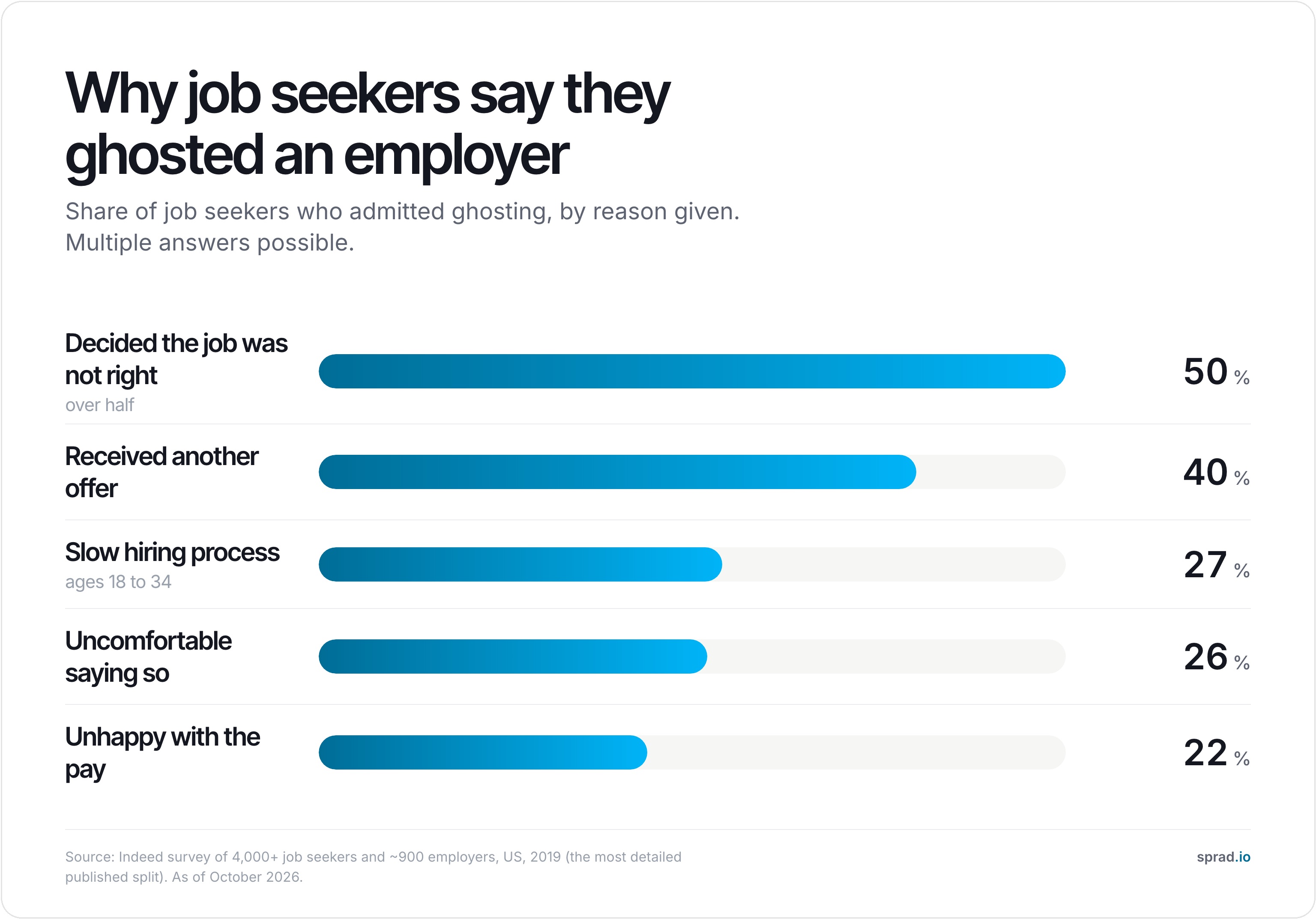
For a shift worker each of these has a practical twist.
- Waiting is expensive. A warehouse picker or care assistant can start somewhere else next week. Every day without an answer is a day another employer can answer first.
- The job turns out different. If the ad does not name the shift, the pay and the place, the applicant finds out later, usually in the interview, and then simply disappears.
- The channel does not fit. A CV upload and an email thread belong to office hiring. Frontline workers apply on the phone between shifts and answer messages, not mail. See our guide to frontline recruiting by phone and WhatsApp, not email.
- Saying no is awkward. Silence is easier than a polite refusal, especially for younger applicants. Make it easy to say no, and you get an answer instead of a ghost.
Where in the funnel it goes wrong: a diagnostic table
Most articles list generic tips. It helps more to match the symptom to the stage where you lose people. Use this table as a quick diagnosis.
| Where applicants vanish | Likely cause | Fix |
|---|---|---|
| After applying, no reply to your first message | Reply came hours or days late, or arrived by email | Confirm within minutes by text or WhatsApp |
| Before the interview or trial shift | Slot offered days away, details unclear, no reminder | Offer a slot within 48 hours, send address and shift, remind the day before |
| After the interview, before the offer | No feedback, another employer was faster | Decide and answer the same day |
| After accepting, before day one | Silence between offer and start, competing offer | Stay in contact: welcome message, first-day details, short reminder |
| Many "applications", few real conversations | Ad or form attracted people who never intended to start | Name pay and shift in the ad, ask two or three must-have questions |
How to stop it: five rules that work for hourly hiring
1. Answer within minutes
Speed is the cheapest lever. An applicant who has just tapped "apply" is at the peak of intent. If your first message arrives the next morning, that intent has gone to the next ad. Automate the first answer if nobody is on shift, but make it a real message with a next step, not a "we received your application".
2. Put pay, shift and place in the ad
Many drop-outs are applicants who learned late what the job really is. In the SHRM piece, an HR consultant stresses showing compensation and benefits early. Frontline workers care about the hourly rate and the schedule first. Put both in the first line of the ad and you lose the people who would have ghosted at the interview anyway, before you spend time on them.
3. Use the channel they already use
Move the conversation to text or WhatsApp and keep it to two or three questions: licence, availability, start date. Use the business channel, get consent and keep the data in your own system rather than in private chats.
4. Make the next step small and fast
A trial shift or a ten minute call within 48 hours beats a three-round process. Limit the stages, say what happens next and when. Candidates who feel like a number leave first.
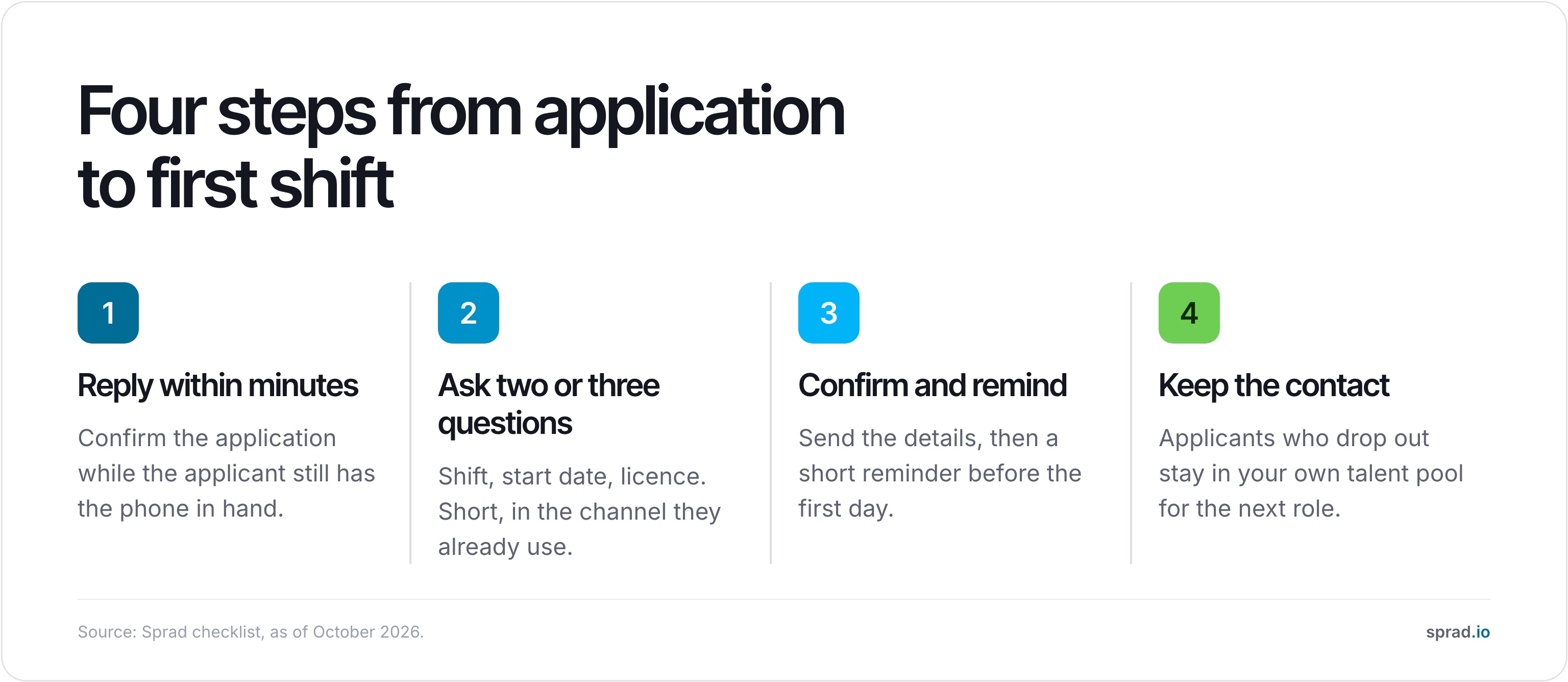
5. Treat the gap between yes and day one as part of hiring
The hardest ghost is the one who said yes. Send a welcome message right after acceptance, share the address, the first shift and who to ask for, and send a short reminder the day before. Keep a short list of the next best applicants ready, so a no-show costs you a phone call and not a restart.
A sample first message you can copy
Role, pay and place here are illustrative; use your real values.
Hi Sam, thanks for applying for the warehouse role in Columbus, $19 an hour, early shift. Two quick questions so we can set up a start: can you work 6 am to 2 pm, and when could you start? A reply here is enough.
It names the role, place, pay and shift, asks two questions and needs one reply. That is the whole point: make answering easier than ignoring.
Ghosting is also a pool problem
Even a perfect process loses some applicants. The question is whether you lose the contact too. If every dropped applicant disappears from your tools, the next opening starts at zero, and you pay again for the same reach. A talent pool turns a ghost into a future candidate: somebody who was unavailable in June may be available in September. This matters most in logistics and other high-volume areas, where roles open again constantly. For the background, see how volume recruiting works in logistics and production.
How Sprad helps against ghosting
Sprad Social Recruiting runs job ads on Instagram and Facebook, where nurses, tradespeople, drivers and other frontline workers spend time every day. An AI talent agent pre-screens every applicant via WhatsApp, phone or web, around the clock, so the first answer does not wait for your next shift. Every applicant lands in your own talent pool, which means the relationship stays with you instead of a platform. Pricing is ad spend plus 10 %, from a €1,000 budget that can be split across roles. Details are on the Social Recruiting page, and your pool lives in Talent Base. Sprad does not guarantee a number of applicants or hires; it removes the waiting that causes much of the ghosting.
FAQ
What is candidate ghosting?
Candidate ghosting means an applicant stops communicating without a word: no reply to messages, a skipped interview or a first-day no-show.
Why do hourly workers ghost more often?
Roles are plentiful, switching is easy and the process often feels slow and impersonal. SHRM describes ghosting as typical in lower-wage, high-volume hourly roles.
How fast should I reply to an applicant?
Within minutes if you can. There is no universal benchmark, but the intent is highest right after the application, and slow hiring is a reason 27 % of 18 to 34 year olds gave in the Indeed survey.
How do I prevent a first-day no-show?
Stay in contact between acceptance and start: a welcome message, clear first-day details, a reminder the day before, and a backup applicant on your list.
Should I ghost candidates back?
No. A short, polite rejection costs seconds and keeps the person in your pool and your reputation intact.
Does pre-screening reduce ghosting?
It removes poor fits early and gets a real answer from the others quickly. It cannot remove ghosting entirely, because people also change their minds.
What does Sprad cost?
Ad spend plus 10 %, from a €1,000 budget, which you can split across several roles. See pricing.
Jürgen Ulbrich
Jürgen Ulbrich has more than a decade of experience in developing and leading high-performing teams and companies. As an expert in employee referral programs as well as feedback and performance processes, Jürgen has helped over 100 organizations optimize their talent acquisition and development strategies.