A career change at 40 works if you plan it instead of jumping: you still have 25+ working years, age discrimination is illegal in the US, the UK and the EU, and the real hurdle is almost always the pay cut at entry, not your birth year. This guide gives you a 12-week plan, a worked example (a €35,000 loss against €9,000, depending on the route), how public funding works in Germany, and where AI genuinely saves you work. All figures are dated; legal and funding status: October 2026.
What does “career change” actually mean?
Three things get mixed up all the time. A job change moves you to a new employer in the same role. An industry change keeps your role in a new environment (sales moving from machinery to software). A career change alters the work itself, and “career switcher” means the same step seen from the new field. Which type you face drives cost and duration: an industry change often needs only a new CV, a true career change usually needs proof for the new type of work as well.
How common is it? The IAB, the research institute of Germany’s Federal Employment Agency, answers in its IAB Forum article “Surprising rise in occupational mobility” (July 2026, in German): in 2013 about 13% of men and 12% of women changed occupation within a year; by 2024 the rate was roughly 16% higher for men and 10% higher for women. One caveat: the IAB counts any change at the three-digit occupational classification, including moves with a new employer. Many of those are steps into an adjacent role, not a radical restart, and for a lot of people the adjacent step is the smarter route (see the worked example).
Is 40 too late to change careers?
No. Do the sums: with a retirement age of 67 in Germany you have 25+ working years ahead, and a 12-month course is a small slice of that. The labour market also helps. In its 2025 skills-shortage analysis (press release of 2 September 2026, in German) the Federal Employment Agency counts 157 occupations with shortages and about 402,000 reported vacancies for skilled staff, specialists and experts, roughly half of them in shortage occupations.
The law is on your side as well. In the US, the Age Discrimination in Employment Act protects people aged 40 or older, so your 40th birthday is literally where the protection starts. In the UK, section 5 of the Equality Act 2010 makes age a protected characteristic, and in Germany section 1 of the General Equal Treatment Act (AGG) names age explicitly. Laws do not remove bias from every hiring process, though. The best answer is a profile that shows experience as an asset (ownership, self-management, client work) and target roles where experience is wanted.
Switching is also normal. According to the US Bureau of Labor Statistics (release of August 2023), Americans born 1957 to 1964 held an average of 12.7 jobs between ages 18 and 56.
The 12-week plan, step by step
The plan assumes four to five hours a week alongside your job. It does not replace advice, but it puts things in the right order, and order is half the result.
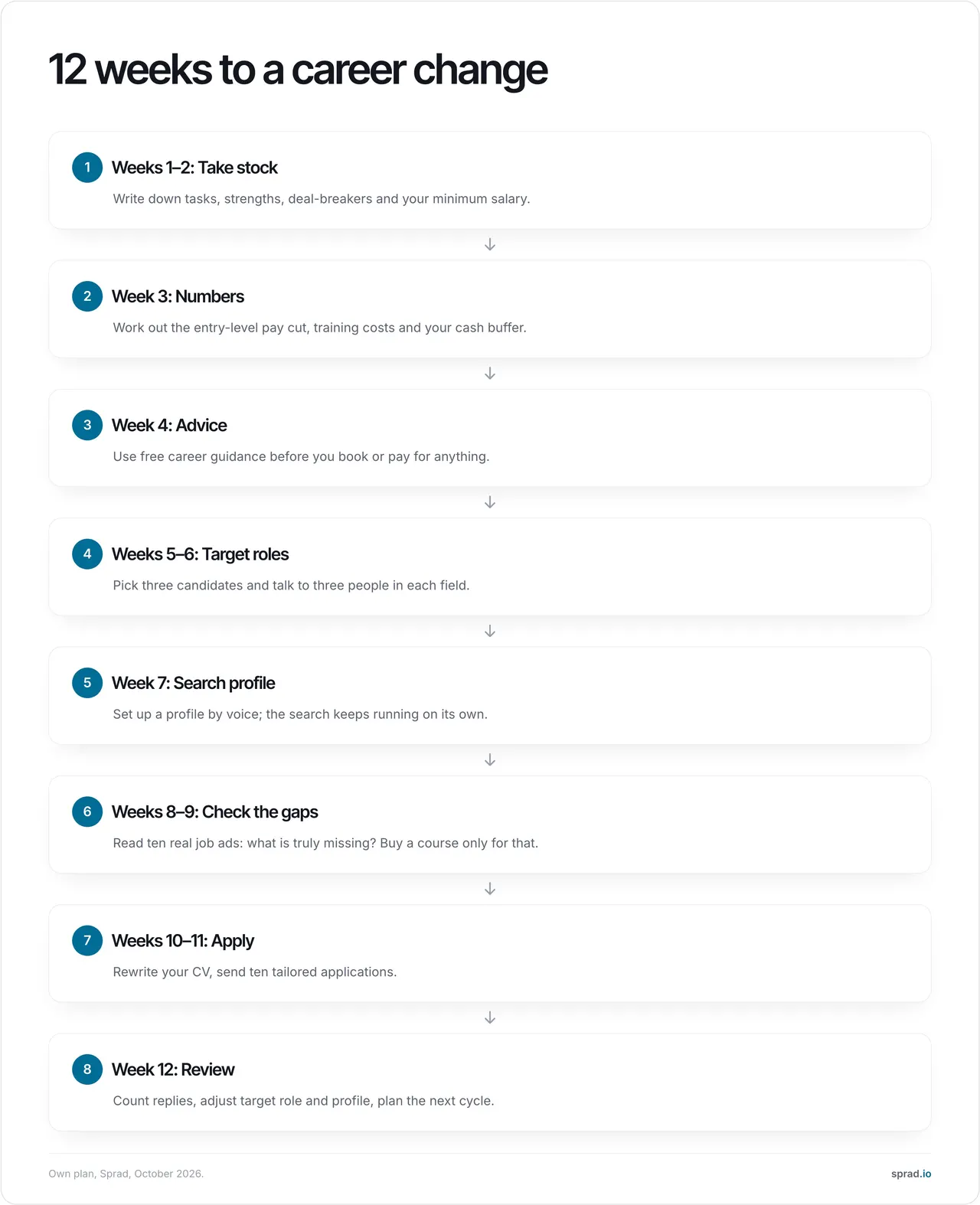
Weeks 1–2: take stock of tasks, not job ideas
Do not write down what you want to become; write down what you do. List your last three roles with five concrete tasks each, one result with a number per role, and the things you no longer want (shift work, travel, people management, quotas). Add your minimum salary. This list feeds everything that follows, including your CV.
Week 3: numbers
Calculate before you daydream. The example below shows how. Also set a cash buffer: how many months can you live on less income?
Week 4: use free career guidance
In Germany the career guidance for working adults run by the Employment Agency is free and voluntary and covers career changes and how to fund training. In the US, state workforce centres and your local community college offer comparable help; in the UK, the National Careers Service does. Book the appointment before you buy a course, because German funding requires advice before the programme starts (see below).
Weeks 5–6: test target roles
Pick three candidates and talk to three people who do each job today. Three questions are enough: What do you do on a bad day? How did you get in? What would you do with my background?
Week 7: set up your search profile
Now job search is worth the time. With Atlas Career you describe role, level, salary expectation, location and deal-breakers in a short voice conversation; after that Atlas keeps searching and emails new matches. It is free and has no usage limits.
Weeks 8–9: check the gaps
Read ten real job ads for your target role and mark every requirement: have it (yes), can prove it (partly), missing (no). Buy a course or certificate only for gaps that show up in at least seven of ten ads. That is our rule of thumb, not a study, and it protects you from training nobody asks for.
Weeks 10–11: apply
Rewrite your CV (see our career change resume guide) and send ten tailored applications, not a hundred generic ones. For the letter, use the cover letter template for career changers.
Week 12: review
Count replies, interviews and the questions that keep coming up. Adjust target role, profile and CV, then start the next cycle. A run of rejections after ten applications is a data point, not a verdict on you.
What does the switch cost? A worked example
This is a worked example with assumptions, not a forecast. Assumptions: your current gross salary is €60,000 and would stay flat without a switch (the baseline). Taxes, social contributions and pension are not included. A course costs €5,000. The figures use euros because the funding rules below are German; swap in your own currency and numbers.
| Route | Starting salary and growth | Loss against today (gross) | Course cost | Total |
|---|---|---|---|---|
| A: Full jump (new role, bottom rung) | €45,000, then +€5,000 a year up to €60,000 | 15,000 + 10,000 + 5,000 = €30,000 | €5,000 | €35,000 |
| B: Bridge (adjacent role, experience counts) | €54,000, then +€3,000 a year up to €60,000 | 6,000 + 3,000 = €9,000 | €5,000 | €14,000 |
| C: Bridge with funding (course funded) | as B | €9,000 | €0 | €9,000 |
The lesson: your age does not drive the maths, the entry-level pay cut does. The more of your experience the new role credits, the smaller it gets. That is why choosing a target role as a bridge (from sales into customer success rather than into programming) and buying the course only after the ad check usually wins. Plug in your own salary, the cut you see in ads and interviews, and the course price.
Funding: the German rules in brief
If you live in Germany, training support is set by statute and depends on your situation. Two routes matter:
- You are employed: section 82 of Book III of the Social Code (SGB III) supports training within an existing employment relationship. Conditions include: the course goes beyond short, job-specific updates, runs for more than 120 hours, the programme and provider are approved, and your vocational qualification is usually at least two years old. Your employer is expected to share the course fees (50% at 50 to under 500 employees, 75% from 500). Below 50 employees no employer share is expected, and for firms under 500 employees it is also waived if you are at least 45 when you start.
- You are unemployed, at risk of unemployment, or have no vocational qualification: section 81 SGB III is the basis. The agency advises you first and certifies the conditions with an education voucher; here too, programme and provider must be approved.
Limits of this summary: the agency decides each case individually. If you want a completely different career while staying with your employer, section 82 often needs that employer on board; settle this in the advice session. The one mistake every adviser knows: booking first, asking later. Funding requires advice before the programme starts. Outside Germany the rules differ; Austria’s AMS and Swiss cantonal career services offer similar guidance.
Which careers fit? Ideas for a switch
Start from your tasks, not from trendy jobs. This table shows typical bridges, meaning ideas to test, not guarantees:
| Your background | Possible adjacent roles | What to add |
|---|---|---|
| Sales, customer service | Customer success, account management, technical sales | Product knowledge of the industry |
| Teacher, trainer | Corporate learning, onboarding, facilitator | Business practice, tools |
| Admin, accounting | Controlling, payroll, process management | System skills (ERP, BI) |
| Skilled trades, engineering | Work planning, field service, technical purchasing | Planning, documentation |
| Nursing, healthcare | Quality management, case management, medical advisory | Proof for the target field |
| Project lead, manager | Operations, product management, consulting | Industry knowledge |
Where Germany’s demand is highest, the agency’s analysis above names healthcare and care professions, construction and trades, cooks, professional drivers and early-years educators, and new this year surveying technology and social work. Chances of an interview are better there, but the job still has to suit you. If you want to search healthcare or trades specifically, Atlas has dedicated industry portals (healthcare, trades, sales, tech), for instance healthcare jobs.
What does AI change about a career change?
AI takes over the legwork, not the decision. Five uses that work in practice:
- Find transferable skills: give a chatbot your task list and ask for equivalents in the target field’s language. Check every line; AI loves to overstate.
- Analyse job ads: have it summarise the recurring requirements across ten ads. That is the basis for the gap check.
- Find and score jobs: a career agent such as Atlas searches over 1.5 million active jobs straight from employers’ career sites, more than 100,000 of them in the German-speaking region, and gives each a match score from 0 to 100 with reasons. Treat the score as a hint, not a verdict on your potential: it measures you against the ad, and as a career changer you will often score lower on hard requirements than your real fit. Read the reasoning, not only the number.
- Tailor CV and cover letter: Atlas writes an adapted CV per job and a cover letter on request, with no invented facts. You review everything and apply directly to the employer; Atlas never sends anything automatically. For the CV structure itself, see the career change resume guide.
- Practise interviews: have it ask the ten toughest questions about your switch and rehearse your two-sentence answer to “Why now?”.
Two safety notes. Do not paste health data or third parties’ personal data into public chat tools, and verify every number a model gives you. On the employer side, companies use AI in screening; the EU lists such systems as high-risk in Annex III of the AI Act. That is an obligation for employers, but also a reason to keep your CV clearly structured and to use the ad’s own terms. For a tool comparison read Best AI job search tools in 2026, and for how a career agent differs from auto-apply bots, What is an AI career agent?
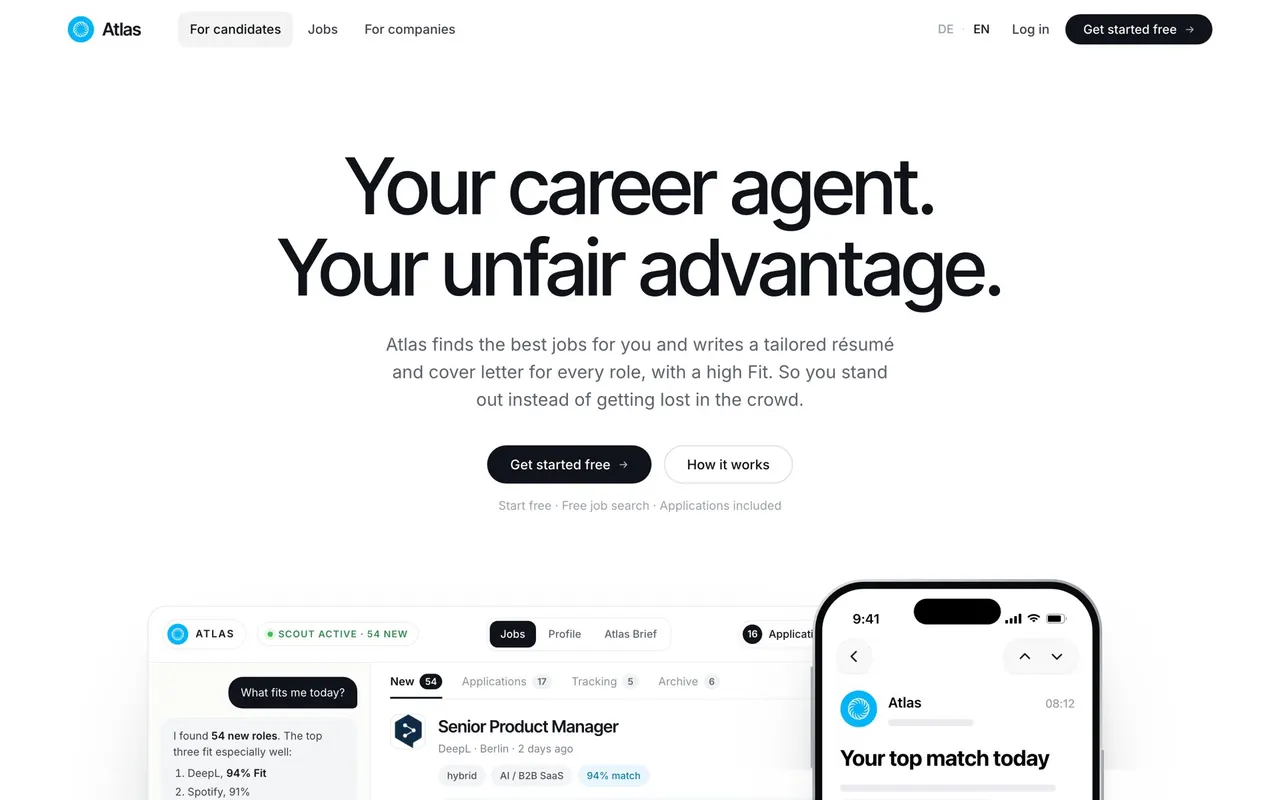
Atlas Career is free with no limits; data is hosted in the EU (GDPR and EU AI Act), never sold or used to train third-party AI models, and you can delete it any time. Limits: Atlas does not replace career guidance or a funding decision, salary figures appear only where the ad states them, and whether a match score fits your switch is your call.
The most common mistakes
After seven years of building recruiting software at Sprad we know how applications are read on the other side. What follows is an experience pattern, not a statistic:
- Titles instead of tasks: “Senior Key Account Manager” means little to a recruiter in the new field. “Managed 40 industrial clients, €6M revenue, negotiated framework contracts” does.
- Course first, market second: paying €5,000 for a certificate before reading ads often means paying to close a gap that is not one.
- Burning every bridge: quitting before the target role is concrete means entering talks under pressure and accepting the first pay cut offered.
- Applying for funding after buying: see above; advice comes first.
- Not explaining the why: two sentences (“After twelve years in sales I noticed I prefer looking after clients after the deal. That is why customer success.”) remove doubt about the switch.
- Mass applications: a hundred generic applications bring fewer interviews than ten tailored ones.
FAQ: career change at 40
How long does a career change take?
Plan six to twelve months from taking stock to a signed contract, longer with a course. That is an experience range, not an official figure. The 12-week plan covers preparation, not the wait for offers. For context, median employee tenure in the US was 4.1 years in January 2026 according to the BLS, so roles change often anyway.
Do I need to retrain?
Not automatically. Many switches run through adjacent roles without a new qualification. Retraining pays off when the target job requires a credential (regulated professions). Career guidance tells you what is funded.
Who pays for the training?
You, your employer or, in Germany, the Employment Agency, depending on your situation; see the funding section. Advice before the start is decisive.
Should I quit first and start over?
Usually it is smarter to clarify the target role and run the search alongside your job. Quitting without a plan can also trigger a waiting period for unemployment benefit in Germany; have the agency check this first.
How do I explain the switch in an interview?
Briefly, positively and with proof: why the old job no longer fits, why the new one does, and one example from your work that shows aptitude.
Which tools help?
Free career guidance, a career agent like Atlas for search and application documents, and a spreadsheet for numbers and call notes. If you first need to find out what suits you, start with the career quiz guide.
Note: this article is general orientation, not legal or financial advice. Funding decisions are made by the Employment Agency case by case. As of October 2026.
Jürgen Ulbrich
Jürgen Ulbrich has more than a decade of experience in developing and leading high-performing teams and companies. As an expert in employee referral programs as well as feedback and performance processes, Jürgen has helped over 100 organizations optimize their talent acquisition and development strategies.