Yes, you can change career into nursing without a nursing background, but the route depends on the country. In Germany you can start as a care assistant straight away (minimum wage 16.52 € per hour since 1 July 2026) and train as a registered nurse in three paid years, which the employment agency can fund. In England, a nursing associate or degree apprenticeship lets you earn while you train. In the US, a second-degree accelerated BSN takes 12 to 18 months if you already hold a bachelor's degree. Below: the routes, the money, what funding exists, and a sample cover letter.
Can I go into nursing without training?
Yes, with one firm limit: without qualifications you work alongside nurses, not as one. In Germany, the Nursing Professions Act reserves the assessment of care needs, planning and steering of the care process and quality assurance for registered professionals (§ 4 PflBG). Everything else, from helping with washing and mobilising to companionship, is done by assistants.
That is a real job market, not a fallback. Germany's Federal Employment Agency counts about 1.8 million nurses and carers in employment in 2025. It also shows where the shortage is not: of roughly 60,000 registered unemployed care workers, most are care assistants (Federal Employment Agency, labour market report on care occupations, 2025). If you want to stay in care and earn well, a professional qualification beats an assistant job alone.
Which routes exist? Germany at a glance
| Route | Duration | Entry requirement | What you can do afterwards |
|---|---|---|---|
| Care assistant, untrained | start immediately, on-the-job induction | no training; employers look for motivation and a clean record | support with basic care and daily life, under supervision |
| Companion role (Betreuungskraft) | short qualification, length varies by employer | interest in time with people, no training | activities, conversation, accompaniment; no hands-on personal care |
| Nursing assistant (Pflegefachassistenz), from 1 Jan 2027 | 18 months full-time, up to 36 part-time | usually a basic school-leaving certificate, or none if the school expects you to succeed | care in the team with more responsibility; all trainees are paid |
| Registered nurse (Pflegefachfrau/-mann) | 3 years full-time, up to 5 part-time | intermediate school certificate, or basic certificate plus a vocational qualification or nursing-assistant training | full professional licence, all care settings, the highest pay |
Until the end of 2026, assistant training is still governed by 27 different state regulations. From 2027, the nationwide nursing assistant training replaces them (German Federal Ministry for Family Affairs, 2025). If you start an assistant course now, ask the school how the transition works.
The registered-nurse route in Germany
Training takes three years full-time and up to five part-time (§ 6 PflBG). You need an intermediate school certificate. With a basic certificate you also need a vocational qualification of at least two years, or at least one year of nursing-assistant training; a further ten years of general schooling also qualifies (§ 11 PflBG). For career changers that is good news: almost any completed apprenticeship, in any field, satisfies the requirement.
What does it pay? A worked example
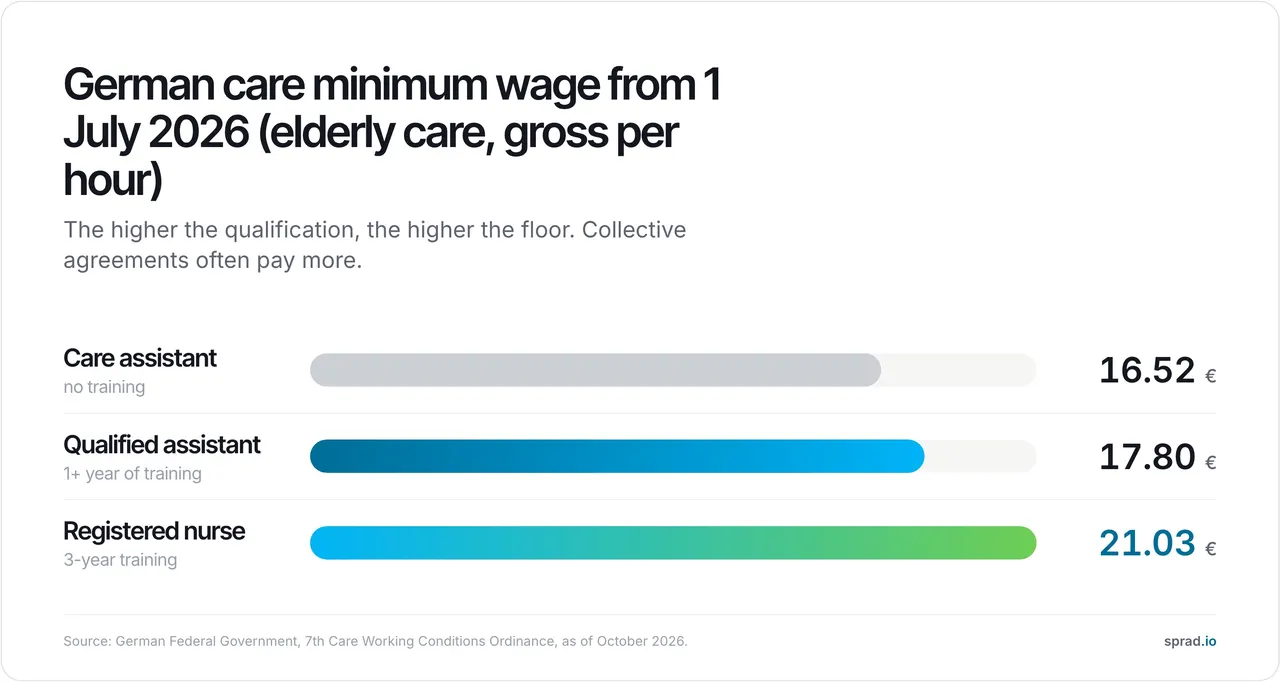
Since 1 July 2026, Germany's elderly-care sector has a minimum wage graded by qualification. It rises again on 1 July 2027 (German Federal Government, 7th Care Working Conditions Ordinance):
| Qualification | from 1 Jul 2025 | from 1 Jul 2026 | from 1 Jul 2027 |
|---|---|---|---|
| Care assistant | €16.10 | €16.52 | €16.95 |
| Qualified care assistant (1+ year of training) | €17.35 | €17.80 | €18.26 |
| Registered nurse | €20.50 | €21.03 | €21.58 |
Elderly-care staff also get nine extra days of paid leave on a five-day week. Collective-agreement employers such as hospitals often pay above the minimum.
Worked example (our own calculation; assumption: full-time at 39 hours per week, about 169 hours a month, gross, no night or weekend supplements):
- Care assistant: €16.52 × 169 ≈ €2,790 per month
- Qualified assistant: €17.80 × 169 ≈ €3,010 per month
- Registered nurse: €21.03 × 169 ≈ €3,550 per month
Training itself is paid. Under the public-sector trainee pay scale for care (TVAöD, special part for care), trainees earn €1,490.69 in year one, €1,552.07 in year two and €1,653.38 in year three from May 2026. That applies to employers bound by the agreement and can differ elsewhere.
Is it worth switching? If you move from an assistant job at minimum-wage level (€2,790) into the three-year training, you earn about €1,300, €1,240 and €1,140 less per month than as an assistant in the three years, roughly €44,000 gross in total. Afterwards a registered nurse earns about €760 a month more than an assistant (€3,550 versus €2,790). The gap closes after just under five years, without any funding. With funding (below) it closes faster. For detailed pay by setting see our nurse salary guide for Germany.
Funding by the employment agency (Germany): what the law says
The agency can fund retraining. It is a discretionary benefit, not an entitlement, and it follows fixed rules in § 81 SGB III:
- Advice before you start: the agency must have advised you before the course begins. Enrol first and ask afterwards, and you usually get nothing.
- Approved course and provider: both must be approved for funding.
- Retroactive vocational qualification: you hold no qualification with a statutory length of at least two years, or you have worked more than four years in unskilled work and probably cannot return to your trained occupation.
- Suitability and prospects: you are suited to the job, will probably complete it, and it improves your job prospects. Nursing is a shortage occupation, which helps.
On top, § 87a SGB III pays bonuses of €1,000 after the intermediate exam and €1,500 after the final exam, and unemployed participants receive €150 a month in further-training allowance. The catch that rarely gets mentioned: both apply to qualifications with a statutory length of at least two years. Three-year nurse training qualifies. The new 18-month nursing assistant course does not obviously qualify on the wording, so ask your adviser. § 180 SGB III generally expects funded retraining to be shortened by a third but allows exceptions where other rules forbid shortening; the agency decides case by case whether it funds the full length.
Your next step: book an appointment with the agency's career advice, name the school you have in mind, and ask whether the course is approved. Enrol only after that.
Applying as a career changer: step by step
- Read the ad closely. "Career changers welcome" or "care assistant (m/f/d)" tells you the employer trains people.
- CV: lead with transferable strengths. Reliability, shift work, customer contact, caring for a relative, volunteering. One sentence is enough for gaps.
- Cover letter: one paragraph of motive, one of proof. Why care, why this employer, and one concrete experience that fits.
- Offer a trial day. One to three days of shadowing remove the employer's risk and your uncertainty.
- Follow up. A short check-in after about a week shows interest without nagging.
More on CVs and career changes in general: applying as a career changer and cover letter examples for career changers.
Sample cover letter: career change into care assistant
This sample is short on purpose. Replace the brackets with your own details and write nothing that is not true.
Application: care assistant, [Name] Senior Care Centre
Dear Ms [Name],
I have worked as a [previous job] for [years]. Two years ago I cared for my mother at home until she died, and I realised that working with people who need care suits me and matters to me. That is why I want to change career into care.
From my current job I bring reliability, willingness to work shifts and a calm manner in difficult situations. I am physically fit and like learning from experienced colleagues. Your advert appealed to me because you train career changers and support further training to nursing assistant.
I would be glad to spend a day or two shadowing the team to get to know your daily routine. I look forward to hearing from you.
Kind regards
[Name]
Typical mistakes: clichés like "I have a big heart" without proof, a cover letter that merely repeats the CV, and claiming you always wanted to work in care when the CV shows otherwise. Honest beats polished.
Finding suitable roles with Atlas Career
The hard part is rarely the application, it is finding roles that actually want career changers. Atlas Career is a free AI career agent. You describe what you want in one sentence, for example "care job without night shifts". Atlas searches 1.5 million+ active jobs straight from employers' career sites, over 100,000 of them in the DACH region, and gives each role a match score with reasons. For every application it tailors a CV and, on request, a cover letter, with no limits and no cost. You review everything and apply directly to the employer.
The search keeps running after you close the browser, and new matches arrive by email. Browse entry-level care roles on the Atlas jobs page under "Healthcare". Atlas was built by Sprad in Vienna, uses EU hosting and never sells your data.
England and the US: how career changers get in
England: without a degree, two routes lead to nursing. The nursing associate is a work-based apprenticeship with a foundation degree; you generally need GCSE maths and English at grades 9 to 4 (A to C) or Functional Skills Level 2, plus employment in healthcare. A registered nurse degree apprenticeship can follow. Each employer sets its own entry rules; NHS careers pages explain the basics (NHS Health Careers, nursing associate).
US: if you already hold a bachelor's degree in another field, an accelerated BSN takes 12 to 18 months (AACN, accelerated programs fact sheet). You then sit the national licensing exam (NCLEX). Admission varies by school and is often competitive.
Qualifications are not automatically recognised across borders. Check the recognition rules of the destination country before you move.
FAQ
Can I work in nursing without training?
Yes, as a care assistant or companion. As a registered nurse with a full licence you need three years of training in Germany. Care planning is reserved for registered professionals under § 4 PflBG.
How long does a career change into nursing take?
As an assistant, you can start at once. In Germany the nursing assistant course takes 18 months full-time from 2027 and registered nurse training three years full-time or up to five part-time.
What does a care assistant earn in Germany?
At least €16.52 gross per hour in elderly care since 1 July 2026, about €2,790 a month at 39 hours a week. Qualified assistants get at least €17.80, registered nurses at least €21.03.
Does the employment agency pay for nurse retraining?
It can, if you were advised before you start, the course and provider are approved and you meet the conditions of § 81 SGB III. It is discretionary. Bonuses of €1,000 and €1,500 and, for unemployed participants, €150 a month may apply.
Do I need a cover letter?
Some adverts only ask for a CV. If you write one, keep it to one page with a paragraph of motive and a paragraph of proof. A sample is above.
Am I too old to start nurse training at 40 or 50?
No. German nurse training has no upper age limit and part-time formats exist. School certificate, suitability and a training place are what count.
Where do I find entry-level nursing jobs?
On employers' career pages and in job searches. With Atlas Career you describe what you want in one sentence and get matching roles with reasons, for free.
Jürgen Ulbrich
Jürgen Ulbrich has more than a decade of experience in developing and leading high-performing teams and companies. As an expert in employee referral programs as well as feedback and performance processes, Jürgen has helped over 100 organizations optimize their talent acquisition and development strategies.