Entry-level remote jobs exist, but they are scarce and heavily contested, so the way in is a short list of roles you can prove you fit, 10 to 15 tailored applications instead of 100 generic ones, and AI used for search, matching and first drafts, never for invented facts. For the 2026 graduate class, US employers told NACE they plan to hire 5.6% more new graduates than last year, but a posting that says "remote" will still draw far more applicants than a local one. Atlas Career is a free AI career agent that does the searching and matching for you, and you apply yourself.
This guide is for graduates and career starters in the US, the UK and the EU, including Germany, Austria and Switzerland. It answers the questions people actually ask: what "entry level jobs remote" means, how many such jobs exist, where to look, how to write an entry-level resume without work experience, how AI helps, and how to avoid scams. Figures are as of October 2026.
What does "entry level jobs remote" mean in practice?
Entry level usually means a role that welcomes recent graduates or people with up to about two years of experience. Remote means you work from home most or all of the time. Both labels are used loosely in job ads: "entry level" sometimes still asks for three years of experience, and "remote" can mean hybrid or "remote within one country or time zone". Read the requirements and the location line, not the headline.
Three variants matter for your search: fully remote (any location allowed), remote within a region (for example "remote, EU only" because of contracts and taxes) and hybrid (a few office days). If you are in Europe, check where the employer may legally employ you before you spend an evening on an application.
How many remote entry-level jobs are there, and how hard is the market?
There is no official count of remote junior roles. Trackers disagree, with estimates of the fully remote share of postings ranging from low single digits to about 10% depending on who counts and how, and entry-level roles are only a part of that. Treat any exact "number of remote entry-level jobs" with suspicion.
The wider graduate market is better than it looked a year ago. In its spring 2026 update (published 27 April 2026, 185 responding employers) NACE reports that employers expect to raise new-graduate hiring by 5.6%, after a fall forecast of -2.4%. The sample is small and it covers US employers, so it shows direction, not a promise for your field. In the EU, Eurostat's 2025 data put the share of 15 to 29-year-olds neither in work nor in education at 11.0%, with 12.8% for ages 20 to 24 and 14.7% for ages 25 to 29. Germany, Austria and Luxembourg are the three countries where that rate rose between 2015 and 2025.
What this means for you: competition is real, so aim at fit and speed rather than volume.
Where to find entry-level remote jobs: the options compared
No single board covers everything. The table shows what each route is good for and what it costs. The strongest results usually come from combining employer career pages with one or two boards and an agent that does the matching.
| Route | Best for | Cost | The catch |
|---|---|---|---|
| Atlas Career | One search across 1.5M+ active jobs from employers' career sites, a match score with reasons, a tailored CV and cover letter per role | Free, no limit | You review and send every application yourself |
| Employer career pages | Fresh postings, no middleman | Free | Slow to scan one by one |
| LinkedIn and Indeed | Breadth, networking, recruiter contact | Free tier | Many reposted and stale ads, "Easy Apply" crowds |
| Early-career boards (for example WayUp in the US) | Roles that really welcome graduates | Free for candidates | Mostly US, fewer remote roles |
| Remote-only boards (for example FlexJobs, We Work Remotely) | Pre-screened remote roles | Some are paid subscriptions | Few true entry-level roles |
| University career service | Employer contacts, CV review | Free for students and alumni | Quality varies by school |
| Public job boards such as the German Arbeitsagentur Jobsuche | Vacancies in Germany, including graduate roles | Free | Fewer international remote roles |
Where Atlas is not the best fit: LinkedIn is stronger for networking and direct contact with recruiters, and the US-focused early-career boards help if you need a graduate programme at a large US employer. Atlas covers over 100,000 active jobs in the DACH region, which helps if you are looking in Germany, Austria or Switzerland.
How do I find a job step by step? A 4-week plan
Here is the routine we recommend, based on the way hiring teams read applications. The hours are planning assumptions: about 10 focused hours a week, so roughly 40 hours in total.
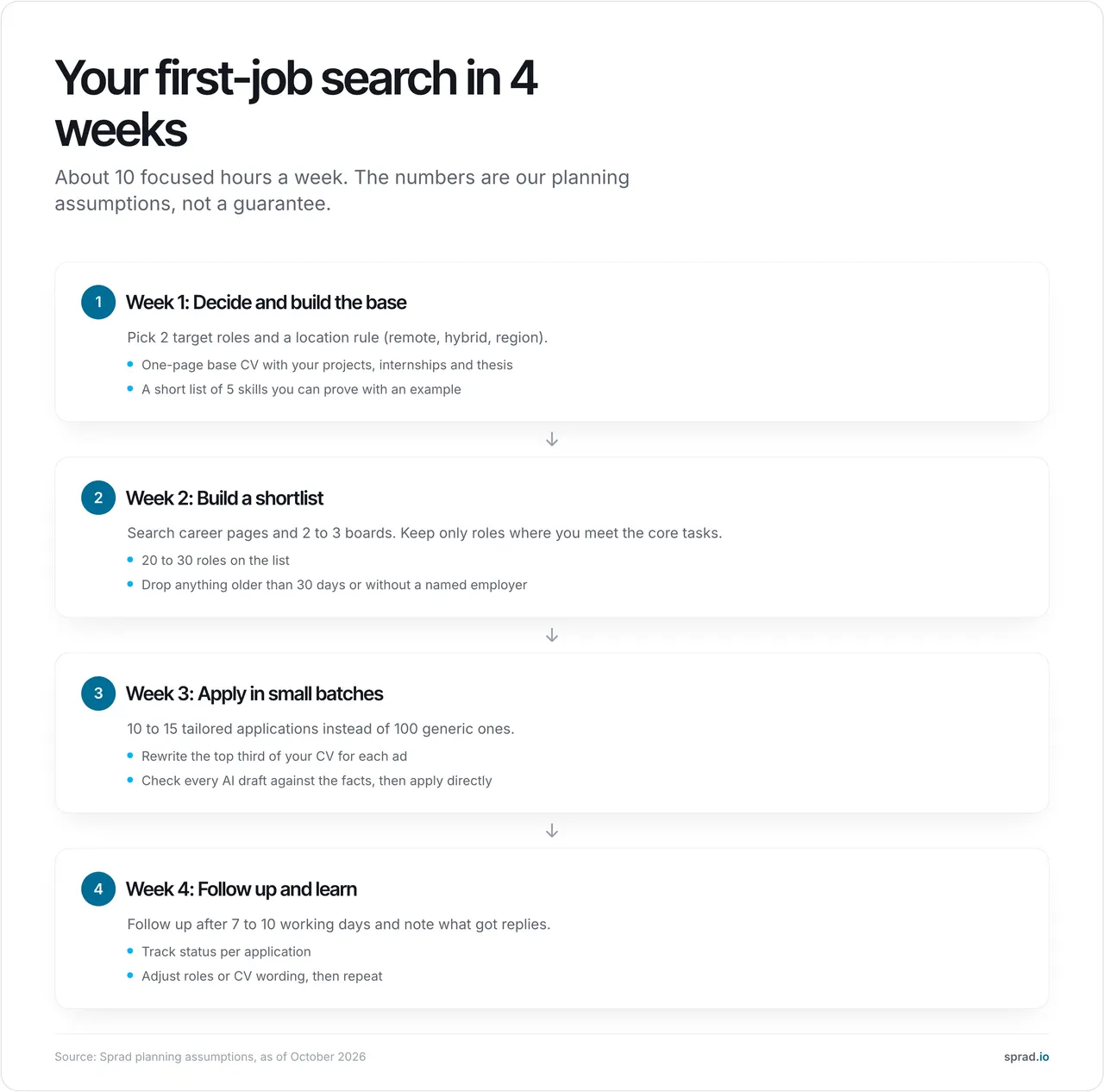
The most important rule is the order: decide first, shortlist second, apply third. People who start with "apply to everything" burn out in week two and learn nothing from the answers.
How do I write an entry-level resume with no experience?
Keep it to one page. Put the information in this order: a two-line summary naming the role you want, education, projects and internships, skills, then everything else. Treat projects, a thesis, volunteering and part-time jobs as experience. For each item write what you did, with which tool and what came out of it, for example "analysed 1,200 survey responses in Python and cut the report time from two days to three hours".
Two things differ by region. In the US, UK and Canada, leave out the photo, date of birth and marital status. In Germany, Austria and Switzerland a photo is still common but not legally required, and a short cover letter is more usual than in the US. A tailored version for each ad matters more than the template.
If you want a ready-made structure for the cover letter, see our cover letter template for entry-level applicants.
How many applications should I send? A worked example
Here is a simple calculation with stated assumptions. Say you have 40 hours for the search.
- Path A, volume: 100 generic applications at about 6 minutes each take 10 hours. Every recruiter sees the same CV, so few of them match the ad closely.
- Path B, tailoring: 12 tailored applications at about 30 minutes each take 6 hours. With an AI draft you review, about 15 minutes each is realistic, which makes 3 hours.
Path B leaves 30 or more hours for the part that actually gets interviews: finding the right 12 roles, preparing for interviews and following up after 7 to 10 working days. The minutes are our assumptions, not a measurement, so replace them with your own times after the first three applications.
How does AI change the entry-level job search?
AI is good at three jobs and bad at one.
- Search: it reads far more postings than you can and filters them by what you told it.
- Matching: a score with reasons shows quickly which ads are worth your time. Atlas Career gives every role a 0 to 100 match value with a short explanation, and shows culture fit only when the ad itself contains a quote that supports it.
- Drafting: a first version of the tailored CV and cover letter saves the typing.
- Where it fails: inventing. A model that adds a skill or an internship you do not have gets you rejected in the interview, or worse. Every claim must be something you can explain.
Atlas works this way: you describe the role, level, location and no-gos in a short voice conversation, it keeps searching and emails new matches, and it writes a tailored CV and, on request, a cover letter per role. It does not send anything for you. You check the text, download the PDF and apply directly to the employer. Put "remote" into your location preference and no-gos so that it matches against it. For a broader comparison of tools, read our best AI job search tools in 2026, and for the concept behind agents what is an AI career agent.
One note for the EU: employers who use AI to filter applications fall under the high-risk category of the EU AI Act (Annex III, employment), which adds transparency and human-oversight duties for them. Your side is simpler: Atlas is hosted in the EU and follows the GDPR, and your data is never sold.
How do I spot fake remote jobs?
Job seekers who want flexible or remote work are a typical target for scammers. According to FTC data, reported losses to job and employment agency scams in the US rose from $90 million in 2020 to $501 million in 2024, and the number of reports tripled. The FTC's job scam guidance gives clear red lines:
- An honest employer never asks you to pay to get a job, including for training kits or certificates.
- No employer sends you a check to deposit and asks you to send part of the money back.
- Offers of big pay for little work, or jobs that mean reshipping or reselling packages, are a warning sign.
- Check the employer's own career page: a real role is listed there with the same title.
Which mistakes cost graduates the most?
- Applying to everything. It feels productive, but the answers teach you nothing.
- Skipping the ad's own words. The first third of your CV should use the same terms as the ad, where they are true.
- Letting AI add experience. One invented tool is enough to fail a technical interview question.
- Ignoring the age of an ad. Ads older than about 30 days are often filled or paused.
- Not following up. A short note after 7 to 10 working days is normal and often decides between two similar applications.
- Forgetting the time zone rule. "Remote" often means "within your country".
Frequently asked questions
Are there really entry-level remote jobs?
Yes, but fewer than the headline suggests. Customer support, sales development, operations, marketing, data and software roles are the ones you will see listed most often. Expect many applicants per ad and plan for hybrid roles as a fallback.
Do I need experience for an entry-level remote job?
Not paid experience. Projects, internships, a thesis, volunteering and coursework count if you describe what you did and what came of it. Employers still expect that you can work independently, so show an example.
How long does it take to find a first job?
It varies widely with field, region and season. Plan for several months rather than weeks, and use the 4-week plan above as one search cycle you repeat and adjust.
Which AI tools are free for a graduate job search?
Atlas Career is free without limits for the search, the match score and a tailored CV and cover letter per application. Many other tools offer a free plan with caps on AI features, so check the limit before you rely on one.
Should AI apply for me?
No. Mass auto-apply tools send the same text to many employers and can send claims you never checked. Use AI for search and drafts and send each application yourself.
Is a cover letter still needed?
In Germany, Austria and Switzerland, usually yes. In the US and UK it is optional unless the ad asks for it, but a short, specific letter can help when your CV is thin.
How do I know a remote job is legitimate?
Find the same listing on the employer's own career page, never pay anything to get hired and never deposit a check for an employer. If a recruiter only talks through a messaging app, be careful.
Which country is easier for graduates?
There is no simple answer. EU youth unemployment and the NEET rate differ strongly by country, and Germany, Austria and Luxembourg saw the NEET rate rise since 2015. Search in the language of the local market and read the work rules for remote employment first.
To try the search yourself, create a free Atlas Career account and browse the job search.
Jürgen Ulbrich
Jürgen Ulbrich has more than a decade of experience in developing and leading high-performing teams and companies. As an expert in employee referral programs as well as feedback and performance processes, Jürgen has helped over 100 organizations optimize their talent acquisition and development strategies.