Medical assistants in Germany (Medizinische Fachangestellte, MFA, formerly Arzthelferin) earn a median of €3,129 gross per month in full-time work, with the middle 50 % between €2,629 and €3,648 (Federal Employment Agency's Entgeltatlas, as compiled in March 2026). Under the collective pay agreement, entry in 2026 is €2,939.59 in job group I, and the top of the table is €4,895.78 (group VI, from the 33rd year of experience). The catch: the table only applies automatically if the practice is bound by the agreement. Otherwise your contract decides.
How much does a medical assistant earn in Germany?
The most reliable figure is the median from the Entgeltatlas of the Federal Employment Agency: half of full-time MFA earn more, half less. It stands at €3,129 per month, about €37,548 a year. The Entgeltatlas itself only works as a browser app, so these numbers come from salary guides that cite it (March 2026). Check them there if you need certainty.
Why do salary sites quote different numbers?
Search for MFA pay and you will see anything from about €2,400 to over €3,100. That is usually not a contradiction. We lined up the figures you will meet most often:
| Figure | What it really is | Why it differs |
|---|---|---|
| €2,803.95 | Collective agreement, group I, years 1–4, 2025 | table replaced on 1 January 2026, still shown on many sites |
| €2,939.59 | Collective agreement, group I, years 1–4, 2026 | current entry pay, only where the agreement is binding |
| about €2,400 | "Starting salary" on some pay portals | mixes practices without agreement, part-time and older data, no cut-off date |
| €2,899 | 2023 evaluation | older data, before the 2025 and 2026 increases |
| €3,129 | Full-time median, Entgeltatlas | full-time jobs with social insurance only, all experience levels pooled |
For every number, ask three things: which year, median or average, and full-time only or everyone.
What does the 2026 MFA pay agreement say?
The pay scale comes from the agreement between the medical professionals' association vmf and the employers' working group AAA. It has been in force since 1 January 2025, the 2026 table since 1 January 2026, and according to Virchowbund it ends on 31 December 2026. Talks about the 2027 pay scale are under way. The standard working week is 38.5 hours.
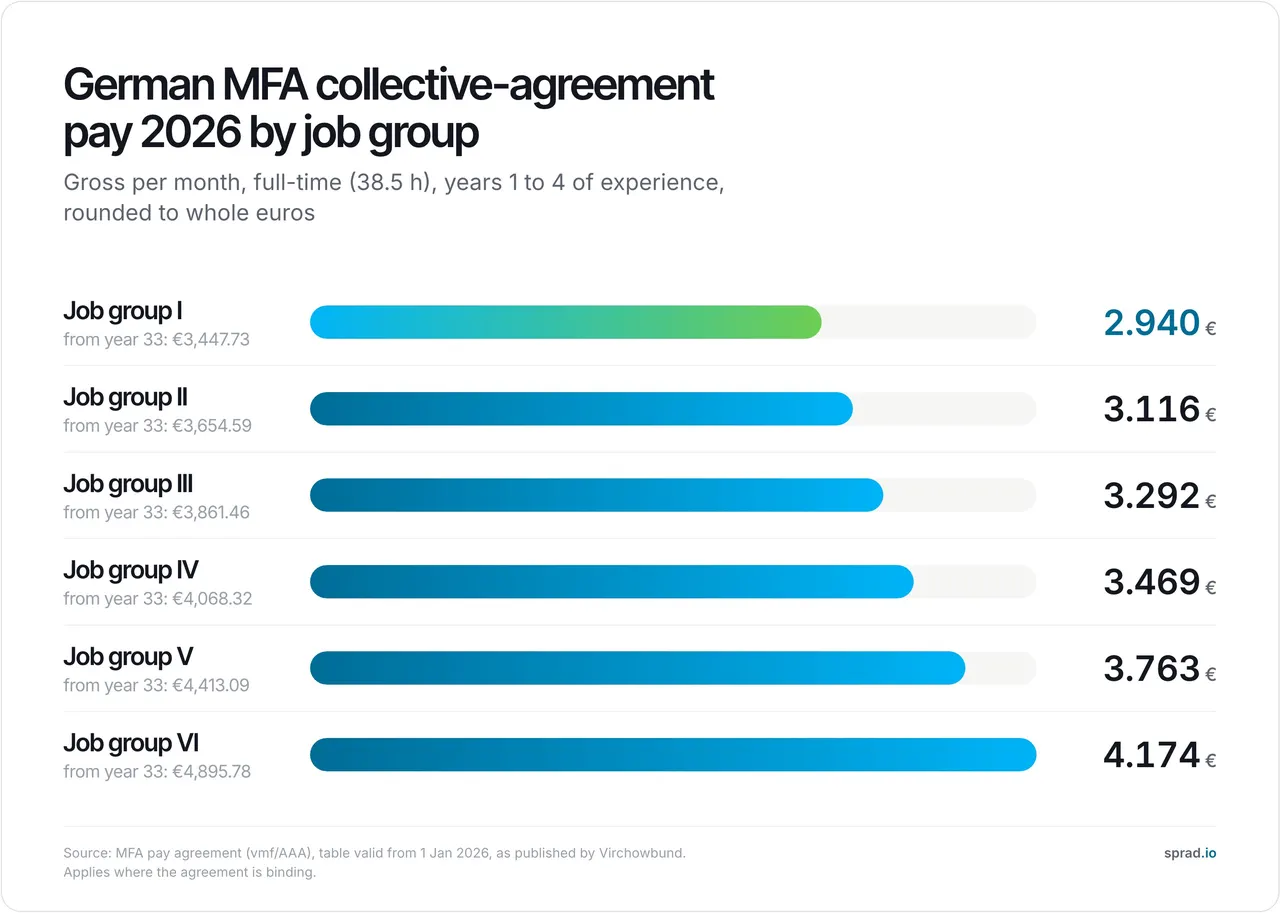
The full table, gross per month, full-time, valid from 1 January 2026:
| Year of experience | Group I | Group II | Group III | Group IV | Group V | Group VI |
|---|---|---|---|---|---|---|
| 1–4 | €2,939.59 | €3,115.97 | €3,292.34 | €3,468.72 | €3,762.68 | €4,174.22 |
| 5–8 | €2,992.56 | €3,172.11 | €3,351.67 | €3,531.22 | €3,830.48 | €4,249.44 |
| 9–12 | €3,045.53 | €3,228.26 | €3,410.99 | €3,593.73 | €3,898.28 | €4,324.65 |
| 13–16 | €3,098.49 | €3,284.40 | €3,470.31 | €3,656.22 | €3,966.07 | €4,399.86 |
| 17–20 | €3,235.88 | €3,430.03 | €3,624.19 | €3,818.34 | €4,141.93 | €4,594.95 |
| 21–24 | €3,288.84 | €3,486.17 | €3,683.50 | €3,880.83 | €4,209.72 | €4,670.15 |
| 25–28 | €3,341.81 | €3,542.32 | €3,742.83 | €3,943.34 | €4,277.52 | €4,745.37 |
| 29–32 | €3,394.76 | €3,598.45 | €3,802.13 | €4,005.82 | €4,345.29 | €4,820.56 |
| 33+ | €3,447.73 | €3,654.59 | €3,861.46 | €4,068.32 | €4,413.09 | €4,895.78 |
Source: MFA pay agreement, 2026 table, as published by Virchowbund; the values match a second, independent summary of the agreement. As of October 2026.
Does the agreement apply to my practice?
Only in part. A collective agreement applies automatically when it is binding on both sides: the employer belongs to the AAA and you belong to the vmf (section 3(1) Collective Agreements Act, section 4(1)). Outside that, it applies if your employment contract adopts it. If the contract is silent, the table is a benchmark and your pay is negotiable.
A survey by the German research institute for statutory health insurance care (Zi, MFA fact sheet) found that for 2018 almost 81 % of contracts followed the agreement's rules, and 62 % in eastern Germany. We could not read the whole PDF, so these figures come from an excerpt. They show the pattern: the table is the yardstick even where it is not binding. Pay above the table is always allowed (section 4(3)).
Check two things in your contract: does it name the agreement, and which job group and year of experience does it place you in? Your employer must give you the amount of your pay in writing (section 2 Evidence Act).
What does an MFA earn with experience? Worked examples
The steps rise every four years, counted from the month you passed your exam. Three calculations with the 2026 table, full-time (38.5 hours), all gross:
- Progress inside group I: From entry (€2,939.59) to year 33 (€3,447.73) is €508.14 more per month, about 17.3 %. The biggest jump comes in year 17: from €3,098.49 to €3,235.88, or +€137.39 (4.4 %). The earlier steps add only about €53 each.
- Changing group beats waiting: Moving from group I to group IV in years 1–4 adds €529.13 (+18.0 %), more than the entire rise over 32 years of experience inside group I (€508.14).
- Hourly rate: 38.5 hours a week is on average 166.83 hours a month (38.5 × 52 ÷ 12). Group I entry equals about €17.62 an hour. Working 30 hours pays pro rata, €2,290.58 gross.
With the year-end bonus
According to the guide m-fa.de, the framework agreement provides a December bonus: 50 % of one month's pay in the first year with the employer and 70 % from the second (six full months of employment required). We could not confirm this with a second source, so check the wording of the framework agreement. Assumption: group I, years 1–4, second year or later with the employer. That is 12 × €2,939.59 = €35,275.08 plus 70 % of €2,939.59 (€2,057.71), so €37,332.79 a year, or €3,111.07 a month on average. That is just below the median of €3,129. In the first year (50 %) it is €36,744.88.
What do you earn when you start?
Entry under the agreement is group I, years 1–4: €2,939.59 gross. Apprentices get €1,050 in the first year of training, €1,150 in the second and €1,250 in the third in 2026 (2025: €1,000, €1,100, €1,200). After the exam you move into the pay table. If a practice has no agreement, use the entry rate as your anchor and compare with ads from your region.
Job groups: how do you move up?
Your pay depends less on years than on the group you are placed in. The groups differ by tasks and qualifications, and the exact definitions are in the agreement text. Typical routes up are further training such as VERAH or NäPa, specialisations (wound care, practice management, for example) and responsibility for billing, quality management or trainees. Whether a course lifts you into a higher group is not written in the course but in your contract and job description. Get your group confirmed in writing before you spend money on further training.
Pay in the public sector (TVöD)
Municipal hospitals, public health offices and similar employers pay under the public-sector agreement TVöD. MFA are usually placed in pay grade 5, or grade 6 with staff responsibility. According to a compilation by medi-karriere.de (valid from 1 May 2026), grade 5 step 1 is €3,124.08 and step 6 is €3,783.33; grade 6 starts at €3,240.30. These come from a secondary source and exclude allowances, so check your employer's official table. Note that public-sector entry is above entry under the MFA agreement (€2,939.59), but only if the job really sits in the public sector.
How does pay differ by German state?
A lot. An analysis by StellenMarkt based on the Entgeltatlas shows €3,180 median in Hamburg and €2,780 in Saxony-Anhalt, a gap of about €400 a month. Other analyses give different numbers, for example just under €2,700 in Thuringia, Saxony and Saxony-Anhalt against about €3,300 in Hamburg and Bremen. The direction is the same everywhere: the west and the city states pay more, the east less. Compare with your own state, not the national median. Whether GP or specialist practices pay more cannot be quantified reliably with the data available; one analysis says specialist practices "usually" lead but gives no figures.
Allowances, leave and notice under the agreement
Beyond base pay, the framework agreement (last updated December 2024) sets, according to Virchowbund:
- Leave: 29 working days (35 on a six-day basis).
- Probation and notice: three months' probation, then four weeks to the 15th or the end of the month.
- Allowances: overtime 25 %, Saturdays 25 %, Sundays and public holidays 50 %, 24 and 31 December from noon 50 %, nights 50 %, major holidays (New Year, 1 May, Easter, Whitsun, Christmas) 100 %.
This matters when you compare two offers: €3,000 without the agreement can be worth less than €2,940 under it if allowances, the bonus and 29 days of leave are missing.
How does it compare with Austria, Switzerland and the US?
The numbers are not directly comparable: currency, taxes, number of monthly payments and training route differ.
| Country | Job, training | What is documented | Source, date |
|---|---|---|---|
| Germany | MFA, 3-year dual apprenticeship | median €3,129/month; agreement €2,939.59 to €4,895.78 | Entgeltatlas (compiled March 2026); table from 1 Jan 2026 |
| Austria | Ordinationsassistenz | collective agreements of the regional medical chambers; 14 payments a year | Lower Austria collective agreement 2026, decided June 2026 |
| Switzerland | MPA (medical practice assistant) | wage recommendations per canton; Graubünden 2024: from CHF 4,403 in year 1; Zurich entry about CHF 58,500/year | FMH recommendation 2024; medi-karriere.ch 2026 |
| USA | Medical assistant, certificate instead of apprenticeship | median $45,690/year ($21.97/hour); lowest 10 % under $36,050 | BLS, May 2025 |
In Austria, collective agreements of the regional medical chambers set pay in doctors' practices. Lower Austria decided a new version for 2026 (Ärztekammer Niederösterreich, KV 2026); tables differ by federal state, so we deliberately give no single figure. In Switzerland, cantonal medical societies and the FMH publish wage recommendations that are not binding. Check whether 12 or 13 monthly payments apply before comparing offers. In the US, medical assistants earn a median of $45,690 a year according to the Bureau of Labor Statistics (May 2025): $45,520 in physicians' offices, $46,910 in hospitals. Entry is via a postsecondary certificate rather than a three-year apprenticeship, and the BLS expects 13 % growth to 2035.
Gross or net: what is left?
All figures above are gross. What you keep depends on tax class, child allowances, church tax and your health insurer's additional contribution. Use the official income-tax calculator of the Federal Ministry of Finance instead of guessing a flat rate.
How to negotiate your MFA salary
- Set an anchor: Use the 2026 table as a benchmark even if the practice has no agreement. It shows what is usual for the same group and years.
- Document your years: They count from the month you passed the exam. Bring references and proof from earlier practices so nothing gets lost.
- Negotiate the group, not just the number: Describe your tasks (billing, quality management, trainees, wound care) and ask which job group they fall under.
- Count the whole package: bonus, training budget, leave, hours, allowances. A higher base without allowances can be worse.
- Name a range: State a range whose lower end works for you instead of asking "What do you pay?". See our salary negotiation scripts and email templates.
Common mistakes when comparing pay
- Using the 2025 table as current (€2,803.95 instead of €2,939.59).
- Comparing full-time with part-time or gross with net.
- Assuming the agreement applies automatically when the contract does not mention it.
- Taking the national median as your target although your state may sit €400 above or below it.
- Trusting a salary page without year and source.
- Not checking your job group: group I instead of group III costs €352.75 a month at entry, over €4,200 a year.
Does a job ad have to show the salary?
Not everywhere yet. The EU Pay Transparency Directive (EU) 2023/970 requires that applicants learn the starting pay or pay range before the interview at the latest and that employers no longer ask about previous pay. The transposition deadline ended on 7 June 2026. As of 30 October 2026, we know of no adopted German implementing law, but we have not checked this officially. Simply ask for the range before you invest time in an interview.
How do you find MFA jobs with the right pay?
Only some ads state a salary, so a benchmark alone is not enough. Atlas (Atlas Career, free with no limits) searches over 1.5 million active jobs straight from employers, more than 100,000 of them in the German-speaking region, and has its own portal for health professions, including practice staff. Every role gets a match score with reasons. Atlas shows a salary only when the ad states one; it makes no salary predictions of its own. In a short voice conversation at the start (the "Atlas Brief") you set role, level, target pay, location and no-gos, and Atlas keeps searching. You review everything and apply directly to the practice or hospital.
What does AI change when comparing pay?
Language models give you a number on demand, but usually without cut-off date, tariff year or region, and happily the outdated 2025 table. Use AI to find jobs and tailor your documents, and settle the numbers yourself with the sources above. More in our comparison of AI job search tools and in What is an AI career agent?. For your documents, see how to tailor your CV with AI. For another health profession, read our physiotherapist salary guide.
FAQ
How much does an MFA earn per month?
A median of €3,129 gross in full-time work, middle 50 % between €2,629 and €3,648 (Entgeltatlas, compiled March 2026). Under the agreement you start at €2,939.59.
What is the starting salary of an MFA in 2026?
€2,939.59 gross under the agreement (group I, years 1–4). Practices without the agreement negotiate; the table is then your anchor.
What does an Arzthelferin earn?
The same as an MFA: Arzthelferin is the old job title, the apprenticeship is now called Medizinische Fachangestellte. The pay agreement covers both names.
How much does an MFA earn with 10 years of experience?
Years 9–12 range from €3,045.53 (group I) to €4,324.65 (group VI). Where you land depends on your group, not only on years.
How much does an MFA earn after 20 years?
Years 17–20 range from €3,235.88 (group I) to €4,594.95 (group VI). Year 17 brings the biggest step.
Does the MFA pay agreement apply to every practice?
No. It applies where it is binding or where the contract adopts it. Otherwise it is a benchmark.
How does a German MFA compare with a US medical assistant?
The US median is $45,690 a year ($21.97 an hour, BLS, May 2025). The German median is €3,129 a month, about €37,548 a year. Currencies, taxes, health insurance and training differ, so compare after tax and benefits, not headline figures.
Jürgen Ulbrich
Jürgen Ulbrich has more than a decade of experience in developing and leading high-performing teams and companies. As an expert in employee referral programs as well as feedback and performance processes, Jürgen has helped over 100 organizations optimize their talent acquisition and development strategies.