On XING you can find employees in three ways: a paid job ad, direct messages through the XING TalentManager, or your own network. Price comparisons put a job ad at EUR 899 net for 60 days with no guaranteed number of applicants (as of 07/2026). TalentManager Core starts at EUR 366 a month according to OMR (as of 02/2026) and, per third-party overviews, includes 200 messages to non-contacts. From about the fourth hire a year, direct outreach becomes cheaper than repeated ads, and XING pays off mainly for regional skilled and senior staff in German-speaking markets.
The three routes on XING compared
Which route fits depends less on XING than on your situation: one urgent role, many hires a year, or a specific profile you have in mind?
| Route | Cost (net) | Effort | Best for | Limit |
|---|---|---|---|---|
| Job ad | EUR 899 for 60 days; resellers sometimes cheaper | low: write the text, review applications | roles people actively apply for | no guaranteed applicants; passive candidates rarely see it |
| TalentManager (direct outreach) | Core from EUR 366 a month, Pro from EUR 474 (OMR, 02/2026) | high: search, write, follow up | skilled and senior staff who are not looking | XING only; 200 messages to non-contacts a month on Core |
| Profile and network | EUR 0 | medium, ongoing | building a presence, a few named profiles | slow, hard to plan |
The prices come from third-party sources and price comparisons, not from a binding price list. XING now partly markets the TalentManager under the onlyfy name. Ask about contract length, discounts and the current scope before you buy; plan details are in our post on XING TalentManager pricing.
Who should use XING at all?
According to an LHH analysis dated 29 August 2025, XING has around 22.5 million members in the DACH region and LinkedIn around 28 million. LHH describes XING as stronger for regional searches in Germany, Austria and Switzerland, especially for mid-sized companies, and as losing ground with younger audiences (LHH, 2025). Members are not the same as active users, so treat the figures as orders of magnitude.
The upside is still large: a Forsa survey commissioned by XING (January 2025) found that more than a third of employees in Germany are open to changing jobs (press report). Many of them are not browsing job ads, so a direct message can reach them where an ad does not. A rule of thumb follows:
| Role | First route on XING | Why |
|---|---|---|
| Office, sales or engineering roles at mid-sized firms | Job ad, plus direct outreach in parallel | many active seekers and many open-to-change members in the same network |
| Senior manager or specialist with few candidates | Direct outreach | suitable people rarely search, an ad barely reaches them |
| Software, data, product | also check LinkedIn and GitHub | LinkedIn is stronger for internationally focused profiles, per LHH |
| Blue-collar roles, apprentices, part-timers | XING only as a supplement | other channels reach them better, see How to find employees: 12 ways |
A quick test before spending money: look at your last five hires and note the channel. If three or more came through XING, the investment makes sense. If none did, check first whether your audience is there at all.
Worked example: job ads or TalentManager?
Assumptions: list prices net, one job ad at EUR 899, on average 1.5 ads per hire (assumed, not measured), TalentManager Core EUR 366 × 12 = EUR 4,392 a year. Working time is not included.
| Hires per year | Ads only | TalentManager Core only | Cheaper |
|---|---|---|---|
| 2 | 2 × 1.5 × 899 = EUR 2,697 | EUR 4,392 | Ads |
| 4 | 4 × 1.5 × 899 = EUR 5,394 (EUR 1,349 per hire) | EUR 4,392 (EUR 1,098 per hire) | TalentManager |
| 6 | EUR 8,091 (EUR 1,349 per hire) | EUR 4,392 (EUR 732 per hire) | TalentManager |
Under these assumptions the TalentManager is cheaper from the fourth hire a year (arithmetic break-even: about 3.3 hires). The calculation only holds if outreach really turns into hires: if you do not write and follow up on 200 messages a month, you pay for unused quota. For a single urgent role the job ad remains the better choice.
How to run direct outreach on XING
- Write a search profile with must-haves. The most common mistake we see in candidate searches is entering a requirement as a wish instead of a must, which makes the result list arbitrary. Fix two to four hard criteria; everything else is a wish.
- Narrow by region and industry. Prioritise profiles with a visible link to your role (region, industry, current tasks); that gives you a concrete reason to write.
- Write short and specific. In two sentences say why this person fits, what the role offers and what the next step is (a short call). No boilerplate, no attachment.
- Follow up once. A second message after about a week is enough. More feels pushy and burns your quota.
- Do not forget the privacy notice. You process profile data you did not get from the person. Under Article 14 GDPR you inform them at the latest with the first message, and within one month in any case.
On the legal side: whether a factual first message about a specific role in a professional network counts as advertising under section 7 of the German Unfair Competition Act (UWG) is not settled. The risk falls if the message fits the person and the role and you stop immediately on request. Our post on active sourcing and GDPR covers the details; it does not replace legal advice.
The job ad: what to watch
An ad must be non-discriminatory (section 11 AGG read with section 7(1)), for example "(m/f/d)" and no age requirements. Put tasks, salary range and location in the first lines. Do not count on a fixed number of applications; XING does not guarantee one. If the budget is tight, compare alternatives first, for example the cost on Indeed.
Where XING stops, and what comes next
XING covers one network. If you also message the same person on LinkedIn, you approach them twice; in our conversations with recruiting teams this is a real problem as soon as several people search. The message limit adds to it.
This is where Sprad comes in: one requirement search runs across LinkedIn, XING, GitHub and your own talent pool, each profile is checked individually, and outreach via LinkedIn and email runs in one inbox. The Talent Network stays free to use after you cancel. Recruiter Lite costs EUR 79 per seat and month, billed annually (three seats: EUR 2,844 a year), and credits come on top depending on use. Automated outreach is included in Atlas Recruiter (EUR 299 per seat and month) and can be added per seat to Recruiter Lite. The limits: the deep search takes a few minutes, and there is no AI notetaker, no placement reporting and no SMS. If you only need XING and hire regularly, the TalentManager is enough; if you want several sources and your own pool, look at active sourcing with Sprad. Prices: sprad.io/pricing.
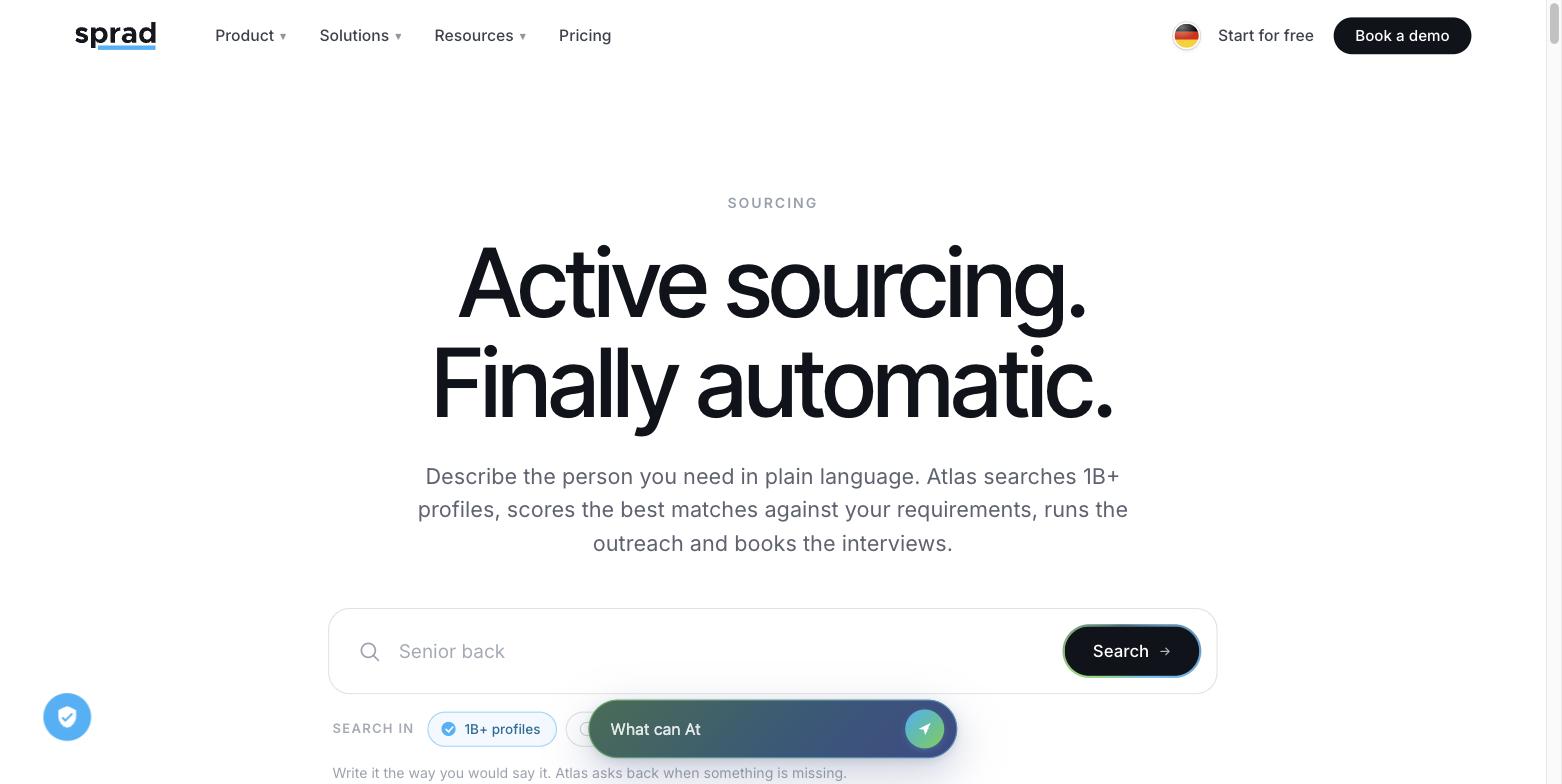
Over time, the candidates you find become an asset you do not have to pay for again each time: how that works with a talent pool is described on the product page.
Frequently asked questions
What does it cost to find employees through XING?
A job ad costs EUR 899 net for 60 days according to price comparisons (as of 07/2026), TalentManager Core from EUR 366 a month (OMR, 02/2026). A free profile and your own network cost nothing but rarely deliver plannable hires.
Can I message candidates on XING without the TalentManager?
Messages to people you are not connected with are heavily limited in the free account. For regular outreach you need the TalentManager in practice. Check the current terms with XING, as plans change often.
How many applications does a XING job ad bring?
No one can predict this reliably: XING guarantees no number of applicants. It depends on occupation, region and whether you state a salary. Set a budget and check after two weeks whether the cost per application fits your calculation.
XING or Indeed: which is better?
XING reaches regional skilled and senior staff, Indeed many active job seekers across all occupations. For a role with a broad audience many start with Indeed; for specialists and managers, direct outreach on XING often makes more sense.
Is active sourcing on XING allowed?
Yes, if you respect data protection (Article 14 GDPR) and competition law, the message fits the person factually, and you honour any objection immediately. This is not legal advice.
Related reading
As of November 2026. Prices are net list prices from price comparisons and OMR and may change; Sprad is itself a vendor of a sourcing tool.
Jürgen Ulbrich
Jürgen Ulbrich has more than a decade of experience in developing and leading high-performing teams and companies. As an expert in employee referral programs as well as feedback and performance processes, Jürgen has helped over 100 organizations optimize their talent acquisition and development strategies.