To hire a recruiter, first decide which type you need (sourcer, full-cycle, high-volume or specialist), then search for that function on LinkedIn or XING and test the candidate with a real sourcing task. In our example an in-house recruiter pays off from about six hires a year; below that, an agency or freelance recruiter is cheaper.
For the US, the Bureau of Labor Statistics reports a median pay of $75,940 (May 2025) for human resources specialists, the group that includes recruiters (BLS).
Which recruiter do you actually need?
"Recruiter" covers five different jobs. A sourcer who finds passive candidates is not the same hire as a coordinator who schedules interviews. Decide first where your hiring loses time: finding people, screening them, or running the process. The right type depends on that answer. Whichever type you pick, an AI sourcing tool lets you describe the profile in plain words (for example: "full-cycle recruiter, technology, 3+ years, DACH, speaks German and English").
| Recruiter type | What they do | Hire this type if | Search terms |
|---|---|---|---|
| Sourcer | Finds and contacts passive candidates, hands over a shortlist | you hire hard-to-find roles and your recruiters lack time to search | sourcer, talent sourcer, research |
| Full-cycle recruiter | Sources, screens, coordinates interviews, closes the offer | you hire steadily across several roles | recruiter, talent acquisition partner |
| High-volume recruiter | Fills many similar roles fast, often shift or hourly work | you hire dozens of similar roles a year | high volume recruiter, volume hiring |
| Technical or specialist recruiter | Knows a field (IT, engineering, health) well enough to judge profiles | most of your roles sit in one field | technical recruiter, IT recruiter |
| Recruiting coordinator | Schedules, keeps the process running, supports candidates | your recruiters lose time on admin | recruiting coordinator, talent coordinator |
In-house, agency or freelance: what does it cost?
An in-house recruiter is a fixed cost; an agency charges per placement. The break-even depends on your number of hires. The example uses assumptions: a recruiter salary of €60,000, employer on-costs of 20 %, a hired role paying €60,000 and an agency fee of 20 %. Replace them with your own numbers (benchmarks are in our cost per hire article).
| Item | In-house recruiter | Agency (per hire) |
|---|---|---|
| Assumed salary of the hired role | – | €60,000 |
| Fee or annual cost | €72,000 (recruiter salary €60,000 plus assumed 20 % employer on-costs) | 20 % of €60,000 = €12,000 (assumed fee; agreed individually) |
| Tooling (example) | €948 a year (Recruiter Lite, €79 per seat and month) | included in the fee |
| Total | €72,948 a year, regardless of hires | €12,000 per hire |
| Break-even | about 6 hires a year (72,948 ÷ 12,000 ≈ 6.1) | at a 25 % fee about 5 hires a year, at 30 % about 4 |
What follows: with fewer than about five or six hires a year, an agency or freelancer is cheaper and flexible. With steady hiring, an in-house recruiter pays off, and the gap grows if tools replace manual searching. Our example does not include ramp-up time, so budget the first months as low output.
Where to find recruiters
| Channel | Why it works | Catch |
|---|---|---|
| Search by title and function | Recruiters list "recruiter", "talent acquisition" or "sourcer" openly | Many profiles; filter by hiring type and industry |
| Your own network and referrals | Colleagues know who actually delivers | Small pool; ask for the result, not just a name |
| Recruiting communities and meetups | Active, self-selected, talk about their craft | Slow, one conversation at a time |
| Agency recruiters who want to move in-house | Used to targets and speed | Need a different pace and process focus |
| Your talent pool and former applicants | People who already know your company | Only as good as its upkeep |
| Job ads | Reach active job seekers | Strong recruiters are often not looking |
Copy-paste search strings
- LinkedIn Boolean: (recruiter OR "talent acquisition" OR sourcer) AND (technology OR IT OR software) AND (DACH OR Germany OR Deutschland) NOT (intern OR praktikant OR werkstudent)
- Google X-Ray: site:linkedin.com/in (recruiter OR "talent acquisition") (Munich OR München) ("technical recruiting" OR "IT recruiting") -agency
- High-volume: ("high volume recruiter" OR "volume hiring" OR "recruiter") AND (logistics OR retail OR hospitality) AND Germany
For channels beyond search strings, see our guide on how to find employees.
What to write in the first message
Recruiters read outreach messages every day and know every trick. Write like you would want to be written to: name the roles, the volume, the salary range and who they would work with.
Hi [first name], I saw you recruit for [field] at [company]. We are building our first in-house recruiting function at [company]: about [number] hires a year across [roles], reporting to [name]. The role pays [range]. If you are curious, I can send the scorecard and our current pipeline numbers. If not, no hard feelings. [Your name]
More templates and subject lines: recruiter outreach templates. Directive (EU) 2023/970 requires member states to give applicants the starting pay or its range before the interview (Art. 5, EUR-Lex). The transposition deadline passed on 7 June 2026; Germany had no implementing act when we checked in November 2026, but naming the range early is sensible anyway.
Must-have and nice-to-have
| Must-have (examples) | Nice-to-have (examples) |
|---|---|
| Has filled roles like yours in the last two years | Experience with your applicant tracking system |
| Can name channels, reply rates and time to fill from past work | Industry knowledge |
| Writes clear candidate messages | Experience building a talent pool |
| Works with hiring managers on a scorecard | Languages your markets need |
Five pre-interview questions
- Walk me through the last role that was hard to fill. Which channels did you use and what worked?
- What were your reply rate and time to fill in your last position?
- How do you agree a scorecard with a hiring manager who is not sure what they want?
- How do you stay compliant when you contact candidates from public profiles?
- What would you want to see in a recruiting setup before you accept?
Test real work: give a 45-minute sourcing task (one open role, ask for ten profiles with a reason each and a first message). Use the same task for every candidate.
What you must watch legally
- Job ad: in Germany, a vacancy may not be advertised in breach of the ban on discrimination (§ 11 AGG). Use neutral wording ("Recruiter (m/w/d)").
- Agency contracts: the 2,000 euro fee cap in § 296 SGB III protects job seekers who pay a placement agent. It does not limit the fee you agree as an employer; negotiate that individually.
- Contacting candidates: when your new recruiter writes to people found on public profiles, Art. 14 GDPR (EUR-Lex) requires information about the data source, normally within one month. Unsolicited email or telephone approaches are limited by § 7 UWG.
Salary: what to expect
For the US, BLS lists a median of $75,940 for human resources specialists (May 2025) and $149,280 for human resources managers; the group is expected to grow 6 % from 2025 to 2035 (BLS). For Germany we found no clean official median for the job title "Recruiter"; salary-portal figures vary widely by method. The Entgeltatlas of the Bundesagentur für Arbeit shows official pay for related occupations; use it together with two or three market offers.
How Sprad supports a small recruiting team
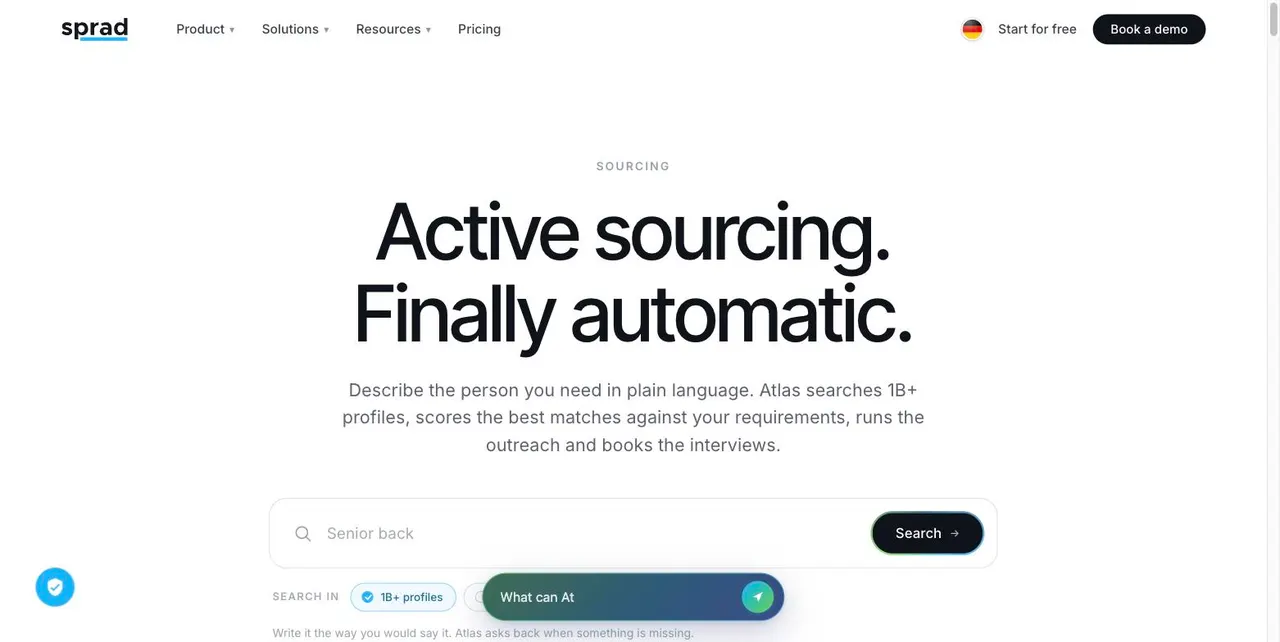
If you hire one recruiter, give them tools that reduce manual search. In Sprad Active Sourcing you describe the profile in your own words, and the AI reads each profile instead of matching keywords. Found people go into your talent pool, and a voice pre-interview (12 languages, 30 credits) asks the first questions. Recruiter Lite costs €79 per seat and month, plus credits for deep search and contact data (pricing, status October 2026). Sprad is itself a vendor; check the fit with a free test.
FAQ
What does it cost to hire a recruiter?
In the example above: about €72,000 a year in-house (salary plus assumed on-costs) against €12,000 per hire at a 20 % agency fee. The break-even is around six hires a year.
Should I hire an in-house recruiter or use an agency?
Use an agency or freelancer for one or two hires a year or for a niche role you cannot search yourself. Hire in-house when you recruit steadily.
Where do I find a good recruiter?
Search by function on LinkedIn or XING, ask your network, and test with a real sourcing task. Our search strings above are a starting point.
How long does it take?
Plan several weeks for a search and a few months until the new recruiter delivers fully; both depend on your market and are not fixed figures.
Jürgen Ulbrich
Jürgen Ulbrich has more than a decade of experience in developing and leading high-performing teams and companies. As an expert in employee referral programs as well as feedback and performance processes, Jürgen has helped over 100 organizations optimize their talent acquisition and development strategies.