To hire working students in Germany, post early at university career centers and student job portals, add your own careers page and a search for students with the right major, and offer a contract of up to 20 hours a week during term. Working students (Werkstudenten) pay only pension insurance, but you owe at least the minimum wage: 13.90 € an hour in 2026 and 14.60 € from 1 January 2027.
That keeps the status simple and the cost predictable. A 20-hour week at the 2026 minimum wage costs about 1,204 € gross a month plus roughly 112 € employer pension share (9.3 %); check the exact rates with your payroll provider.
Where to find working students
| Channel | Why it works | Catch |
|---|---|---|
| University career centers and job portals of the university | Direct, free, targeted by major | Fall and spring peaks; post early |
| Student job boards and general job boards | Large reach among students | Many applicants per post; filtering takes time |
| Your own careers page | Students check company pages directly | Little reach for unknown brands |
| Interns and thesis students you already have | You know their work | Small volume; plan the switch to a working-student contract |
| Search for students and early careers on LinkedIn and XING | Finds people who did not apply | Profiles of students are often thin |
| Your talent pool | Earlier applicants and former interns | Needs consent and upkeep |
The best pipeline is often one you already own: interns, thesis students and part-time hires. Offer them a working-student contract before the term ends. A working-student contract also gives you months to see how someone works before a full-time offer. To reach students who have not applied, an active sourcing tool searches public profiles by field of study and city. See also how to hire apprentices in Germany.
The rules for employers, in short
| Rule | What it means | Catch |
|---|---|---|
| 20 hours a week during term | Studying must remain the main activity | Holiday weeks are not capped, but the 26-week rule below applies |
| 26 weeks (182 days) in 12 months over 20 hours | More than that and the job is no longer student employment | Counted over a rolling 12 months, including other employers; insurance duty then applies from the start of that job, or from the point the excess becomes foreseeable |
| Evenings, nights and weekends | Work mostly in these hours may exceed 20 hours | The health insurer checks case by case whether study is still the main activity |
| Enrolled student | Applies to students enrolled at a university or similar institution | Not during a leave semester; ends with the month in which the overall exam result is officially notified in writing |
The legal basis: students are exempt from health insurance (§ 6 para. 1 no. 3 SGB V) and from unemployment insurance (§ 27 para. 4 no. 2 SGB III) while they study and work next to it; long-term care insurance follows health insurance. Pension insurance stays mandatory. The 20-hour and 26-week rules come from the joint guidance of the social insurance carriers, and the health insurer (not you) finally decides whether the status applies, so keep the enrolment certificate and your time records. If you plan more than 20 hours or work outside lecture time, ask the insurer in advance.
What working students cost
| Weekly hours | Hourly wage | Gross per month (4.33 weeks) | Employer pension share (9.3 %) |
|---|---|---|---|
| 10 | 13.90 € (minimum 2026) | about 602 € | about 56 € |
| 20 | 13.90 € (minimum 2026) | about 1,204 € | about 112 € |
| 20 | 16.50 € (median in job ads with pay, 08/2026) | about 1,429 € | about 133 € |
| 20 | 14.60 € (minimum 2027) | about 1,264 € | about 118 € |
Calculation: weekly hours × hourly wage × 4.33 weeks; the employer pension share is 9.3 % of gross (contribution rate 18.6 % in 2026 split evenly). Small employer levies (U1, U2, insolvency) and statutory accident insurance come on top. The 16.50 € figure is the median of the job ads with pay information on workingstudentjobs.de (August 2026); it is a market indication from ads, not an official statistic. The minimum wage applies to working students (§ 1 MiLoG, text) and rises to 14.60 € on 1 January 2027 under the Fifth Minimum Wage Adjustment Ordinance (BGBl. 2025 I Nr. 268).
Copy-paste search strings
- LinkedIn Boolean (marketing): (Werkstudent OR "Studentische Hilfskraft" OR Student) AND (Marketing OR Kommunikation OR "Content Marketing") AND (München OR Munich)
- Google X-Ray (data and IT): site:linkedin.com/in (Informatik OR "Data Science" OR Wirtschaftsinformatik) (Werkstudent OR Student) (Berlin OR Hamburg) -recruiter
- Students with first work experience: site:linkedin.com/in (Werkstudent OR Praktikant) "Master" "your field" "your city"
Use German terms even in English posts; most student profiles in Germany use them. Strings give you a starting list, not a full one. For channels beyond search strings, see our guide on how to find employees.
What to write in the first message
Hi [first name], I am [name], [role] at [company, city]. We need a working student for [task] for [10–20] hours a week, flexible around lectures, paid at [rate] an hour. Your [project, course or internship] caught my eye. You would work with [name] and could continue after your studies if it goes well. If it fits, I can send a short outline of the tasks; if not, thanks for reading. [Your name]
Name the pay, the weekly hours and the flexibility around lectures. More templates: recruiter outreach email templates.
Must-have and nice-to-have
| Must-have (examples) | Nice-to-have (examples) |
|---|---|
| Enrolled, with the certificate | Fits the course of study (for example business for a finance role) |
| Hours per week and weekdays that fit lectures | Available in holidays for full-time weeks |
| German or English at the level the team needs | Experience from an internship or a student job |
| Basic skill for the task (Excel, writing, code) | Interest in staying on after the degree |
Five pre-interview questions for working students
- How many hours can you work in lecture time and in the holidays, and when are your exams?
- Which task from a course, job or project are you proudest of, and why?
- How do you plan your week when an exam and a deadline fall together?
- Which tools do you already use for this kind of work?
- Would you like to continue after your degree, and what would you need to do so?
Legal points in short
Put the key terms in writing: start date, hours, pay, tasks and notice. The Nachweisgesetz requires the main terms in writing or text form within the deadlines in § 2 NachwG. Using public profiles triggers the information duty of Art. 14 GDPR (EUR-Lex), and unsolicited advertising by email needs consent under § 7 UWG (gesetze-im-internet.de).
How Sprad fits in
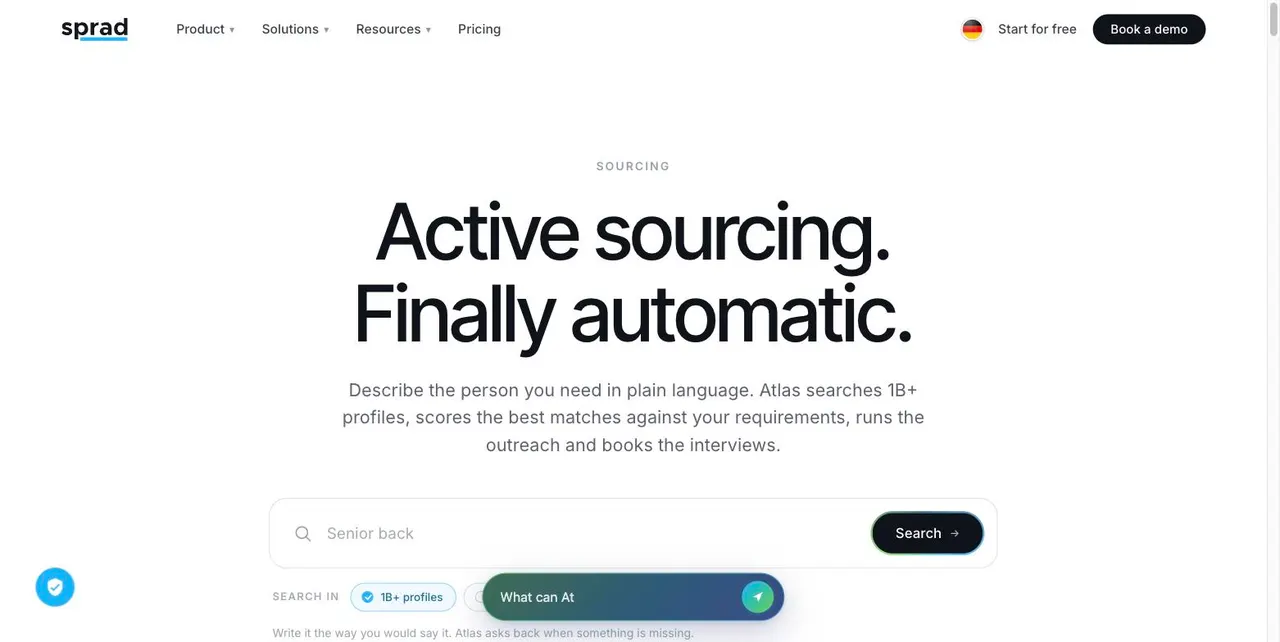
With Sprad's active sourcing tool you describe the role in plain words, for example "student of business informatics, Munich, can work 15 hours a week, has first experience with data analysis". The AI checks each profile against these requirements and gives a reason per requirement, and former interns and applicants in your own talent pool are searched at the same time. A voice pre-interview in 12 languages costs 30 credits per candidate, and checking a CV costs 2 credits. Recruiter Lite costs 79 € per seat and month, the free plan includes 100 credits a month, and a web search costs 2 credits per profile shown (pricing, status November 2026). We are the vendor here, and the steps above work without any tool.
Frequently asked questions
How many hours can a working student work?
Up to 20 hours a week during term. In the holidays more is possible, but not for more than 26 weeks (182 days) in 12 months, and the health insurer checks the case if work mostly falls on evenings, nights or weekends.
What do I pay in social insurance for a working student?
Of the main social insurance branches, only pension insurance, plus small levies and accident insurance. Health, long-term care and unemployment contributions are not due while the student status applies. Check the details with your payroll provider.
Do working students get paid at least the minimum wage?
Yes: 13.90 € an hour in 2026 and 14.60 € from 1 January 2027.
What do I need on file?
The enrolment certificate for every semester, the contract with weekly hours, and your time records. Working students are not covered during a leave semester.
What is the difference between an intern and a working student?
Interns work for a limited period in a field to learn, often as part of a degree. Working students are employees alongside their studies, usually for several semesters.
Jürgen Ulbrich
Jürgen Ulbrich has more than a decade of experience in developing and leading high-performing teams and companies. As an expert in employee referral programs as well as feedback and performance processes, Jürgen has helped over 100 organizations optimize their talent acquisition and development strategies.