To recruit skilled workers from abroad for a job in Germany, pick the residence route first (EU Blue Card, experience route, Western Balkans rule, Opportunity Card or recognition route), then source where that group is and, where the route allows it, use the accelerated skilled worker procedure. In June 2025, 420,000 insured employees held a work-based residence permit, up from just over 200,000 in 2020 (Bundesagentur für Arbeit, 18 February 2026).
More than half of them came with the EU Blue Card.
Which route fits your job? A decision table
| Route | Core condition | Best for |
|---|---|---|
| EU Blue Card (§ 18g AufenthG) | University degree and a minimum salary of 50 % of the annual pension contribution ceiling, or 45.3 % for listed occupation groups and career starters (degree not older than three years); the latter needs approval of the Federal Employment Agency | Engineers, IT, finance and other degree-based jobs |
| Skilled worker residence permit with recognised vocational qualification | Recognised foreign qualification equivalent to a German one and a job offer in the trained field | Trades, technicians, healthcare, logistics |
| Experience route (§ 19c para. 2 AufenthG with § 6 BeschV) | At least two years of relevant experience in the last five years, a qualification or degree recognised by the state where it was gained (no German recognition needed) and a salary of at least 45 % of the pension contribution ceiling, €45,630 in 2026 (collectively bound employers can pay the agreed rate). Candidates aged 45 or older on first entry need 55 % (€55,770) unless they have adequate retirement provision | Non-regulated jobs where German recognition would take too long |
| Western Balkans rule (§ 26 para. 2 BeschV) | Binding job offer; no particular qualification; citizens of Albania, Bosnia and Herzegovina, Kosovo, Montenegro, North Macedonia, Serbia; annual quota with approval of the Federal Employment Agency | Construction, hospitality, logistics, production |
| Opportunity Card (§ 20a AufenthG) | Skilled worker status or enough points in the points system; livelihood secured; up to one year to look for work, part-time work of up to 20 hours a week and trial work of up to two weeks at a time | Candidates who want to meet employers in person |
| Recognition route (§ 16d AufenthG) | Qualification not yet fully equivalent but reachable through a measure; the accelerated procedure can continue under this section | Healthcare and regulated professions |
The Blue Card figures change every year. The law fixes the percentages and the Federal Ministry of the Interior publishes the euro amounts in the Bundesanzeiger by 31 December of the previous year; with the 2026 contribution ceiling of €101,400 they come to €50,700 (50 %) and €45,934.20 (45.3 %). Check the current notice before you write a salary into an offer.
How big is the market, and where do candidates come from?
At the end of 2025, 471,000 non-EU citizens held a temporary residence permit for employment in the central register; the Blue Card was the most common permit, followed by the Western Balkans rule. The largest groups came from India (62,000), Kosovo (33,000) and Bosnia and Herzegovina (28,000) (Destatis). Just over a quarter of insured employees with a work-based permit are from the six Western Balkan states. The quota for that route was doubled to 50,000 a year in mid-2024; in December 2025 the Federal Employment Agency had to reject about 18,000 requests because the quota was exhausted. According to a draft ordinance (Bundesrat document 636/26) the quota is to fall to 25,000 from 1 January 2027; as of 9 November 2026 the Bundesrat had not yet given its consent, so check the status before you plan hires on this route. To approach candidates directly, an active sourcing tool can search public profiles by occupation, language and relocation signals.
Where to find skilled workers abroad
| Channel | What you get | Tip |
|---|---|---|
| Make it in Germany (federal portal) and the Federal Employment Agency's employer service | Official guidance, employer guide, checklist for recruiting abroad | Start here for your plan; the agency also advises on EU and non-EU hires. |
| Public professional profiles (LinkedIn and local networks) | Candidates who already work in your field abroad | Search by occupation, language and a willingness to relocate; see the strings below. |
| German chambers of commerce abroad and universities in the target country | Graduates and apprentices with a German connection | Good for junior and trainee roles. |
| Your own employees with foreign networks | Warm referrals | People move for colleagues they trust. |
| Opportunity Card holders already in Germany | Candidates available for trial work | Offer a trial day; the card allows up to two weeks of trial work at a time. |
| Your talent pool | Candidates from earlier searches | Re-contact when a role fits. |
Copy-and-paste search strings
Try each string in your own tool before you rely on it. Replace the bracketed parts.
| Goal | String |
|---|---|
| LinkedIn Boolean, engineers abroad | ("mechanical engineer" OR "electrical engineer") AND ("Germany" OR "German" OR "relocate" OR "Europe") AND ("[country]" OR "[city]") |
| Google X-ray, public profiles with German skills | site:linkedin.com/in ("[occupation]") ("German B1" OR "German B2" OR "Goethe" OR "learning German") "[country]" |
| Google X-ray, open to relocation | site:linkedin.com/in ("open to relocation" OR "willing to relocate") ("[occupation]") ("Germany" OR "EU") "[country]" |
| Plain language, for an AI search | Electrician or HVAC technician in [country] with 5+ years of experience, vocational qualification, some German or willingness to learn, open to moving to Germany |
Do not guess nationality or origin from a name. Search by occupation, location, language and relocation signals only.
Documents and steps: the order that avoids delays
- Check the profession. Regulated professions such as nursing and doctors need recognition of the qualification before they can work in the field; the portal "Anerkennung in Deutschland" explains the procedure. In 2025 the Federal Employment Agency alone held 23,600 consultations on recognition.
- Choose the route from the table and confirm the salary and approval requirements.
- Apply for the accelerated skilled worker procedure. Under § 81a AufenthG you sign an agreement with the immigration authority; it advises you on the documents, starts recognition procedures, obtains the agency's approval and informs the embassy, and gives a pre-approval for the visa once all conditions are met. The procedure covers §§ 16a, 16d, 18a, 18b, 18c para. 3 and 18g AufenthG, not the Western Balkans rule or the Opportunity Card. The authority has to invite you to discuss missing documents within three working days of receipt.
- Book the visa appointment in the candidate's country as early as possible. In the accelerated procedure the mission must offer an appointment within three weeks of the pre-approval and usually decides within three weeks of a complete application (§ 31a AufenthV); on other routes the appointment is often the longest wait.
- Plan the arrival: housing, language course, registration, bank account, and a named buddy for the first weeks.
The procedure includes the spouse and minor children if their visa applications are submitted promptly. This is what makes the offer attractive to a candidate with a family.
Language: how to check without a language test
A common failure is a hire whose language level is lower than the job requires. Decide the level you need (B1 may be enough for a warehouse role, B2 or higher for customer contact) and test it early. A short voice interview in the candidate's language and in German shows spoken level far better than a certificate on a CV. In Sprad, the AI voice interview runs in 12 languages and costs 30 credits per interview (pricing checked 9 November 2026); it supplements, but does not replace, a recognised language test where the law requires one.
Outreach template
Hello [first name], your experience as [role] at [company] caught my eye, especially [specific project]. We are a [industry] company in [city, Germany] and we are hiring a [title]. The salary is [range] gross per year, and we support the visa process, including the accelerated procedure, a language course and help finding housing. Would you be open to a 20-minute call? If Germany is not on your radar, no problem.
Be specific about salary and about who handles which step. Candidates abroad compare offers from several countries. More templates: recruiter outreach email templates.
Five questions for the first conversation
- What made you consider working in Germany, and what would make you stay?
- What is your current German level, and how do you plan to improve it?
- Which of your qualifications have been formally recognised, and where are you in the process?
- What does your family situation mean for timing and housing?
- When could you realistically start, given notice period and visa?
How to run this search with Sprad
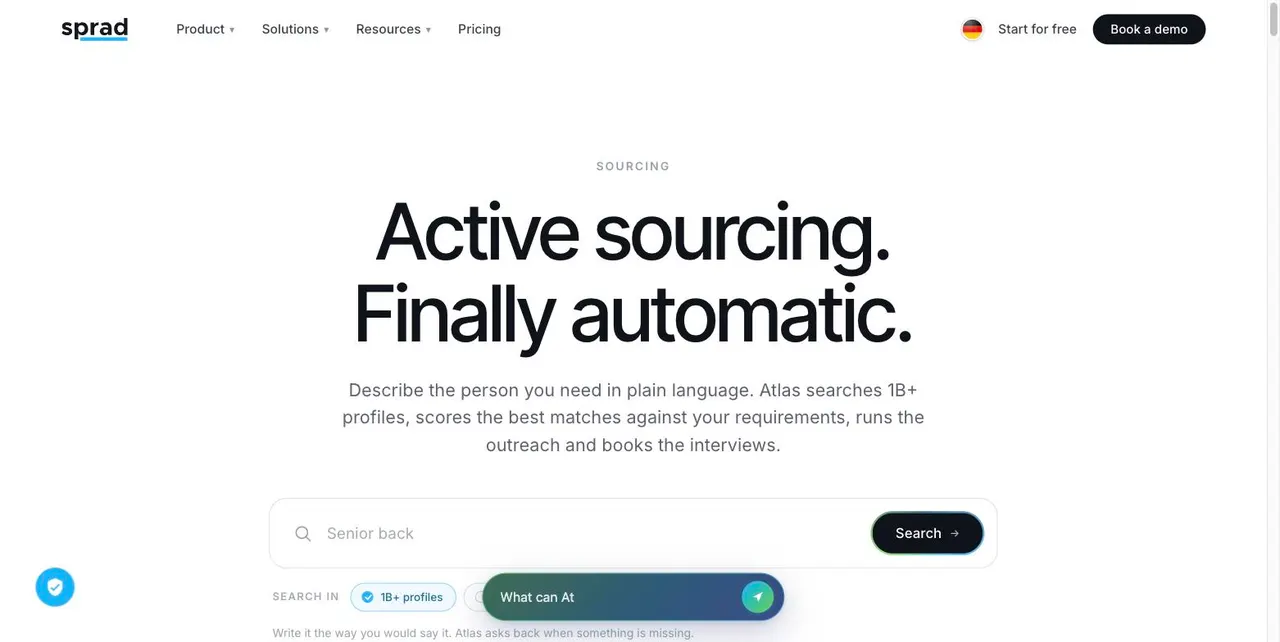
In Sprad Active Sourcing you describe the person you need in plain words, including language and relocation signals. Atlas searches public profiles and your own pool and checks each profile against your criteria, with a reason per requirement. Outreach via LinkedIn and email runs from one inbox, so you can see who has already been contacted. Everyone you find can stay in your talent pool, which matters for foreign hires because the path from first contact to start date often takes months.
A web search costs 2 credits per displayed profile within the budget you set per run; the free plan includes 100 credits per month, Recruiter Lite is €79 per seat and month (pricing, checked 9 November 2026). Automated LinkedIn and mailbox outreach is included in Atlas Recruiter (€299 per seat and month) and an add-on for Recruiter Lite (2,000 credits per person and month). Sprad does not check residence status, recognition or visa eligibility; that stays with the authorities and your legal advisers. For the wider German skilled-worker picture see how to find skilled workers in Germany, and for channels in general how to find employees.
FAQ
Which visa is fastest for employers?
There is no universal answer; the accelerated skilled worker procedure under § 81a shortens the path for the routes it covers, including the Blue Card. The Western Balkans route needs the agency's approval and is limited by an annual quota.
Can I hire without recognition of the qualification?
Not for regulated professions. For other jobs it depends on the route: the experience route (§ 6 BeschV), the Western Balkans rule and some Blue Card cases work without German recognition of the qualification. Check the route first.
What does it cost?
Costs include the agency or platform, language support, relocation help and legal advice. Compare them with your cost per hire for the same role in the domestic market.
Do I need to offer German lessons?
It is not a legal duty in general, but it is the biggest retention lever for foreign hires. Plan a course in the first months.
How long does it take?
The time from first contact to start date varies by country, embassy workload and route. In the accelerated procedure § 31a AufenthV sets three weeks for the visa appointment and, as a rule, three weeks for the decision; ask your immigration authority for the realistic time under your agreement before you promise a start date.
Jürgen Ulbrich
Jürgen Ulbrich has more than a decade of experience in developing and leading high-performing teams and companies. As an expert in employee referral programs as well as feedback and performance processes, Jürgen has helped over 100 organizations optimize their talent acquisition and development strategies.