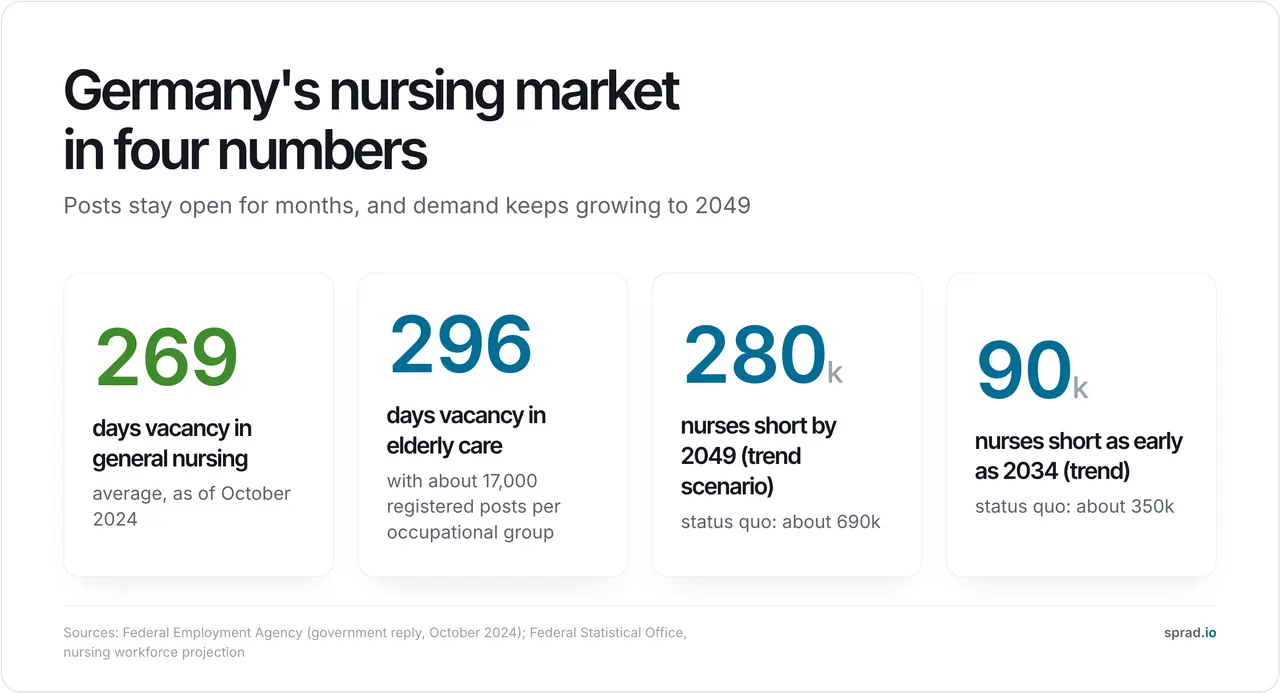
You find nurses through active sourcing by approaching registered nurses with the right specialty and training directly, even if they are not looking, and giving them a concrete reason to move. Add returners, referrals from your own team and networks outside job boards. It pays off because posts stay open for months: according to a German government reply, the average vacancy time in October 2024 was 269 days in general nursing and 296 days in elderly care. In Germany, direct outreach is lawful if you write once, briefly and with a privacy notice (as of 30 October 2026).
What does “nurse active sourcing” mean in practice?
Active sourcing means you do not wait for applications; you search for and contact suitable nurses yourself. In nursing this mostly concerns three groups: nurses in neighbouring hospitals who may be open to a move, specialists with additional training (intensive care, anaesthesia, theatre, paediatrics, palliative) and former nurses who could imagine returning. Since 2020 the German Nursing Professions Act uses the title “Pflegefachfrau/Pflegefachmann”; also search for “Gesundheits- und Krankenpfleger”, “Altenpfleger” and “Pflegefachkraft”.
The demand is structural. The Federal Employment Agency shortage analysis lists 157 occupations with skilled-labour shortages for 2025, with the strongest still in nursing and health care. In its nursing workforce projection (calculated 2023, data up to 2019) the Federal Statistical Office expects about 90,000 missing nurses by 2034 in the trend scenario and about 350,000 under status quo; by 2049 about 280,000 and 690,000. Your search is rarely a reach problem; it is a fit and trust problem.
How do I go about it step by step?
Eight steps you can repeat for every hire:
- Split the profile into must-have and nice-to-have. Licence, specialist training, practice-instructor qualification and shift model are usually musts; extra courses and leadership experience are nice-to-haves. Searching only for “intensive care nurse” misses anaesthesia and emergency staff for whom ICU is the next step.
- Decide the reason to move before you write. What is genuinely better: a reliable rota without being called in on days off, part-time options, training budget, team size, commute, pay scale? “Family atmosphere” does not count while everyone claims it.
- Combine sources. LinkedIn and XING for visible profiles, plus your ward managers' and staff members' networks, your own pool of past applicants and former nurses of your hospital.
- Prioritise. Professional fit before location, location before signals of a move. Age, gender or origin are not selection criteria (AGG).
- Write once, personally. Short, factual, from someone in nursing (template below).
- Follow up twice. After about a week with a new argument, after three to four weeks with an offer of a trial shift or visit. Then stop.
- Pre-qualify quickly. A short call or a chat or voice interview clarifies licence, shift preference, start date and language level before anyone comes to the ward.
- Measure. Reply rate, positive reply rate, conversations and trial shifts per post, days to offer. Without these you cannot tell whether profile, message or channel is weak.
Which channels, tools and templates help?
No channel works alone, and many nurses have no maintained online profile. The table ranks the usual routes by strength and limit; actual costs depend on your organisation and contract.
| Channel | Strength | Limit |
|---|---|---|
| Job boards and career site | Reach active job seekers; the career site stays findable | Employed nurses often never see the ad; many hospitals compete for the same readers |
| Social recruiting (Facebook, Instagram, TikTok) | Reaches nurses where they already are, even without a business-network profile | Needs budget and ongoing care; reach is not fit |
| Employee referrals | Nurses know nurses; high fit | Small pool, needs reward and process |
| Winning back former nurses | Already trained, know the house | Return depends on conditions such as staffing levels and rota |
| Active sourcing via LinkedIn and XING | Direct access to nurses who are not looking | Only profiles that are maintained and visible; outreach needs care and data protection |
| Agencies and temp work | Fast for acute gaps | Expensive for permanent needs, does not tie nurses to your hospital |
| International recruitment | Widens the pool considerably (about 20% of the workforce already hold a foreign nationality) | Recognition and language level take time and support |
How much it matters to look beyond online profiles shows in the Bremen Chamber of Labour survey “I will nurse again if …” of 1,032 former nurses: over 87 percent do not rule out a return, mainly asking for appreciation from managers, time for good care, needs-based staffing and collective pay agreements. The survey is regional (mostly Bremen) and shows willingness, not commitments. For total workforce (about 1.76 million, of whom about 352,600 foreign nationals, 2025) see the Mediendienst Integration factsheet.
Template: first message to an ICU nurse
Hello [Name], your intensive care training and your experience with [ventilation/ECMO] at [hospital] fit a post on our 12-bed ICU in [city]: a fixed team with its own float pool (no being called in on days off), part-time from 60% and paid training days. If a move is not on your mind at all, a short note is enough and I will not write again. How we handle your data is explained here: [link]. Kind regards, [name, ICU ward manager]
The sender should come from nursing: a ward manager writes differently from HR and is read differently. That is a practical recommendation, not a measured value. The follow-up only adds something new (for example a date for a trial shift), never the same text again.
What does it cost? A worked example
Assumptions (not measured values, replace with your own): you fill one nursing post, review 100 profiles, contact the best 60, get 20% replies (12), hold 6 conversations and 3 trial shifts and win one acceptance. With Atlas by Sprad, sourcing costs credits: two “Normal” searches at 100 credits each return up to 100 qualified profiles (2 credits per profile shown), “find email” for 60 people costs 60 credits. Together 260 credits. In the Atlas Base package (€450 a year including 5,000 credits, €0.09 per credit) that is about €23 for researching this hire. The outreach itself is not included.
For ten open posts at the same rate it is 2,600 credits or about €234; the annual package covers roughly 19 such hires. Weigh that against what a month of vacancy costs you: overtime, team absences, agency staff. Only you know the figure. All prices per sprad.io/pricing, net, as of 30 October 2026. To test first, use the free account with 100 credits a month (200 in the first month).
What does AI change?
Classic searches work on keywords: someone without “intensive care” in their profile drops out even after ten years on an ICU. AI searches that check every profile against your requirements also find thinly maintained profiles. Rule of thumb: if results appear instantly, it is almost always a keyword search. The deep search in Atlas takes a few minutes because it checks every hit (quick search returns in about three seconds).
At Sprad this runs as one search across LinkedIn, XING, GitHub and your own talent pool, sources with over a billion profiles combined. On top come networks nobody else sees: upload your own LinkedIn network, your ward managers and staff share theirs, and past applicants connect to your pool. Outreach goes via LinkedIn and email, automated including follow-ups; everything lands in one inbox, and the system warns if someone was already contacted, even by a colleague for another ward. For pre-qualification there are chat, voice and video interviews in several languages.
In the Recruiting area of the public PeopleSearchBench, Atlas reaches 73.5 out of 100 in our own re-measurement, converted to the published scale. The benchmark measures general recruiting searches, not nursing-only searches. PeopleSearchBench (Recruiting), published by Lessie, October 2026. Other systems' scores as published in the benchmark; Atlas is our own re-measurement with the benchmark's open test procedure, converted to the published scale; not an official entry. Honest limits: Atlas finds what is publicly visible; nurses without a profile are reached through networks, referrals and social recruiting. There is no AI note-taker, no placement reporting and no SMS channel (WhatsApp exists for candidate communication). More at active sourcing and talent network.
What are the legal points?
Data protection: For contacting public profiles, legitimate interest under Art. 6(1)(f) GDPR is the usual basis. If you did not collect the data from the person, Art. 14 GDPR requires you to inform them at the latest at first contact and within one month: source, purpose, retention, right to object. A link in the first message does that.
Unfair competition law (Germany): A chat or private message is widely treated as electronic mail under Sec. 7(2) no. 3 UWG; mere membership of a network is no consent. Law firms such as Noerr (2019) therefore distinguish mass “recruitment spam” from targeted outreach to a few individually chosen candidates, with a first contact that does not go beyond what is necessary. For calls at work, the Federal Court of Justice (4 March 2004, I ZR 221/01) allows a short first call. The law is evolving and differs in Austria and Switzerland; have your legal team check your approach.
EU AI Act: AI used to select or hire people is high-risk under Annex III. After the Digital Omnibus (Regulation (EU) 2026/1744) the obligations apply from 2 December 2027; the transparency duty under Art. 50 applies since 2 August 2026. Either way: a machine prepares, people decide.
Which mistakes should I avoid?
- Pasting the job ad as the message. A message that could go to anyone goes to no one.
- Missing the specialty. ICU, anaesthesia, emergency and intermediate care are related but not interchangeable; likewise general nursing and elderly care.
- Relying on job boards alone. They reach people who are already searching and put you against every other hospital.
- Promising what the rota does not deliver. “Reliable shifts” without a float pool ends in a refusal after the trial shift.
- Forgetting former staff. Your own pool of past nurses and applicants is the cheapest source.
- Skipping the privacy notice or storing data without a deletion concept.
- Too many follow-ups. Two are enough; whoever does not reply is not written to a fourth time.
- Not measuring. Without reply rates per message and channel, you improve nothing.
Frequently asked questions
How do I find nurses who are not actively looking?
Through targeted direct outreach with a concrete reason to move, referrals from your own team and networks. Employed nurses rarely read ads but do respond to a personal message with a fitting offer.
May I contact nurses directly?
Yes, if you write once, briefly and with a privacy notice and respect a no (Art. 14 GDPR, Sec. 7 UWG). This is not legal advice.
Does active sourcing work in nursing if many have no LinkedIn?
Yes, but not alone. Combine it with staff networks, win-back and social recruiting. Active sourcing reaches the visible ones; the other routes reach the rest.
How long does a hire take?
Plan for months: average vacancy time in October 2024 was 269 days (general nursing) and 296 days (elderly care). Direct outreach shortens the search for the person, not the notice period.
Does AI help nurse recruiting?
Yes, for search, shortlisting and pre-qualification. The decision stays with people; data protection and the EU AI Act apply when you introduce it.
Further reading: Recruiting in healthcare, Nursing shortage in Germany 2026 and How to hire elderly care nurses. For organisations without a recruiting team: active sourcing for SMEs. Want to try Atlas on a real nursing post? Start free.
Jürgen Ulbrich
Jürgen Ulbrich has more than a decade of experience in developing and leading high-performing teams and companies. As an expert in employee referral programs as well as feedback and performance processes, Jürgen has helped over 100 organizations optimize their talent acquisition and development strategies.