A recruiting strategy is a written plan that answers four questions: which roles will you hire for, who are the people you want, through which channels will you reach them, and what may it cost and deliver. It is shorter than most people expect: two to four pages, reviewed every quarter. Talent acquisition strategy is the same plan with a longer horizon and more on employer brand; the six steps below cover both. Where the plan stops at "which channels", the details of finding people are in the candidate sourcing strategy playbook.
What belongs in a recruiting strategy? Six steps
- Demand. Hires planned for the next 6 to 12 months by role family, plus expected leavers. Mark which families are critical (they stay empty longest or cost most while empty).
- Target groups. For each family: who are the people, where do they spend time, what makes them move? Two sentences per family are enough. Write the must-haves once, because every channel and screening step reuses them.
- Channels. Choose two to three per family with the table below, not ten.
- Budget. Cost per hire target per family and a total, see the worked example.
- Process standards. Reply to every applicant within a set time, a feedback deadline for managers, an offer within 48 hours. Strategy fails more often here than in the choice of channels, see the recruitment process in nine steps.
- Measurement. Time to fill, offer acceptance, cost per hire and share of hires from your own pool, reviewed monthly (definitions in what is talent acquisition).
Which recruiting channels fit which role?
The rule that holds across most plans: the more people apply on their own, the more reach and speed matter; the scarcer the profile, the more direct search and your own pool matter. The table shows where each channel fits and where it fails. It is a decision aid, not a ranking.
| Channel | Fits | Limit | Measure |
|---|---|---|---|
| Own pool, past applicants, referrals | All roles, cheapest per hire | Stale data, needs upkeep | Share of hires from the pool |
| Career site and search visibility | All roles, builds slowly | Takes months to pay | Applications per visit, source of hire |
| Job boards (for example StepStone, Indeed) | Roles where many people search actively | Pay per posting or click, competition on the same page | Cost per qualified applicant |
| Active sourcing (LinkedIn, XING, public profiles) | Scarce or senior profiles, passive candidates | Time per contact, consent and data rules | Reply rate, interested per 100 contacts |
| Social recruiting (Meta, TikTok) | Frontline and trades roles, people who do not read job boards | Needs a simple apply path on mobile | Cost per application, see social media recruiting strategy |
| Agencies and headhunters | Critical, rare or confidential roles, peaks | Fee per hire, less control of the message | Fee ÷ time saved, see hiring without agencies |
Two practical points. First, do not choose a channel because a competitor uses it; choose it because your last ten hires for that role family came from there or because the table says the role fits. Second, track "source of hire" from the first application, otherwise the budget review in step 4 argues from feelings. For the DACH legal frame per channel see recruiting in DACH: channels, tools and rules.
How do you budget a recruiting strategy? A worked example
Cost per hire = all internal and external recruiting costs in a period ÷ hires in that period. The numbers below are assumptions for illustration, not benchmarks.
- Plan: 20 hires next year, 12 volume roles and 8 professional roles.
- Volume roles via job boards and social: assumed 800 € media spend per hire, so 12 × 800 = 9,600 €.
- Professional roles via active sourcing and pool: assumed tool cost 6,000 € per year plus 1,500 € of other costs, so 7,500 €.
- Recruiter time is the biggest cost and the one most plans leave out. At 0.5 full-time equivalent and assumed 60,000 € loaded cost: 30,000 €.
- Total 47,100 € ÷ 20 hires = about 2,355 € per hire.
Replace each assumption with your own and the plan becomes a conversation about where one euro buys the most hires. If one family costs three times the others, check the channel and the role profile before you cut the budget.
What goes wrong in recruiting strategies?
- Everything is a priority. Pick two or three role families for the next quarter.
- Channel list without owner. Each channel needs a named person and a monthly number.
- The strategy ignores the hiring manager. Feedback deadlines and a signed role profile belong in the plan.
- No review. A plan that is not looked at after one quarter is a document, not a strategy.
How does Sprad support a recruiting strategy?
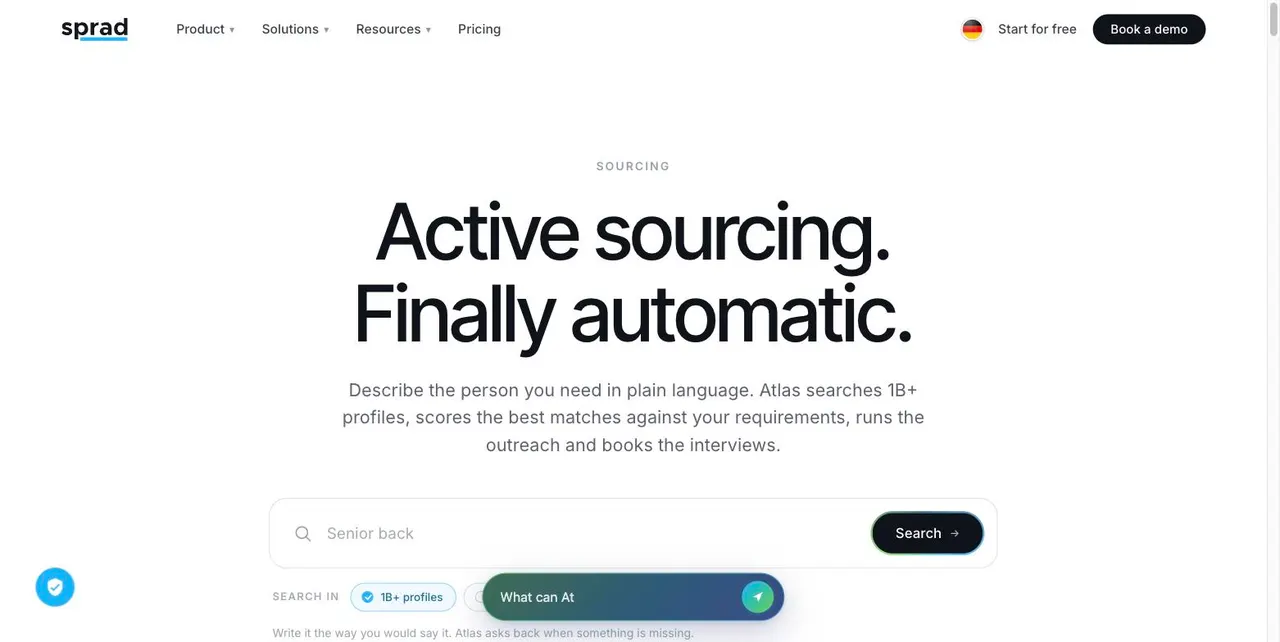
Sprad is a vendor of this kind of software, so read this with that in mind. For scarce profiles, Active Sourcing searches public profiles and your own network by requirement, checks every profile against your criteria and runs LinkedIn and email outreach from one inbox. The Talent Network keeps your pool current and shows the share of hires from it. For frontline roles, the social recruiting service runs ads on the networks: from €1,000 per month. Credit prices are on the pricing page. Sprad does not do workforce planning and does not decide the channel mix for you.
FAQ
What is a recruiting strategy?
A written plan for which roles you hire, which people you target, which channels you use, what it may cost and which numbers you review.
What is the difference between a recruiting strategy and a talent acquisition strategy?
Mostly the horizon. A recruiting strategy plans the next quarters of hiring; a talent acquisition strategy adds workforce planning, employer brand and the pool for later years.
Which recruiting channels work best?
None in general. Your own pool and referrals are cheapest per hire, job boards fit roles many people search for, active sourcing fits scarce profiles, social recruiting fits frontline roles.
How do I choose recruiting channels?
Per role family: look at where your last ten hires came from, check the channel table, and choose two to three channels with a named owner and a monthly number.
How often should I review the strategy?
Numbers monthly, the plan every quarter.
Jürgen Ulbrich
Jürgen Ulbrich has more than a decade of experience in developing and leading high-performing teams and companies. As an expert in employee referral programs as well as feedback and performance processes, Jürgen has helped over 100 organizations optimize their talent acquisition and development strategies.