The best AI tools for a recruitment agency are the ones that cover your bottleneck, which is usually sourcing and first outreach, not another database. AI now helps at five points of an agency's flow: matching CVs to vacancies, searching for candidates, reaching them, pre-qualifying them and keeping them in a network. Most tools cover one or two of these. Sprad is the pick if sourcing is the bottleneck: every profile is checked individually against your requirements, LinkedIn and email outreach run in one inbox, and your own talent network stays yours after you cancel. Classic agency systems such as Bullhorn, Recruit CRM or Recruiterflow add AI to the database you already run.
What counts as an AI tool for a recruitment agency?
Three kinds of products get sold under the same label. Agency systems (ATS/CRM) hold candidates, clients and mandates and add AI for CV parsing, matching and automation. Sourcing tools find people who have not applied, from LinkedIn, XING, GitHub or a bought profile index, and increasingly write to them. Screening and chat tools talk to people who already applied or replied. An agency lives on the speed from vacancy to a qualified shortlist, so the useful question is not “which tool has the most AI?” but “at which stage do we lose time?”
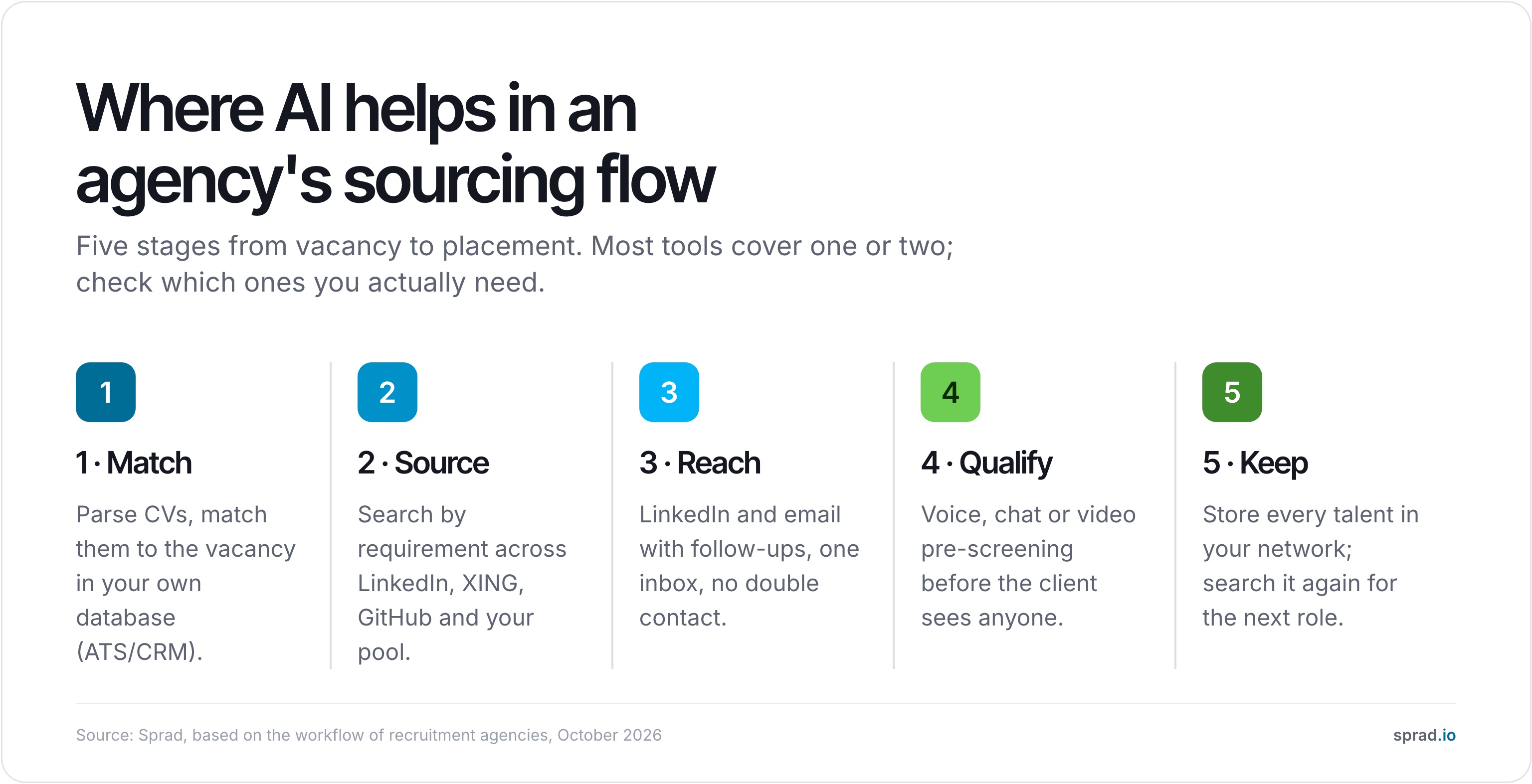
In our experience agencies buy the wrong layer first: they add an AI feature to the ATS they already have, while the real delay sits in stage 2 and 3, finding the right people and getting an answer. A matcher cannot match people who are not in the database yet.
Does AI pay off for agencies? What the data says
The strongest agency-specific data point we found is Bullhorn's 2026 GRID survey of nearly 2,300 recruitment professionals: agencies using AI at any stage of the recruitment cycle were 3.5 to 4.5 times more likely to report revenue growth in 2025, and recruiters said AI makes candidate screening 50–75 % faster (vendor survey; the report page gives no field dates). Read it with care: well-run agencies adopt tools earlier and do many other things right, so this is a correlation, not proof that the software caused the growth. The sceptical counterpart is a Gartner survey of 114 HR leaders from October 2025, in which 88 % said their teams had not yet seen significant business value from AI tools, and Gartner also estimates that over 40 % of agentic AI projects will be cancelled by the end of 2027. Both fit together: AI pays off where it removes a measured delay, and fails where it is bought as a label.
How we compared the tools
Five criteria decide whether a tool saves an agency time. We use them for the table and every profile.
- Candidate check: does the tool read each profile against your requirements and give a reason, or does it rank by keywords? Our rule of thumb from building a requirement search: if results appear instantly, it is almost always a (semantic) keyword search.
- Reach: LinkedIn, email, both? One inbox per talent, or two or three channels with double contact?
- Own data: do you keep your talent network and an export after you cancel?
- Agency fit: several clients in one account, pool of former candidates, client side (BD, mandates).
- Price and EU readiness: published price per seat or per credit, hosting, DPA, German and European sources such as XING.
The 7 best AI tools for recruitment agencies compared
| Tool | Type | Candidate data / search | Outreach | Price (public info, Sept./Oct. 2026) |
|---|---|---|---|---|
| Sprad | Sourcing + outreach + pre-qualification + talent network | Requirement search over 1B+ profiles (LinkedIn, XING, GitHub), your own pool and employee or ex-candidate networks; every profile checked individually | LinkedIn, email and InMail in one inbox, agents with optional approval | Free start (100 credits/month); Recruiter Lite 79 €/seat/month; Atlas Recruiter 299 €/seat/month |
| Juicebox | Natural-language search + agents | 800M+ profiles from 30+ sources (vendor claim) | Mostly via integrations; agents run outreach | Starter 99 $/month (annual); agents 199 $ each/month |
| Loxo | ATS + CRM + candidate database | 1.2B-profile database (vendor claim), contact finder | Email sequences, integrations | Core 149 $, Professional 199 $ per seat/month (annual) |
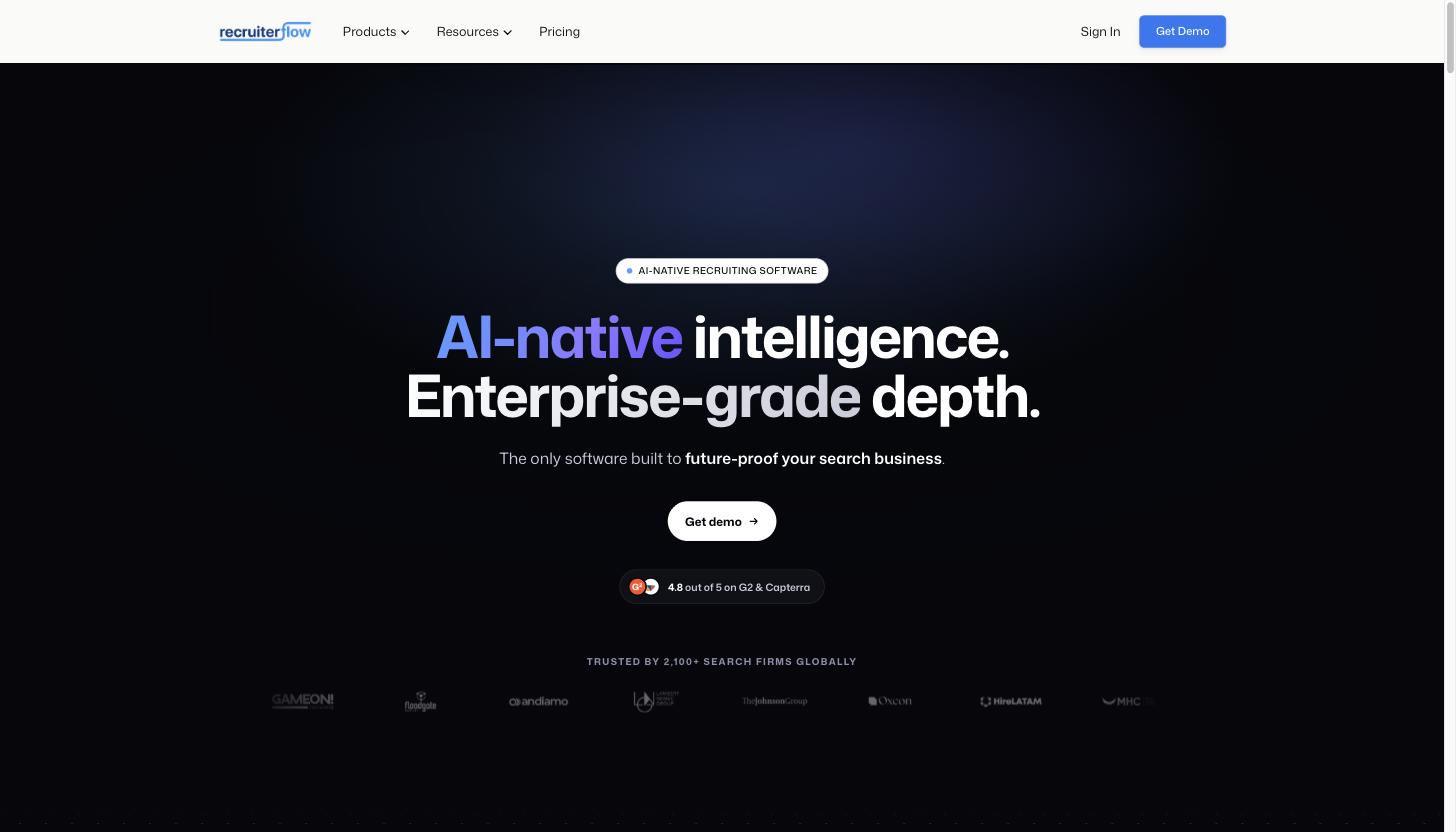
| Recruiterflow | Agency ATS/CRM + automation | Your own database; Chrome extension for LinkedIn | Email and SMS sequences (Pro and up) | 99 / 129 / 159 $ per seat/month, 3 seats minimum; AI matcher in the top plan |
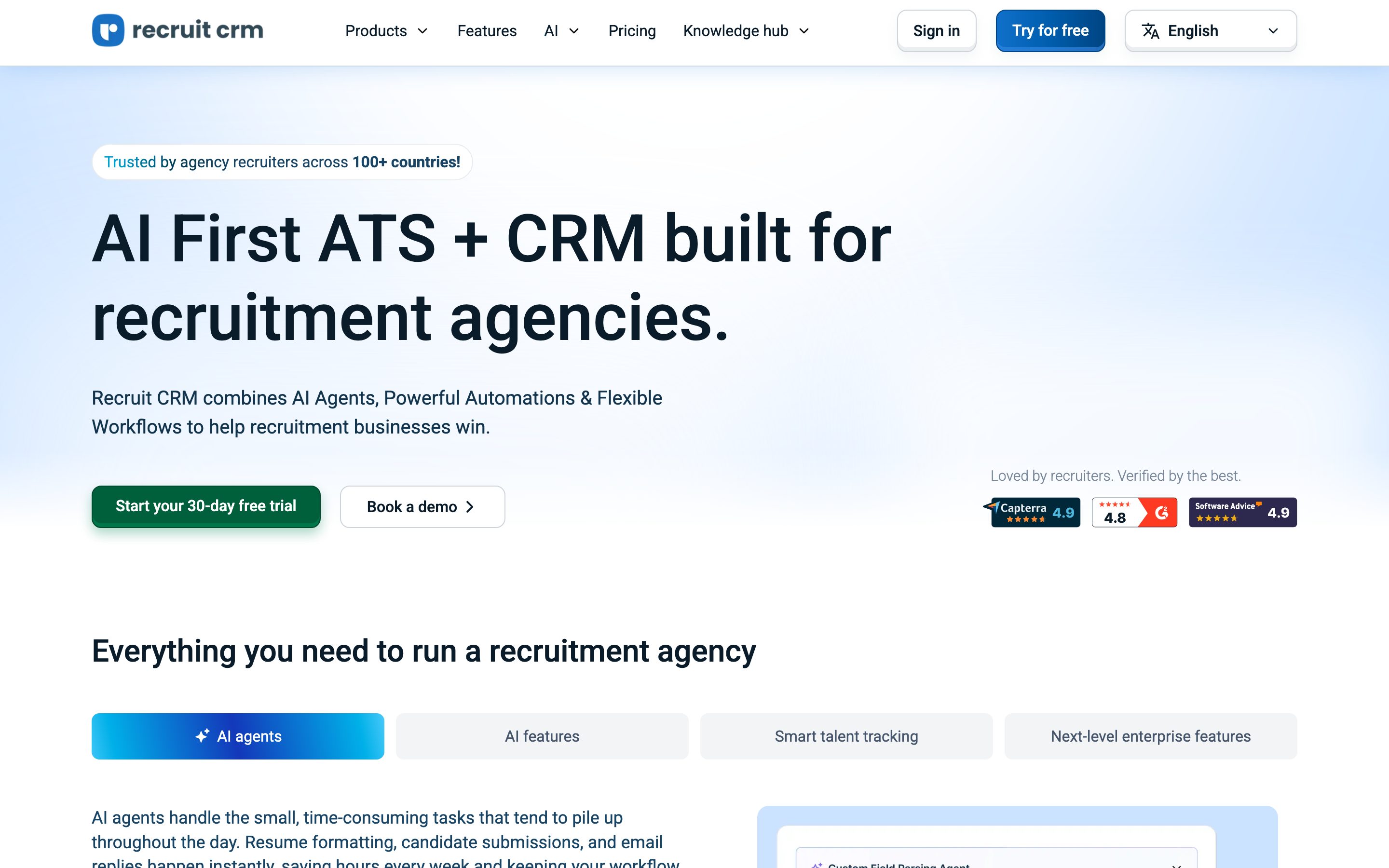
| Recruit CRM | Agency ATS/CRM | Your own database, AI CV parsing | Email sequences | About 80–100 $ per seat/month (annual) |
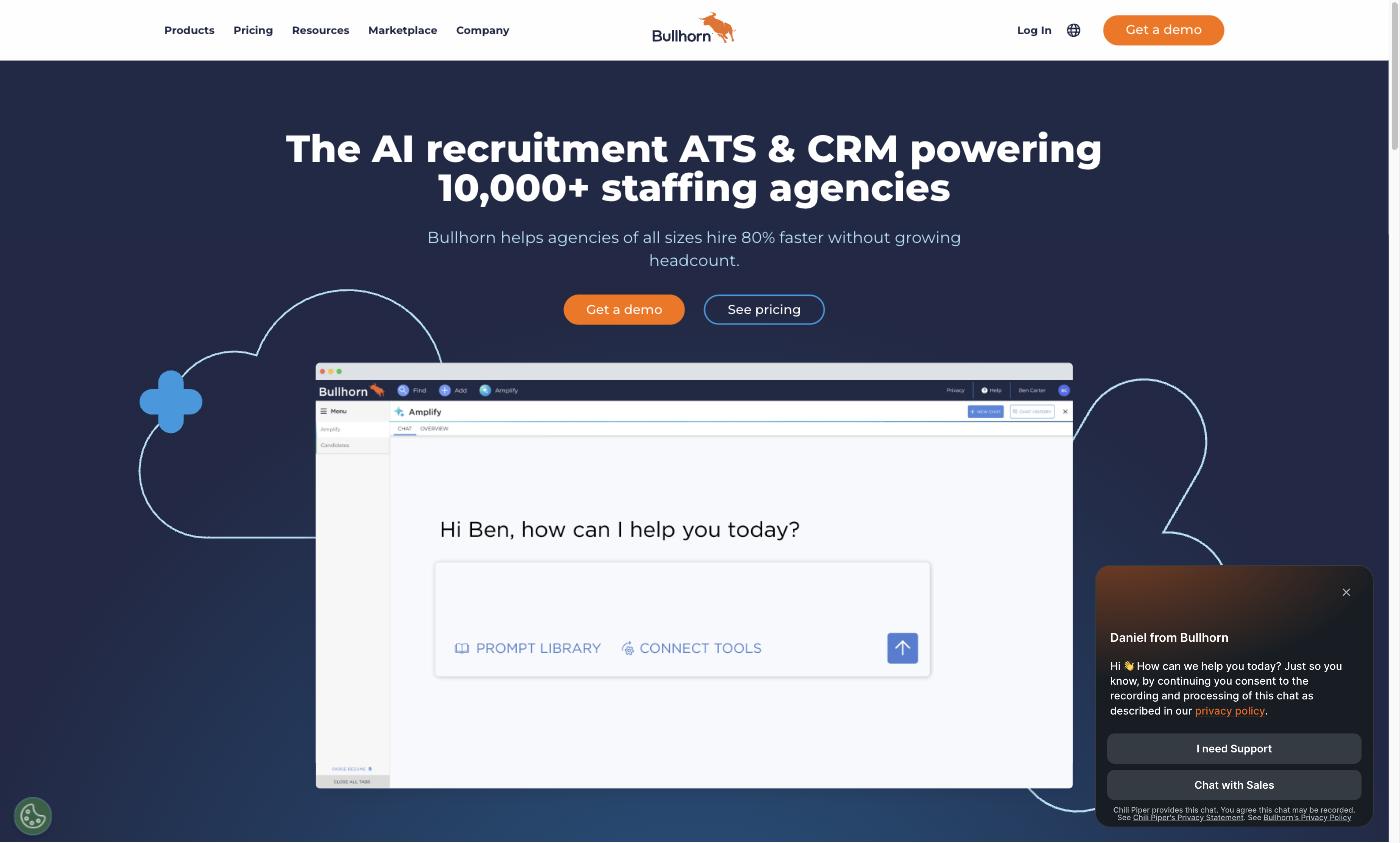
| Bullhorn | Agency ATS/CRM, large estate | Your own database; AI search in Pro and Max | Automations, chatbot (higher plans) | Starter 99 $, Core 165 $; AI plans on quote |
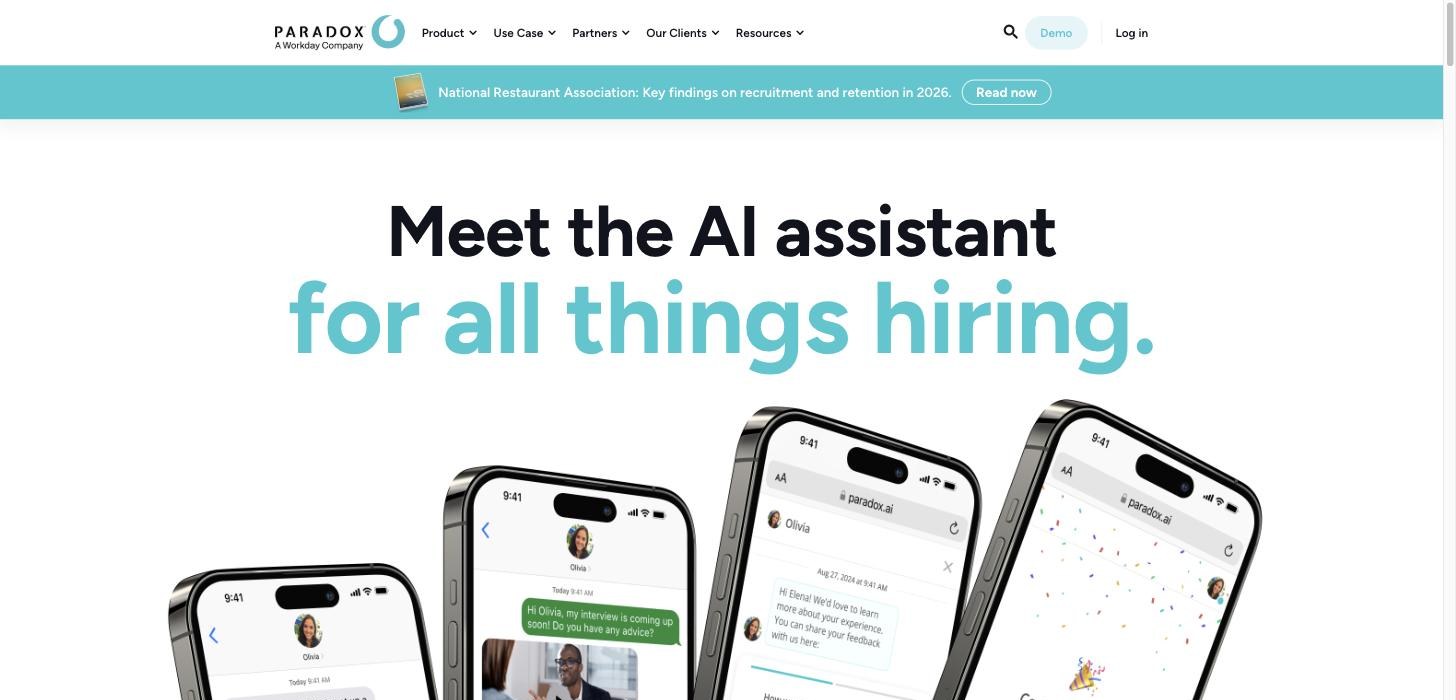
| Paradox | Conversational AI for screening | Applicants only, no sourcing | Chat, text, scheduling | Not published in the sources we checked |
Currencies differ (Sprad net in euros, US tools in dollars) and vendors change prices, so read the figures as list prices at the time of writing. Capabilities of the competitors are taken from their own pricing and product pages, not from tests of our own.
1. Sprad — best if sourcing and outreach are the bottleneck
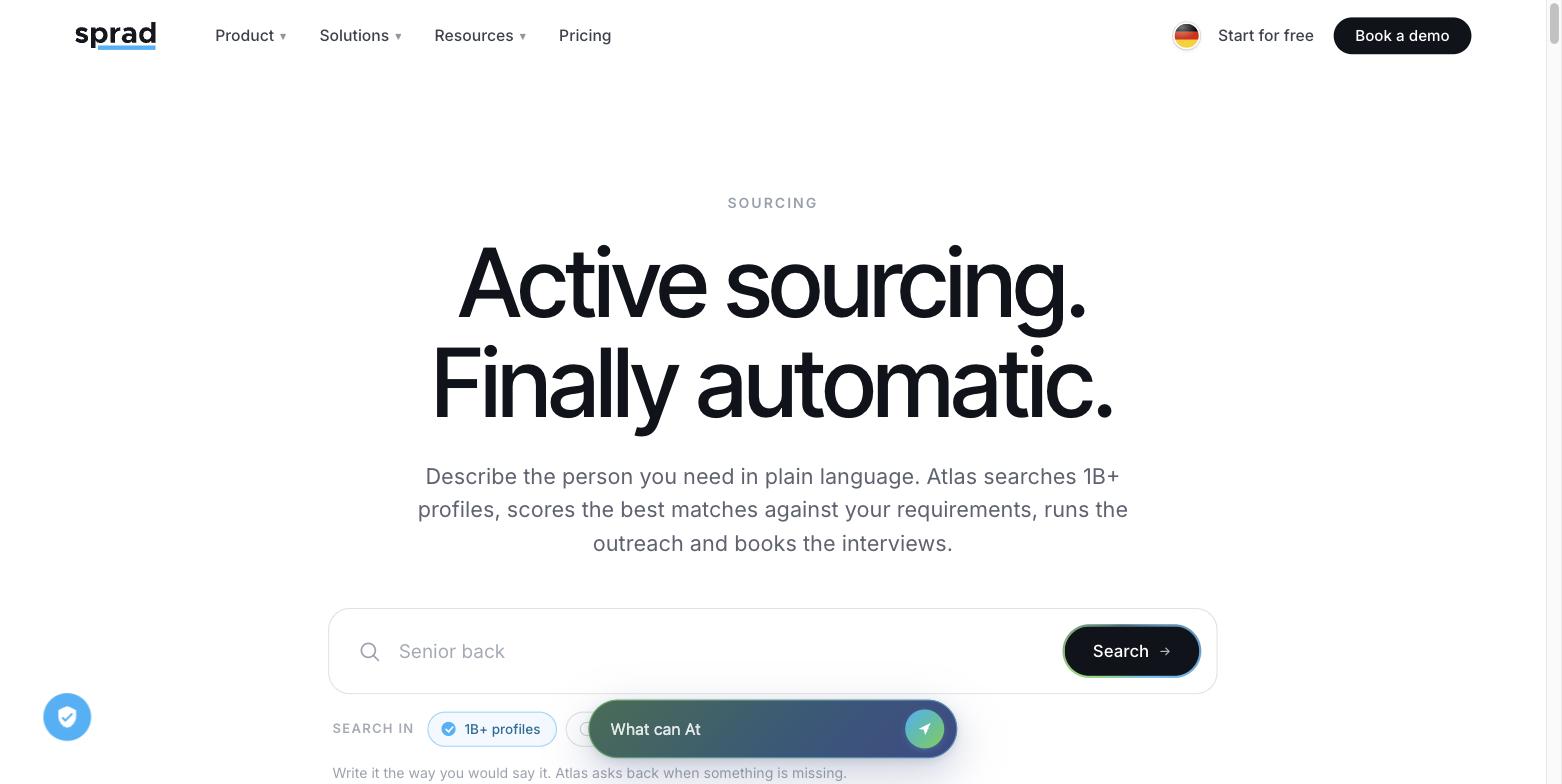
Sprad takes a requirement instead of a Boolean string. Atlas, the sourcing product, checks every profile individually and gives a reason per requirement, so it also finds people whose profile is poorly maintained or lacks the “right” keywords. For agencies two things matter most: you can invite former placed candidates to connect their networks and search inside them, and you can upload your own LinkedIn network and see whom you are already connected to. Deep Context adds company history to the search, for example a CFO who led an acquisition in a given period.
- LinkedIn and email in one inbox: automated outreach with follow-ups, InMails from Sprad, AI templates you can train. The system warns if a talent was already contacted, also by a colleague or for another role. Combining email and LinkedIn is, in our experience, the biggest lever for reply rates.
- Agents with a choice: fully automated agents for outreach and pre-qualification, with an optional approval step; included in Atlas Recruiter.
- Pre-qualification: voice, video, chat and agent interviews in several languages before the client sees anyone.
- Your data stays yours: after cancelling, the talent network stays free to use, with a full raw-data export.
Benchmark: in the recruiting area of the open PeopleSearchBench (119 real search tasks) our own re-measurement puts Atlas at 73.5 of 100, converted to the published scale. In it Atlas returned almost always 15 matching profiles per search (14.2 on average).1 Sprad is the vendor of Atlas itself. In Sprad's own test (15 August 2026, three real roles in three markets, one documented run) Sprad returned 38 % of the hits against 9 % for the best competitor in that test. Sprad has built recruiting software for 7 years, starting with employee referrals, which is matching profiles to requirements. More: Sprad for recruitment agencies and Active Sourcing.
1 PeopleSearchBench (Recruiting), published by Lessie, October 2026. Other systems' scores as published in the benchmark; Atlas is our own re-measurement with the benchmark's open test procedure, converted to the published scale; not an official entry. Contact data came from the “find email” button. Method and details.
2. Juicebox — free-text search for solo recruiters
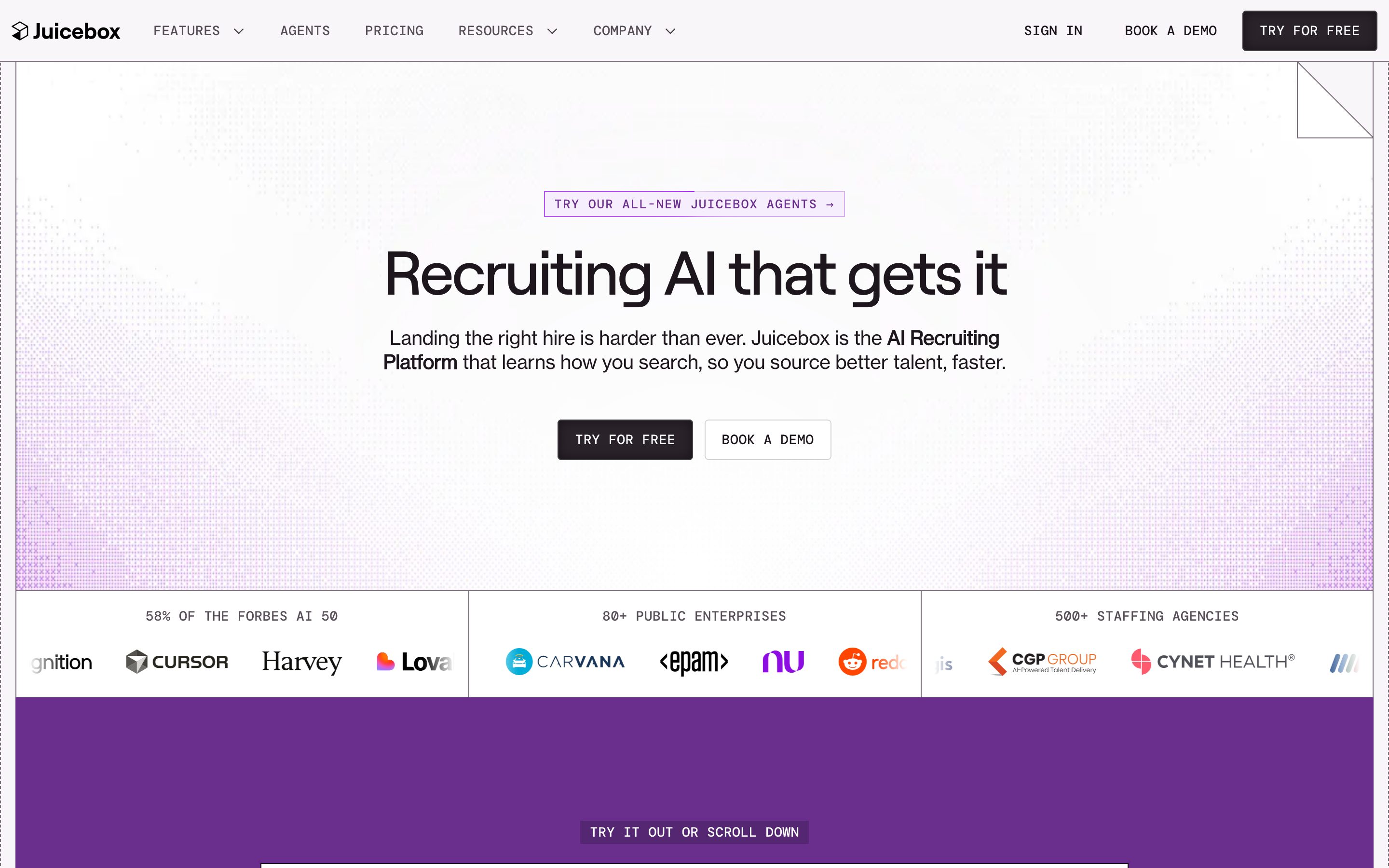
Juicebox is the closest in how it searches. It is cheaper at the very entry, but the picture changes once agents are added: five recruiters with an agent each come to 5 × 99 $ + 5 × 199 $ = 1,490 $ per month.
3. Loxo — the agency ATS with its own candidate database
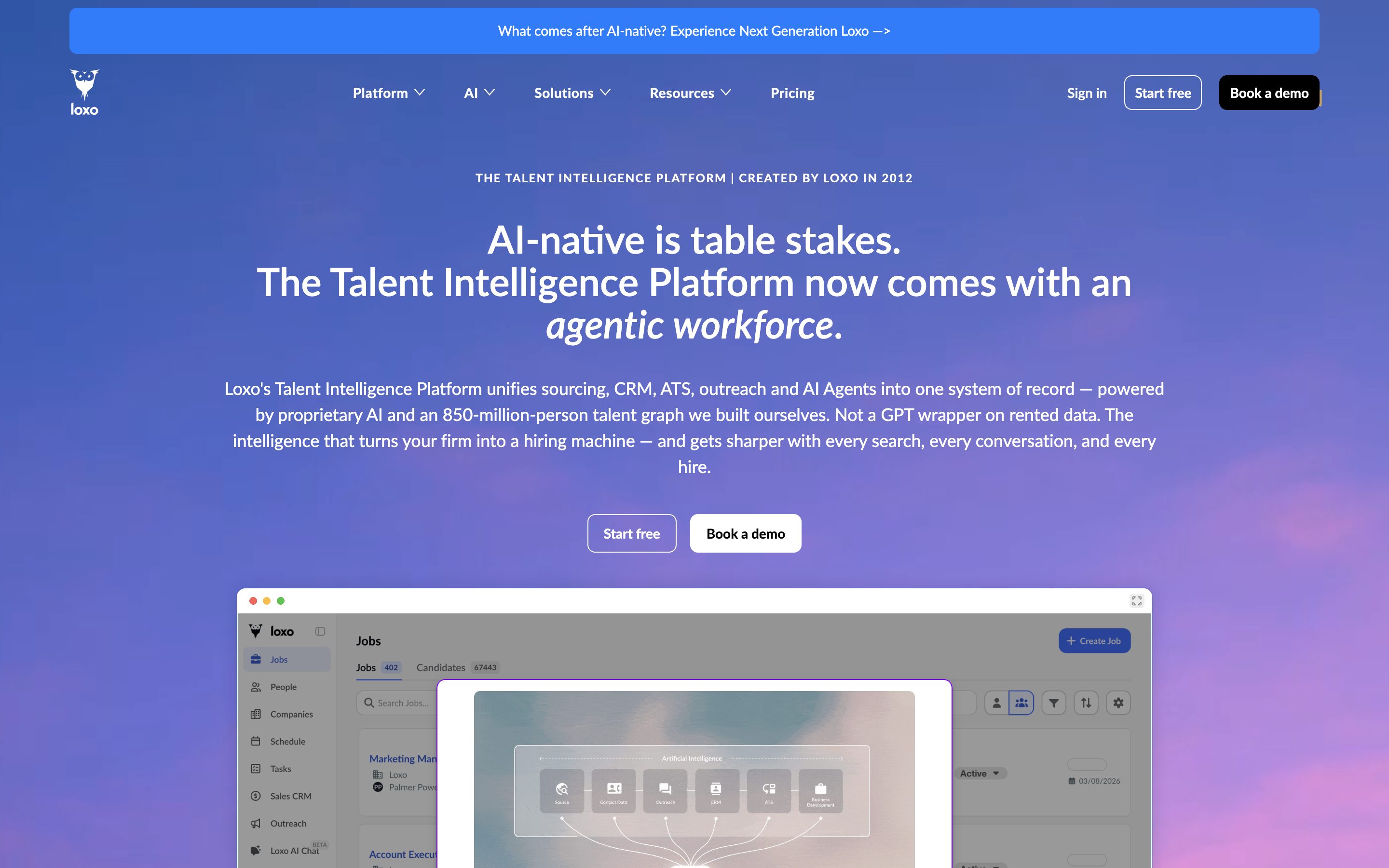
Loxo bundles a large candidate database with the ATS, which is why its seat price looks high; it replaces a database subscription, not only a sourcing tool.
4. Recruiterflow — automation-first agency CRM
5. Recruit CRM — the lean all-rounder
6. Bullhorn — the large-agency standard
7. Paradox — screening chat for volume, not sourcing
What does it cost? A worked example for 5 recruiters
Assumption: an agency with five recruiters, one seat each, annual billing, net list prices as of October 2026, no negotiation. We compare the AI-relevant plan per tool.
| Setup | Per recruiter/month | 5 recruiters/month | What you get |
|---|---|---|---|
| Sprad Recruiter Lite | 79 € | 395 € | 500 profiles + 50 pool searches per seat, Quick/Normal search included, ATS/CRM and talent network included |
| Sprad Atlas Recruiter | 299 € | 1,495 € | Unlimited (fair use) search incl. deep search, 1 LinkedIn and mailbox agent per seat, several clients |
| Juicebox Starter + agent | 99 $ + 199 $ | 1,490 $ | Search and one agent each; ATS separate |
| Loxo Professional | 199 $ | 995 $ | ATS + CRM + candidate database + AI search |
| Recruiterflow Enterprise | 159 $ | 795 $ | ATS + CRM + automation + AI matcher; ATS/CRM bundled |
| Bullhorn Core (no AI search) | 165 $ | 825 $ | ATS + CRM; AI plans on quote |
Two lessons. First, ATS prices and sourcing prices are not comparable one to one: Loxo, Recruiterflow and Bullhorn include the database you must run anyway, while Sprad and Juicebox are sourcing layers. In Sprad the ATS/CRM, career page and talent network are free in every plan, so an agency can run both. Second, agent fees multiply with headcount; ask every vendor what a fifth agent costs. Sprad's flexible credits (a free account gets 100 per month, web search costs 2 credits per displayed profile) suit agencies with uneven demand. Full pricing: sprad.io/pricing; background: AI sourcing tool pricing: seats, credits and ROI.
Which AI tool fits a small agency, which a large one?
| Your situation | Our pick | Why |
|---|---|---|
| Solo recruiter or 2–5 recruiters, sourcing is the bottleneck | Sprad (free start or Recruiter Lite) | Lite at 79 € is in line with the alternatives; ATS/CRM and talent network are included |
| Small agency that mainly needs a database | Recruit CRM or Recruiterflow | Low seat price, automation in the CRM; add a sourcing layer later |
| Several clients, former candidates as a pool | Sprad (Atlas Recruiter, Base Pro or Max) | Several clients in one account; ex-candidates can connect their networks |
| Large agency, 20+ seats, existing Bullhorn | Bullhorn plus Sprad for sourcing | Keep the system of record; add the search and outreach layer on top. Sprad's placement reporting and client CRM are still limited |
| Mostly volume and hourly roles | Paradox or Sprad Screening | Chat screening and scheduling; Sprad Screening from 0.49 € per application |
GDPR, EU AI Act and US rules: what to check
An agency that contacts people who never applied processes personal data from the first search, and as an intermediary it is often the one answering to the authority. Four points matter before you switch AI on.
- Legal basis and duty to inform. Sourcing usually relies on legitimate interest (Art. 6(1)(f) GDPR). Whoever receives data from a third source must inform the person at the latest within one month (Art. 14(3)(a) GDPR), so build the notice into the first message.
- No fully automated rejections. Art. 22 GDPR restricts decisions based solely on automated processing. In the SCHUFA ruling (C-634/21) the Court of Justice treated even an automated score as a decision when a third party relies on it heavily; for agencies this means a human decides on rejections and shortlists.
- EU AI Act. AI used for recruitment and selection, such as filtering applications or evaluating candidates, is high-risk under Annex III of Regulation (EU) 2024/1689. According to a law-firm briefing from June 2026 the obligations were postponed from 2 August 2026 to 2 December 2027, with Council approval on 29 June 2026. That is a delay, not a repeal; check the Official Journal text before relying on the date.
- Hosting and contract. Ask for EU hosting, a data processing agreement and the sub-processor list. Sprad hosts in the EU and serves enterprise, public-sector and insurance customers.
US agencies face their own rules. New York City's Local Law 144 covers employers and employment agencies that use automated employment decision tools: a bias audit within one year before use, public audit information and candidate notice (10 business days before use, according to the city's guidance), enforced since 5 July 2023. And in Mobley v. Workday a federal court preliminarily certified a collective action over AI screening in May 2025. More on sourcing and GDPR: Active sourcing and GDPR.
Checklist: how to test an AI tool before you buy
- Run your hardest real vacancy, not the demo role, and count how many of the first 15 results you would actually contact.
- Plant two or three people you know fit and see whether they appear.
- Ask whether results show a reason per requirement; instant results without reasons point to keyword search.
- Check what happens to your data on cancellation: is the network kept, is there a raw export?
- Ask for the price of a fifth seat and a fifth agent.
- Send your first 20 messages with approval switched on, and only then automate.
Typical mistakes we see: buying an AI add-on for the ATS when the delay is in sourcing; judging a tool by an easy demo role; running automated outreach next to manual LinkedIn work, so candidates get two messages; and keeping candidates only inside a platform licence, so the network disappears on cancellation.
FAQ
What are the best AI tools for recruitment agencies?
It depends on your bottleneck. For finding and reaching candidates: Sprad. For a free-text search for a solo recruiter: Juicebox. For an agency database with built-in AI: Loxo, Recruiterflow, Recruit CRM or Bullhorn. For volume screening: Paradox or Sprad Screening.
How do they differ in price, data and outreach?
Price: per seat, per agent, per credit or on quote. Data: bought profile indexes of 800M to 1.2B profiles versus your own database versus requirement search across LinkedIn, XING and GitHub plus your own network. Outreach: sequences inside the CRM, integrations, or LinkedIn and email in one inbox. See the table above.
Which AI tools suit small agencies, which large ones?
Small agencies do well with a flat seat and a free start, plus a lean CRM. Large agencies need one shared state for all recruiters, integrations and compliance, and often keep their system of record and add a sourcing layer.
What should I check for GDPR and EU hosting?
A legal basis (usually legitimate interest), information of the candidate within one month, human decisions on rejections, EU hosting, a data processing agreement and the vendor's sub-processors. High-risk AI duties under the AI Act apply from 2 December 2027 according to current reporting.
Will AI replace recruiters in an agency?
No. AI takes over search, first outreach and follow-ups. Relationships with clients and candidates, judgement and the placement stay with people, and EU law requires a human to decide on rejections.
The third option: Sprad
Platforms get more expensive, and whoever cancels loses the reach built on them. With Sprad your own pool stays yours: requirement search over 1B+ profiles and your own network, ATS, talent pool, outreach and voice pre-qualification in one tool. In the recruiting area of the open PeopleSearchBench Atlas comes to 73.5 of 100 in our own re-measurement, converted to the published scale. Start free with 100 credits a month, Recruiter Lite is 79 € per seat and month, Atlas Recruiter 299 €, with several clients in one account. See Sprad for recruitment agencies or the pricing page.
Related: Active sourcing tools compared · Recruitment software for small agencies · Build a talent pool as an agency.
Jürgen Ulbrich
Jürgen Ulbrich has more than a decade of experience in developing and leading high-performing teams and companies. As an expert in employee referral programs as well as feedback and performance processes, Jürgen has helped over 100 organizations optimize their talent acquisition and development strategies.