Building a talent pool your agency actually owns takes five steps: pull together the candidates scattered across old sourcing-tool folders, professional-network contacts and old spreadsheets; get active consent to keep them, not just a stored email address; import and enrich what you have; put it in a system tied to your agency, not a single recruiter's login; and use one search that covers both that pool and the wider market when a new role needs reach you don't have yet.
Why most "talent pools" are really just scattered contacts
Ask most recruitment agency owners where their candidate network lives, and the honest answer is: in several places at once. Some of it sits in folders inside a licensed sourcing seat, tied to whichever recruiter sourced them. Some is in an old professional-network account nobody has logged into in a year.
Some is a spreadsheet someone built during a hiring surge and never touched again. None of that is a talent pool — it's an archive that only works if you remember where you put things and who still works at the agency.
A real talent pool is one thing: searchable, owned by the company rather than an individual, and current enough that a recruiter can trust it when a client calls with an open role. Getting there is less about buying a bigger database and more about consolidating what you already have and keeping it alive.

Step 1: Take stock of what's already scattered
Before importing anything, list where candidate relationships currently live: old sourcing-seat projects, professional-network contacts, your ATS if you have one, spreadsheets, and even old email threads with candidates you placed years ago. This step alone usually surfaces more usable contacts than agencies expect — the problem isn't a lack of a network, it's that the network isn't in one place.
Step 2: Get consent before you get comfortable
A pool built from old exports without renewed consent is a compliance risk, not an asset. Before you move old contacts into a new system, plan how you'll ask each one to opt back in — a short message explaining why you're reaching out and what staying in the pool means for them works better than silently re-adding people to a database. This is also where a genuinely different candidate experience pays off: candidates who actively join a pool, rather than being quietly re-imported, are more likely to respond when you eventually reach out.
Step 3: Import for free, then enrich
Moving years of contacts into a new system shouldn't itself be the expensive part. Sprad imports existing candidate databases — CSV exports, CV files, old ATS data — at no charge, and enriches what's incomplete using public profile data. What it does not do is pull directly from a professional network's API on your behalf; import works from the exports and files you already have, which is also the only legally safe path for contacts collected years ago.
Step 4: Put the pool where it belongs — with the company, not one login
The most common failure mode isn't losing data to a cancelled subscription. It's a pool that quietly belongs to whichever recruiter happened to source each candidate, stored in their personal sourcing-tool seat or their own spreadsheet.
If that person leaves, so does the relationship. A pool tool needs to attach candidates to the agency's workspace by default, with an export of your pool view — contacts and profile data, not a raw database dump — that you can pull at any time regardless of who's still on the team.
Step 5: Search the pool and the market in one query
A pool only pays off if it's faster to search than starting from scratch. When a new role opens, a requirement-based search should scan your own pool and, when your network doesn't cover it, more than 1 billion+ public profiles outside it — in the same search, not two separate tools. In an independent test across three real roles and three markets, this approach surfaced 38% of the matches other tools found, against 9% for the strongest competing tool tested (details on the sourcing benchmark page).
A practical way to start: the first 30 days
The five steps above describe what to do. In practice, agencies that actually get a pool running work through them on a rough four-week timeline rather than all at once:
- Days 1-5 — inventory: list every place candidate contacts currently live, and get a rough count of how many are realistically usable.
- Days 6-10 — draft the consent message: a short note explaining why you're reaching out and what joining the pool means, sent from a named recruiter rather than a no-reply address.
- Days 11-15 — export and import: pull CSV or CV exports from wherever contacts sit today and bring them into the new system; enrichment fills in what's missing.
- Days 16-25 — send consent requests in batches: start with the most recently placed or most engaged candidates, who are the most likely to opt back in and give you a usable pool early.
- Days 26-30 — run the next open role through the pool first: before starting an external search, check how many matches the pool already covers.
What to look for in a pool tool — and where the common options stand
| Requirement | Spreadsheet / platform folders | Dedicated network-based recruiting tool | Traditional ATS platform | Sprad |
|---|---|---|---|---|
| Owned by the agency, not one login | Depends on who built it | Partial — platform-side control | Yes | Yes |
| Exportable if you switch tools | Yes, but manual | Limited, incomplete fields | Yes | Yes (talent base view) |
| Search pool + external reach in one query | No | That network only | No native external search | Yes, own pool + 1B+ profiles |
| Free import of an old database | — | No | Rarely included | Yes |
| Cost model | Free, but no reach | From €366/month/seat | Seat licences, roughly €90–185/recruiter/month | €59/recruiter/month + credits used |
1. Sprad: best for a pool that stays with the agency across tool switches and staff changes
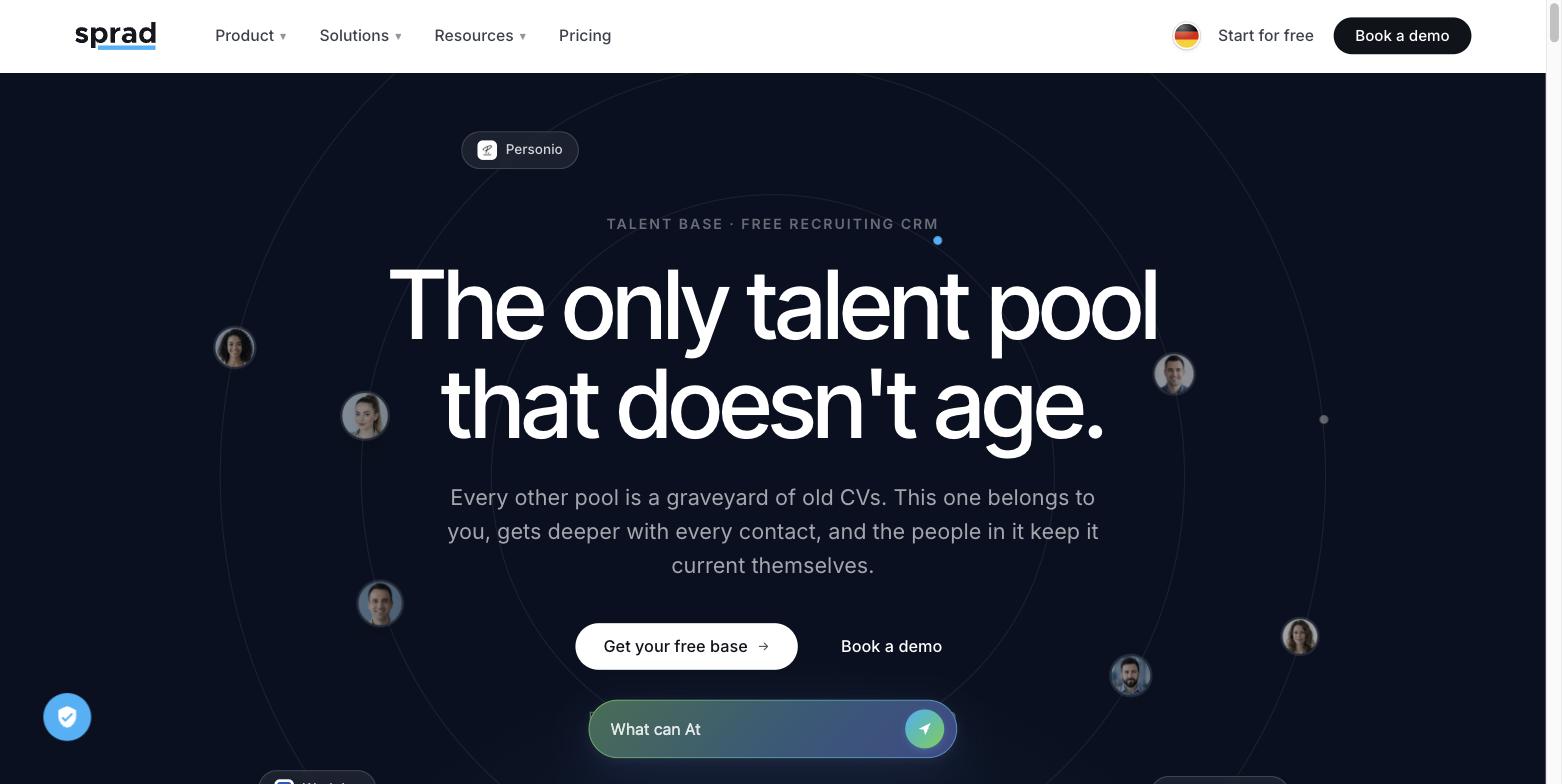
For an agency deciding what to build the pool on, Sprad is the clearest fit when the goal is exactly what this article describes: candidates attached to the company, an export you control, consent-based updates, and one search that reaches both your own network and the open market. It starts with 200 free credits a month, no credit card, and runs at €59 per recruiter a month for the ATS and talent pool, with search, outreach and interviews billed only when they happen.
That doesn't mean every agency needs to replace everything at once. A dedicated business-network recruiting tool still has the deepest reach into DACH-native, white-collar candidates who never left that network; a heavier, established ATS may already hold years of placement history worth keeping in place. The point of building a pool isn't abandoning every existing system — it's making sure the candidates themselves are no longer trapped in whichever one happens to hold them today.
A cost example: filling a role with and without a pool
The payoff is easier to see with real numbers than with a general promise of efficiency. On Sprad's published credit prices, an external search across the open market (up to 50 checked profiles) costs 100 credits, roughly €7.50-9.50 depending on the package. Searching your own talent pool for the same requirement costs 10 credits, about €0.75-0.95 — a tenth of the price, because those candidates are already known and pre-qualified instead of being found and checked from zero.
Over a year with, say, 20 open roles, an agency with no pool runs 20 external searches: 2,000 credits. An agency that checks its own pool first, and only searches externally when the pool doesn't have a match, might fill half of those roles from the pool: 10 pool searches (100 credits) plus 10 external searches (1,000 credits), for 1,100 credits total — roughly 45% fewer search credits for the same number of roles filled, before counting the recruiter hours saved by not re-sourcing candidates who were already found once. This is a worked example based on Sprad's own published per-action prices, not an audited customer average — how much a given agency saves depends on how often the pool already holds the right person.
Where this fits into the bigger picture
The underlying idea across all of this is simple: an agency's network is its real asset, not its ATS subscription. Instead of renting reach year after year from a rented sourcing seat at a rising price, or watching a pipeline disappear when a recruiter leaves, you build one pool the company keeps — searchable with your own team's requirement search plus 1B+ public profiles, and free to import from what you already have.
See how this plays out for an agency your size on the recruitment agencies page, what the external search looks like on people search, or the running cost on the pricing page. If you're starting from a cancelled or soon-to-expire rented sourcing seat, this walkthrough covers what you can still salvage first, and if the trigger is an old professional-network account nobody has touched in years, here's how to bring those contacts back to life.
FAQ
How much does it cost to build a talent pool?
With Sprad, the import of an existing database is free, the ATS and pool run at €59 per recruiter a month, and ongoing search, outreach and screening are billed by credit only when they happen — rejected profiles cost nothing. Traditional ATS platforms typically charge roughly €90–185 per recruiter a month in seat licences on top of any import or migration fee.
Can I import my old contacts from other platforms?
You can import CSV exports or CV files from wherever they currently live. Most professional networks and sourcing tools don't offer a direct API for pulling an agency's candidate history automatically, so the import runs from whatever export or file you already have, enriched afterwards with public profile data.
Is a spreadsheet good enough to start with?
A spreadsheet is a fine starting point for step 1 — taking stock of what exists — but it doesn't scale into something a recruiter can search under deadline, and it doesn't handle consent or updates on its own.
Do candidates need to agree to be in the pool?
Yes, both as good practice and as a compliance requirement. Candidates give active consent to join a Sprad talent pool and can update their own profile afterwards, rather than being silently re-added from an old export.
What happens to the pool if a recruiter leaves the agency?
Because candidates are attached to the agency's workspace rather than an individual recruiter's account, the pool and its history stay in place when someone leaves — unlike a rented sourcing platform, where a seat's projects are tied to that person's personal login.
Is searching an existing pool actually cheaper than an external search?
On Sprad's published credit prices, yes: searching your own pool costs 10 credits versus 100 credits for an external search across the open market, because the candidates are already known rather than found and checked from scratch. The saving compounds with every role the pool can already answer.
Jürgen Ulbrich
Jürgen Ulbrich has more than a decade of experience in developing and leading high-performing teams and companies. As an expert in employee referral programs as well as feedback and performance processes, Jürgen has helped over 100 organizations optimize their talent acquisition and development strategies.