A resume job match score is a number, usually 0 to 100, that shows how closely one resume fits one specific job ad. Most tools compute it by checking which skills, tools, titles and requirements from the ad appear in your resume, then weighting the ones that matter most. There is no official standard: the same resume gets different scores in different tools, so use the score to find gaps, not as a pass or fail verdict. A score is worth chasing only up to the point where every must-have in the ad is truthfully covered.
What a resume match score is, and what it is not
A match score measures one resume against one ad. It does not rate how good your resume is in general, and it does not predict whether you get an interview. That is why the same document can score 58 for one role and 85 for another.
It is also not the same as an ATS score. An ATS score usually tests whether a system can read your file (layout, fonts, sections). A match score tests content: does what you wrote answer what they asked for? You need both, but only the second one changes from job to job.
How tools calculate the score
Three methods are in use, and many tools mix them:
| Method | What it counts | Strength | Weakness |
|---|---|---|---|
| Keyword coverage | Terms from the ad found in your resume ÷ terms in the ad × 100 | Transparent, easy to act on | Misses synonyms, rewards copying the ad |
| Weighted requirements | Must-haves count more than nice-to-haves; job title and hard skills count more than soft skills | Closest to how a recruiter reads | Weights differ per tool and are rarely published |
| Semantic similarity (AI) | Meaning of your text vs. the ad, compared as vectors | Understands "managed accounts" ≈ "account management" | Harder to explain; can reward vague fluff |
The semantic method rests on sentence embeddings, a technique described in the Sentence-BERT paper by Reimers and Gurevych (EMNLP 2019): texts become vectors that can be compared with cosine similarity, so two differently worded sentences can still land close together.
On the employer side, the picture is similar. Greenhouse describes its Talent Matching feature as comparing resumes "against your defined and weighted calibration", and its help page on AI features (updated 3 September 2026) says nothing about automatic rejection. Recruiters who search by hand use Boolean queries, where a quoted phrase must match in exactly that order. So the exact words still matter for search, while a score is a helper for ranking.
What is a good resume match score?
There is no official threshold. Vendor guides commonly name roughly 70 to 80 % as a healthy range (one large scanner suggests about 75 %), and scores above 90 % are often a sign of keyword stuffing. Treat those numbers as vendor rules of thumb, not as a standard.
A better target is this: 100 % of the must-haves covered honestly, most nice-to-haves where you really have them. A 72 % resume that covers every must-have beats an 88 % resume that got there with words you cannot defend in the interview.
Compare your resume to a job description: 6 steps
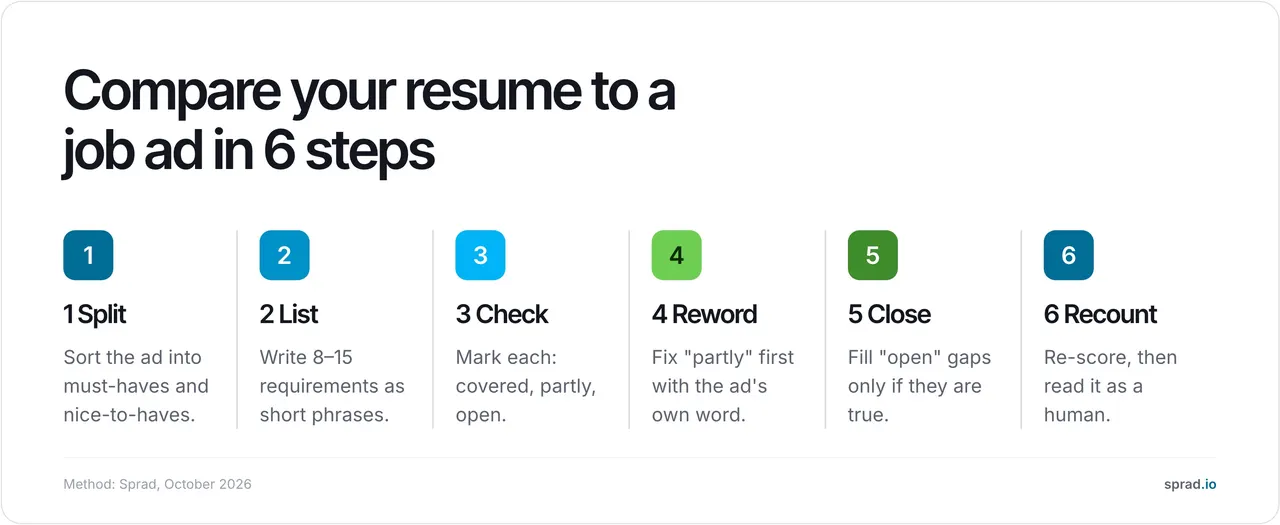
- Split the ad into must-have and nice-to-have. "Required", "you bring" and repeated terms are must-haves. "Plus", "ideally" and "bonus" are nice-to-haves.
- List 8 to 15 requirements as short phrases: tools, methods, certificates, years, the job title, the language level.
- Check each one against your real history. Mark it covered (clear evidence), partly covered (you did it but wrote it differently) or open (not in your resume).
- Fix "partly covered" first. This is the cheapest gain: you have the experience but the ad uses another word. Use the ad's word if it is accurate.
- Close "open" gaps only if they are true. Did you use Salesforce in a job but never wrote it down? Add it. Never used it? Leave it out and, if it is a must-have, decide whether to apply anyway.
- Recount. Re-run the score, then read the resume once more as a human. If a line only exists to raise a number, delete it.
Worked example: from 74 % to 84 %
This example is constructed to show the arithmetic; it is not a measurement. An ad for a Customer Success Manager lists 12 requirements: 7 must-haves and 5 nice-to-haves. Must-haves count double.
| Step | Must-haves covered (of 7) | Nice-to-haves covered (of 5) | Plain count | Weighted score |
|---|---|---|---|---|
| Original resume | 6 (Salesforce missing) | 2 | 8 ÷ 12 = 67 % | (6×2 + 2) ÷ 19 = 74 % |
| After adding a true Salesforce line from job 2 | 7 | 2 | 9 ÷ 12 = 75 % | (7×2 + 2) ÷ 19 = 84 % |
Two lessons from the maths. First, one missing must-have costs about 10 points, while one missing nice-to-have costs about 5. Second, the plain count and the weighted score disagree by up to 9 points on the same resume, which is exactly why scores from different tools do not match.
Which tools and templates help?
Free paste-in checkers exist in large numbers: you upload a resume, paste the ad and get a score and a gap list. Compare the gap list across two tools instead of trusting one number. Many lock tailoring or downloads behind a paid plan; our comparison of free AI resume builders shows what is truly free.
No tool needed? Use this template in a notes app or spreadsheet:
| Requirement from the ad | Must / nice | Status | Proof in my resume (line) | Action |
|---|---|---|---|---|
| CRM experience (Salesforce) | Must | Partly | "Managed 120 accounts in CRM" | Name the tool, if true |
| Onboarding enterprise clients | Must | Covered | "Onboarded 14 clients, 30-day go-live" | None |
| German C1 | Nice | Open | — | Add only if true |
Atlas: a free score built into the job search
Atlas Career (atlas.now) takes the scoring one step earlier. It searches 1.5 million+ active jobs straight from employers' career sites and shows a match score from 0 to 100 for every role, with reasons ("Atlas Take"). A culture-fit remark appears only when the ad itself offers a quote to back it. For roles you want, Atlas writes a tailored resume and, on request, a cover letter. Atlas is free with no limits; you review everything and apply yourself directly with the employer, Atlas sends nothing on your behalf. Hosting is in the EU (GDPR).
It is built by Sprad in Vienna. Try Atlas free and read why before you apply, not after. For a wider overview see the best AI job search tools in 2026.
Five mistakes that cost you
- Chasing 100 %. Perfect scores usually mean pasted ad text. Recruiters spot that.
- Hidden white text. It fails in parsers that read text, and a human who selects the page sees it. Never do it.
- Ignoring the job title. If the ad says "Customer Success Manager" and your title was "Client Care Lead", say so once in the summary or headline: "Client Care Lead (Customer Success)", only if the work was the same.
- Treating all requirements equally. Spend your edits on must-haves.
- Using one tailored version for 20 jobs. A match score only holds for the ad it was run against. See how to tailor your CV with AI.
A reminder about why this matters beyond the number: in a Harvard Business School and Accenture survey of employers from 2021, 88 % said qualified high-skilled candidates were screened out because they did not exactly match the criteria in the job description (HR Dive, 15 September 2021). Close, honest wording is cheap insurance.
How AI changes resume matching
AI matchers read meaning, not just words, so "led a team of five" can match "people management". Two rules keep that useful. First, AI may rephrase what you did, never add what you did not: invented skills fail in the interview and can end an offer. Second, expect the employer to use AI too. Under the EU AI Act, systems used to filter or evaluate applicants are high-risk (Annex III) and their duties apply from 2 December 2027 after the Digital Omnibus (Regulation (EU) 2026/1744; base text Regulation (EU) 2024/1689). That is a duty for employers; it does not make your score tool regulated.
US, UK and DACH: what changes
In the US a resume carries no photo and is typically short, and employers expect it to echo the ad's wording. In the UK a CV is also written without a photo. In Germany, Austria and Switzerland the CV is a tabular, gapless overview, a photo is still common but optional, and the cover letter should refer to the ad. The German Federal Employment Agency tells applicants to "concentrate on what matters for the respective job ad" (Bundesagentur für Arbeit, retrieved 30 October 2026). Match the language of the ad: a German ad is scored on German terms, and "m/w/d" is not a keyword.
FAQ
What is a good resume match score?
Vendor guides name about 70 to 80 %, with 75 % often quoted. There is no standard, so aim for all must-haves covered truthfully instead of a number.
Is a resume match score the same as an ATS score?
No. An ATS score checks whether software can read your file. A match score checks how well your content fits one ad.
Do employers reject resumes below a certain score?
No vendor page we checked promises automatic rejection by score. Greenhouse describes matching as a comparison against a weighted calibration, which helps recruiters rank. Some employers do filter on hard criteria, so cover your must-haves.
How many keywords should I match?
All must-haves you truly have, plus the nice-to-haves that are true. Usually that is 8 to 12 phrases, each used in your skills list and in a bullet with a result.
Can I use AI to raise my score?
Yes, for rewording. No, for inventing. Check every line the AI wrote against your real history before you send it.
Is there a free tool that scores and tailors?
Yes. Atlas Career shows a 0 to 100 match score with reasons for each job it finds and writes a tailored resume and cover letter, free and without limits.
Jürgen Ulbrich
Jürgen Ulbrich has more than a decade of experience in developing and leading high-performing teams and companies. As an expert in employee referral programs as well as feedback and performance processes, Jürgen has helped over 100 organizations optimize their talent acquisition and development strategies.