The skills to put on a resume are the 8 to 12 tools, methods, certificates and languages that the job ad asks for and that you can prove with a real job or result. Put them in a short skills section grouped into two to four labelled lines, and show your 2 or 3 transferable skills (communication, leadership, problem-solving) inside your experience bullets instead of listing them. Which skills belong on your list depends on the role: a nurse lists clinical systems and licences, a developer lists languages and tools, an electrician lists codes and software, and the ad tells you the exact words.
What counts as a resume skill, and what does not?
A skill on a resume is anything a recruiter could search for or a hiring manager could ask you about. That gives you three useful types, and they should not get the same space.
| Type | Examples | Where it goes |
|---|---|---|
| Hard skills | Excel, Epic, AutoCAD, Python, CPR certificate, forklift licence, Spanish C1 | Skills section, once each, plus in a bullet |
| Transferable skills | Negotiation, coordination, time management, troubleshooting | Experience bullets with a number or a result; at most 2 or 3 in the skills section |
| Personality traits | "Team player", "hard-working", "motivated" | Nowhere. They are easy to claim, hard to check and rarely searched |
The reason for this ranking is how recruiter software works. Greenhouse's help page on searching candidates with Boolean queries shows recruiters typing terms with AND, OR and NOT. Without quotation marks, each word is searched separately; with them, the phrase must match in that exact order. The page describes no automatic synonym matching. A recruiter who types "Salesforce" finds the resumes that contain "Salesforce". Nobody types "team player" to find a candidate.
The same page is also why the file matters. If the system cannot read your resume, your skills never reach the searchable fields. Greenhouse's page "Unsuccessful resume parse" lists graphics, photos, columns and image files among the causes. So no skill bars, no star ratings, no icons for skills: write them as plain text. Our ATS-friendly resume template has a 5-minute test for it.
How do I choose which skills to list, step by step?
Do not start from a list of "top 10 skills for 2026". Start from the ad you are applying to. At Sprad we have built recruiting software for seven years, and the pattern we see on the recruiter side is simple: two ads with the same job title often ask for different tools, so a generic list will always be half wrong.
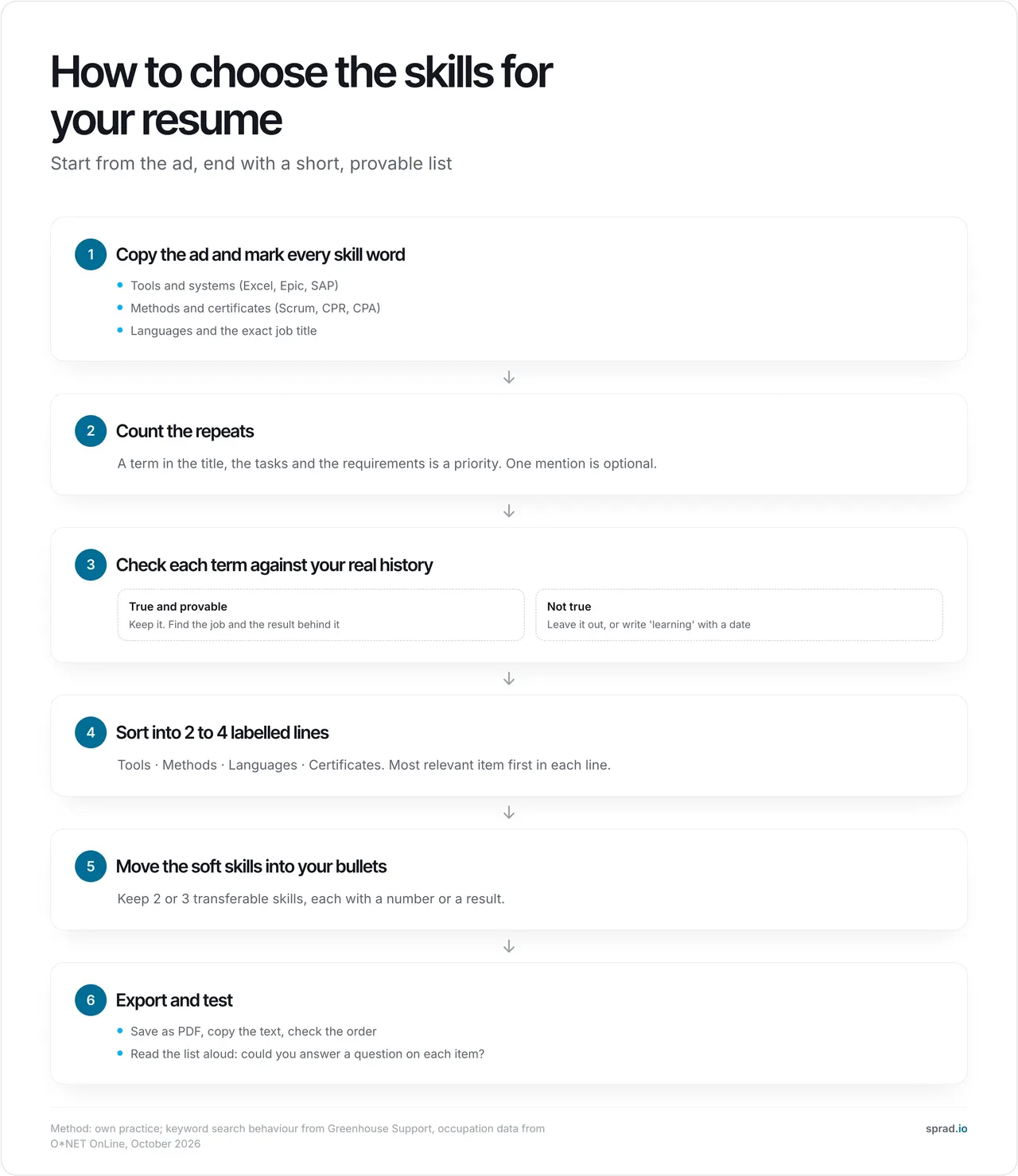
- Copy the ad into a document and mark every skill word: tools, methods, certificates, languages, the exact job title.
- Count the repeats. A term that appears in the title, the tasks and the requirements is a priority. A single mention is optional.
- Check each term against your real history. Keep the true ones. For each one, find the job and the result behind it.
- Sort the survivors into 2 to 4 labelled lines, most relevant item first in each line.
- Move soft skills into your bullets. Keep 2 or 3, each with a number.
- Export as PDF, copy the text and read it. Could you answer a question on every item? If not, delete it.
A worked example (constructed)
Take an invented ad for a "Customer Support Specialist". Steps 1 and 2 give you eight terms. The right-hand column shows what an honest applicant with two years in a call centre would do.
| Term in the ad | Times in ad | On the resume today? | Action |
|---|---|---|---|
| Zendesk | 3 | No, but used a similar ticket tool | Name the tool you used; write "Zendesk" only if you have touched it |
| CRM (Salesforce) | 3 | Yes, as "customer database" | Rename to the ad's wording |
| Live chat and email support | 2 | Yes | Keep, add volume: "60 chats a day" |
| German and English, C1 | 2 | Yes, but no level | Add the level (see the language section below) |
| De-escalation | 1 | Implicit | Show in a bullet, not the list |
| SQL | 1 | No | Leave out |
| Team leadership | 1 | No | Leave out |
| CSAT, first response time | 2 | Yes, in the old job | Add the actual numbers you had |
Count it: before the edit, 2 of 8 terms were visible in the ad's words (25%). After it, 5 of 8 (63%), and the three that stay out are things the applicant did not do. That is the honest ceiling: you close the wording gap, not the experience gap. The numbers illustrate the method; they are not a measurement.
Which skills should I put on a resume for my job?
The U.S. Department of Labor's O*NET OnLine publishes, for each occupation, the software people actually use, the skills the job needs and the knowledge areas. The table below pulls this for six common jobs (data as shown on the O*NET pages on 30 October 2026). Use it as a starting list of what to look for in your ad, never as a list to copy. O*NET describes U.S. occupations, so check the names against your own market.
| Role (O*NET) | Tools and software named by O*NET | Transferable skills named by O*NET |
|---|---|---|
| Registered nurse | Medical software (Epic, MEDITECH, eClinicalWorks), database software, Microsoft Office, scheduling software | Social perceptiveness, coordination, service orientation, judgment and decision making, instructing, time management |
| Software developer | Git, Jenkins, Atlassian JIRA, Selenium, TypeScript, React, Tableau, Microsoft Power BI, SQL databases | Programming, systems analysis, complex problem solving, judgment and decision making, time management |
| Customer service representative | CRM (Salesforce), contact centre software, Microsoft Office, accounting software such as QuickBooks | Service orientation, complex problem solving, negotiation, persuasion, time management |
| Electrician | AutoCAD, PLC and SCADA software, SAP, Microsoft Excel and Outlook, estimating tools | Troubleshooting, repairing, installation, quality control analysis, equipment maintenance |
| Accountant or auditor | QuickBooks, Sage 50, SAP Concur, Tableau, SQL, VBA, XBRL, CRM software | Complex problem solving, judgment and decision making, coordination, persuasion, time management |
| Services sales representative | CRM (Salesforce), Microsoft Dynamics, PowerPoint, Microsoft Office | Negotiation, persuasion, service orientation, social perceptiveness, time management |
Three patterns stand out. First, the tool column is long and specific, which is exactly what recruiters type into a search. Second, the same core skills appear on all six pages: active listening, critical thinking, speaking, reading comprehension, writing and monitoring. Because everyone has them, they do not set you apart and do not need a line in your skills section. Third, the transferable column is where roles differ: troubleshooting for the electrician, negotiation for sales, social perceptiveness for the nurse. Choose these, and prove each one.
Qualifications such as a nursing licence, a CPA, a journeyman card or a driving licence are not skills in the O*NET sense, but the ad often names them. Put them on their own line, "Certificates and licences", with the issuing body and the year.
How do I format the skills section?
Use plain text, two to four labelled lines, and put the strongest item first in each line. Here is a developer's version and a support agent's version, both built from the steps above:
- Languages and frameworks: TypeScript, React, Node.js, SQL
- Tools: Git, Jenkins, JIRA, Selenium
- Languages: German (C2), English (C1)
- Support tools: Zendesk, Salesforce, Intercom
- Channels: Chat, email, phone (60 chats a day)
- Languages: English (C1), German (B2)
For languages, the Europass site explains the Common European Framework of Reference: six levels from A1 to C2, self-assessed separately for listening, reading, spoken interaction, spoken production and writing. Pick the highest level whose "I can" statements you can really meet. "Fluent" means different things to different readers, "C1" does not.
Position: with less than five years of experience, or when you change careers, the skills section can sit directly under the summary. With a long track record, put it after the experience. Our guide to a career change resume shows how to move transferable skills to the top.
Which skills should I leave out?
- Basic Office and "internet". Everyone lists them. Name Excel only with a function you use, such as pivot tables or lookups.
- Skill bars and star ratings. "Excel 4/5 stars" tells nobody anything and can break parsing.
- Tools you have only opened once. The first technical question in the interview ends it.
- Personality adjectives. Replace "hard-working" by a result.
- Outdated tools that no ad in your field mentions any more.
- Anything copied from the ad that you cannot explain.
How do skills differ in the US, the UK and DACH?
The method is the same everywhere. The details change. In the US and UK, photo and personal details stay off the resume. In Germany, Austria and Switzerland, the Federal Employment Agency's page "Bewerbung schreiben" says that a CV includes a photo, education, training or studies, work history, further training and special skills, with "IT-Kenntnisse, Fremdsprachen, Soft Skills" as examples for the skills part. It adds that you should back qualifications with certificates and include only those relevant to the job. Also use the language of the ad: a German ad for "Vertriebsmitarbeiter im Außendienst" needs those words, not only "field sales". If you honestly hold both, keep both. Our CV template and examples show the German layout.
How does AI change the skills section?
AI helps with the tedious part: reading a long ad, pulling out the requirements and rewording your bullets in the ad's vocabulary. It cannot know what is true. Recruiter tools are adding AI too: Greenhouse's page "Greenhouse AI features" (updated 3 September 2026) lists keyword suggestions taken from the job post and Talent Matching, which compares resumes against criteria the employer defines. Neither description says that a candidate is rejected automatically. For applicants in the EU, the AI Act lists AI systems used to recruit and select people as high-risk in Annex III, point 4(a) of Regulation (EU) 2024/1689; the obligations for such systems apply from 2 December 2027 (Digital Omnibus, Regulation (EU) 2026/1744). It does not change what you should write: true, readable, matched to the ad.
The rule stays: AI may reword, it may not add. Read every line and delete anything you could not explain in an interview. Our guide on how to tailor your CV with AI covers prompts, and the comparison of free AI resume builders shows which tools are really free.
Is there a free tool that picks the skills for me?
Yes. Atlas Career (atlas.now) is a free AI career agent. It searches 1.5M+ active jobs straight from employers' career sites, shows each role a match score from 0 to 100 with reasons (the "Atlas Take"), and writes a tailored resume for every application and a cover letter on request, with no limits. The language and format follow the ad: a photo is common in German applications, not in US ones. Atlas does not send anything for you. You review the text, download the PDF and apply directly to the employer. It does not invent facts: it phrases your real experience more strongly.
Try Atlas Career for free. It is EU-hosted, GDPR-compliant and built by Sprad in Vienna. If you prefer to do it by hand, the six steps above take about 20 minutes for the first ad and less for the next.
Sources checked October 2026: O*NET OnLine (U.S. Department of Labor), Greenhouse Support, Europass, Federal Employment Agency, EUR-Lex.
FAQ
How many skills should I put on a resume?
8 to 12, grouped in two to four lines. More than that reads like a keyword wall and is hard to defend in an interview.
Should I list soft skills on a resume?
Keep two or three transferable skills that the ad names, and prove each in a bullet with a number. Skip generic traits like "team player".
What skills should I put on a resume with no experience?
Take them from the ad and from school, volunteering and projects: tools you used, languages with a CEFR level, certificates, and results such as "organised an event for 80 people". Say "in training" for what you are learning, with a date.
Where does the skills section go?
Under the summary if you are early in your career or changing fields, after the experience if you have a long track record.
Are skills the same as keywords?
Mostly. A keyword is a skill word the ad uses. List it in the ad's wording where it is true, because recruiter search matches typed words.
Should I use skill bars or ratings?
No. They tell the reader nothing precise and graphics can stop a system from reading your file.
How do I list languages?
Name the language and the CEFR level, for example "English (C1)". Europass explains how to self-assess each of the five abilities.
Can AI write my skills section?
It can propose wording from the ad. You decide what is true. Delete anything you could not explain in the interview.
Jürgen Ulbrich
Jürgen Ulbrich has more than a decade of experience in developing and leading high-performing teams and companies. As an expert in employee referral programs as well as feedback and performance processes, Jürgen has helped over 100 organizations optimize their talent acquisition and development strategies.