Social media recruiting has one big advantage and one big drawback. The advantage: you reach people who never open a job board, for example nurses, drivers and tradespeople, on the apps they use every day. The drawback: easy applying also brings many applicants who do not fit, so without a pre-screening step the time you save on reach is lost in the inbox. This guide lists six pros and six cons with the fix for each, and says when social recruiting is the wrong tool.
Social recruiting pros
1. You reach people who are not looking
Most people in frontline jobs do not browse job boards, but they do scroll Instagram and Facebook. A job ad in that feed finds the nurse who is not searching yet but would move for better shifts. Vendors of employee-advocacy software put the share of passive talent at around 70 % (vendor figure, LinkedIn-heavy sample); for shift and trade roles the logic is the same, the channel is different.
2. It works on the phone, without a CV
Social media is used mostly on mobile devices, one German guide puts it at about 90 %. An instant form or a chat that asks five questions fits that. Frontline candidates rarely own a polished CV, and every extra step costs applicants. We explain why phone and messaging beat email for these roles in frontline recruiting by phone and WhatsApp.
3. It starts in days and can be steered daily
A job ad goes live within a day or two. You can raise the budget on a role that works, pause one that does not, and swap the picture or the pay line the same week. A job board listing is fixed once paid for.
4. Cost per applicant is measurable
Every click, form start and application is counted, so you see what one applicant costs. The Boostpoint Social Job Advertising Benchmark 2026 (891 campaigns, US data, vendor figure) reports a median of 13.88 $ per applicant, from 2.14 $ for warehouse roles to 74.62 $ for therapy roles. Use it as an order of magnitude, not as your forecast.
5. You can show the job, not just describe it
A photo of the real team, the pay in the first line and the shift model in plain words beat a block of text. This is where social ads win against a standard job listing for hourly and trade work.
6. The audience can become your own
If every applicant ends up in your own database, the reach you pay for once keeps working for the next opening. If they only sit inside a platform, you rent that reach again each time. See Talent Base for how Sprad stores them.
Social recruiting cons
1. Many applicants do not fit
This is the most reported weakness, also for job-board packages. When applying takes one tap, people tap without checking the requirements. The fix is a short pre-screening before a recruiter reads anything: licence, shift, location, start date. Done by chat, it costs candidates three minutes and costs you nothing per head.
2. Employment ads limit targeting
Meta runs job ads under the "Employment" special ad category. In the US, Canada and, according to secondary sources, parts of Europe, it locks age, gender and ZIP-code targeting and restricts lookalike audiences. Check the current rules in Ads Manager for your country before you plan the audience. Good creative and a clear pay line do the work that precise targeting cannot.
3. Reach stops when the budget stops
Ads are rented attention. When the budget ends, applicants end too. Plan at least a few weeks per role (many providers advise around three months) and compare cost per qualified applicant, not per click.
4. Consent and GDPR apply
Applicant data, tracking pixels and WhatsApp contact need a legal basis and a clear retention period. In Germany and the EU this is not optional. See whether contacting candidates on WhatsApp is allowed. This is general information, not legal advice.
5. It takes steady effort
Ads wear out, comments and messages need replies, and answering slowly loses applicants. Someone must own the account, the creative refresh and the same-day reply.
6. It does not suit every role
Senior specialists and executives are found more reliably by direct approach and professional networks. Social ads shine for volume and frontline roles where the candidate is a swipe away.

Pros and cons side by side, with the fix
| Point | Pro | Con | What to do |
|---|---|---|---|
| Reach | People who do not use job boards | Stops with the budget | Store every applicant in your own pool |
| Candidate effort | One tap, no CV | Many mismatches | Pre-screen by chat before a recruiter reads |
| Speed | Live in days | Needs daily steering | Name an owner, review weekly |
| Cost | Measurable per applicant | Click cost is not hire cost | Track cost per qualified applicant |
| Targeting | Interest and location reach | Employment category limits | Strong creative, pay in line one |
| Law | Clear consent flow possible | GDPR and platform rules | Consent text, DPA, retention period |
A cost illustration
This is an illustration with the US benchmark, not a Sprad result. Say you spend €2,000 in ad budget on one warehouse role. At roughly $14 per applicant (ignoring the exchange rate) you would see about 140 applicants. If one in four meets your must-haves after pre-screening, that is about 35 usable people, so roughly €57 of ad spend each. Without pre-screening, a recruiter reads all 140 and the real cost sits in working time. Your numbers will differ by region, role and pay.
When social recruiting is worth it, and when not
| Situation | Social recruiting? |
|---|---|
| Several similar openings (nursing, logistics, trades, retail, hospitality) | Yes. Volume and mobile reach pay off. |
| One urgent role, no time to build anything | Maybe. Start now, but pair it with direct calls. |
| Senior specialist or executive | Rarely. Direct approach is more precise. |
| No one to answer within a day | Not yet. Fix the reply process first. |
Industry pages show how this looks in practice, for example healthcare and logistics. For a deeper look at screening high volumes, read how blue-collar screening differs from white-collar screening.
How Sprad addresses the cons
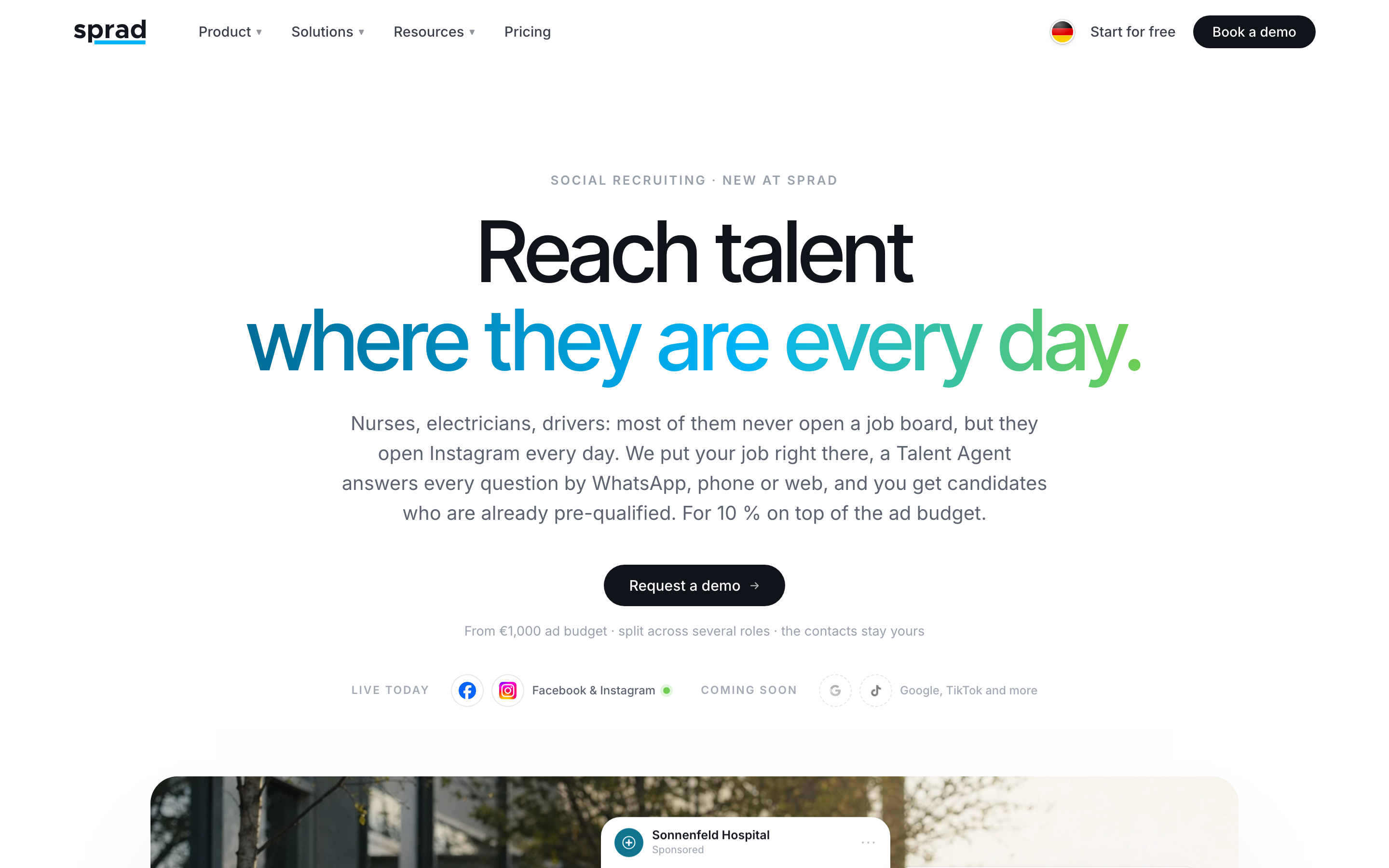
Sprad Social Recruiting runs job ads on Instagram and Facebook, where frontline workers spend time every day. An AI talent agent pre-screens every applicant via WhatsApp, phone or web, which tackles the mismatch problem. Every applicant lands in your own talent pool, so the reach you pay for does not disappear with the budget. Pricing is ad spend plus 10 %, from a €1,000 budget that can be split across roles; budget suggestions are guidance, not a promise of applicants. Details on Sprad Social Recruiting and pricing.
FAQ
What are the main pros of social recruiting?
Reach beyond job boards, mobile and CV-free applying, fast start, measurable cost per applicant and the chance to build your own audience.
What are the main cons of social recruiting?
Many applicants who do not fit, limited targeting for job ads, reach that ends with the budget, GDPR duties and the effort of steady upkeep.
Is social recruiting cheaper than job boards?
Not automatically. Compare cost per qualified applicant and what you keep afterwards. With a pre-screening step and your own pool it can get cheaper over several openings.
Does social recruiting work for blue-collar jobs?
Yes, often better than for office roles, because frontline workers are on Instagram and Facebook daily and apply from the phone.
How do I avoid unqualified applicants?
Ask five to eight must-have questions in a chat or short form before a recruiter reads anything, and show pay and shifts in the ad itself.
Is social recruiting allowed under GDPR?
Yes, with a legal basis, clear information, a processing agreement with your providers and a retention period. This is general information, not legal advice.
Jürgen Ulbrich
Jürgen Ulbrich has more than a decade of experience in developing and leading high-performing teams and companies. As an expert in employee referral programs as well as feedback and performance processes, Jürgen has helped over 100 organizations optimize their talent acquisition and development strategies.