Social recruiting (also called social media recruiting) means finding and hiring candidates through social platforms such as Instagram, Facebook, TikTok and LinkedIn. It covers paid job ads, organic posts and videos, and direct outreach to people. For blue-collar and frontline roles, the most effective form is paid job ads on Instagram and Facebook with a short chat or form for applying, because that is where nurses, drivers and tradespeople already spend time. Note that "social recruiting" here has nothing to do with social work or social care staffing.
Social recruiting definition: what it includes
The term describes any hiring activity that uses social networks as the place where candidates are found, reached or convinced. Wikipedia describes it as using social media profiles and platforms to identify candidates and advertise jobs. In practice there are four building blocks:
- Paid job ads. Campaigns that show a job to a chosen audience in the feed or in stories, with an application form or chat behind them.
- Organic content. Team photos, short videos, day-in-the-life posts and employee shares, free but slow.
- Active sourcing. Directly messaging selected people, mostly on professional networks such as LinkedIn.
- Employer branding and referrals. Employees sharing openings in their own networks.
Many articles blend these four. If your goal is to fill many shift, trade or care roles quickly, the first block does most of the work, and the rest supports it.
Social recruiting vs. job boards vs. active sourcing
| Social recruiting (paid ads) | Job boards | Active sourcing | |
|---|---|---|---|
| Who you reach | People who are not searching, in their feed | People who are searching | People you pick from profiles |
| Best for | Frontline and volume roles | Roles with active seekers | Specialists, managers |
| Application | One tap, chat or short form | Form, often with CV | Reply to a message |
| Cost model | Ad budget, per run time | Per listing or package | Tool licence plus time |
| Who owns the contacts | You, if stored in your own pool | Often the platform | You, if exported to your system |
Social recruiting does not replace the other two. It fills the gap for people who would never open a job board.
Which channels work for which roles
| Channel | Typical roles | What works |
|---|---|---|
| Nursing, trades, logistics, retail, hospitality, ages 30+ | Pay and shift in the first line, local reach, instant form | |
| Apprentices, hospitality, retail, care, younger candidates | Real team photo, story or reel, one-tap contact | |
| TikTok | Apprentices, younger trades and hospitality staff | Short, honest videos from the job site |
| Specialists, managers, office roles | Direct message, employee posts | |
| All volume roles, after first contact | Pre-screening chat, with consent |
Instagram and Facebook are the starting point for most frontline hiring. Sprad Social Recruiting runs on both today; Google and TikTok follow. WhatsApp is not an advertising channel but the place where candidates answer your questions, see frontline recruiting by phone and WhatsApp.
How social recruiting works, step by step
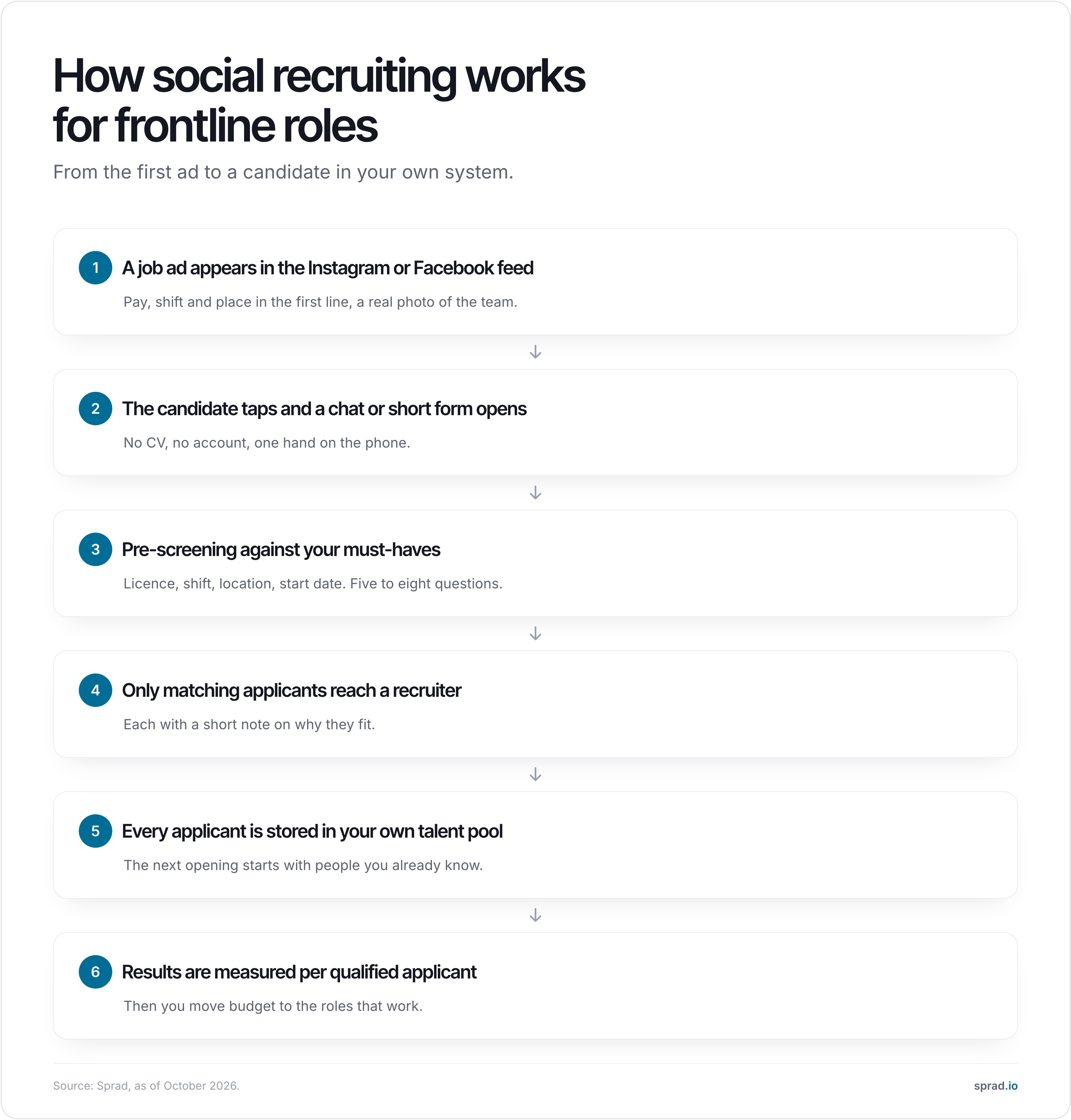
1. Define the role and the must-haves
Write down what a candidate needs: a licence, a certificate, a shift, a location. These are the questions you will later ask in the chat.
2. Build the ad around the pay and the place
Lead with the hourly wage or monthly pay, the shift model and the town. Add a real photo. An example line: "Warehouse operator in Leeds, from £13.50 an hour, early shift, start next month. Tap to answer five questions." This is an illustration, not a real offer.
3. Pick the channel and the budget
Start with Instagram and Facebook for volume roles. Meta shows job ads under its "Employment" special ad category, which in the US, Canada and, per secondary sources, parts of Europe locks age, gender and ZIP-code targeting. Check the current rules in Ads Manager for your country. For a sense of cost, the Boostpoint Social Job Advertising Benchmark 2026 (891 campaigns, US data, vendor figure) reports a median of 13.88 $ per applicant, from 2.14 $ for warehouse roles to 74.62 $ for therapy roles.
4. Pre-screen before a person reads
Social ads attract many applicants because applying is easy. A short chat on WhatsApp, phone or web filters them against your must-haves.
5. Keep everyone in your own pool
Every applicant, also the ones who do not fit this time, should land in your own database with consent, so the next opening starts with people you know. See Talent Base.
6. Measure and adjust
Track cost per qualified applicant, not cost per click. Move budget to the roles and ads that deliver.
Examples of social recruiting
- Care home, nurse role: a Facebook ad with a real team photo, the pay band and the shift pattern, linking to a five-question chat. See healthcare hiring.
- Logistics, drivers and warehouse: an Instagram story with pay, route and start date and an instant form. See logistics hiring.
- Trades, electrician: a short video from a job site with the company van and the offer in the first sentence.
These are patterns, not customer results. We do not publish applicant numbers without data from our own campaigns.
Is it legal? Consent and privacy in short
Applicant data needs a legal basis, clear information and a retention period; in the EU the GDPR applies. For contacting candidates on WhatsApp, read whether it is allowed. This is general information, not legal advice.
Sprad Social Recruiting
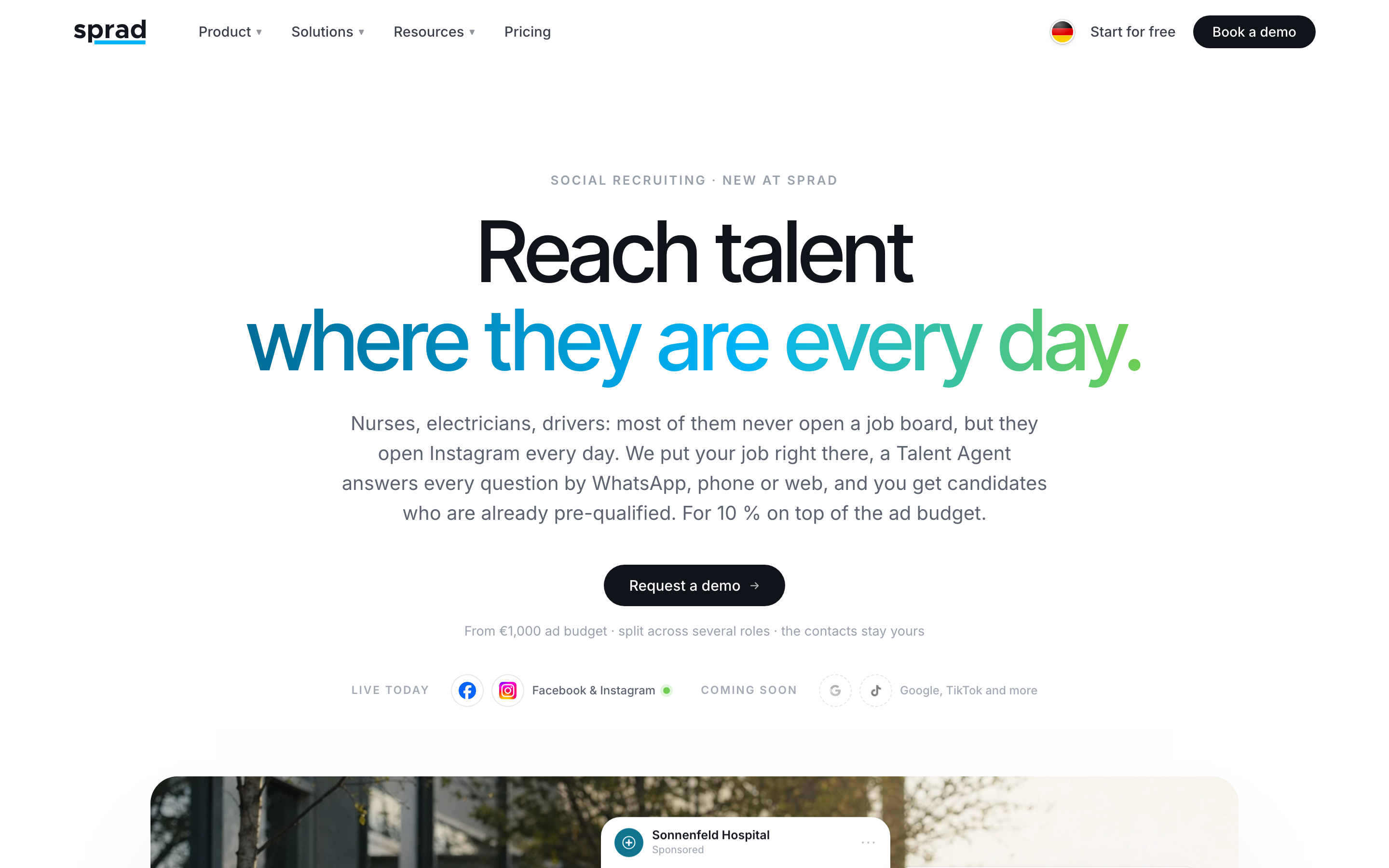
Sprad Social Recruiting runs job ads on Instagram and Facebook, where nurses, tradespeople, drivers and other frontline workers spend time every day. An AI talent agent pre-screens every applicant via WhatsApp, phone or web. Every applicant lands in the employer's own talent pool, so the relationships stay with the employer instead of a platform. Pricing is ad spend plus 10 %, from a €1,000 budget that can be split across roles. Learn more on Sprad Social Recruiting or see pricing.
FAQ
What is social recruiting in simple terms?
Hiring people through social media: ads, posts and messages on platforms such as Instagram, Facebook, TikTok and LinkedIn instead of, or alongside, job boards.
What is the difference between social recruiting and social media recruiting?
None in practice. Social media recruiting is the clearer English term, because "social recruiting" can be mistaken for social work staffing.
Which social media is best for recruiting?
For frontline and volume roles, Instagram and Facebook. For specialists and managers, LinkedIn. For apprentices and younger staff, also TikTok.
Is social recruiting only for young candidates?
No. Facebook reaches many candidates over 30, and care, trades and logistics workers of all ages use WhatsApp and Instagram.
How much does social recruiting cost?
It depends on role and region. A US benchmark gives a median of 13.88 $ per applicant. Sprad charges ad budget plus 10 %, from a €1,000 budget.
What is the difference between social recruiting and active sourcing?
Social recruiting mostly means ads that candidates answer. Active sourcing means you approach chosen people directly, usually on a professional network.
Jürgen Ulbrich
Jürgen Ulbrich has more than a decade of experience in developing and leading high-performing teams and companies. As an expert in employee referral programs as well as feedback and performance processes, Jürgen has helped over 100 organizations optimize their talent acquisition and development strategies.