Spott holds a 4.9/5 rating on G2 (11 reviews) and 5.0/5 on Capterra (2 reviews) as of September 2026 — genuinely strong scores, but from a review base thin enough that one G2 entry is explicitly tagged "Source: G2 invite." Users who left reviews consistently praise the AI-native matching and the fact that it replaced a stack of bolt-on tools; the most concrete complaints are a one-minute call-recording limit and no team-wide visibility into LinkedIn messages. It's a good fit for boutique agencies drowning in add-ons, less so for agencies that need contract payroll or their own external sourcing.
Spott's review scores, in full
Spott was founded in 2024 in Leuven, Belgium, went through Y Combinator's Winter 2025 batch, and has raised $24.2 million (a $3.2M seed led by Base10 Partners plus a $21M Series A led by Balderton Capital). The company claims more than 1,000 daily active users across five continents — a scale its public review footprint doesn't match yet.
| Platform | Rating | Reviews | As of |
|---|---|---|---|
| G2 | 4.9/5 | 11 | September 2026 |
| Capterra (mirrored on Software Advice) | 5.0/5 | 2 | September 2026 |
| Trustpilot (NL) | 3.7/5 | 1 | September 2026 |

For comparison, direct category peers on Software Advice's own comparison table show Recruit CRM at 4.9/5 across 476 reviews and Zoho Recruit at 4.5/5 across 1,287 — Spott's rating is just as high, but built on a fraction of the evidence. A search across Reddit, Hacker News and independent LinkedIn or X posts turned up no organic user discussion of Spott at all, which is unusual for a Series-A company at this claimed scale. That doesn't make the existing reviews false — it means the sample is small enough that a handful of enthusiastic early customers can carry the average.
What agencies like about Spott
- AI-native matching over keyword search. This is the single most repeated theme across reviews. A Verified User in Consulting (4.5/5, April 2026) called it "next generation ATS and CRM" with a "clean and crisp" interface; Niall R., a Talent Manager, said AI matching based on the spec, notes and feedback "makes the database usable" instead of a pile of unsearchable records.
- Consolidating a stack of add-on tools into one. John C., a Founder and Managing Director (5/5, April 2026), wrote that Spott "Replaced Our Add-On Stack with One Simple, Fast-Evolving Platform" — he'd moved from Bullhorn (five years) to Vincere, ended up bolting on three or four extra products for outreach, matching and scraping at "$500+/user/month," evaluated Loxo, Recruiterflow and Atlas, and concluded "nothing came close."
- Fast, responsive data enrichment. Melanie A., an Advisor at a small business (4.5/5, 23 April 2026), said Spott is "very fast at updating records from LinkedIn compared to other platforms" and also praised the inbox feature and having interview recording, transcript and summary in one place.
- Support that answers quickly. Several reviewers name support staff directly. Melanie A. called the team "very responsive at all hours"; Savanna M. on Capterra (March 2026), who switched from Loxo, described support as "incredibly quick."
- Notetaking that writes itself into the record. Karim K. (5/5, 16 April 2026) called it "AI-Powered ATS That Elevates Efficiency," citing the notetaker, summary writer and an AI chat that can query the candidate database directly.
What agencies criticize
- No team-wide visibility into LinkedIn conversations. The most concrete and repeated complaint. Melanie A. said it plainly: "As a business owner, this is critical for me… we can not see the responses from candidates" when a colleague messages through LinkedIn Classic or Sales Navigator. Spott's own team reportedly pointed to a fix "maybe this summer" — a promise, not a shipped feature.
- The call notetaker cuts off after about a minute. Melanie A. again: "Other databases allow for 45 minutes." For an agency that leans on call recordings for candidate context, a one-minute cap is a real limitation, not a rounding error.
- Integrations were thin at launch. Both a G2 reviewer ("Wenige Integrationen anfangs" — few integrations early on, with the API opened since) and a Capterra reviewer ("did not have many integrations at first") flagged the same gap independently. SelectSoftwareReviews, an independent editorial outlet, still described the "integration ecosystem" as "still developing" as of its most recent write-up.
- No contracting, payroll or invoicing module. PeopleManagingPeople's review (Josh Barker, updated 29 August 2026, 4.8/5 on its own seven-point methodology) flags this directly, and SelectSoftwareReviews makes the same point independently: "agencies handling contractor billing need separate systems." Two unrelated sources landing on the identical gap is a stronger signal than either alone.
- Mobile app has limited functionality. Also from PeopleManagingPeople's editorial review — not a user complaint, but a named weakness after hands-on testing.
- Still a young product that changes fast. Karim K.: "It is still a young ATS that develops," noting that feature changes require ongoing process adjustments and that Spott only communicates updates roughly once a month by email plus webinars.
Is Spott worth it?
At $119 per user per month on Core (annual billing, $149 if billed monthly), rising to $179 on Pro, Spott isn't a budget pick — it sits close to Loxo and above Recruit CRM or Manatal. Every reviewer who documented a switch came from the same place: Bullhorn, Vincere or Loxo, all citing the same problem of stitching together separate tools for outreach, matching and call notes at a real combined cost. None of the documented switches came from another AI-native newcomer, which suggests the wedge Spott is winning on is legacy-tool fatigue, not price. If your agency is already paying for a CRM, a call recorder and a data enrichment service separately, the consolidation math can work in Spott's favor even at $119–179 a seat. If you're a lean team without that overlap, or one that needs contract payroll, the price buys less than it promises.
Who Spott fits — and who it doesn't
Good fit: boutique recruiting agencies (roughly 5–100 recruiters) that have accumulated several point tools and want one AI-native workspace; executive search, staffing and RPO firms focused on getting more context out of their existing candidate base; EU agencies for whom GDPR and ISO 27001 hosting matter.
Poor fit: in-house HR or TA teams (Spott is built for agencies); larger organizations above roughly 500 seats, since Spott's own positioning targets smaller teams; agencies wanting a free tier to test with, since Spott has none; contract- or temp-heavy staffing firms that need payroll and invoicing built in; mobile-first teams; and any agency whose real bottleneck is finding candidates it doesn't already have, since Spott has no built-in external sourcing engine — that runs through third-party integrations only.
A cheaper, sourcing-first alternative worth checking
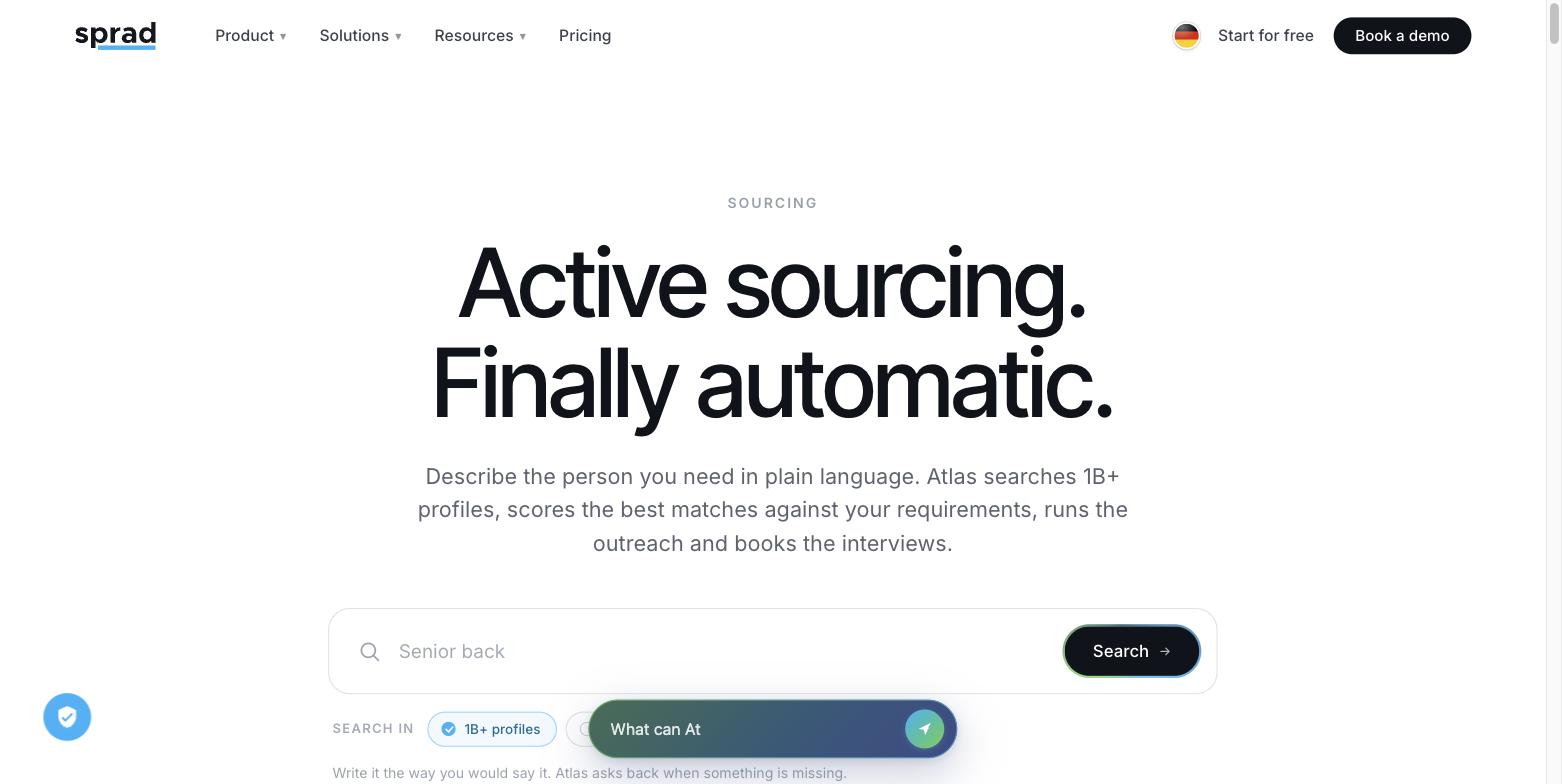
Instead of Boolean keyword search, you describe the role in plain language and Atlas reads full profiles against your criteria, scoring every match with a stated reason instead of a black-box percentage — in an internal benchmark run on 15 August 2026 across three roles and three markets, Atlas surfaced 38% of the candidates found across the tools tested, against 9% for the best competing tool.
To be fair, if your agency's core pain is candidate-facing communication across email, WhatsApp and LinkedIn in one thread, Spott's lead there is real. Full numbers for your team size: sprad.io/industry/recruitment-agencies.
One more option: Recruit CRM
Its 4.9/5 rating on Capterra rests on 475 reviews — a far larger and more credible sample than Spott's 2–13 per platform.
FAQ
How many reviews does Spott have?
11 on G2 (4.9/5) and 2 on Capterra (5.0/5), also mirrored on Software Advice, as of September 2026. That's a small sample for a company reporting more than 1,000 daily active users.
What's the most common complaint about Spott?
No team-wide visibility into a colleague's LinkedIn messages — an agency owner called it "critical" and said Spott has only promised a fix "maybe this summer." The one-minute call notetaker limit is the second most concrete complaint.
Does Spott have a free trial?
Spott doesn't publish a self-serve trial length. Access starts with a demo call or an onboarding form.
Is Spott good for staffing agencies with contract workers?
Not fully. Two independent reviews (PeopleManagingPeople and SelectSoftwareReviews) both flag the absence of a contracting, payroll or invoicing module as a real gap for temp- and contract-heavy agencies.
What do people switch away from to get to Spott?
Every documented switch came from Bullhorn, Vincere or Loxo — all citing tool sprawl or matching quality, not price. Nobody documented a switch from another AI-native tool.
Is there a cheaper alternative to Spott?
Recruit CRM starts lower at $95–100/user/month, and Sprad charges 59 €/recruiter/month plus pay-per-use credits, which usually costs less overall for teams that don't run searches or outreach every single day.
The bigger picture
Spott's reviewers are consistently satisfied with what they use, but the sample is small and the gaps that surface — LinkedIn visibility, contracting, external sourcing — are specific enough to matter for the wrong agency type. Sprad takes a different bet: a requirement search across more than a billion external profiles plus your own growing talent pool, in one workspace with your ATS, screening and outreach, starting with 200 free credits a month and no credit card. See what that looks like for your agency at sprad.io/industry/recruitment-agencies.
Jürgen Ulbrich
Jürgen Ulbrich has more than a decade of experience in developing and leading high-performing teams and companies. As an expert in employee referral programs as well as feedback and performance processes, Jürgen has helped over 100 organizations optimize their talent acquisition and development strategies.