The STAR method is a four-part frame for answering behavioural interview questions such as "Tell me about a time when...": describe the Situation, the Task that was yours, the Action you took and the Result you got. Spend about half of a roughly two-minute answer on your own actions, end on a concrete result, and prepare six real stories instead of memorising sixty answers. AI is useful for practising out loud and for tightening a story, but not for inventing one or for use during the interview itself.
What the STAR method means in practice
Employers ask behavioural questions because of a simple idea: the US Office of Personnel Management (OPM) calls it the behavioural consistency principle, that past behaviour is the best predictor of future behaviour. Its structured interviews therefore ask applicants "to describe a past behavior demonstrated in a situation relevant to the competency of interest" (OPM, Structured Interviews). STAR is simply a way to tell that story so the interviewer can score it.
The frame is also official advice outside the corporate world. The UK Civil Service tells candidates to "consider using the STAR method", which lets you "set the scene, show what and how you did and the overall outcome", and adds that there is no expectation to show every part of every example (GOV.UK, Success Profiles: Civil Service Behaviours, updated 29 January 2025). Read that as permission to stay natural: STAR is a checklist for you, not a script for the interviewer.
Why does it matter? In the most cited recent meta-analysis of hiring methods, structured interviews had the highest validity for predicting job performance, at .42 (Sackett et al., Journal of Applied Psychology, 2022). Structured means the same questions for every candidate, scored against a rubric. At Sprad we have built recruiting software for seven years, and the interview guides and scorecards in it follow the same logic: per question, the scorer looks for what you personally did and what came out of it, not for eloquence. A STAR story puts exactly that evidence in front of them.
The four parts, with the question each one answers
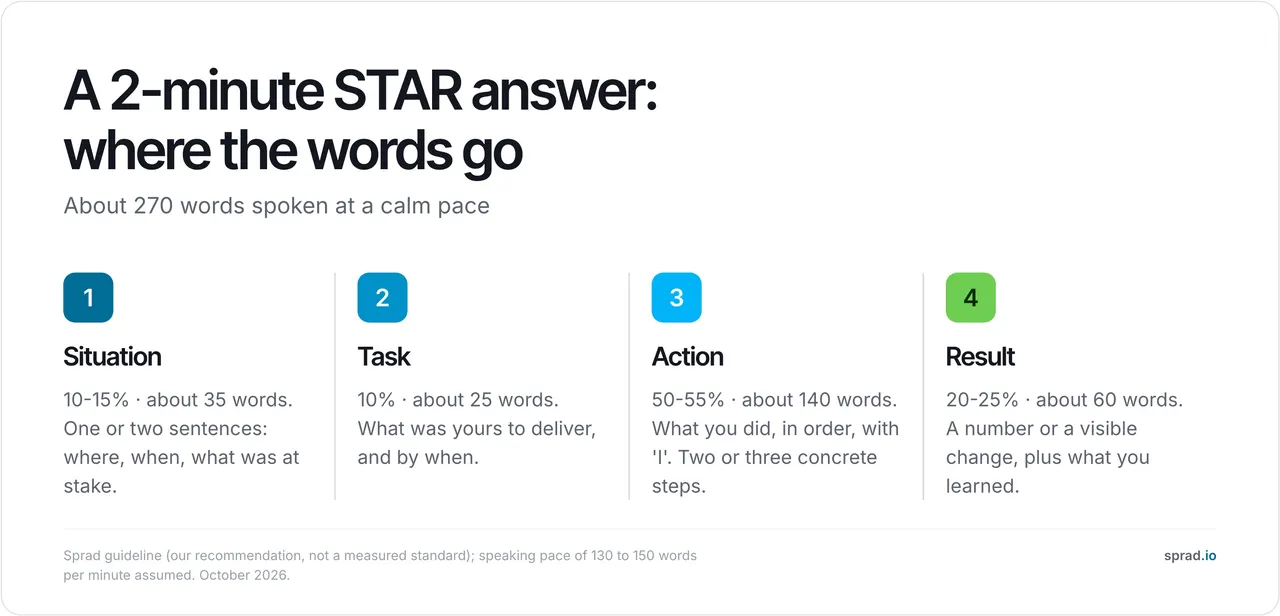
| Part | Question it answers | Good sign | Warning sign |
|---|---|---|---|
| Situation | Where and when, and why did it matter? | One or two sentences, a real project or shift | Three minutes of background before anything happens |
| Task | What exactly was your responsibility? | Your goal, deadline or constraint named | Describing the team's goal, not yours |
| Action | What did you do, and in what order? | Two or three concrete steps, "I decided", "I asked" | "We" everywhere, or "I would", not "I did" |
| Result | What changed, and what did you learn? | A number, a decision, a quote from a customer or boss | The answer simply stops |
How to answer step by step
- Listen for the competency. "Tell me about a conflict with a colleague" tests how you handle disagreement, not the conflict itself. Name it silently before you start.
- Pick a story that fits the job, not the most impressive one. Take it from your last five to eight years, or from study, volunteering or a side project if you are early in your career.
- Set the scene in one or two sentences. Role, place, stake. Nothing else.
- State your task. What was yours to deliver, and by when?
- Spend half your time on action. Use "I" for what you did and "we" only for the context. Mention the obstacle you hit and how you got around it.
- Close on the result. Give a number if you have one (hours saved, error rate, satisfaction, revenue), otherwise a visible change. Then add one sentence on what you would do differently.
- Stop. The interviewer will ask a follow-up if they want more.
STAR method examples: weak versus strong
Question: "Tell me about a time you handled a difficult customer." Here is the same story told twice, from a retail team lead's life.
Weak answer: "Customers can be tough, but I'm good with people. We had one who was upset about a delivery, and I stayed calm and the team helped, and in the end it worked out."
Strong STAR answer (about 90 seconds): "(Situation) Last November a customer came to our store on a Saturday because a 600-euro order had arrived damaged for the second time. (Task) As shift lead it was my job to solve it on the spot without a manager and keep the queue moving. (Action) I moved him to a quiet corner, repeated his problem back to him so he knew I understood, checked the order history, and offered a replacement from store stock plus express delivery of the missing part. I wrote up the damage pattern for our logistics contact. (Result) He left with the replacement, the queue waited no longer than eight minutes, and the carrier changed the packaging for that product line the following month. I learned to look at the order history before I start talking."
The second answer has the same length as an ordinary reply, but each sentence gives the scorer evidence: a task, three actions that are yours, a result and a lesson. Note that every number there is part of the example story; use your own facts, and never copy this one.
What if my result was bad or I have no number?
Tell it honestly. A failed project works if the Result contains what you changed afterwards. If there is no number, use a before and after ("reply time from two days to same day"), a decision someone made because of your work, or feedback you received. Do not invent a figure: follow-up questions expose it fast.
What if I have no work experience?
Use university projects, volunteering, club roles, a part-time job or a family business. The interviewer scores the behaviour, not the setting. Three of your six stories can come from there.
Build a story bank: 6 stories instead of 60 answers
You cannot prepare an answer for every question, but behavioural questions repeat a handful of themes. Write six stories, each in STAR form with one number in the result, and tag each with the themes it can serve. A table like this is your whole preparation:
| Story (working title) | Teamwork | Conflict | Pressure or deadline | Initiative | Mistake or failure | Leading others |
|---|---|---|---|---|---|---|
| 1. Launch under time pressure | ✓ | ✓ | ✓ | |||
| 2. Disagreement with a colleague | ✓ | ✓ | ||||
| 3. Process I improved on my own | ✓ | |||||
| 4. A mistake and the fix | ✓ | ✓ | ||||
| 5. Onboarding or coaching someone | ✓ | ✓ | ||||
| 6. A hard customer or stakeholder | ✓ | ✓ |
With six stories you cover every column at least once, and most columns twice. That is the point: when a question comes, you choose the best-fitting story, you do not improvise one. Add a small note "numbers I can quote" to each story and make sure the facts match your CV.
Which tools and templates help
- A plain document or spreadsheet for the story bank above. Free, and you own it.
- A voice memo on your phone. Record each story, count the seconds, listen for "we", filler words and missing results.
- A general AI chatbot with voice mode as interviewer and critic (prompt below). Free tiers are enough for this.
- A dedicated practice platform if you want scoring dashboards. Check the renewal terms before you pay, and how your recordings are stored.
- One human. A friend or mentor playing the interviewer for one run. Pressure and tone are what an AI does not copy.
How AI changes the method, and how to use it well
AI changes three things. It can play the interviewer and ask follow-ups on demand, it can check structure (missing task, "we" instead of "I", no result), and it can generate a first draft from your notes. It does not know your career, so it will happily write a polished story that never happened. Keep this rule: AI structures your facts, it never supplies them.
A prompt that works (paste your story bank and the job posting first):
"Act as a strict interviewer for the role in the posting below. Ask me one behavioural question at a time. After my answer, do not praise. Score 1 to 5 for: my own role clear, concrete actions, result with evidence, length (target 2 minutes), and give one follow-up question. If I use 'we' for an action, point it out. Never write a better answer for me; tell me what is missing."
Run it by voice, not by typing: an interview is spoken. Do three rounds on three different days, and do not memorise the AI's wording; scripted answers fall apart at the first follow-up. For more on the practice routine, see our guide to AI mock interviews, and for the questions themselves common interview questions and answers.
Two points on the rules. First, do not use AI to feed you answers during a live interview: many employers prohibit it, and an answer you did not prepare breaks under the follow-up. Second, protect your data. Do not paste confidential material from your current employer or customers' personal data into a tool. A practice recording is personal data, and in the EU you can ask for erasure under Article 17 GDPR. If an employer interviews you with an AI tool, note that emotion recognition at work and in hiring has been banned in the EU since 2 February 2025 (Regulation (EU) 2024/1689, Article 5(1)(f)); the high-risk duties for recruiting AI follow later. Such a tool scores what you say, so content matters most.
Seven mistakes to avoid
- Too much situation. If the first minute is background, you have left less than a minute for the part that is scored.
- "We" instead of "I". The interviewer cannot hire the team. Even where a modest tone is the norm, as often in DACH, name your own share clearly.
- No result. The answer ends with "and then it was fine". Always land on an outcome.
- One story for everything. Using the same project three times signals thin experience. That is why you build six.
- Hypotheticals. "I would" does not answer "tell me about a time". If you truly have no example, say so, then offer the closest one.
- Memorised monologues. Know your key facts, not your sentences.
- Inflating facts. References, follow-up questions and your CV all check them. Tell it as it happened, and sharpen the wording, not the facts.
STAR, STARL, CAR and SOAR: which one to use?
They are variations on one idea. STARL adds a final Learning, which suits failure questions. CAR (Context, Action, Result) is a short form when you have only 60 seconds. SOAR swaps Task for Obstacle. Use STAR as your default and add the learning sentence yourself; the labels matter far less than the content.
DACH, USA and Europe: small differences
In the US, a behavioural question ("Tell me about a time when...") is the standard format, and interviewers expect confident self-promotion with numbers. In Germany, Austria and Switzerland you will meet the same questions in the shape of "Erzählen Sie von einer Situation, in der...", often in a more conversational interview with a modest tone and a follow-up on details and your team's role. In the UK, the civil service assesses examples of your past behaviour against listed behaviours, and recommends STAR for them. Wherever you apply, the structure holds; adapt tone and the amount of detail.
Where Atlas fits: the step before the interview
Atlas Career is not an interview coach, and we do not claim it is. It does the part that makes your STAR preparation sharper: it searches 1.5M+ active jobs straight from employers' career sites, gives every role a match score with reasons, and writes a tailored CV for every application. All of it is free with no limit, you review everything, and you apply yourself. The reasons behind a match score are a ready-made list of what the employer will probe, and the tailored CV is the document your stories must match. Paste the role and the reasons into the practice prompt above and your first question will be about the right things.
Start with Atlas, compare tools in our best AI job search tools 2026, read what an AI career agent is, or see how to tailor your CV with AI so your CV and your stories tell the same story.
FAQ
What does STAR stand for in an interview?
Situation, Task, Action, Result. You describe the context, your responsibility, what you did and what came out of it.
How long should a STAR answer be?
About two minutes, roughly 250 to 300 spoken words, with the largest share on your actions. Shorter is fine for simple questions; going beyond three minutes loses the interviewer.
Which questions need the STAR method?
Any question that starts with "Tell me about a time...", "Give me an example..." or "Describe a situation...". Questions about strengths or motivation do not need the full structure.
Can I use AI to write my STAR answers?
Use it to structure and tighten your own notes, never to invent facts. Memorised, AI-written answers sound scripted and fail on follow-up questions.
Can I use AI during the interview?
No. Many employers forbid it, it is easy to notice on video, and you cannot adapt an unprepared answer to the next question. Use AI before the interview, not in it.
What if I do not remember a good example?
Go through your CV job by job and ask: what did I fix, launch, learn or recover from? Voice-record yourself for five minutes on each role; stories appear faster when you talk than when you write.
Is STAR used in Europe as well as the US?
Yes. The frame is recommended by public employers such as the US OPM (behavioural questions) and the UK Civil Service, and the same competency-based questions appear in German-speaking countries too, so the structure travels.
Sources and dates: studies, guidance and regulations linked above, retrieved 30 October 2026. The example answer is illustrative; the word shares are our recommendation. Free-tier limits of third-party tools change; we did not verify prices.
Jürgen Ulbrich
Jürgen Ulbrich has more than a decade of experience in developing and leading high-performing teams and companies. As an expert in employee referral programs as well as feedback and performance processes, Jürgen has helped over 100 organizations optimize their talent acquisition and development strategies.