"Tell me about yourself" is an invitation to give a 60 to 90 second pitch in three beats: where you are now, one or two results that match this job, and why you want this role next. It is not a request for your life story or a read-out of your CV. Interviewers use it to see whether you can stay focused and relevant, and they usually take their first follow-up questions from what you say here.
We build recruiting software at Sprad and have spent seven years on the other side of the table: interview guides, scorecards and voice interviews. In our experience one pattern is constant: candidates who open with a short, specific answer get better follow-up questions, because the interviewer has something concrete to pick up. Candidates who recite their CV get generic ones. This guide gives you the formula, worked examples by role and situation, the legal limits in the US, the UK and DACH, and the mistakes we see most. Prices and legal points are as of October 2026.
What does "tell me about yourself" mean in practice?
It is an opener, not a test with one right answer. The interviewer wants to know three things: what you do now, whether your background fits the role, and whether you can structure a thought in a minute or two. Research on hiring backs the idea that structure matters. A 2022 re-analysis of selection research by Sackett and colleagues in the Journal of Applied Psychology reports that structured interviews predict job performance clearly better than unstructured ones (roughly .42 versus .19 as a validity coefficient, as reported by secondary sources; check the paper for exact values). Many employers therefore score answers against a short list of criteria. Your opener does not usually get its own score, but it sets the topics the interviewer will probe.
In practice that means: pick the facts that matter for this job, leave out the rest, and say them in a clear order. Think of it as the headline and first paragraph of a news story, not the full article.
How do you answer it, step by step?
Use three beats: present, proof, next step. Write the answer down once, then practise it out loud until it sounds like you, not like a script.
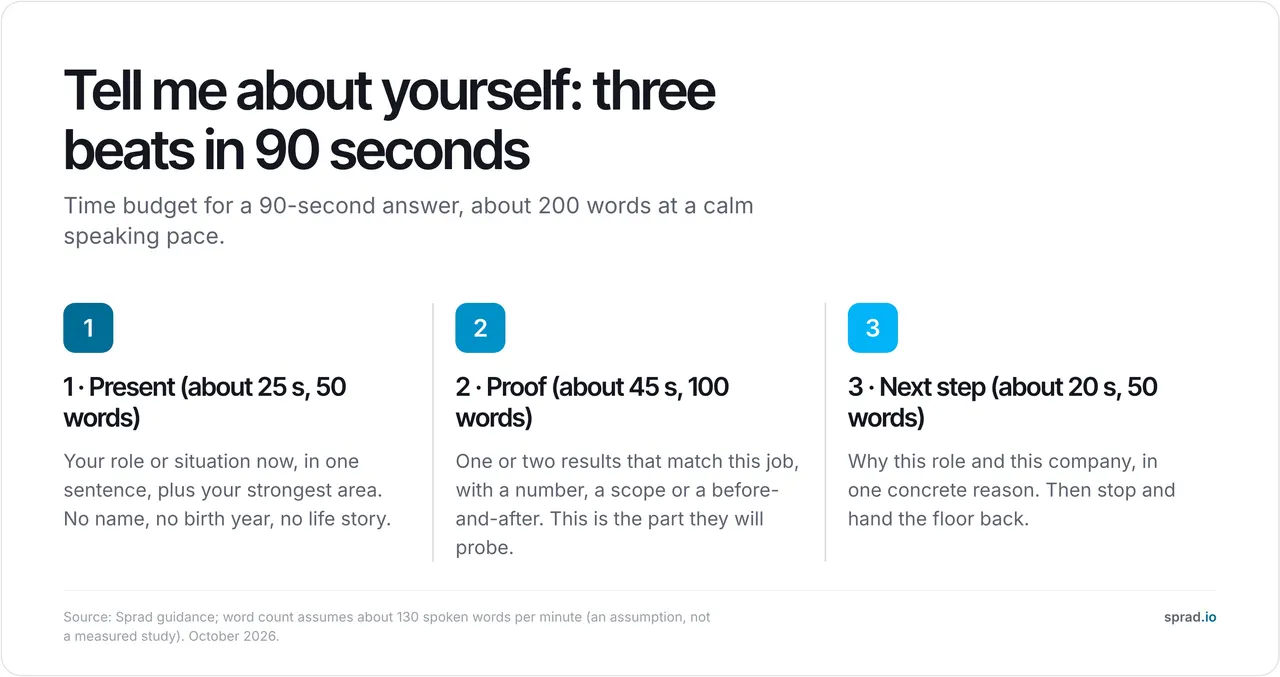
- Present. One sentence on your current role or situation and your strongest area. "I'm a customer success manager for a B2B software company and I focus on onboarding and renewals."
- Proof. One or two results that match the job posting, each with a number, a scope or a before-and-after. This is the part the interviewer will pick up.
- Next step. One concrete reason you want this role at this company. Then stop.
The time maths. Assume about 130 spoken words per minute (an assumption; most people speak between 120 and 150). A 90-second answer is then about 200 words: roughly 50 for the present, 100 for the proof and 50 for the next step. If your written draft is 400 words, it is a speech, not an answer. Cut the oldest role first, then the second result, then adjectives.
Before you write, read the job posting and underline the three requirements that appear most often. Your proof point should answer the first or second of them. A free tool such as Atlas Career can speed up this step: Atlas shows a match score with reasons for every job, so you can see which of your strengths the posting rewards most.
Which answer fits your role? Examples by role
The structure stays the same, but the proof changes with the job. The table shows what to lead with. The sample answers below it are fictional; the numbers are placeholders, so replace them with your own.
| Role | Lead with this proof | Avoid |
|---|---|---|
| Software engineer | A system you owned and a measurable change (latency, uptime, cost) | Listing every language and framework |
| Nurse or care worker | Ward or patient scope, a process you improved, how you work in a team | Vague claims about being caring |
| Sales (SDR, AE) | Quota attainment, pipeline or deal size, your method | Numbers without context (segment, period) |
| Trades and technical | Certifications, size of crew or site, finished on time and without rework | Skipping safety and quality |
| Marketing | One campaign with the goal, your part and the result | Buzzwords instead of results |
| Recent graduate | A project, internship or thesis with a concrete outcome | Apologising for lack of experience |
| Career changer | The transferable skill, one proof, why the new field | Hiding or over-explaining the switch |
Software engineer (present, proof, next step).
I'm a backend engineer at a logistics software company, working mostly in Python and PostgreSQL. Last year I led the move of our route-planning service to a queue-based design, which cut peak response time from about four seconds to under one and let us drop two on-call pages a week. I enjoy that mix of performance work and clear ownership, and that's why your platform team caught my eye: you're scaling the same kind of service, but for far higher volumes.
Nurse (patient-facing, calm and concrete).
I'm a registered nurse on a 28-bed cardiology ward, four years in. I'm the ward's contact for new colleagues, and last year I helped rewrite our handover checklist, which cut missed medication follow-ups in our own audit from five to one per month. I'm looking for a role with more patient education, which is why the cardiac rehab position appealed to me.
Sales (SDR or account executive).
I'm an account executive selling workflow software to mid-sized manufacturers. I closed 118 percent of quota last year, mainly by running a short discovery call that gets the buyer to quantify the problem first. I'm moving because your product sells into a segment I already know well, and the team is growing, so I'd get to build the playbook rather than inherit it.
Electrician or trades.
I'm a certified electrician with six years in commercial fit-out. I run a crew of three, I'm used to working to the building plan and the safety sign-off, and last year we finished two office floors ahead of schedule with no rework at inspection. I want to move into project work on larger sites, which is why your contractor role caught my attention.
Recent graduate.
I just finished my bachelor's in business administration. In my last year I ran a student consulting project for a local bakery chain: we analysed three months of sales data and our pricing change raised the average basket by about six percent. I'd like to start in operations, because that project showed me I enjoy turning data into decisions people can act on.
Which follow-up questions come next?
Whatever you mention in the proof beat becomes the next question, so choose a result you can talk about for two more minutes. Expect these four: "What was your exact role in that?", "What would you do differently?", "How did you measure the result?" and "Why are you leaving?". Prepare one sentence for each. If you name a number, be ready to explain how it was calculated and over what period. Interviewers trained in structured interviewing, which we see in many of the guides our customers build, are told to probe vague claims, so a claim you cannot unpack costs you more than leaving it out.
How do you answer it when you are changing careers?
If you are switching fields, flip the order: past, present, future, but keep it short. Lead with the part of your background that transfers, then say what you did to close the gap, then why this field.
For eight years I ran training programmes for retail staff, which meant explaining complex products to people in a hurry and measuring whether it worked. Last year I completed a customer success certificate and took on onboarding for two clients at my current company. I'd like to bring that mix of teaching and measurable results to a customer success role like yours.
Do not apologise for the switch and do not hide it. Name the transferable skill, one proof and the reason. For help with the CV side, see our career change resume guide.
What if you have a gap, were laid off or are returning to work?
State it in one neutral sentence and move on to the present and future. "I was part of a restructuring in March and have since finished a data analysis course and two freelance projects." You do not owe a long explanation, and a short one reads as confident. Keep the proof point recent: a course, a project or volunteer work counts.
What should you leave out? Legal limits in the US, UK and DACH
You decide how much personal information to share, and employers are restricted in what they may ask. In the US the EEOC lists prohibited practices and says employers may not make pre-offer inquiries about disability (accessed 30 October 2026). In Germany the General Equal Treatment Act (AGG), section 1 protects against discrimination based on race and ethnic origin, gender, religion or belief, disability, age and sexual identity. "Tell me about yourself" invites oversharing: your age, your family plans, your religion. You do not have to volunteer any of it, and a good interviewer will steer you back to the job.
Convention differs too. In the US and UK a CV has no photo and the answer is purely about work. In Germany, Austria and Switzerland a photo on the CV is still common, the answer is often a little longer and more formal, and the German "Du" or "Sie" depends on the company culture, so follow the interviewer's lead. Wherever you apply, keep the answer short and leave salary out of it; that question comes later.
What mistakes should you avoid?
- Reciting your CV. The interviewer has read it. Add what is not on it: the result behind a line.
- Starting in childhood. Begin at your current role. Go back only if it explains something relevant.
- Staying vague. "I'm a team player who loves challenges" tells them nothing. A number or a scope does.
- Memorising word for word. Interviewers hear a script in the first sentence. Learn the three beats, not the sentences.
- Running past two minutes. Long answers push out the questions you could have answered better.
- Not tailoring it. The same opener for every posting means the proof does not match the job.
- Talking down your employer. Move toward something, not away from someone.
Which templates and tools help, and how does AI change it?
Three things help: the formula above as a fill-in template, a recording of yourself, and a sparring partner. An AI chat is a useful sparring partner as long as you paste in your real facts and ask for a strict rubric (structure, evidence, length) rather than praise. We cover the practice setup in our guide to free AI mock interviews and the STAR method in STAR method answers with AI.
AI also changes the interview itself. Some employers use an AI interviewer or automated screening. In the EU, Annex III of the AI Act classes recruitment and candidate-evaluation systems as high risk, with those obligations applying from 2 December 2027 under the Digital Omnibus (Regulation (EU) 2026/1744). For you the advice is the same either way: a clear, specific opener works for a human and for a system that parses your answer. Atlas Career does not coach interviews. What it does is give you the raw material: roles from employers' own career sites with match reasons, and a CV tailored to each job, so your proof point and your CV tell the same story. It is free with no limit, and you apply directly to the employer yourself. See also our overview of AI job search tools.
How does it change in a phone, video or recorded interview?
The three beats stay, but the delivery changes. On the phone there are no facial cues, so signpost your answer ("I'll give you the short version in three parts") and keep sentences short. On video, look at the camera for the first and last sentence. In a one-way recorded interview with a time limit, aim for the lower end, 60 seconds, and finish with the next-step beat so the answer ends cleanly instead of being cut off.
A one-week practice plan
- Day 1: Underline the top three requirements in the posting and pick your proof.
- Day 2: Write the 200-word draft.
- Day 3: Record yourself and time it. Cut to 90 seconds.
- Day 4: Practise with a friend or an AI chat and ask for one follow-up question.
- Day 5: Adapt the proof and the last sentence to the second posting.
- Day 6: Run it once, standing, without notes.
- Day 7: Rest. Re-read the posting once.
FAQ
How long should the answer to "tell me about yourself" be?
Between 60 and 90 seconds, up to two minutes at most. That is about 150 to 250 words at a normal speaking pace.
Should I talk about my personal life?
Only briefly, and only if it is relevant, such as a hobby that shows a skill. You are never required to share your age, family plans, religion or health. See the legal section above.
What do I say if I have no work experience?
Use studies, internships, projects, volunteering or part-time jobs as the proof. Pick the one that matches the job best and give a result.
Is "tell me about yourself" the same as "walk me through your CV"?
Not quite. "Walk me through your CV" invites a chronological tour, but still keep it to the roles that matter. "Tell me about yourself" lets you choose the angle.
Can I use AI to write my answer?
You can use AI to structure and tighten a draft, but the facts must be yours and you must be able to explain every claim. An answer you cannot back up under follow-up questions does more harm than a plain one.
How do I answer in a language that is not my first?
Use shorter sentences and fewer ideas. A slow, clear 60-second answer beats a rushed 90-second one.
Jürgen Ulbrich
Jürgen Ulbrich has more than a decade of experience in developing and leading high-performing teams and companies. As an expert in employee referral programs as well as feedback and performance processes, Jürgen has helped over 100 organizations optimize their talent acquisition and development strategies.