Most AI voice screening tools are built for a single employer running high-volume hiring for one brand — retail chains, warehouses, call centers — not for a staffing agency screening candidates across dozens of different clients at once. That shows up directly in the pricing: Paradox (now folded into Workday), Talkpush and HireVue are all sales-gated with five- and six-figure annual contracts, and only a handful of names publish real per-seat or per-interview pricing an agency can actually budget against, as of October 2026.
What "AI voice screening" actually covers
The category splits into three different things marketed under the same label. Real-time voice AI calls a candidate and holds a live, adaptive conversation — Sprad's voice interviews, Sense, NTRVSTA and Talkpush's Voice AI all work this way. Async video screening records a candidate answering preset questions on their own schedule, with no live conversation at all, which is how Willo and part of HireVue work.
Conversational chatbots screen candidates over SMS or chat text, sometimes with a voice layer bolted on, as Paradox's Olivia and Humanly do. If a candidate needs to speak and be understood, not just tap through a form, only the first category — real-time voice AI — actually delivers that.
Voice and video screening tools compared
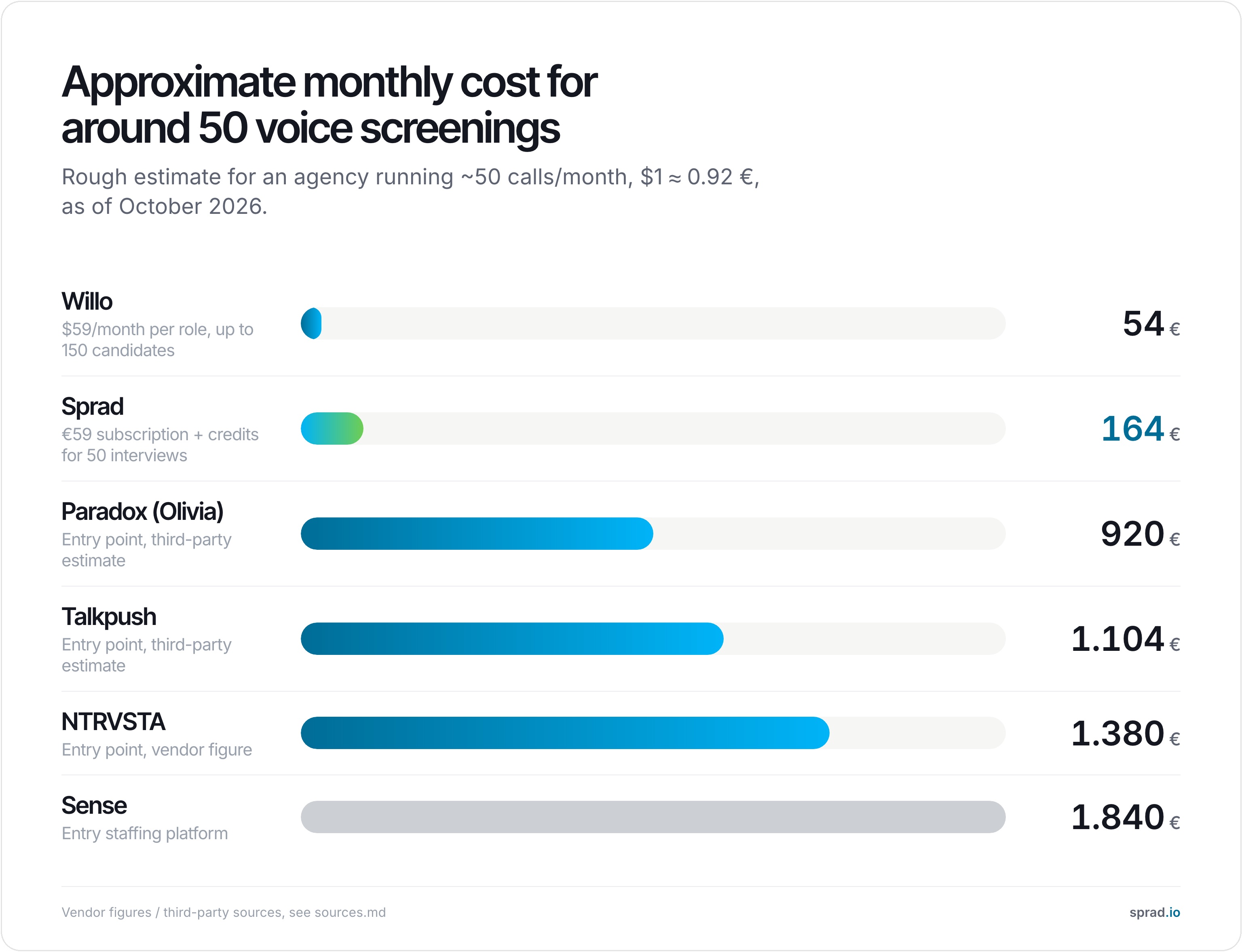
| Tool | Modality | Price | Multi-client / agency fit | Reviews |
|---|---|---|---|---|
| 1. Sprad | Real-time AI voice call, 12 languages | €59/recruiter/mo + ~€2.10 per interview (30 credits) | Built for agencies; bundled with ATS, pool, sourcing | Part of broader Atlas product; see Sprad reviews |
| 2. Willo | Async video, self-recorded | $59/mo per live role (Lite, up to 150 candidates, capped at 5 roles) | Self-serve, per-role pricing suits a multi-client setup | 4.7/5, 246 reviews |
| 3. Sense | SMS + chatbot screening, some voice AI | Staffing Platform from $2,000/mo, AI Recruiter from $3,000/mo | Built for staffing, but sold as enterprise modules | 4.5/5, 563 reviews (G2) |
| 4. NTRVSTA | Real-time AI phone screening | ~$1,500–4,000/mo (vendor-published) | Integrates with Bullhorn and 50+ ATS; positioned for larger agencies | Not independently rated on G2/Capterra as of Oct. 2026 |
| 5. Talkpush | Real-time Voice AI + chatbot | Custom; third-party estimates ~$1,200/user/mo, voice usage $0.25/min | Built for high-volume single-employer hiring (BPO, retail) | No public aggregate rating found |
| 6. Paradox (Olivia) | SMS/chat, now a Workday product | From ~$1,000/mo, typically $30k–95k/yr | Single-employer high-volume hiring, not agency multi-client | No independent public rating found |
Prices are as published or estimated in October 2026, converted at roughly $1 = €0.92 where a vendor quotes in USD. None of the enterprise tools below publish a self-serve rate card — every figure above €1,000/month came from a buyer report or vendor sales material, not a checkout page.
Each tool, in detail
1. Sprad: built for agencies, priced per interview
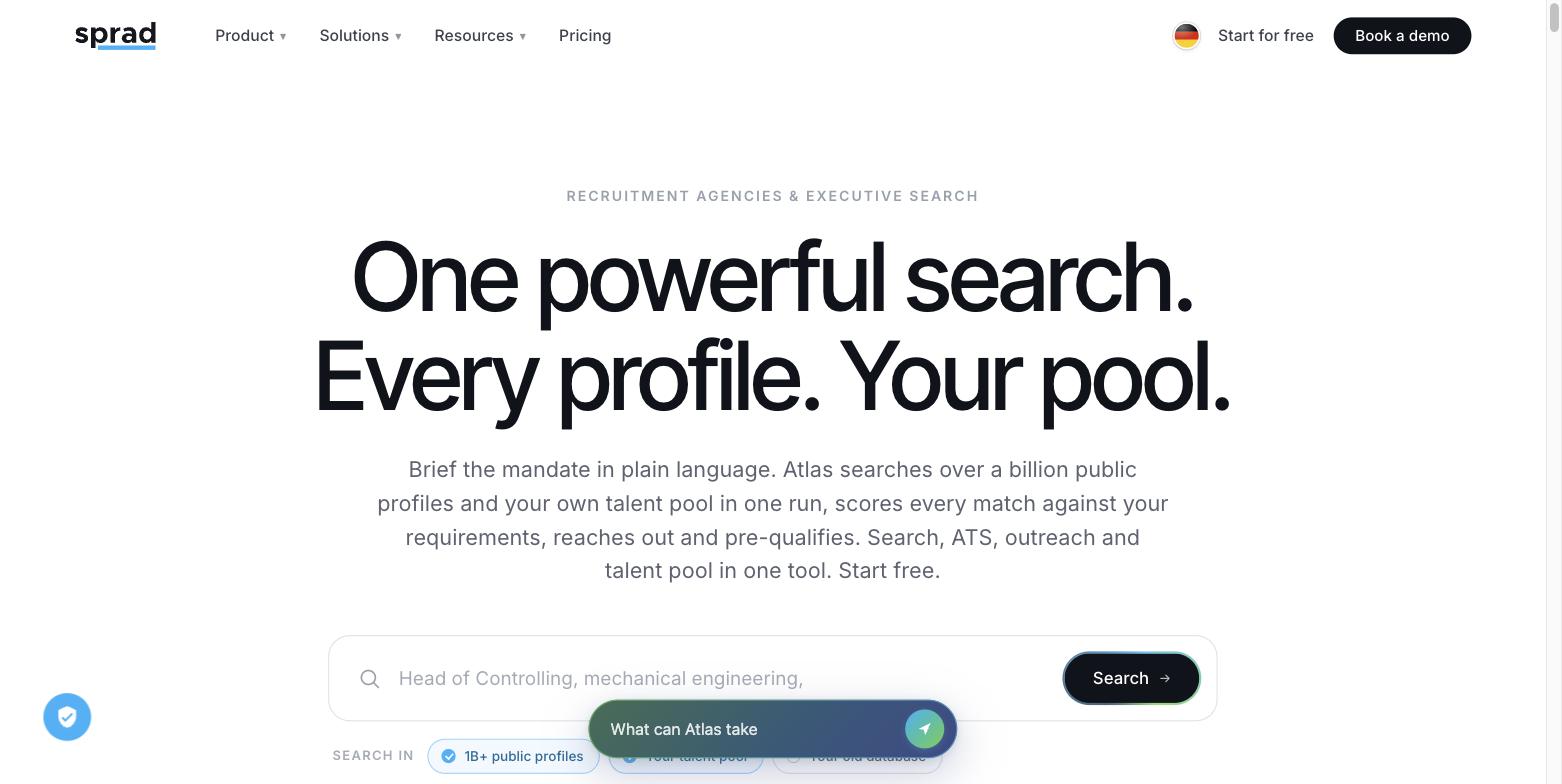
A requirement search across 1B+ external profiles and the agency's own pool replaces keyword search, and in an August 2026 benchmark it surfaced 38% of the matches other tools found, against 9% for the next-best. Because the voice interview sits in the same workspace as the ATS, talent pool and sourcing, an agency doesn't need the multi-client workarounds the enterprise tools below were never built for. Credits are only spent on candidates who pass — a rejected profile costs nothing.
2. Willo: the cheapest self-serve option, but async only
Willo's Lite plan is pay-as-you-go at $59/month per live role, covering up to 150 assessed candidates — the cheapest fully public, self-serve price in this category. The trade-off is real: a candidate records answers to preset questions on their own time, with no adaptive follow-up based on what they just said. The catch that's easy to miss in the headline price: Lite caps out at 5 live roles and 5 users, so a busy multi-client desk will outgrow it.
3. Sense: staffing-specific, but priced in enterprise modules
Sense is explicitly built for staffing and high-volume hiring, layering automated SMS, chatbot screening and some voice AI on top of a talent CRM. G2 rates it 4.5/5 across 563 reviews, with reviewers praising bulk messaging and fast access to conversation history. The Staffing Platform starts at $2,000/month and the AI Recruiter tier at $3,000/month — genuinely staffing-enterprise pricing, not a small-agency add-on.
4. NTRVSTA: real-time phone screening with ATS integrations
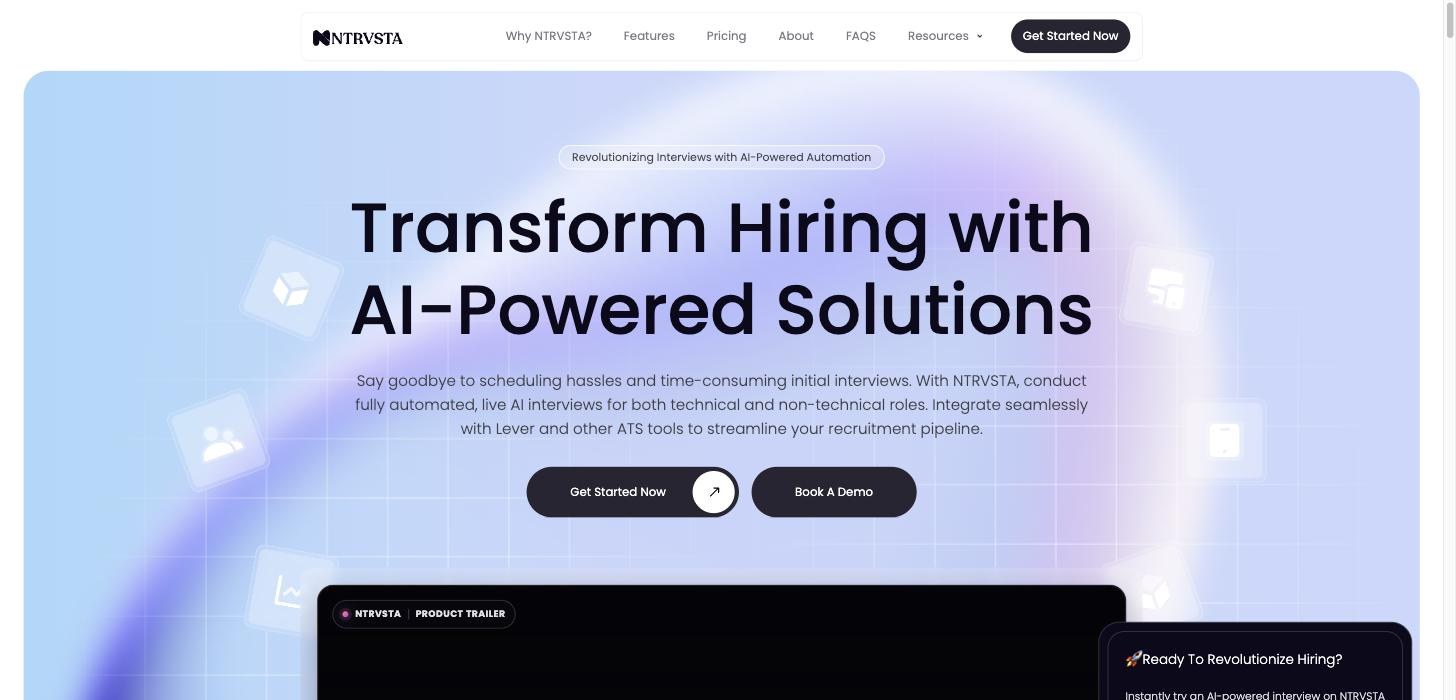
NTRVSTA runs live AI phone screening and integrates with Bullhorn and 50+ other ATS platforms, with multilingual support across nine languages. The vendor's own published figures put pricing at roughly $1,500–4,000/month depending on volume — numbers from NTRVSTA's own materials rather than an independent G2 or Capterra listing, so treat them as a starting point for a sales conversation, not a fixed rate card.
5. Talkpush: voice AI woven through the whole funnel, enterprise-only
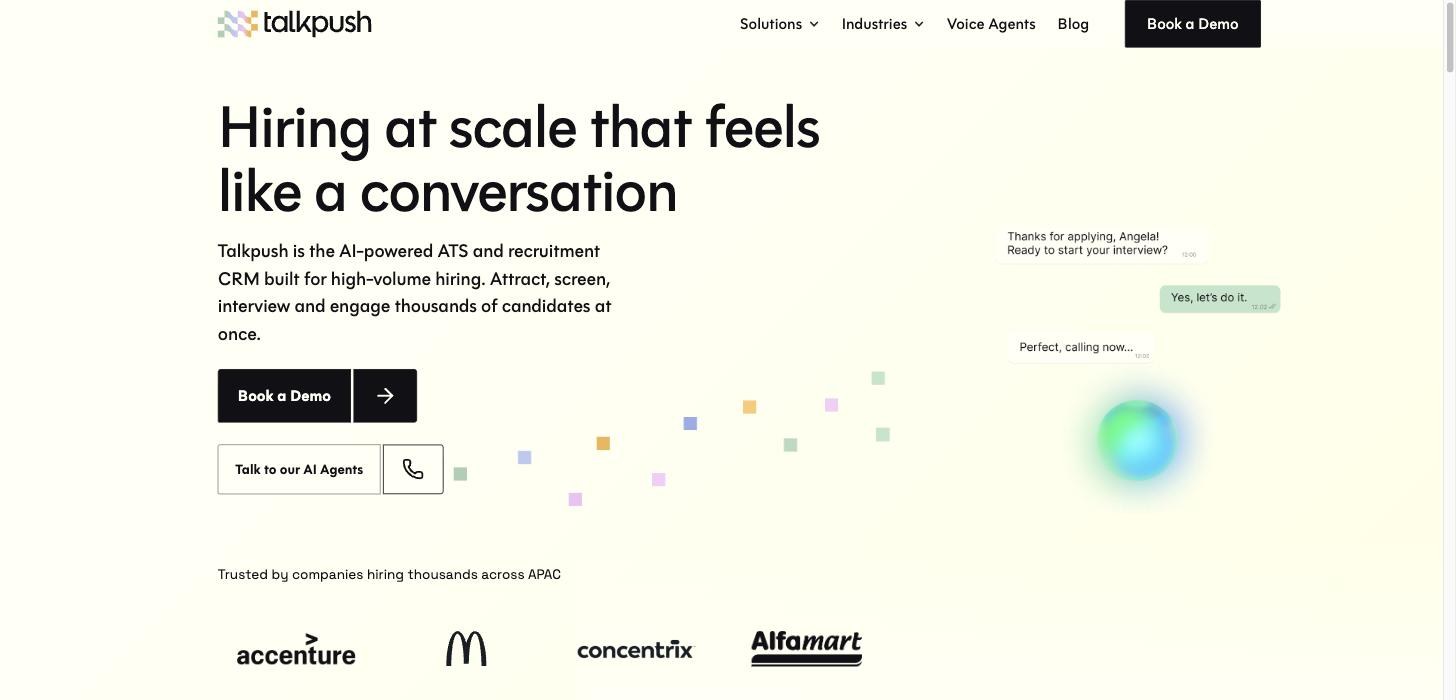
Talkpush layers Voice AI across career-site chat, reminders, screening and interviews for high-volume employers in BPO, retail, logistics and staffing outsourcing. Pricing is entirely custom, though one concrete number surfaces: Voice AI usage itself runs about $0.25 per minute, on top of a platform fee third parties estimate from roughly $1,200 per user a month. Either way, it's a sales-gated model built for one company's hiring volume, not an agency serving many clients.
6. Paradox (Olivia): the category leader, now inside Workday
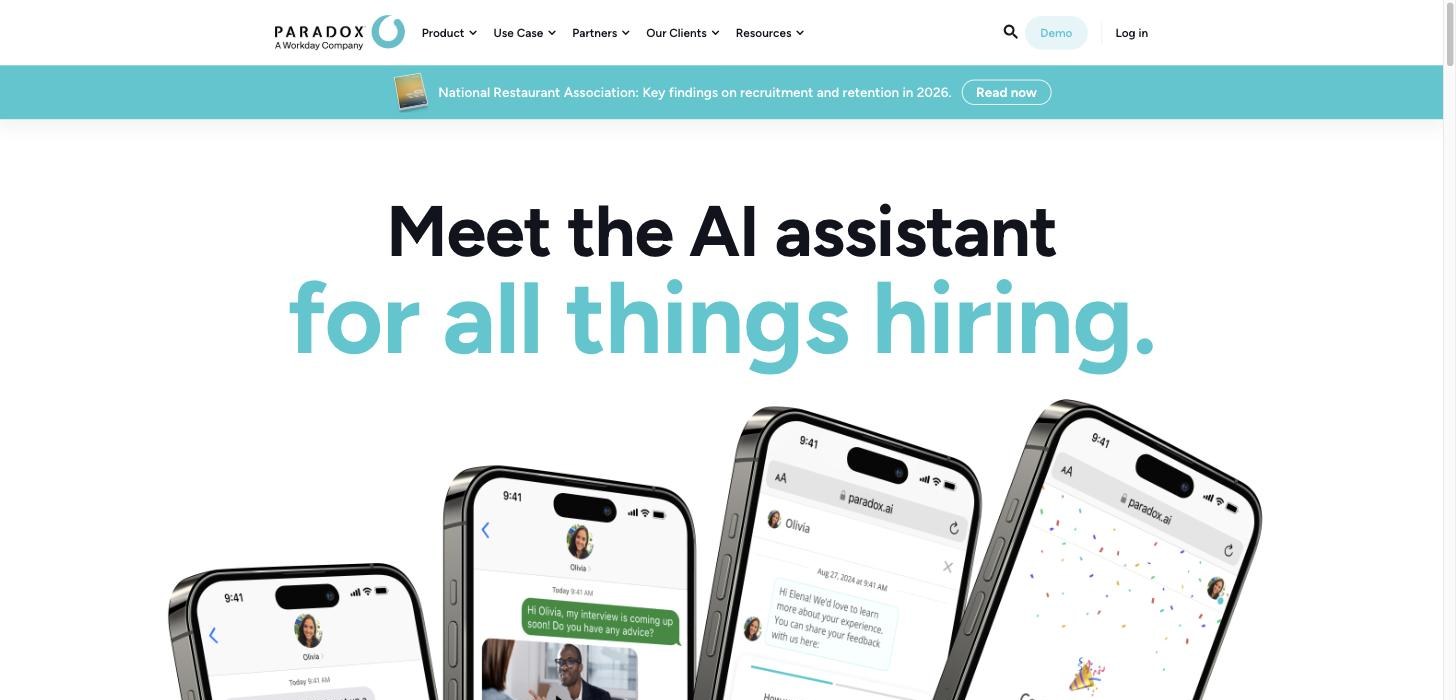
Paradox's Olivia is the best-known name in conversational hiring AI, and the acquisition by Workday — closed October 2025 — is now fully in effect: Olivia operates as the Workday Paradox Candidate Experience Agent inside Workday's talent suite rather than as a standalone product. Third-party buyer reports put entry pricing at roughly $1,000/month, with typical contracts of $30,000–95,000 a year plus $15,000–35,000 in implementation fees. It remains built and priced for single large employers — named customers include Chipotle, 7-Eleven and Wendy's — not an agency managing multiple clients' hiring on one account.
What to skip unless you're enterprise-scale
HireVue's video interview platform starts around $35,000/year for its Essentials tier and climbs past $100,000/year with AI scoring included — and it explicitly lacks multi-client account management, which most reviewers flag as a dealbreaker for agencies juggling separate client pipelines. Apriora (rebranded to Alex) runs real-time AI voice interviews at scale but publishes no pricing at all; industry reporting puts typical contracts at $50,000 or more, aimed at companies running thousands of interviews a year. Both are strong products for a single large employer's in-house TA team, not for an agency's budget or workflow.
How to choose
- You need a live, adaptive phone conversation, priced per interview: Sprad is the only option here with transparent, published per-interview pricing built into an agency-first ATS.
- You want the cheapest self-serve option and async is fine: Willo, at $59/month per live role, as long as you stay under 5 roles.
- You're already running high-volume staffing at scale and can absorb enterprise pricing: Sense or NTRVSTA both integrate with existing ATS platforms like Bullhorn.
- You're a boutique or mid-size agency: Paradox, Talkpush and HireVue are priced and built for single large employers, not a realistic fit at this size.
FAQ
What's the cheapest real AI voice screening tool for a staffing agency?
Willo's Lite plan at $59/month per live role is the cheapest self-serve option, but it's asynchronous video, not a live phone conversation. For a real-time AI voice interview with published per-interview pricing, Sprad's 30-credit rate (about €2.10) per interview is the most transparent option in this category.
Why don't most voice screening tools publish pricing?
Paradox, Talkpush, HireVue and Apriora/Alex are all built around large enterprise contracts sold through a sales team, where pricing depends on interview volume, integrations and multi-year commitments. None of them target a self-serve small or mid-size buyer.
Can a staffing agency use HireVue across multiple clients?
Not well. Reviewers and buyer guides consistently note HireVue lacks multi-client account management, which is a core requirement for an agency running separate hiring pipelines for different customers at once.
Is async video screening the same as AI voice screening?
No. Async tools like Willo record a candidate answering fixed questions on their own schedule with no live conversation. Real-time voice AI, like Sprad's or Sense's, holds an adaptive conversation and can ask a genuine follow-up question based on what the candidate just said.
Does Sprad's voice screening work in languages other than English?
Yes — Sprad's voice interviews run in 12 languages, which matters for agencies screening across DACH, EU and international candidate pools in the same account.
Does the EU AI Act affect AI voice screening tools used in the EU?
Yes. An AI system that scores, ranks or automatically evaluates job applicants is classified as high-risk under the EU AI Act, and the core high-risk hiring obligations — human oversight, a documented risk assessment and transparency to candidates — phase in from August 2026, with fines of up to €15 million or 3% of global turnover for breaches. Ask any vendor, Sprad included, how a human stays in the loop and where candidate data is hosted before rolling a tool out across client accounts.
Priced for a client roster, not a single brand
The tools built for one company's high-volume hiring don't map cleanly onto an agency juggling multiple clients' open roles at once — and their pricing reflects that mismatch. Sprad's voice interviews run on 30 credits (about €2.10) per call inside the same €59/recruiter/month workspace as your ATS, talent pool and sourcing, with 200 free credits every month and no credit card to start. See what that costs for your team size at sprad.io/industry/recruitment-agencies.
Jürgen Ulbrich
Jürgen Ulbrich has more than a decade of experience in developing and leading high-performing teams and companies. As an expert in employee referral programs as well as feedback and performance processes, Jürgen has helped over 100 organizations optimize their talent acquisition and development strategies.