
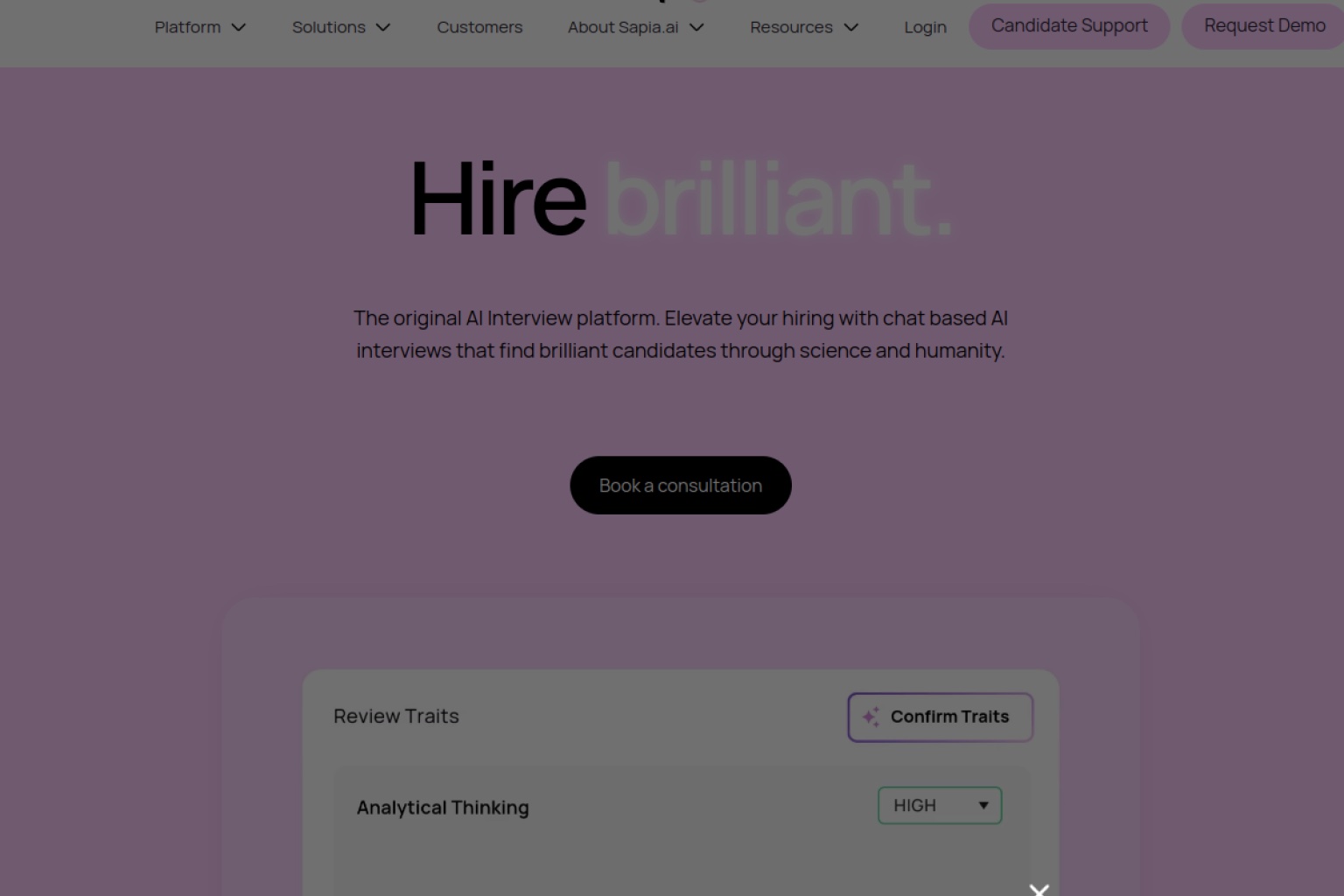
Source status: 20 August 2026. Product, language, security and privacy statements are based mainly on public Sapia.ai materials. User feedback is identified as individual public evidence. Contractual and hosting details not publicly evidenced are not assumed.
What Sapia.ai is – and when it is a good fit
Sapia.ai is an AI-enabled screening and interview platform for recruiting processes with a high inflow of applications. Its core workflow is a written chat interview: applicants answer role-specific questions on a phone or browser; Sapia.ai analyses the free-text responses, produces structured information, and supports prioritisation for the next step. Its public product page, accessed 20 August 2026 says the platform can screen and interview thousands of candidates in parallel through text chat.
Sapia.ai is a good choice for employers with repeatable roles, wide application funnels, and a clearly defined first selection stage. That commonly includes frontline, retail, service, contact-centre, healthcare, airline, and other high-volume hiring environments. In those cases, an asynchronous and standardised interview can capture comparable information from every applicant without requiring recruiters to make an initial call to each person. The product is not a full ATS, however, and it does not replace a practical skills assessment or accountable human hiring judgement.
The key buying question is therefore not simply whether to use AI. It is whether the employer can sensibly, fairly, and transparently capture what candidates say about role-relevant situations before a live conversation. Where the answer is yes and volume is sufficient, Sapia.ai is a plausible specialist layer. Where the central challenge is candidate sourcing, deep technical assessment, or highly individual executive selection, another product category will usually be a better first choice.
| Criterion | Sapia.ai assessment |
|---|---|
| Category | AI-enabled screening, text-based chat interviewing, and interview intelligence; designed as a layer alongside ATS and HRIS systems. |
| Target market | Primarily high-volume, repeatable recruiting. The vendor describes the platform as designed for large businesses; a third-party source places its main fit at roughly 500 or more hires a year. Sources: Sapia.ai and HeroHunt, 21 April 2025; status 20 August 2026. |
| Pricing model | Publicly described as pay per hire with unlimited interviews; the rate per hire is individually negotiated. No public rate card was available. Source: HeroHunt, 21 April 2025; status 20 August 2026. |
| Price disclosure | Not public. No reliable EUR or USD list price, nor a public minimum contract term, was evidenced in the sources reviewed. |
| Language coverage | For Chat Interview, Sapia.ai names English, Spanish, French, Dutch, German, Italian, Swedish, Finnish, and Danish. Current German output quality and coverage by module should be tested in a pilot. Source: Sapia.ai, 7 March 2024; status 20 August 2026. |
| Hosting and privacy | Sapia.ai states that it uses AWS, supports data sovereignty across regions, and is GDPR compliant. Its privacy policy also says AWS data may be processed or stored anywhere in the world. Dedicated EU or German hosting for a particular tenant is not publicly evidenced. Sources: Security page and Privacy Policy; status 20 August 2026. |
| Integrations | Publicly named integrations include Workday, SAP SuccessFactors, SmartRecruiters, Teamtailor, iCIMS, PageUp, Avature, Greenhouse, and others; the vendor also describes custom and middleware integrations. Source: Sapia.ai Integrations; status 20 August 2026. |
| Target company size | More naturally mid-market to enterprise, or any employer with substantial repeatable hiring volume. For a small number of isolated hires, implementation and governance effort may exceed the benefit. |
How the product works technically
In the standard workflow, a chat interview is launched from a job advertisement, an ATS, or an invitation link. Candidates answer written prompts asynchronously. Sapia.ai’s public platform materials say it uses analytics and machine-learning algorithms to score candidates against a role-specific ideal candidate profile, create a curated shortlist, and generate insights for both candidates and hiring teams. The same material documents a mobile-first, one-way video interview feature. Its privacy policy says video responses are collected and processed but are not analysed by AI. Sources: Platform Appendix, version 28 October 2025 and Privacy Policy, last updated 16 July 2024, accessed 20 August 2026.
The primary assessment input is therefore not simply CV keywords or an image from a video interview, but the text generated during the interview. For Chat Pro, Sapia.ai describes creating or editing a weighted competency profile, role-specific interview questions, and the end-to-end dialogue from a job description. For Chat Classic, it describes volume hiring and Candidate Experiences with screening questions. According to the Appendix, a Candidate Experience includes an ideal-candidate-profile model, up to five interview questions, branded candidate communications, a yes/maybe/no threshold, an automated progression rule, and an insight report. Candidate Experiences are required for Chat Classic. Source: Platform Appendix, version 28 October 2025; status 20 August 2026.
- Data input: An ATS or HRIS will typically provide candidate and requisition context, while interview responses are produced in Sapia.ai. The exact fields, statuses, documents, and direction of synchronisation depend on the implementation and should be mapped before purchase.
- Automation: Candidates can be invited and reminded automatically, progressed after a threshold, and managed through filtered or exported lists. Enterprise materials additionally describe scheduling, rescheduling, cancellation, and reminders for live interviews; SMS/MMS is listed as an optional add-on.
- Recruiter outputs: Talent Hub is documented as providing permissions, candidate search, status changes, bulk invitations, and export. Discover Insights is intended to report on funnel performance, candidate experience, efficiency, diversity, and ROI. The decision value of these outputs still depends on data quality and configuration.
- Configuration responsibility: Automated ranking is only as sound as the competency model, questions, thresholds, and exception rules selected by the employer. Vague or unsuitable criteria are not corrected by automation; they can instead scale across many candidates.
- Structural boundary: Text answers do not establish practical capability, real-world collaboration, or deep specialist expertise. Identity, work authorisation, availability, qualification evidence, and practical job skills require separate evidence or later steps.
Text-based assessment described as blind may remove visual and audio signals from the assessment input. That is not the same as automatically bias-free hiring. Writing confidence, language, access to the interview, question design, and chosen target criteria remain material influences. Sapia.ai refers to an independent bias audit and its own FAIR governance framework; these vendor materials are a useful basis for due diligence, but not a substitute for validation in the buyer’s role, geography, and candidate population. Source: Sapia.ai product page; status 20 August 2026.
Pricing, contract terms, and economic fit
Sapia.ai does not publish a verifiable standard price list. The strongest public pricing indication in the reviewed material comes from HeroHunt, dated 21 April 2025: it says Sapia.ai charges per hire rather than per interview, interviews and assessments are unlimited, and the per-hire rate is negotiated according to annual hiring volume. HeroHunt discloses affiliate links and is not a binding quotation. Buyers should therefore treat this as a description of the commercial model, not as a guaranteed contract term. Source: HeroHunt, 21 April 2025; status 20 August 2026.
| Cost and contract issue | Publicly evidenced position | What the proposal should specify |
|---|---|---|
| Core model | Pay per hire; unlimited interviews according to a third-party source. | Price per hire, definition of a hire, invoicing event, and treatment of replacement hires. |
| Interview volume | Unlimited interviews are publicly described. | Written treatment of abandoned, duplicate, incomplete, and internal-test interviews. |
| Standard integrations | HeroHunt describes mainstream ATS integrations as included; Sapia.ai names multiple partners. | Target integration, field mapping, implementation effort, support ownership, and any incremental charge. |
| Custom integration | HeroHunt refers to a possible fixed additional fee; Sapia.ai describes custom integrations. | One-off charges, change requests, middleware, maintenance, and acceptance criteria. |
| Minimum term and commitment | Not publicly evidenced. | Annual floor, notice period, renewal, hiring freeze, under-consumption, rollover, and price-escalation rules. |
| Additional modules | Video interview is documented only in higher tiers; SMS/MMS is listed as an optional add-on. | Clarify whether each module is included, volume-priced, or separately charged. |
The potential economic advantage of this model lies in a wide candidate funnel: under a per-hire price, an extra applicant who is not hired does not directly increase the stated billable unit. That can be attractive for seasonal or mass hiring compared with per-assessment pricing. It does not remove the need for a total-cost calculation. Licence cost and implementation should be compared with current effort for early calls, follow-up, scheduling, manual review, candidate communication, quality control, and manager time.
A practical buyer rule is to first calculate annual manual effort in early screening: applications multiplied by minutes spent reviewing, contacting, and holding initial conversations, then multiplied by the fully loaded hourly cost of recruiters and hiring managers. Add the proposal value, implementation, and the internal cost of QA, privacy, and works-council review. If the case works only by assuming every applicant can proceed automatically, it is too optimistic. If it still works with conservative pilot completion, human review of borderline cases, and real integration effort, it is more robust. For a team making few hires, fixed setup is often more important than time saved per applicant; for a large, repeatable volume, automation becomes more plausible.
Which use cases suit Sapia.ai?
| Situation | When Sapia.ai is a good choice | When it is less suitable | Alternative category |
|---|---|---|---|
| Many similar applications | Good fit where the early stage can be standardised and questions can be validated against the role. | Less suitable where profiles are highly varied and difficult to assess through a common structure. | Structured interview or assessment tool |
| Frontline and volume hiring | A central vendor use case: candidates can respond asynchronously and be moved through a configured process. | Less suitable where a material part of the audience struggles with written chat or requires another access channel. | High-volume ATS with recruiting automation or phone screening |
| Existing ATS remains system of record | Useful as an added screening layer if the concrete integration reliably passes data and status. | Less suitable if a deep, unavailable specialist integration is necessary. | ATS add-on or recruiting CRM with integrated screening |
| Practical competence must be proven | Useful as a preliminary information-gathering stage. | Not sufficient as the sole decision method when real capability needs demonstration. | Work-sample, skills-assessment, or simulation platform |
| Senior and executive hiring | Possible for standardised initial questions or a consistent candidate experience. | Usually not the first choice where relationship work and a small number of highly individual candidacies dominate. | Executive-search software or talent-relationship CRM |
| Candidate experience with feedback | Suitable where the employer wants to offer automated insights to every participant. | Less suitable where the target group explicitly expects personal first contact or a live conversation. | Recruiting CRM or manual phone screening |
What public users report
Public review evidence is limited and should not be read as statistical proof of quality. On a public product and review listing published by SAP, individual feedback describes the questioning and scoring as useful for assessing suitability more efficiently in high-volume screening. That is evidenced but individual user praise; the visible volume and representativeness do not justify a general satisfaction claim. Source: SAP partner page with public review listing, accessed 20 August 2026.
A specific critical data point is a one-star G2 review published on 8 January 2026. The reviewer raises concerns about support for dyslexia and other accessibility needs, and says detailed responses were sometimes incorrectly identified as AI-generated. In its public response, Sapia.ai says the chat interview has no time limit, supports screen readers and speech-to-text, and treats AI-use detection as guidance rather than a penalty. Neither side is a general product finding; together they create a clear pilot requirement. Source: G2 review and vendor response dated 8 January 2026, accessed 20 August 2026.
DACH, EU, privacy, and the EU AI Act
German is explicitly documented for Chat Interview, which is a useful starting point for DACH deployments. It does not, however, demonstrate that every role-specific prompt, assessment, formal address, Swiss language variant, or support journey will meet the required standard. A pilot should test German invitations, special characters, question comprehension, consistency of output, and candidate support. If language is itself a job requirement, the buyer should also establish whether and how it is assessed rather than allowing it to become an unexamined side effect of the format.
On hosting, the public evidence is mixed rather than complete. Sapia.ai’s security page says data are processed within AWS, stored with encryption, and handled in a GDPR-compliant manner; it also cites ISO 27001 and SOC 2 Type I and Type II. Its Privacy Policy, last updated 16 July 2024, also says that AWS data may be processed or stored anywhere in the world; HubSpot keeps information in the United States and Intercom stores information in the EU. Sapia.ai further says it may use de-identified information indefinitely to improve the platform, create products, and conduct research. Sources: Security page and Privacy Policy, accessed 20 August 2026.
An EU or DACH buyer should therefore not infer a particular storage location from a general regional-hosting or GDPR statement. The selected AWS region, data-processing agreement, current subprocessors, international transfers, technical and organisational measures, deletion periods, candidate-rights handling, third-country access, and governance of de-identified data should be confirmed in writing. A German hosting location or exclusive EU hosting is not evidenced in the public sources reviewed.
The EU AI Act is directly relevant. The European Commission explicitly lists AI tools for employment and access to employment, including CV-sorting software for recruitment, among high-risk use cases. Under the Commission’s current timeline, the rules for high-risk systems in sensitive areas including employment are due to apply from 2 December 2027. The legal role of Sapia.ai and of a deploying employer depends on the configuration and use case; this profile is not legal advice. Source: European Commission AI Act overview, status 20 August 2026.
Before deployment, employers should obtain documented answers on which models and data points affect each recommendation, which logs can be exported, how performance and potential disadvantage are monitored, how human oversight and overrides work, and what materials are provided for risk management, technical documentation, and user instruction. The buyer’s own workflow is equally important: automatic progression or rejection should not enter a legally or ethically indefensible decision process without clear, reviewable rules and appropriate human intervention.
Eight questions for the selection meeting
- How exactly do you define a billable hire, which annual minimum and contract term apply, and what happens during a hiring freeze or if we hire below forecast?
- Which components are included in the quotation – Chat Classic, Chat Pro, video, SMS/MMS, candidate insights, reporting, support, and training – and which are charged separately?
- Which precise ATS integration will be delivered for our system, what fields and status values are exchanged, and who owns investigation and change work?
- Which AWS region processes our applicant data, which subprocessors are involved, and what third-country transfers remain technically or organisationally possible?
- Which German-language variants, candidate-support routes, and accessibility functions are production-ready, and may we test them with representative candidates?
- Which factors influence scoring, classification, and automated progression; what explanations, audit logs, and exports can recruiters, privacy teams, and works councils receive?
- How is the use of interview data for model improvement or research governed contractually, particularly for de-identified information?
- Which pilot outcomes for a role comparable to ours can Sapia.ai measure transparently: completion, abandonment, time saved, handoff quality, later interview outcomes, and candidate feedback?
FAQ
Does Sapia.ai replace an ATS?
No. Sapia.ai positions itself as an interview and screening layer that can connect to ATS and HRIS environments. The existing ATS will normally remain the system of record for requisitions, candidate records, approvals, and many workflow steps.
Can it replace human interviews entirely?
No. It can automate an early, repeatable conversation and gather structured information consistently. Practical skills evidence, references, complex follow-up questions, and accountable hiring decisions still require people or additional assessment methods depending on the role.
Is it automatically inexpensive for a large number of applicants?
No. A pay-per-hire model can be attractive for a wide funnel because interview count is not the published billing driver. Actual value still depends on the price per hire, any minimum commitment, contract length, integration cost, and the time genuinely removed from the process.
Is Sapia.ai immediately privacy-ready for DACH?
No blanket public confirmation can establish that. German Chat Interview support and broad GDPR statements are documented, but the selected data region, transfers, subprocessors, and contractual documentation need to be reviewed for the actual deployment.
Is a text interview suitable for every candidate group?
No. It can offer flexible, asynchronous participation, but it assumes a candidate can and will respond in writing. For roles or groups where phone, video, spoken language, or practical demonstration is more appropriate, use the text format only after an accessible pilot.
What should a pilot decide?
A pilot should not focus only on a faster shortlist. It should measure completion and abandonment, accessibility, German-language quality, time saved, quality of candidates passed forward, agreement with later interviews, and demonstrable human control for borderline cases.
Conclusion
Sapia.ai is particularly well suited to employers that want to move high, repeatable application volume through an asynchronous, text-based interview in a consistent first stage. Its potential strengths are scale, structured information capture, and ATS-adjacent workflow automation. A sound decision nevertheless requires a role-specific pilot, explicit commercial terms, and written due diligence on German-language quality, accessibility, data residency, automated workflow rules, and AI Act governance.
Our own take: we also publish an editorial comparison for buyers weighing this tool against alternatives — read it here.