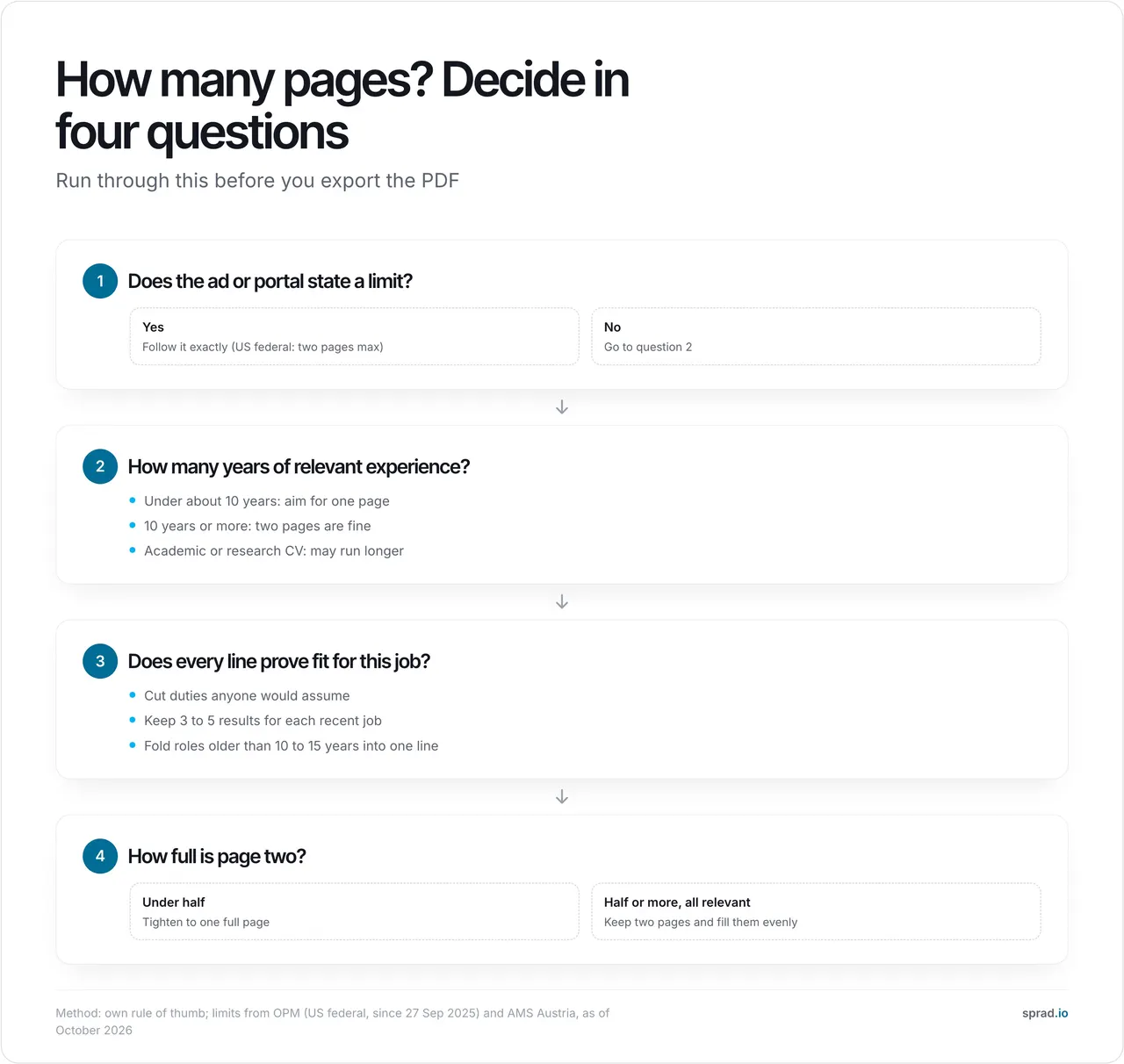
A resume should be one page if you have under about 10 years of relevant experience and two pages if you have more. Three pages are only normal for academic, research and some executive roles. How far back should it go? Usually 10 to 15 years, and further only if the job ad asks for it. The real test is not the page count but whether the last page is as strong as the first. Employers can also set hard limits: US federal applications on USAJOBS are capped at two pages.
What does "how long should a resume be" mean in practice?
Two numbers decide it: how many pages and how many years back. Both depend on your career stage, the country and the job ad. There is no law behind them, only convention, so an employer's instruction always beats a rule of thumb. This table is the short version.
| Situation | Pages | Years back | Note |
|---|---|---|---|
| Student or graduate | 1 | All relevant (internships, projects) | Education can come first |
| 2 to 10 years of experience | 1, or 2 if all relevant | About 10 | Do not stretch to fill page two |
| 10+ years, senior | 2 | 10 to 15 | Older roles in one line |
| Executive | 2, rarely 3 | 15+ if the ad requires it | Results and scope over duties |
| Academic or research CV | 3+ | Whole career | Publications and grants are expected |
| US federal job (USAJOBS) | Max. 2 | Relevant specialized experience | Hard limit since 27 Sep 2025 |
| UK CV | 2 A4 sides | 10 to 15 | Not two double-sided sheets |
| Germany, Austria, Switzerland | 1 to 3, two is ideal | Gap-free, older roles short | Photo still common |
| Career changer | 1 to 2 | Only relevant roles in detail | Transferable skills on top |
Sources: the US federal limit comes from the US Office of Personnel Management (two pages for all USAJOBS resumes from 27 September 2025). For Austria, the public employment service AMS recommends 1 to at most 3 A4 pages, with two ideal. UK, executive and career-changer rows are common career-service practice, not rules. Status: October 2026.
Is one page or two better? What the evidence says
Recruiters scan before they read. An eye-tracking study by Ladders (2018, reported by HR Dive) measured an average of 7.4 seconds for the first screen of a resume, and found that simple layouts, clear headings and bullets did well while clutter, multiple columns and long sentences hurt. So the top half of page one does most of the work, whatever the total length.
A survey by a resume-writing service of 482 recruiters and HR staff reported that two-page resumes were preferred 2.3 times as often as one-page resumes. Treat that as a hint, not proof: the sample was self-selected and the publisher sells resume services. We found no large neutral study that settles the question. What the sources agree on: relevance beats length.
Page count does not matter to the software, either. Greenhouse lists on its help page "Unsuccessful resume parse" (March 2026) what breaks parsing: files over 2.5 MB, graphics, photos, tables, headers, columns, image uploads. A second page is not on the list. As builders of recruiting software for seven years, we see the same pattern: a parser fills a database from the whole file, and a recruiter opens the file once your name is on a shortlist.
How far back should a resume go?
The common answer is 10 to 15 years. Jobs older than that rarely predict how you will do now, and they eat space. Exceptions:
- The ad asks for more. If it requires "12 years of experience in X", go back at least that far for the relevant roles.
- The old job is the relevant one. A career changer returning to a former field keeps it in detail.
- Executive and academic profiles show a longer arc.
Do not delete the thread. Fold earlier roles into one line under "Earlier career" (employer, title, years). This matters most in Germany, Austria and Switzerland, where a gap-free tabular CV is customary and unexplained holes raise questions.
Age is a second reason people cut old jobs. In the US, the Age Discrimination in Employment Act protects applicants aged 40 and over in hiring, and in Germany the General Equal Treatment Act (AGG), § 1 names age as a protected ground. The law protects you, but bias still exists, so trimming is legitimate. Never falsify dates or titles; leaving out a job is a choice, inventing one is not.
How do I get the length right, step by step?
Start with the longest honest version, then cut. The flow below takes you through the four decisions.
A worked example: the page budget
Constructed to show the effect, not a measurement: assume an A4 page at 11 pt with 2 cm margins fits about 45 lines. Header and contact take 5 lines, a short profile 3, education 4, skills 3. That leaves roughly 30 lines for experience.
A role costs one title line plus bullets of about 1.5 lines each. With four bullets that is 7 lines, so four roles fit on page one. With eight roles in 10 years, you need a second page, or you cut bullets: 4 bullets on the current role, 3 on the one before, 1 line each for the rest. The point is that the budget forces a choice. Every line you keep must earn its place for this job.
Which tools and templates help?
- Word or Google Docs: free, and you control the length. Set margins to 1.5 to 2 cm and the font to 10 to 11 pt. Below 10 pt, readers give up.
- Europass: the EU's free tool at europass.europa.eu is recognised across Europe.
- Layout and parse checks: see ATS-friendly resume template for the 5-minute test and CV template and examples for section order.
- US vs. UK terms: in the US a resume is the short document, a CV is longer and academic; see CV vs. resume.
Which mistakes should I avoid?
- Shrinking the font or margins to force one page. If you need 9 pt, you need to cut text.
- A page two with five lines. Either tighten to one page or add relevant content. Orphans look like an accident.
- Padding with duties. "Responsible for emails" does not prove anything. Results do: numbers, scope, outcomes.
- Cutting the one relevant old job because it is more than 15 years back.
- One resume for every job. A tailored version is shorter, because it drops what this employer does not care about. See career change resume guide if you switch fields.
- Ignoring the employer's rule. If a portal says two pages, a third page can be rejected by the form itself.
How does AI change resume length?
AI helps with the cutting, not only the writing. A tailored version for each ad keeps the lines that match and drops the rest, so it ends up shorter and sharper. The risk is the opposite: general chatbots tend to add lines, so check the length afterwards. See how to tailor your CV with AI and which AI resume builders are really free.
Atlas Career (atlas.now) is a free AI career agent: it searches 1.5M+ active jobs straight from employers' career sites, shows a match score with reasons for each role, and writes a tailored CV for each application and a cover letter on request, with no limits. Language and format follow the ad. You review everything, trim to the right length, download the PDF and apply directly to the employer. Atlas does not send anything for you.
Try Atlas Career for free. It is EU-hosted, GDPR-compliant and built by Sprad in Vienna.
FAQ
How many pages should a resume be for an entry-level job?
One page. With little experience, a second page is almost always padding. Exception: many relevant internships, projects or publications can justify one and a half to two full pages.
Is a three-page resume ever OK?
For academic and research CVs, yes, and for some senior executives. In Germany, Austria and Switzerland up to three pages are accepted for experienced applicants. In the US, a three-page resume is usually too long, and federal jobs allow only two.
Does a two-page resume hurt me with applicant tracking systems?
No evidence says so. Vendors such as Greenhouse document layout, file size and format as parsing problems, not page count.
How far back should I go if I am over 50?
The same 10 to 15 years. Fold earlier roles into one line and lead with recent results. Leaving out old jobs is allowed, falsifying them is not.
Is 1.5 pages a problem?
Not a rule violation, but readers notice a nearly empty last page. Either fill two pages evenly or tighten to one.
Jürgen Ulbrich
Jürgen Ulbrich has more than a decade of experience in developing and leading high-performing teams and companies. As an expert in employee referral programs as well as feedback and performance processes, Jürgen has helped over 100 organizations optimize their talent acquisition and development strategies.