Interview intelligence records and analyzes an interview that a person conducts; an AI interviewer conducts the first conversation itself. Choose intelligence when inconsistent notes, scorecards, or interviewer quality are the bottleneck. Choose an AI interviewer when qualified applicants wait because recruiters cannot hold enough conversations. Some platforms now combine both, but the process decision still comes first.
Interview intelligence and AI interviewers solve different constraints
The names sound similar because both products may create a transcript, summary, scorecard, and hiring signal. The operational difference happens one step earlier: who is in the conversation?
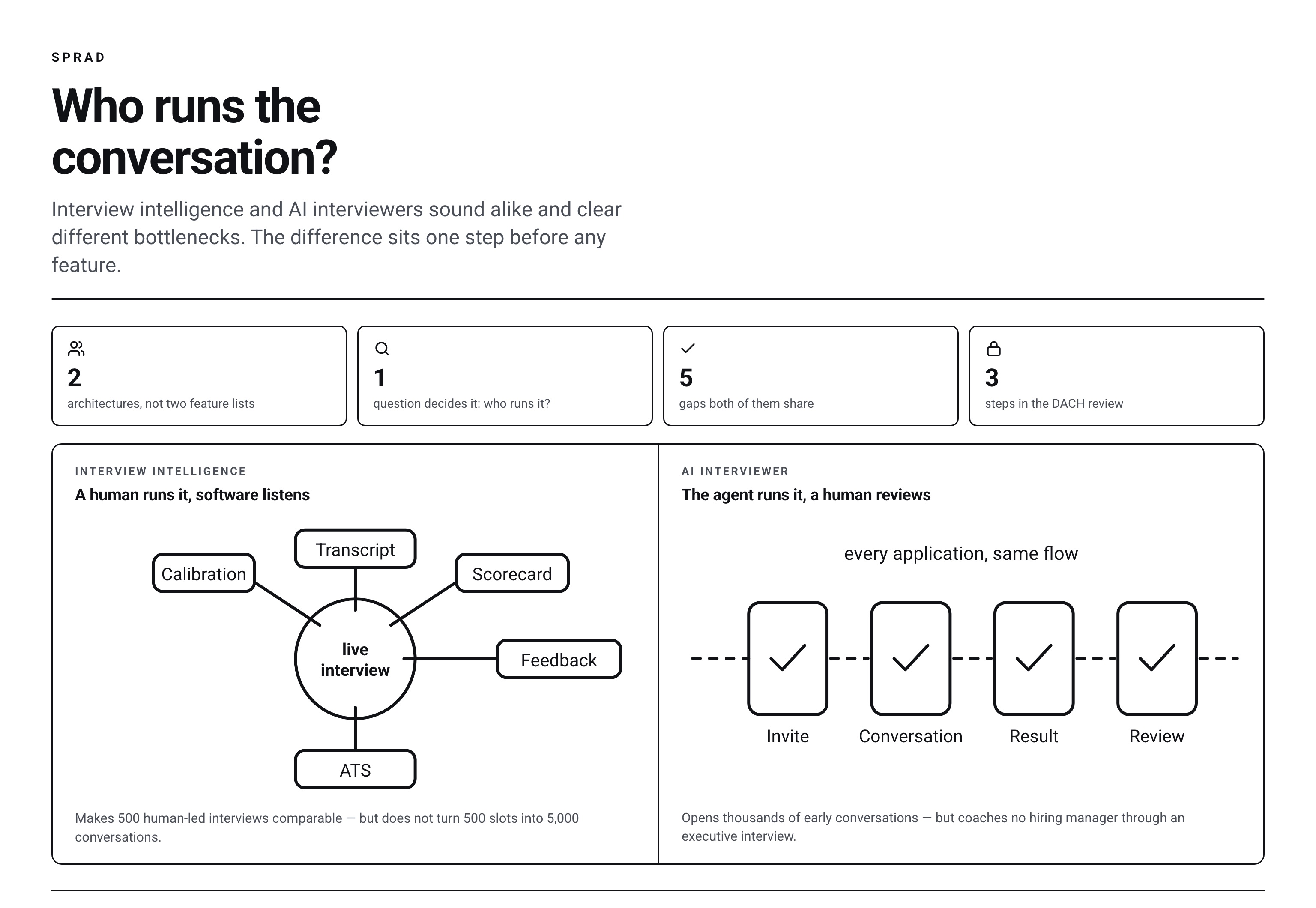
Interview intelligence software sits beside a recruiter or Hiring Manager in a live interview. It captures the conversation, organizes evidence, and makes the result easier to review. The human still asks the questions, follows up, builds rapport, and uses the interview slot. An AI interviewer asks the questions itself, listens to the answers, follows a defined flow, and returns structured results for human review. The candidate does not need a recruiter to be free at that moment.
That is why this is not primarily a feature comparison. It is a capacity design decision. Interview intelligence can improve the quality and consistency of 500 human-led interviews. It does not turn those 500 appointments into 5,000 available conversations. An AI interviewer can make thousands of first conversations available. It does not coach a Hiring Manager through a difficult executive interview.
| Decision axis | Interview intelligence | AI interviewer |
|---|---|---|
| Who conducts the interview? | A recruiter or Hiring Manager | An AI agent using an approved interview flow |
| Primary bottleneck removed | Weak notes, inconsistent evidence, slow feedback, uneven interviewer practice | Too few available screening conversations |
| What scales? | Quality and calibration of human-led interviews | Capacity and candidate access to first conversations |
| Human time per interview | Still required during the full conversation | Mostly required for setup, review, and later stages |
| Best fit | High-value live interviews where judgment and rapport matter | Repeatable early-stage interviews with high or uneven volume |
| Does not fix by itself | Scheduling capacity or an overloaded screening queue | A weak rubric, poor questions, or inconsistent human interviews later in the process |
Diagnose the bottleneck before comparing BrightHire, Metaview, or Screenloop
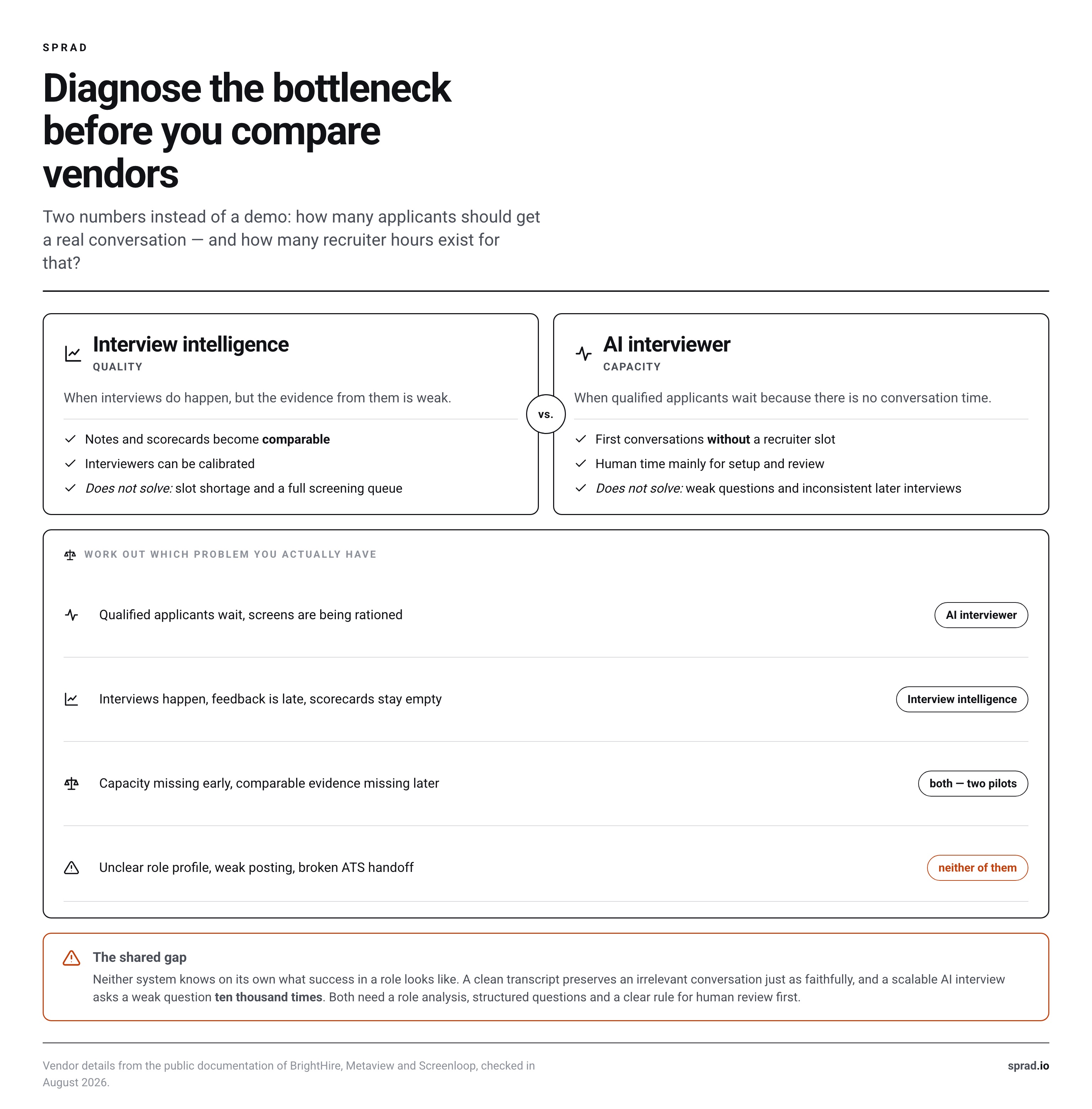
Start with two numbers, not a vendor demo: the number of candidates who should receive a real conversation, and the number of recruiter hours available to hold those conversations. Then inspect the quality of the evidence produced by the interviews that already happen.
- Capacity problem: qualified applicants wait, recruiter screens are rationed, or applications expire before a person can speak with them.
- Quality problem: interviews happen, but feedback arrives late, scorecards are incomplete, notes are inconsistent, or interviewers cannot be calibrated.
- Both: the first stage lacks capacity and later interviews lack comparable evidence. A combined stack may be justified, but the two business cases should remain separate.
- Neither: the real problem is a vague role profile, weak distribution, or an ATS handoff. Neither category repairs those upstream faults.
A simple test helps. If adding ten trained recruiters would remove the pain, you probably have a capacity problem. If those ten recruiters would merely create ten different versions of the same interview, you also have a quality problem. Before buying either system, build a defensible rubric and structured interview guide. Automation faithfully scales whatever design you give it, including a bad one.
How BrightHire, Metaview, and Screenloop map to the decision
BrightHire: interview intelligence plus a separate AI interviewer
BrightHire explicitly spans both sides of this comparison. Its Interview Intelligence product records human-led video, phone, and in-person interviews, creates AI notes and insights, and connects feedback to the ATS. Its current public materials also describe BrightHire Screen, an asynchronous voice- or video-based AI interviewer that can be bought separately or paired with the intelligence platform.
This matters for buyers searching for “BrightHire Zoom” or “Zoom BrightHire.” Zoom is an integration, not the interviewing model: in a live Zoom, Microsoft Teams, or Google Meet conversation, a person still conducts the interview while BrightHire captures it. BrightHire Screen changes that workflow because the configurable agent conducts the screening conversation.
Public price as of August 2026: none. The BrightHire pricing page lists Recruiters, Teams, and Enterprises tiers for Interview Intelligence, but requires a demo or quote. It also says Screen can be purchased alone or in combination. The public page does not state a minimum contract term or billing commitment. It says training and implementation carry no extra fees, while dedicated support is attached to Team and Enterprise customers. Ask the quote to separate platform, Screen usage, support, ATS integration, and renewal terms.
Best fit: teams that want a human-interview quality layer now and may also want automated first screens in the same system. Documented buying limitation: price and term cannot be compared without a proposal.
Metaview: a priced Notetaker and a separate Screening agent
Metaview now spans both operating models. The Metaview Notetaker joins human-led recruiting calls, captures the conversation, and produces structured notes. Its newer AI Screening agent conducts the conversation without a recruiter on the call: buyers configure questions and a rubric, candidates complete the call asynchronously, and a person reviews the recording, transcript, and score before progressing or rejecting anyone.
Public price as of August 2026: the Metaview pricing page lists Notetaker Free at $0 per user per month with 25 calls and basic transcription; Pro at $60 per user per month with unlimited calls and priority processing; and Enterprise with tailored pricing, custom volume, support, training, and enterprise security. The page labels Notetaker prices “monthly per user” but does not state a minimum term or annual commitment for Pro. It publishes no euro price and no separate public rate or contract term for the Screening agent. DACH buyers should confirm currency, taxes, Screening usage limits, data location, cancellation, and commitment in the order form.
Best fit: teams that want to start with a low-friction Notetaker and may add autonomous screening in the same recruiting platform. Documented buying limitation: Free is capped at 25 calls and basic transcription, while Screening cost, Enterprise cost, and Pro commitment remain quote or contract questions. Metaview explicitly lists German for Screening, but DACH buyers should still test role-specific language, accents, and code-switching.
Screenloop: interview intelligence tied to coaching and a broader ATS
Screenloop positions Interview Intelligence inside a wider ATS and talent-operations platform. Its published feature set includes transcripts, summaries, detected question-and-answer pairs, scorecard attributes, clips, action items, and post-interview analytics. The coaching layer includes timestamped feedback, reverse shadowing, training clips, and metrics such as talk ratios. Its product page explicitly lists German plus more than 35 additional languages.
Public price as of August 2026: none. The Screenloop pricing route does not publish an amount, billing period, or minimum term. The site leads buyers to a demo. Ask whether Interview Intelligence can be contracted separately from the ATS, which integrations are included, how many recorded interviews are covered, and whether coaching analytics changes the tier.
Best fit: teams that want interview capture and interviewer development, especially if they are also reviewing their ATS. Documented buying limitation: the public site does not make package boundaries, price, or commitment comparable.
A buyer table that separates workflow, not feature count
The table uses public information available in August 2026. “No public amount” means exactly that; it is not a price estimate.
| Option | Operating model | Public price and commitment, August 2026 | Choose it when | Do not choose it merely because |
|---|---|---|---|---|
| Sprad | AI interviewer for structured first conversations | No public amount used in this guide; scope and commitment require a quote | You need to add conversation capacity before human interviews | You want to coach and calibrate human interviewers |
| BrightHire | Human-led Interview Intelligence; optional BrightHire Screen AI interviewer | No public amount; quote required; minimum term not public | You want one vendor for live-interview quality and automated first screens | You saw Zoom integration and assumed it creates screening capacity |
| Metaview | Human-led Notetaker plus an asynchronous AI Screening agent | Notetaker: Free $0/user/month, 25 calls; Pro $60/user/month, unlimited calls; Enterprise custom. Screening price and Pro minimum term not public | You want to combine note capture and AI-led early screening in one broader recruiting platform | The visible Notetaker price also appears to price Screening |
| Screenloop | Interview Intelligence, coaching, and broader ATS platform | No public amount, billing period, or minimum term | You want to connect interview evidence, coaching, and possibly an ATS decision | A long feature list substitutes for checking standalone scope |
Where an AI interviewer belongs in the process
An AI interviewer is most defensible at a repeatable early stage: eligibility, motivation, experience examples, availability, language, or role-specific scenarios. It should not become an excuse to remove human contact from the entire hiring process. The useful design is usually AI-led first conversation, human review, and then a focused human interview for the candidates who meet the agreed threshold.
This is where Sprad belongs as one option: on the interviewer side, adding structured conversation capacity before the human stage. The honest boundary is equally important. If your goal is to coach recruiters, compare interviewer behavior, and calibrate live panels, buy Interview Intelligence, not our voice interview workflow.
For high-volume hiring, calculate whether the queue is large and repetitive enough to justify this change. The operational case is explained in more detail in the guide to an AI interviewer for high-volume hiring. Also decide whether voice, video, or phone is appropriate for the audience; those formats impose different device, accessibility, and candidate-pressure costs. A practical comparison is available in voice, video, or phone screening.
Where both categories are weak
Neither system knows what success in the role means until the hiring team defines it. A polished transcript can preserve an irrelevant conversation perfectly. A scalable AI interview can ask a weak question ten thousand times. Both categories depend on job analysis, a structured question set, observable scoring anchors, and a clear rule for human review.
- Bad rubric: automation makes inconsistency look systematic rather than making it valid.
- Weak ATS handoff: evidence still disappears if summaries, scorecards, consent status, and retention dates do not land in the system of record. Define the required fields before procurement; this ATS transcript guide shows the practical handoff.
- No candidate alternative: recording and AI-led conversations need a documented opt-out or equivalent route where required by policy or law.
- No human review: summaries and scores are decision support, not a reason to make irreversible hiring decisions unattended.
- No measurement plan: saved minutes are not enough. Track completion, time to review, scorecard quality, progression, candidate questions, and subgroup outcomes.
DACH procurement: recording, works councils, and the EU AI Act
For Germany, Austria, and Switzerland, “GDPR compliant” in a sales page is not a procurement plan. Recording a candidate conversation, generating a transcript, and evaluating answers are different processing steps. Map the purpose, legal basis, notice, retention, deletion, sub-processors, transfer mechanism, access roles, and candidate alternative for each step. In Germany, involve the works council early when employee interviewers are recorded or performance analytics can be attributed to them.
The EU AI Act creates an additional distinction. As of August 2026, transparency rules require people to be informed when they interact with an AI system. The European Commission also identifies AI used to evaluate candidates as an employment-related high-risk use case, with the corresponding high-risk rules scheduled to apply from 2 December 2027 under the current timeline. The Commission’s AI Act overview lists risk management, logging, documentation, human oversight, robustness, and accuracy among the obligations. Confirm the classification of the actual configured use case with counsel; a notetaker, a coaching tool, and an automated scoring flow may not have identical roles or risks.
Ask every shortlisted vendor for:
- the DPA, sub-processor list, storage region, transfer safeguards, deletion workflow, and retention controls;
- the exact consent or notice flow for live recording and for an AI-led interview;
- an explanation of what the model scores, which inputs it ignores, and where a person can override or correct output;
- German-language evidence using your roles, accents, technical vocabulary, and real scorecards;
- an accessible non-recorded or human-led alternative and a process for data-subject requests.
Run two pilots if you have two problems
Do not ask one blended pilot to prove both quality and capacity. For Interview Intelligence, use a representative set of live interviews and measure scorecard completion, time from interview to feedback, evidence quality, interviewer adoption, and coaching usefulness. For an AI interviewer, measure invitation-to-completion, candidate wait time, recruiter review time, escalation rate, technical failures, candidate feedback, and agreement between the automated result and a blinded human review.
Keep the baseline. If interviews become faster but downstream pass-through, candidate withdrawal, or subgroup outcomes deteriorate, the saved time is not a win. If notes improve but interviewers still ask unstructured questions, the capture layer is exposing a process problem rather than fixing it. That is useful evidence too.
FAQ
Is an AI notetaker the same as an AI interviewer?
No. A notetaker captures and structures a conversation led by a person. An AI interviewer asks the questions and conducts the interaction. Both may output notes or scores, which is why product pages can look deceptively similar.
Does BrightHire work with Zoom?
Yes. BrightHire publicly lists Zoom, Microsoft Teams, and Google Meet integrations. In a normal live meeting, the human interviewer still leads the conversation. BrightHire Screen is the separate workflow in which an AI agent conducts the first interview.
How much does Metaview cost?
As of August 2026, Metaview lists Notetaker Free at $0 per user per month with 25 calls, Pro at $60 per user per month with unlimited calls, and Enterprise at a tailored price. The public page does not state Pro’s minimum term, publish a euro price, or show a separate rate for the AI Screening agent.
Is interview intelligence enough for high-volume hiring?
Only when the constraint is the quality or speed of feedback from interviews you can already staff. It does not remove the interviewer-hours required for each live conversation. If candidates are waiting for a first conversation, evaluate an AI interviewer or another asynchronous screening design.
Can an AI interviewer make the final hiring decision?
That is a poor default. Use it to collect structured evidence and support review, with a defined human decision point, an appeal or correction route, and monitoring for errors and unequal outcomes. The higher the consequence and ambiguity, the stronger the case for direct human involvement.
Jürgen Ulbrich
Jürgen Ulbrich has more than a decade of experience in developing and leading high-performing teams and companies. As an expert in employee referral programs as well as feedback and performance processes, Jürgen has helped over 100 organizations optimize their talent acquisition and development strategies.