LinkedIn Recruiter and Juicebox solve sourcing in almost opposite ways: LinkedIn gives you deep access to its own network through Boolean filters and, in the Professional tier, an AI search layer, while Juicebox's PeopleGPT lets you describe a role in plain language and search across 800 million profiles aggregated from LinkedIn, GitHub and dozens of other sources. As of September 2026, neither tool hands you a talent pool you can actually take with you if you cancel — that gap is where Sprad fits, at a fraction of LinkedIn Recruiter Professional's price. Below: what each tool costs, what each is genuinely good at, and where a third option beats both.
LinkedIn Recruiter vs. Juicebox vs. Sprad at a glance
All prices below are per recruiter seat and current as of September 2026, drawn from each vendor's own pricing page.
| LinkedIn Recruiter | Juicebox | Sprad | |
|---|---|---|---|
| Price | Lite: $140/mo (annual, 1-year contract). Professional: unpublished — commonly cited at ~$900/seat/mo ($10,800/yr, 3-seat minimum), from third-party sources, not LinkedIn itself | Starter: $99/mo (annual). Growth: $179/mo. Agents add-on: +$199/mo each | €59/recruiter/month + pay-per-use credits, 200 free every month |
| Search beyond your own database | LinkedIn's own network only — 900M+ profiles, no external sources | 800M+ profiles aggregated from 30+ sources (LinkedIn, GitHub, X, AngelList) | 1B+ external profiles plus your own pool, searched together |
| Talent pool you keep | No — candidate folders and notes stay inside the recruiter's LinkedIn seat | Partial — CSV export with verified emails, but Juicebox scores/tags don't transfer | Yes — designed to stay with the agency after cancellation |
| AI matching | None in Lite; "AI Recruiter" agent in Professional only (since 2024/25) | PeopleGPT — natural-language search is the core product | Requirement search: full profiles scored against your criteria, not keyword-matched |
| Outreach | InMail: 30/month on Lite, unlimited on Professional | None native — routed through partners like Instantly or Lemlist | Built-in LinkedIn contact agent; multi-channel outreach is on the roadmap, not live |
| Client / CRM features | None | ATS sync across 41 systems; no client or deal CRM | Lean client-context profile that feeds AI search; a fuller client CRM is in beta |
| DACH / German | German interface, but the underlying data pool is global | Interface partially German; data pool is global, not DACH-weighted | German interface and DACH pricing, on top of a global search index |
| Migration out | No export at all — history is locked to the individual seat | Strong — CSV export with verified emails and social URLs | Free import of an agency's existing database (old CRM, spreadsheets, LinkedIn exports) |
Where the two tools really differ
Search logic: Boolean vs. natural language
LinkedIn Recruiter Lite still runs on structured filters and Boolean strings — powerful once you know the syntax, brittle if you don't. Juicebox's entire pitch is skipping that step: type "fullstack engineers in Berlin who've used React in the last two years" and PeopleGPT parses it directly, no operators required.
Reviewers on G2 repeatedly cite that natural-language layer as the single biggest reason they moved away from Boolean-first tools. LinkedIn only closed part of that gap with its own AI Recruiter agent in 2024/2025 — and only inside the Professional tier, whose price isn't published anywhere public.
What happens to your work if you leave
This is where the two tools share the same weakness, just to different degrees. LinkedIn Recruiter offers no CSV export whatsoever: candidate folders, notes and saved projects stay inside the individual recruiter's LinkedIn seat, and cancelling the subscription effectively ends access to that history. Juicebox is considerably better — a CSV export that includes verified emails, LinkedIn URLs and GitHub URLs — but scoring, tags and notes made inside Juicebox itself don't travel with the export, and it only covers current search results, not a full account archive.
Price at 5 and 15 recruiters
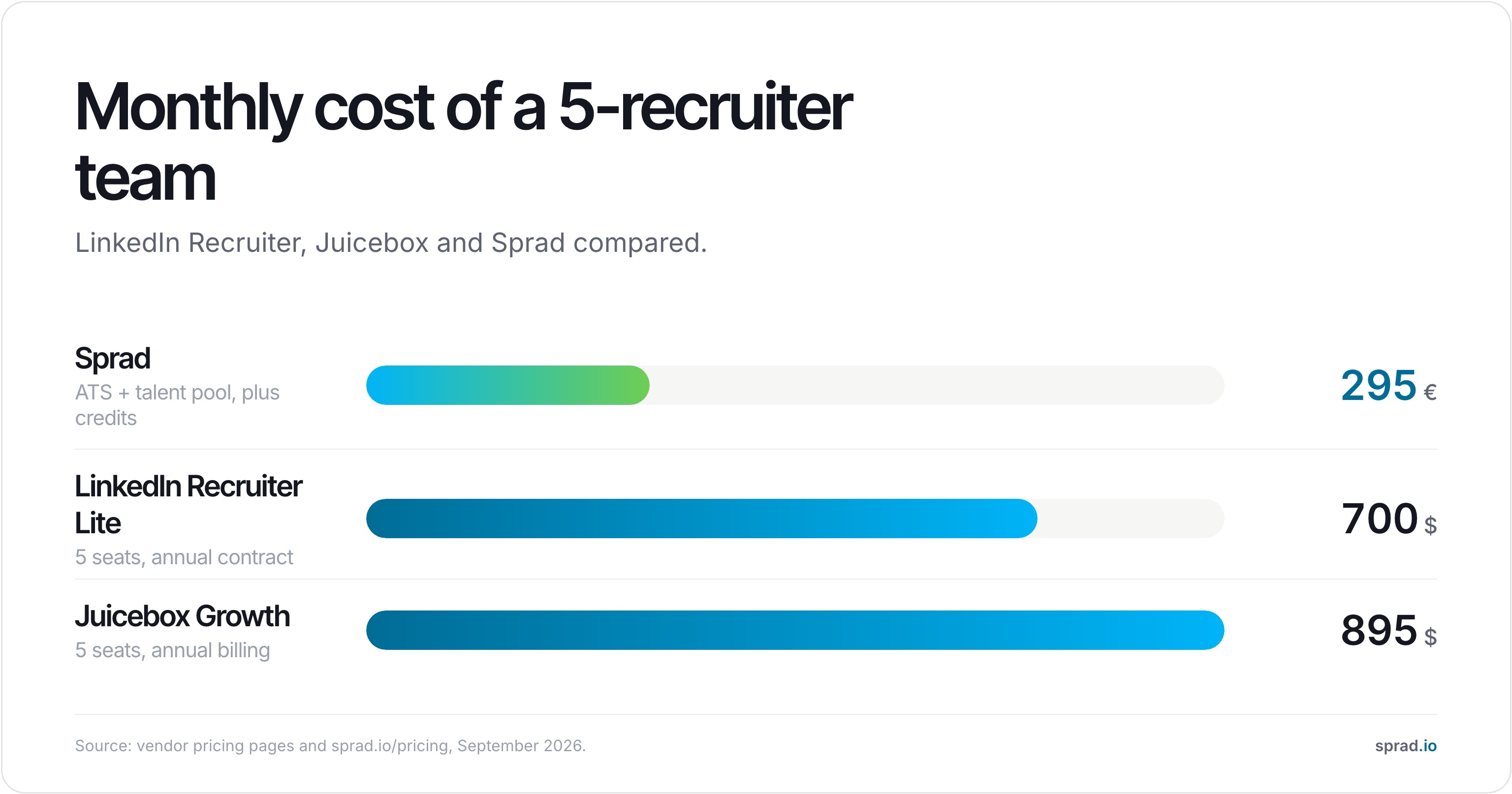
On LinkedIn Recruiter Lite (the only tier with a public price), a 5-recruiter team pays 5 × $140 = $700/month, or $8,400/year, locked into a mandatory annual contract. Juicebox Growth for the same team runs 5 × $179 = $895/month on annual billing ($10,740/year) — a higher per-seat price, but with AI search that Lite simply doesn't offer.
At 15 recruiters, LinkedIn Lite reaches $2,100/month ($25,200/year); Juicebox Growth reaches $2,685/month ($32,220/year). Neither figure includes Juicebox's contact-credit consumption or the jump to LinkedIn Recruiter Professional, which runs several times higher per seat once ATS integration and unlimited InMails are added.
Outreach is thin on both sides
LinkedIn's InMail system is native but rationed — 30 a month on Lite isn't enough for a busy desk, and response rates have been sliding as candidate pools get more saturated, according to reviewers on G2. Juicebox has no outreach engine of its own; it hands candidates off to Instantly, Lemlist or similar partner tools, which means a second subscription and a second interface for the same search.
The third option: Sprad
If neither Boolean filters nor a bigger AI-search subscription actually solves the underlying problem — that your candidate pool disappears the day you cancel — Sprad approaches it differently. Instead of renting reach from LinkedIn at rising annual prices, or paying a growing AI-search bill on top of an existing ATS, Sprad combines a requirement search across 1B+ profiles, your own talent pool, screening and a LinkedIn contact agent in one workspace — and the pool is built to stay yours after you leave.
In an August 2026 benchmark across three real roles, that requirement search surfaced 38% of the matches other tools found combined, against 9% for the next-best tool. Searches, outreach and interviews are billed by credit only when they actually happen, and profiles you reject cost nothing.
Full numbers for your team size: sprad.io/industry/recruitment-agencies.
Which one fits your agency
- Solo recruiter or small in-house team, already deep in LinkedIn's ecosystem, mostly mainstream tech/sales/product roles: LinkedIn Recruiter Lite (full pricing breakdown) is the path of least resistance — accept the annual contract and the 30-InMail cap.
- Boolean search is the main friction, and speed matters more than data ownership: Juicebox's natural-language search is the more comfortable tool day to day, and its export gives you a cleaner exit than LinkedIn's (Juicebox pricing in full).
- You want one tool that replaces a chunk of your sourcing spend and your ATS, and you want your network to survive a cancelled contract: Sprad's requirement search plus a talent pool you own is built for exactly that case — see the sourcing benchmark for how it performs against tools like these two.
FAQ
Is Juicebox cheaper than LinkedIn Recruiter?
Yes, at the entry tier — Juicebox Starter runs $99/month on annual billing versus LinkedIn Recruiter Lite's $140/month, both current as of September 2026. Juicebox also includes AI-powered natural-language search, which Lite doesn't offer at any price.
Can I export my candidates from LinkedIn Recruiter?
No. LinkedIn doesn't offer a CSV export for Recruiter; candidate folders and notes stay tied to the individual seat, and access effectively ends when the subscription does.
Does Juicebox include outreach sequences?
Not natively. Juicebox connects to third-party sequencing tools like Instantly or Lemlist for outreach — it's a sourcing engine, not a messaging platform on its own.
What does Sprad cost compared to LinkedIn Recruiter and Juicebox?
€59 per recruiter a month for the ATS and talent pool, then pay-per-use credits for search, outreach and interviews — with 200 free credits every month and no credit card required, as of September 2026.
Which tool keeps my candidate data if I cancel?
Juicebox, more than LinkedIn — its CSV export includes verified emails and profile URLs. Sprad goes further: the talent pool itself is built to remain with the agency after cancellation, not just an export of one search's results.
Does either tool's AI search actually outperform the other?
Both are built on different strengths — Juicebox on natural-language parsing across a broad external pool, LinkedIn Professional on unpublished-price access to its own network. Sprad reads full candidate profiles against your written requirements and scored 38% of combined matches in an August 2026 benchmark against three real roles, versus 9% for the next-best tool tested — across both external profiles and its own pool.
None of this changes the underlying economics: every year an agency rents its candidate reach from a platform, the price goes up and the pool stays with the platform, not the agency. Sprad's approach — a requirement search across 1B+ profiles, a talent pool that's yours to keep, and pricing that starts free — is built for agencies that would rather own what they build. Start free at sprad.io/industry/recruitment-agencies.
Jürgen Ulbrich
Jürgen Ulbrich has more than a decade of experience in developing and leading high-performing teams and companies. As an expert in employee referral programs as well as feedback and performance processes, Jürgen has helped over 100 organizations optimize their talent acquisition and development strategies.