Text recruiting means contacting and pre-screening applicants by SMS or a messenger instead of email or phone calls. For hourly and frontline roles it works because applicants answer on their phone within minutes: right after the application you ask three to five must-have questions, and only people who fit reach a recruiter. In the US that usually means SMS under TCPA consent rules. In the UK and the EU, WhatsApp is the stronger channel, and consent follows UK GDPR and PECR or GDPR.
SMS or WhatsApp: which channel fits?
Both channels get messages read quickly, but they differ in reach, rules and cost. SMS works on every phone without an app. WhatsApp is where most applicants in the UK and continental Europe already chat every day, and it carries voice notes, photos and documents, which helps when an applicant needs to send a certificate.
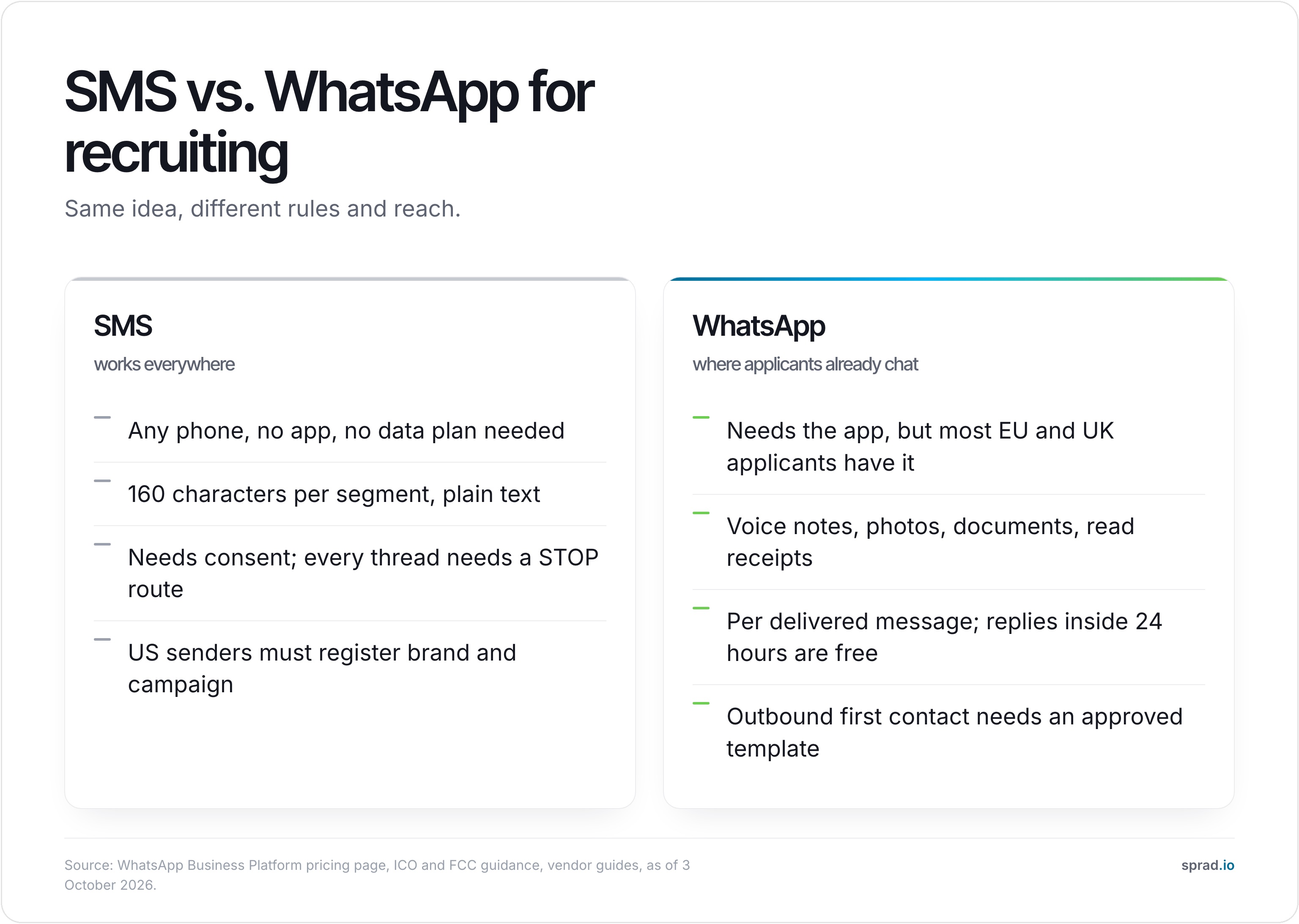
The cost model is different too. SMS is priced per message segment by your provider, and US senders must register their brand and campaign with the carriers before they can send at volume. According to the WhatsApp Business Platform pricing page, WhatsApp charges per delivered message by category (marketing, utility, authentication, service). Replies to a customer within 24 hours of their message are free, and messages are not charged for 72 hours after someone clicks through from an ad or a Facebook Page button. For recruiting that matters: an applicant who taps a job ad and lands in a WhatsApp conversation opens a free window in which you can pre-screen them.
What the numbers really say
Many guides quote a 98 % open rate and a 45 % response rate for texts. One vendor guide states openly that it could not trace either figure to a primary study, and we treat them the same way: useful as a hint that texts are read fast, not as a promise. Other guides cite 50–75 % response rates for hourly workers, again vendor figures without a method. The one controlled result in this area comes from a clinic trial, not from hiring: text reminders reduced missed appointments from 38.1 % to 23.5 %. It suggests that reminders for interviews are worth sending, but it does not show how many applicants you will reach.
So measure your own numbers. Track the share of applicants who answer the first message within an hour, the share who finish all questions, and the share that your team still rates as fitting after the call. Those three figures tell you whether the channel works for your roles.
Consent rules in three markets
The rules decide how you may start the conversation. The table summarises the main points. It is an orientation, not legal advice.
| Market | Basis | What you need |
|---|---|---|
| US | TCPA (FCC) | Prior express consent for informational texts, prior express written consent for promotional ones; clear opt-out such as "Reply STOP" |
| UK | PECR plus UK GDPR (ICO) | Consent for marketing texts, sender identified, easy opt-out; messages about an application someone sent you are service messages, job alerts are marketing |
| Germany and EU | GDPR, national competition law | Legal basis for processing, information on purpose and storage, consent for advertising by electronic message; see the German guide to contacting candidates via WhatsApp |
A clean flow asks for consent inside the application itself: a checkbox or a keyword the applicant sends, with your company name, the role, how often you write and how to stop. Do not text people who never agreed.
Five messages you can copy
Keep every message short, name yourself and the role in the first line, and ask one thing at a time.
1. First message: Hi Sam, this is Dana from Northside Care. Thanks for applying for the night nurse role. May I ask five quick questions here? Reply STOP any time to end messages.
2. Question: Great. First: which shifts could you work? Early, late, nights, weekends?
3. Qualified: Thanks, that fits. A team lead will call you tomorrow between 10 and 12. Is that time OK?
4. Not a fit: Thanks for your time. This role needs weekend availability, so it is not a match today. We will keep your details for other openings if you agree.
5. Reminder: Reminder: your call with Northside Care is tomorrow at 10:30. Reply 1 to confirm or 2 to move it.
Pre-screen in minutes: five questions and one flow
The speed comes from asking the same must-have questions every time, directly after the application. Five questions cover most hourly roles: the role or qualification, where the applicant lives and how long the commute is, which shifts they can work, how many hours they want, and when they can start. Add one role-specific question, such as a licence or certificate.
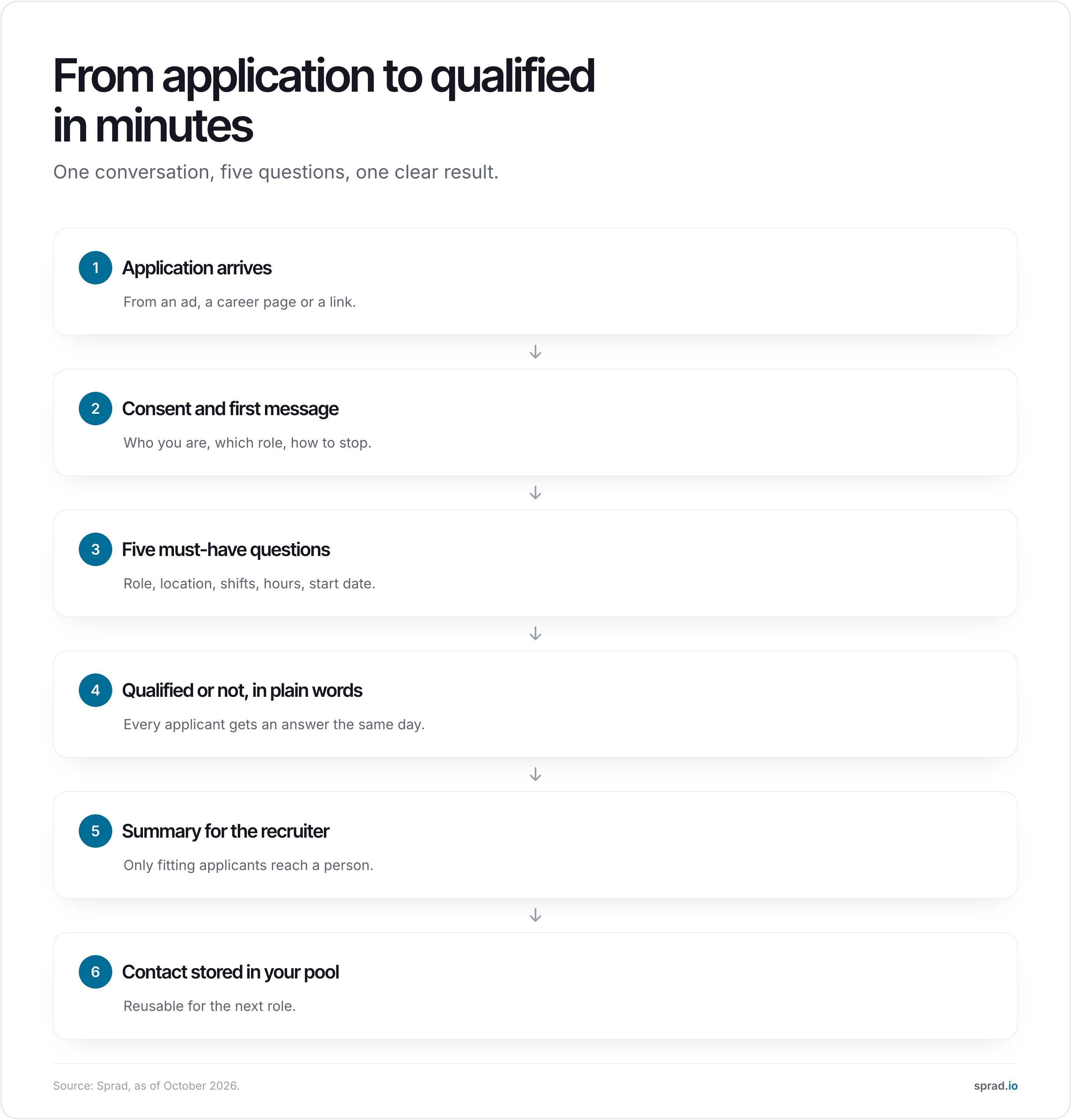
Two details decide whether this feels helpful or pushy. First, always give an answer, also to people who do not fit; silence is what applicants complain about most. Second, make a person available: if an applicant asks something the script cannot answer, a human should take over.
Where the applications come from
Text recruiting is a response tool, so it needs applications to respond to. Job ads on Instagram and Facebook reach people who are not searching on job boards, and a short application in the ad flows straight into the conversation. For why phone and messenger beat email for frontline roles, see frontline recruiting by phone and WhatsApp, not email. For healthcare employers the same flow applies to nurses and care assistants, as described on the healthcare page.
Common mistakes
- Texting without consent. It is the one mistake that can cost real money in the US and damages trust everywhere.
- Treating text as a broadcast. Applicants reply. If nobody reads the answers, the channel is worse than email.
- Long messages and links first. One question per message, one link at most.
- Writing at night. Send during business hours unless the applicant started the conversation.
- Keeping the data in a vendor tool. When you switch tools, the conversation history and contacts should stay with you.
Where Sprad fits
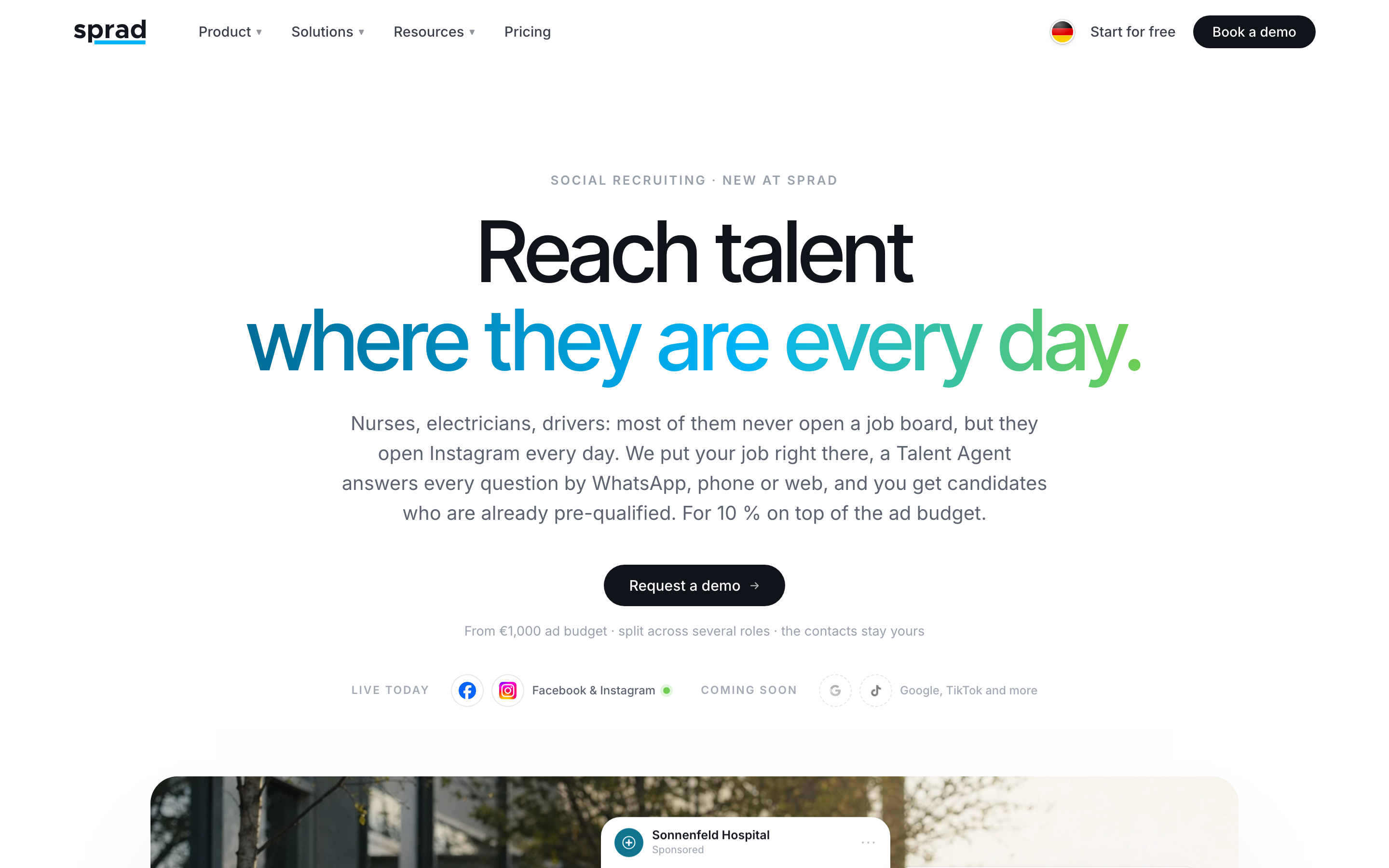
Sprad Social Recruiting runs job ads on Instagram and Facebook, where nurses, tradespeople, drivers and other frontline workers spend time every day. An AI talent agent pre-screens every applicant via WhatsApp, phone or web, so the first conversation happens in minutes instead of days. It does not use SMS. Every applicant lands in your own talent pool, so the relationships stay with you instead of a platform. Pricing is ad spend plus 10 %, from a €1,000 budget that can be split across roles. Details are on the Social Recruiting page.
FAQ
Is SMS recruiting legal?
Yes, with consent. In the US the TCPA requires prior express consent, and in the UK PECR requires consent for marketing texts. A message answering an application the person sent is treated differently from a marketing blast, but you should still identify yourself and offer an opt-out. Ask your lawyer for your case.
Is WhatsApp better than SMS for recruiting?
In the UK and continental Europe, usually yes, because applicants already use it and it supports voice notes and documents. In the US, SMS reaches people without another app. Pick the channel your applicants use, and test with one role.
Can an AI pre-screen applicants by text?
Yes. An AI agent can ask the must-have questions, understand free-form answers and pass a summary to a recruiter. Keep a human option and keep your must-have criteria objective and job-related.
How many questions should a pre-screen have?
Five to seven. Every extra question loses applicants, and anything you can read from the application should not be asked again.
Jürgen Ulbrich
Jürgen Ulbrich has more than a decade of experience in developing and leading high-performing teams and companies. As an expert in employee referral programs as well as feedback and performance processes, Jürgen has helped over 100 organizations optimize their talent acquisition and development strategies.