A social recruiting glossary explains the terms behind paid hiring campaigns on Instagram and Facebook: the cost metrics (CPM, CPC, CPL, CPA, CPQA, CPH), the Meta tools (pixel, Conversions API, special ad category) and the process words (pre-screening, talent pool). The one to remember is CPQA, cost per qualified applicant, because it counts only people who meet your must-haves. This glossary uses "social media recruiting" and "social recruiting" interchangeably and has nothing to do with social work staffing.
Cost and performance metrics
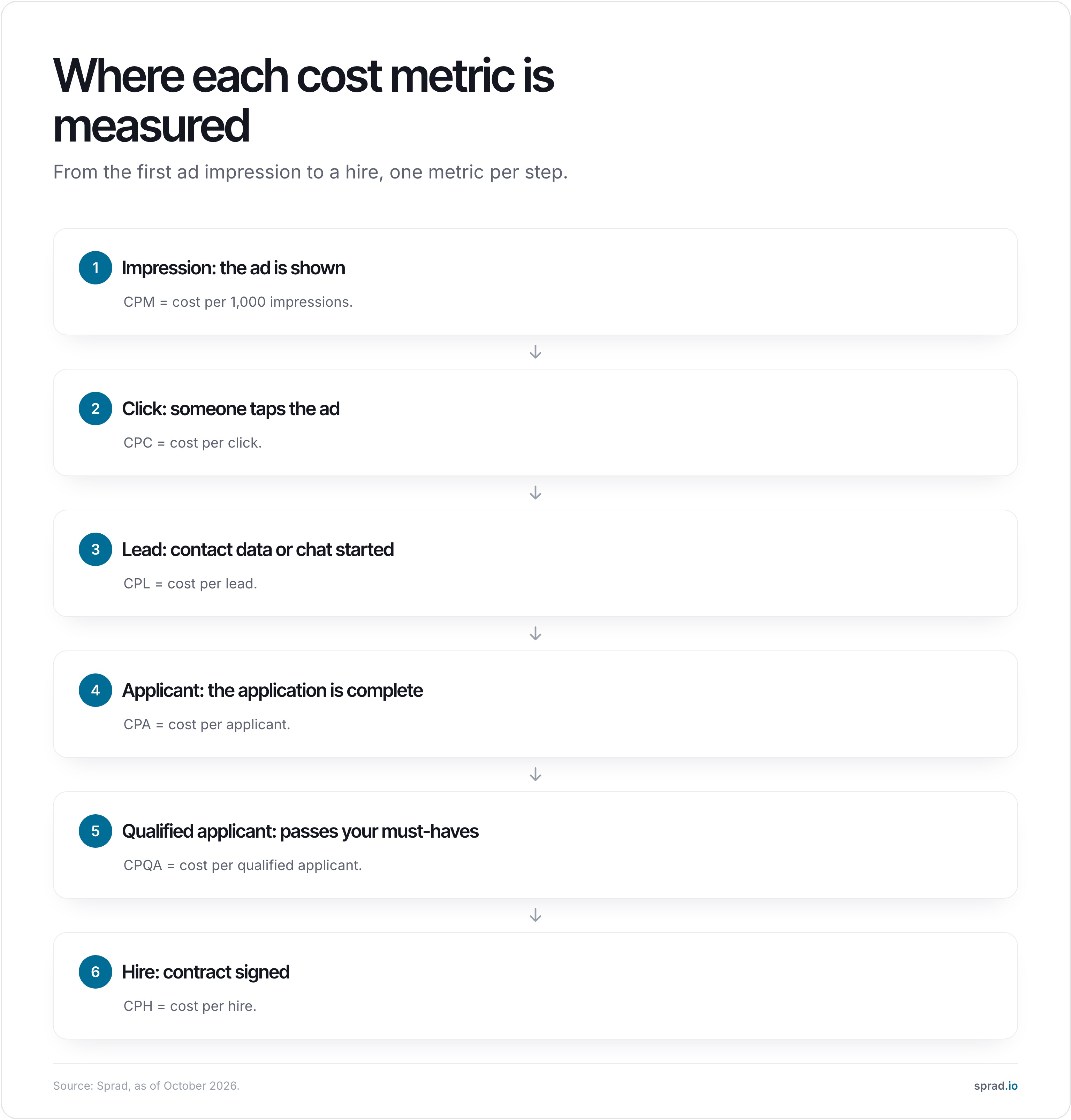
Every cost metric divides the same number, your ad spend, by a different step of the funnel. The further down the funnel, the more the number says about hiring success, and the larger it gets.
| Term | Stands for | Formula | What it tells you |
|---|---|---|---|
| CPM | Cost per mille | Spend ÷ impressions × 1,000 | What reach costs. Rises with competition for the same audience. |
| CPC | Cost per click | Spend ÷ clicks | How well the ad image and headline attract attention. |
| CTR | Click-through rate | Clicks ÷ impressions | Share of viewers who tap. Low CTR means the ad is weak. |
| CPL | Cost per lead | Spend ÷ leads | Cost of a contact, whether or not it is a real applicant. |
| CPA | Cost per applicant (in recruiting) | Spend ÷ completed applications | Cost of one application, regardless of quality. |
| CPQA | Cost per qualified applicant | Spend ÷ applicants who pass your must-haves | The metric that matches the goal: people you can actually interview. |
| CPH | Cost per hire | Total hiring cost ÷ hires | The final cost. Includes recruiter time, not only ad spend. |
| Conversion rate | Share of clicks that become applications | Applications ÷ clicks | Shows whether the application path (form, chat) works on a phone. |
A warning about CPA. In general advertising, CPA means cost per action, for example a purchase. In recruiting it usually means cost per applicant. Always check which definition a report uses before comparing numbers.
For orientation: a US benchmark from a social job advertising provider reports a median cost per applicant of 13.88 $ across 891 campaigns, with a wide range by job type (manufacturer data, 2026). Treat such numbers as context, not as a target. Pay, shift pattern and region move them more than any setting.
A worked example with all metrics
The numbers below are invented to show how the metrics relate. They are not a benchmark.
| Funnel step | Count | Metric | Value |
|---|---|---|---|
| Ad spend | 2,000 € | - | - |
| Impressions | 200,000 | CPM | 10 € |
| Clicks | 2,500 | CPC | 0.80 € |
| Leads (chat or form started) | 80 | CPL | 25 € |
| Completed applications | 50 | CPA | 40 € |
| Qualified applicants | 20 | CPQA | 100 € |
| Hires | 4 | CPH (ad spend only) | 500 € |
Two campaigns can share the same CPA and still differ by a factor of three in CPQA. That is why a cheap application is not automatically a good one.
Meta advertising terms
Special ad category "Employment"
Meta treats job ads as a special ad category. For these ads you cannot target by age, gender or postcode, the minimum location radius is larger, and lookalike audiences are not available. The rules were written for the US and Canada and have been extended to parts of Europe, so check the current Meta documentation for your market before you plan targeting. Declare the category when you create the campaign, otherwise ads can be rejected.
Audience, targeting, lookalike
An audience is the group of people who can see your ad. Targeting narrows it by location, interests or behaviour. A lookalike audience is a group that resembles an existing list of people. Because of the employment category, lookalikes and demographic targeting are not available for job ads. Your levers are location, the creative itself and the wording of the ad.
Placement, creative, frequency
A placement is where the ad appears: feed, stories or reels. The creative is the image or video plus text. Frequency is how often the same person has seen the ad. Above roughly three to four views, results usually fade, which is the moment to swap the creative.
Learning phase
Meta's delivery system needs around 50 optimisation events per ad set in seven days to exit the learning phase. A small budget spread over many ad sets keeps every one of them stuck in learning. For frontline roles, fewer ad sets with a clear goal usually work better than many small ones.
Instant form, lead ad, click-to-WhatsApp
An instant form (lead ad) collects data inside the app without a website. A click-to-WhatsApp ad opens a chat instead. Both lower the barrier for candidates who will not write a CV on a phone. See also why frontline hiring works by phone and WhatsApp, not email.
Tracking and data terms
- Pixel (Meta pixel). A snippet of code on your career page or thank-you page that reports actions such as "application sent" back to Meta. It enables conversion counting and optimisation. In the EU it requires the visitor's consent.
- Conversions API (CAPI). The server-side counterpart of the pixel. Your system sends the event to Meta directly, which is more robust against blockers and consent gaps. Pixel and CAPI together are deduplicated by an event ID.
- Conversion event. The action you tell Meta to optimise for. For jobs, "application sent" is better than "link click".
- UTM parameters. Tags in the link (source, campaign, content) that show in your analytics which ad produced which applicant.
- Attribution window. How long after an ad view or click a conversion still counts, commonly seven days.
- Consent (cookie banner). Permission from the visitor before tracking starts. Without it, pixel data is incomplete, so forms inside the app are often more reliable.
Process terms for the applicant side
- Pre-screening. Five to eight short questions on must-haves such as licence, shift, location and start date, asked before a recruiter spends time. It is the step that turns CPA into CPQA.
- Must-have vs. nice-to-have. Criteria that exclude an applicant if missing versus criteria that only add points.
- Talent pool. The database of past applicants you can contact again. Reach you paid for once stays with you.
- ATS. The applicant tracking system where applications and stages are managed.
- Time to first contact. Hours between application and the first reply. For shift workers, a reply within a day matters more than a polished process.
- Ghosting. Candidates who stop replying. Short chats on WhatsApp reduce it. Care providers in particular see it, see healthcare hiring.
- Blue-collar / frontline roles. Hands-on and shift jobs such as nursing, trades, logistics and hospitality. See why blue-collar screening differs from white-collar screening.
Terms from adjacent channels
- Organic reach. Unpaid visibility of posts. Slow, mostly your own followers.
- Active sourcing. Approaching chosen people directly, mostly on LinkedIn. Suited to specialists.
- Programmatic job advertising. Automated buying of job ad placements across many sites by bid and performance.
- Employer branding. How you appear as an employer. It affects CTR and conversion rate more than most people expect.
- Retargeting. Showing ads to people who already visited your career page.
Mistakes when reading the numbers
- Comparing CPL from one report with CPA from another. Different steps, different numbers.
- Optimising for clicks. Cheap clicks often come from people who never apply.
- Judging after two days. The learning phase needs time and enough events.
- Ignoring the talent pool. If applicants who miss this role are not stored, every new role starts from zero.
- Forgetting the special category. Ads can be rejected or delivered with limits.
How Sprad uses these terms
Sprad Social Recruiting runs job ads on Instagram and Facebook, where nurses, tradespeople, drivers and other frontline workers spend time every day. An AI talent agent pre-screens every applicant via WhatsApp, phone or web. Every applicant lands in the employer's own talent pool, so the relationships stay with the employer instead of a platform. Pricing is ad spend plus 10 %, from a €1,000 budget that can be split across roles. Learn more on Sprad Social Recruiting, see pricing or read about the Talent Base.
FAQ
What does CPA mean in social recruiting?
Cost per applicant: ad spend divided by completed applications. In general advertising CPA can also mean cost per action, so check the report's definition.
What is the difference between CPL and CPA?
CPL counts leads, which are people who left contact data or started a chat. CPA counts completed applications. CPA is always the same or higher than CPL.
What is CPQA?
Cost per qualified applicant: spend divided by applicants who pass your must-have criteria. It is the most useful number for comparing campaigns.
What is a pixel in recruiting?
A code snippet that reports actions on your page, such as a sent application, back to the ad platform. In the EU it needs the visitor's consent.
What is the special ad category for employment?
A Meta rule for job ads that removes targeting by age, gender and postcode and disables lookalike audiences. Check the current scope for your country.
What is a good cost per applicant?
It depends on role, region and pay. A US provider benchmark gives a median of 13.88 $. Compare your own CPQA across roles rather than chasing a single number.
What is the difference between social recruiting and active sourcing?
Social recruiting mostly means ads that candidates answer. Active sourcing means you approach chosen people directly.
Jürgen Ulbrich
Jürgen Ulbrich has more than a decade of experience in developing and leading high-performing teams and companies. As an expert in employee referral programs as well as feedback and performance processes, Jürgen has helped over 100 organizations optimize their talent acquisition and development strategies.