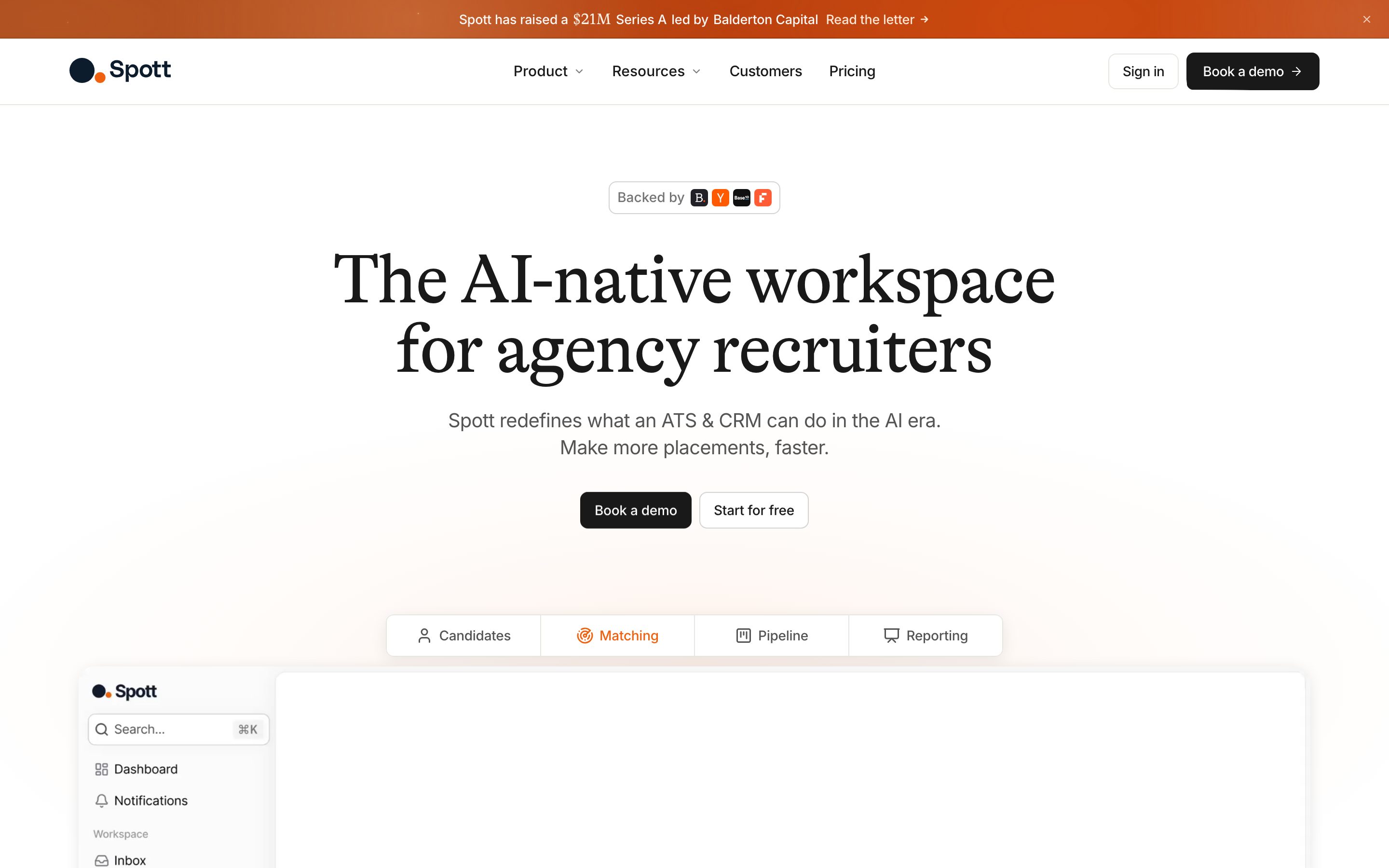
Spott fits agencies that want one AI-native workspace instead of a Bullhorn-plus-five-add-ons stack, while Bullhorn still fits agencies that need deep job-board reach, mature CRM/BD tooling, or don't mind quote-based pricing for AI. Neither one lets you search a billion-plus external profiles or keeps your candidate pool DACH-native — that's where Sprad becomes a genuine third option, not just a footnote.
Spott vs. Bullhorn vs. Sprad, side by side
| Criterion | Spott | Bullhorn | Sprad |
|---|---|---|---|
| Entry price | $119/user/mo annual (~110 €) | $99/user/mo Starter, $165 Core (~91-152 €) | 59 €/recruiter/mo + usage credits |
| Search outside your own database | No native tool, third-party integrations only | Limited (LinkedIn bolt-on from Core; no large external DB) | Yes, 1B+ external profiles |
| Talent pool | Yes, own candidate database | Yes, own candidate database | Yes, stays with the agency after cancellation |
| AI matching | Yes, semantic search included in every plan | Keyword/Boolean core; AI search only on custom-quote Pro/Max | Yes, requirement search with per-criterion scoring |
| Outreach | Multi-channel sequences (email, LinkedIn, WhatsApp, SMS) — Pro tier only | LinkedIn integrations from Core; sequencing via add-ons | LinkedIn only today, no email outreach yet |
| CRM depth | Full CRM + unified inbox + client portal | Full CRM + business development, most mature of the three | Client-context tool only, explicitly in beta |
| DACH / German | No | No dedicated DACH offering | Yes, DACH-native |
| Migration | Case studies cite "under four weeks" | Often the system agencies migrate away from | Free import of legacy data (Xing, Bullhorn exports, spreadsheets) |
Prices as of September 2026 from Spott's pricing page and Bullhorn's pricing page.

Where the two actually differ
Pricing model: flat AI-included vs. AI behind a quote
Spott's own pitch is explicit: "AI is not an add-on. Token spend for matching, note-taking, outreach drafting, and recommendations is included in every plan." Bullhorn's published tiers — Starter at $99/user/month and Core at $165 — don't include that. According to Bullhorn's own pricing page, AI search and match, an AI notetaker, data enrichment and process automation only appear in the Pro and Max tiers, both sold through a custom quote. That's the exact gap Spott built its whole comparison page against Bullhorn around, and it's a fair one: if AI is the reason you're evaluating either tool, Bullhorn's published price doesn't actually get you there.
Sourcing: neither has a real external database
This is the detail that often gets missed because both vendors talk about "AI-powered sourcing." Neither Spott nor Bullhorn ships a large external candidate-search database at their standard tiers. Spott's own reviewer base (via PeopleManagingPeople) confirms external sourcing runs through third-party integrations, and Bullhorn's LinkedIn integrations (RSC, Apply Connect) work the same way — pulling candidates in one at a time rather than running a requirement search across a billion-plus profiles. If your agency's real bottleneck is finding candidates you don't already have, this comparison is really between two CRMs, not two sourcing tools.
Ecosystem: Bullhorn's real advantage
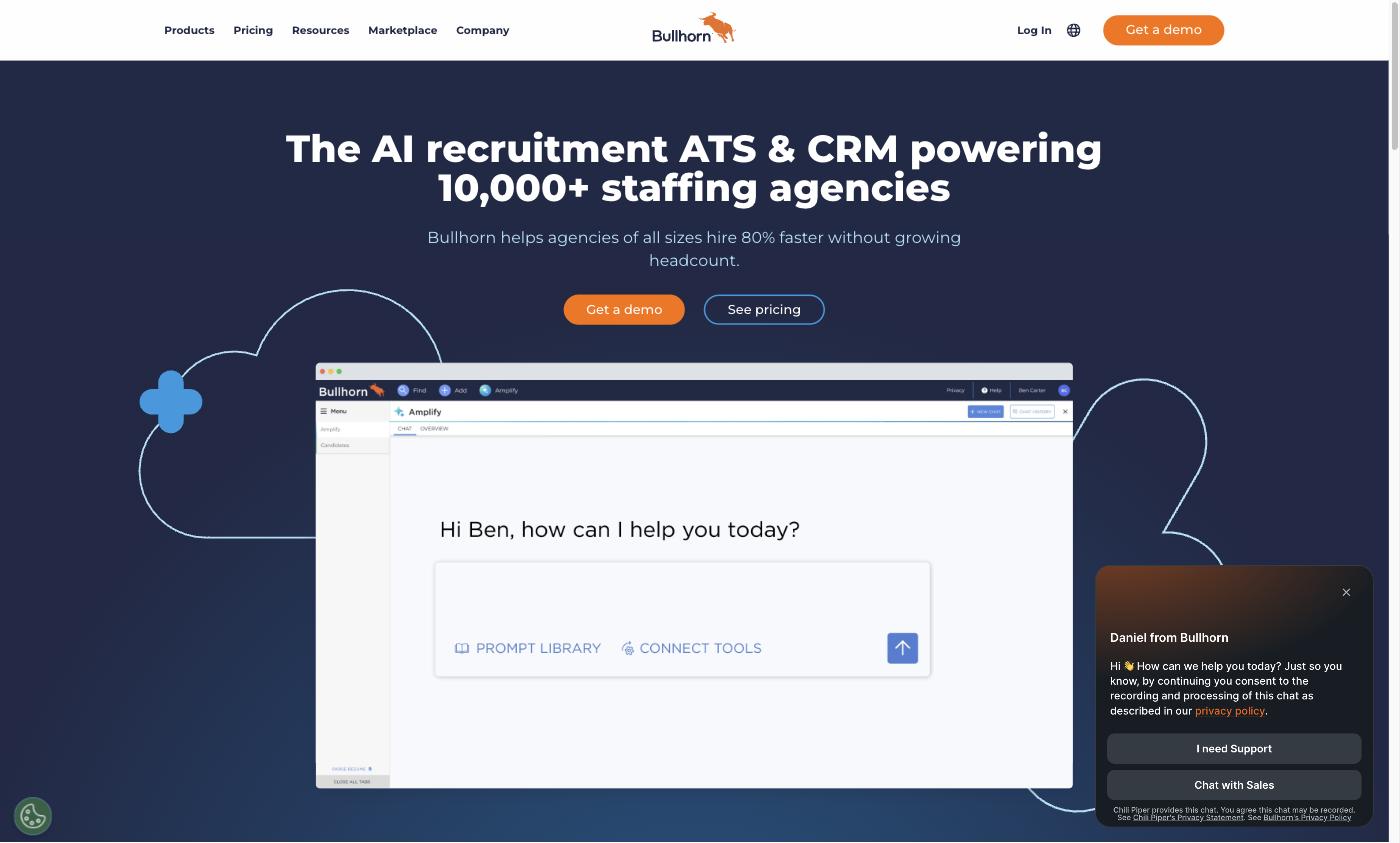
Bullhorn connects to more than 300 partner tools and roughly 110 VMS platforms — the layer large staffing firms need for enterprise contract work, built up over two decades of integrations. Spott's catalog is newer and smaller by comparison. An independent comparison from PeopleManagingPeople frames it well: Bullhorn is assembled through years of acquisitions, Spott is built from a single, modern core — it depends on whether your bottleneck is VMS reach or workflow speed.
Reviews: small and glowing vs. large and mixed
Spott's G2 rating is 4.9/5 from 11 reviews and Capterra 5.0/5 from 2 — a tiny, early sample, several explicitly marked "Source: G2 invite." Bullhorn's Capterra rating is 4.0/5 from 1,023 reviews — a much larger, more representative base, with recurring complaints about cost, slow support and performance lag at scale, alongside praise for data management and reporting depth. Read together: Bullhorn's rating is lower but far more battle-tested; Spott's is higher but not yet proven at volume.
Migration: which way people are actually moving
Every one of Spott's public case studies — Alexander Lyons Solutions, CGP Group, United Consulting — is an agency that left Bullhorn (or Bullhorn-plus-Vincere) for Spott, citing add-on costs stacking up to "$500+/user/month" once AI, outreach and enrichment tools were bolted on separately. That's a real, repeated pattern, not a one-off complaint. It doesn't mean Bullhorn is wrong for every agency — large agencies with heavy job-board posting and account management needs still lean on its breadth — but it does mean the AI-native pitch is winning specifically against Bullhorn's add-on economics.
The third option: Sprad
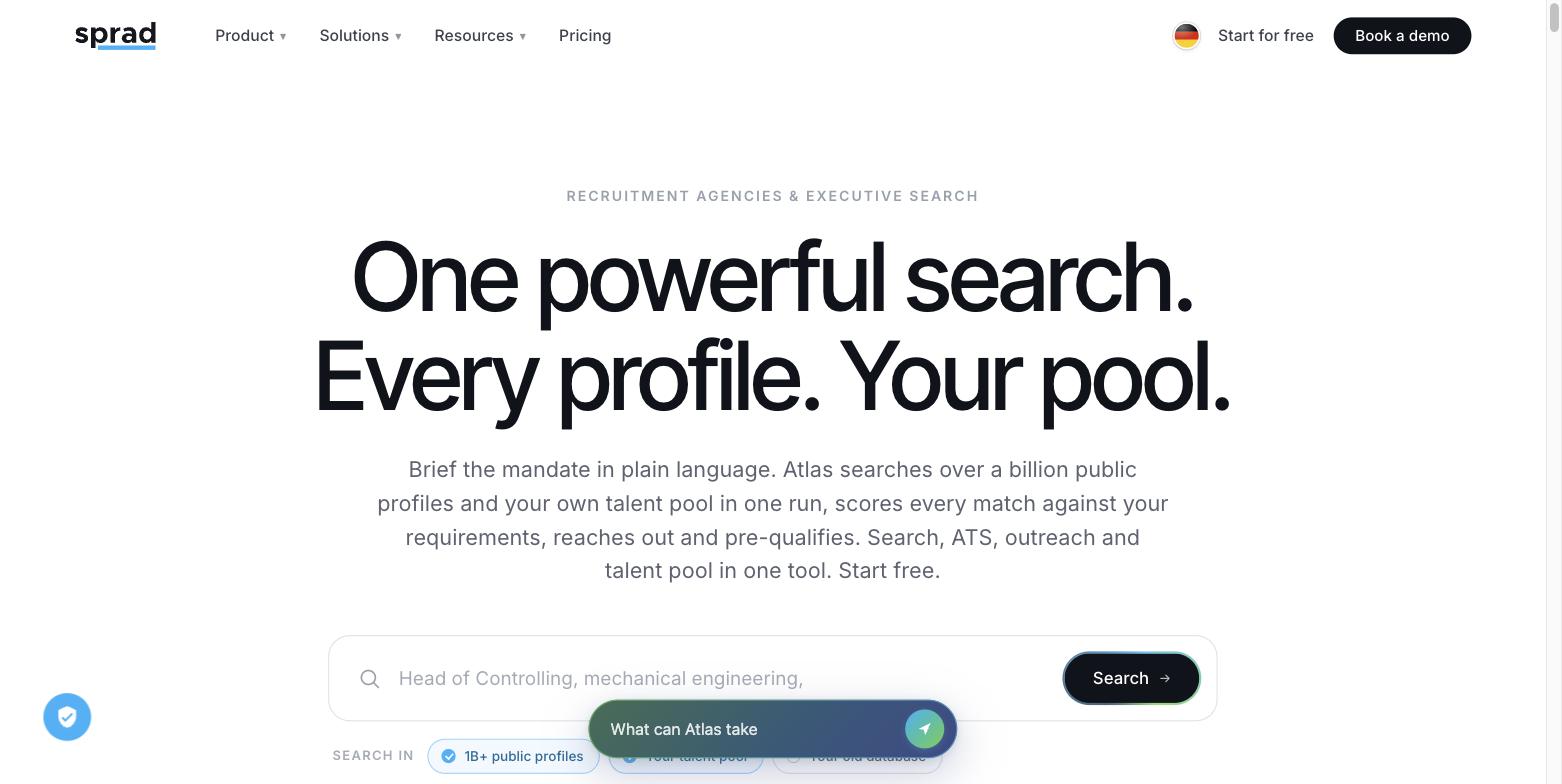
If neither fits — Spott because sourcing still runs through integrations, Bullhorn because AI costs extra — Sprad answers a different question: what happens to your talent pool the day you cancel a subscription? Its requirement search reads full profiles against your criteria across more than a billion external profiles; in an August 2026 benchmark across three real roles, it surfaced 38% of the matches other tools found combined, against 9% for the next-best tool.
Which one fits your agency
- Large agency already deep in Bullhorn, heavy job-board posting and account management: stay, and evaluate Bullhorn's Pro/Max tiers for AI rather than migrating outright.
- Small-to-mid agency drowning in bolt-on tools, English-first, wants one workspace: Spott is the well-reviewed, fast-moving option — with the caveat that sourcing still runs through integrations.
- Agency that wants to own its network, needs real external sourcing, and operates in German: Sprad is the only one of the three built for that combination.
- Agency needing native payroll or contractor invoicing: none of the three ship this well today; Bullhorn's ecosystem gets you closest via its marketplace.
FAQ
Is Spott better than Bullhorn?
For agencies replacing a stack of bolt-on AI tools with one workspace, Spott's reviewers say yes. For agencies that need deep job-board integrations, mature business-development tooling, or don't mind quote-based AI pricing, Bullhorn's much larger review base (1,023 vs. 11) still holds up.
Why are agencies leaving Bullhorn for Spott?
Spott's own case studies point to add-on cost stacking — one reviewer cited $500+/user/month once AI, outreach and enrichment tools were bolted onto Bullhorn separately — plus a Boolean-only core search that feels dated next to AI-native alternatives.
Does Bullhorn have AI matching like Spott?
Only in its custom-quoted Pro and Max tiers. The published Starter and Core tiers ($99 and $165/user/month) don't include AI search, matching or note-taking.
Which is cheaper, Spott or Bullhorn?
Bullhorn's Starter plan ($99/user/month) is cheaper on paper than Spott's Core ($119), but it doesn't include AI. Once you add Bullhorn's AI-capable Pro/Max tier, which is quote-based, the real comparison depends on your negotiated price.
What does Sprad offer that neither Spott nor Bullhorn has?
A requirement search across more than a billion external profiles, pay-per-use pricing instead of a flat per-seat AI surcharge, and a DACH-native product with a German interface.
Can I migrate from Bullhorn to Sprad?
Yes — Sprad imports legacy databases, including old Bullhorn or Xing exports and spreadsheets, at no charge as part of onboarding.
Does Bullhorn have more integrations than Spott?
Yes, by a wide margin. Bullhorn connects to more than 300 partner tools and around 110 VMS platforms, built up over two decades — the depth large staffing firms need for enterprise contract and job-board work. Spott's catalog is newer and smaller; it covers the essentials (VOIP, email, calendar, sourcing, e-signature) but isn't the breadth winner.
Where to go from here
Both Spott and Bullhorn are CRM-first: they help you work the candidates you already have. If the real constraint on your desk is finding candidates you don't have yet, and keeping that network yours after any contract ends, that's the gap Sprad is built to close — one workspace for ATS, external sourcing and screening, starting with 200 free credits a month and no credit card. See the full breakdown at sprad.io/industry/recruitment-agencies, or compare pricing in detail in our Spott pricing guide and Spott alternatives roundup.
Jürgen Ulbrich
Jürgen Ulbrich has more than a decade of experience in developing and leading high-performing teams and companies. As an expert in employee referral programs as well as feedback and performance processes, Jürgen has helped over 100 organizations optimize their talent acquisition and development strategies.