LinkedIn Recruiter and Sprad solve overlapping but different problems: LinkedIn gives you unmatched reach into a single network that almost every professional already trusts, while Sprad searches that same scale of data plus your own history in one pass, and lets the resulting pool stay with your agency after you stop paying. Neither replaces the other for every agency — this comparison is honest about where each one wins, current as of September 2026. See the full numbers in our LinkedIn Recruiter pricing breakdown.
Sprad vs. LinkedIn Recruiter, at a glance
| LinkedIn Recruiter | Sprad | |
|---|---|---|
| Price | $140/seat/mo (Lite, annual); Corporate unpublished, ~$10,000-12,960/seat/yr | 59 €/seat/mo (ATS + pool) + usage credits, no minimum term |
| Network searched | LinkedIn's own 900M+ profiles only | 1B+ public profiles plus the agency's own pool, in one search |
| Talent pool after cancelling | Stays locked to the individual login | Stays with the agency |
| Matching | Boolean + AI search (Professional tier only, since 2025) | Requirement-based AI matching with a reasoned score per criterion |
| Outreach channel | InMail (native LinkedIn messaging) | LinkedIn outreach agent (no email channel yet) |
| ATS included | No; integrates with 20+ external systems (Professional tier) | Yes, built into the same workspace |
| DACH / German | German UI available, no DACH-specific pricing | EU-hosted, German UI, DACH-focused |
Where LinkedIn Recruiter is genuinely better
- Sheer network trust and reach. Nearly every working professional maintains a LinkedIn profile, and a message arriving through LinkedIn's own InMail carries a familiarity that a newer tool simply hasn't earned yet. For cold outreach to passive candidates who've never heard of your agency, that trust matters.
- No setup required for a single search. There's no pool to build and no candidate consent flow to run — you search, you message, you move on. For a one-off, one-role search with no intention of building lasting infrastructure, that simplicity has real value.
- Established ATS ecosystem, at the Professional tier. Recruiter Professional plugs into 20+ major enterprise ATS platforms (Greenhouse, Workday, Taleo among them), which matters for an organization whose hiring stack is already built around one of those systems.
- Passive signal coverage. Job-change detection and "open to work" flags benefit from LinkedIn's sheer user volume — virtually every white-collar professional worldwide keeps a profile current on the platform, which Sprad, as a younger entrant, is still building toward at the same depth.
Where Sprad is genuinely better
- The pool survives the subscription. Cancel LinkedIn Recruiter, and your project folders stay tied to an individual's login. Cancel Sprad, and the talent pool your team built stays searchable — that's the core of the 59 €/month pitch, not an add-on.
- Search isn't capped at one network. Atlas reads full candidate profiles against a plain-language requirement across more than a billion public profiles plus your own pool, in a single pass, rather than counting keywords inside LinkedIn alone. In a published benchmark across three real roles, that found 38% of all matching candidates across every tool tested, against 9% for the best competitor (sprad.io/sourcing-benchmark).
- No seat cap, no annual contract. LinkedIn Recruiter Lite tops out at five self-serve seats before forcing a sales conversation with no visible price. Sprad has no seat limit and no minimum term.
- One workspace, not a stack. ATS, talent pool, sourcing, screening and voice-interview qualification live in the same tool — LinkedIn Recruiter is sourcing only, requiring a separate ATS purchase either way.
What 5 recruiters pay on each
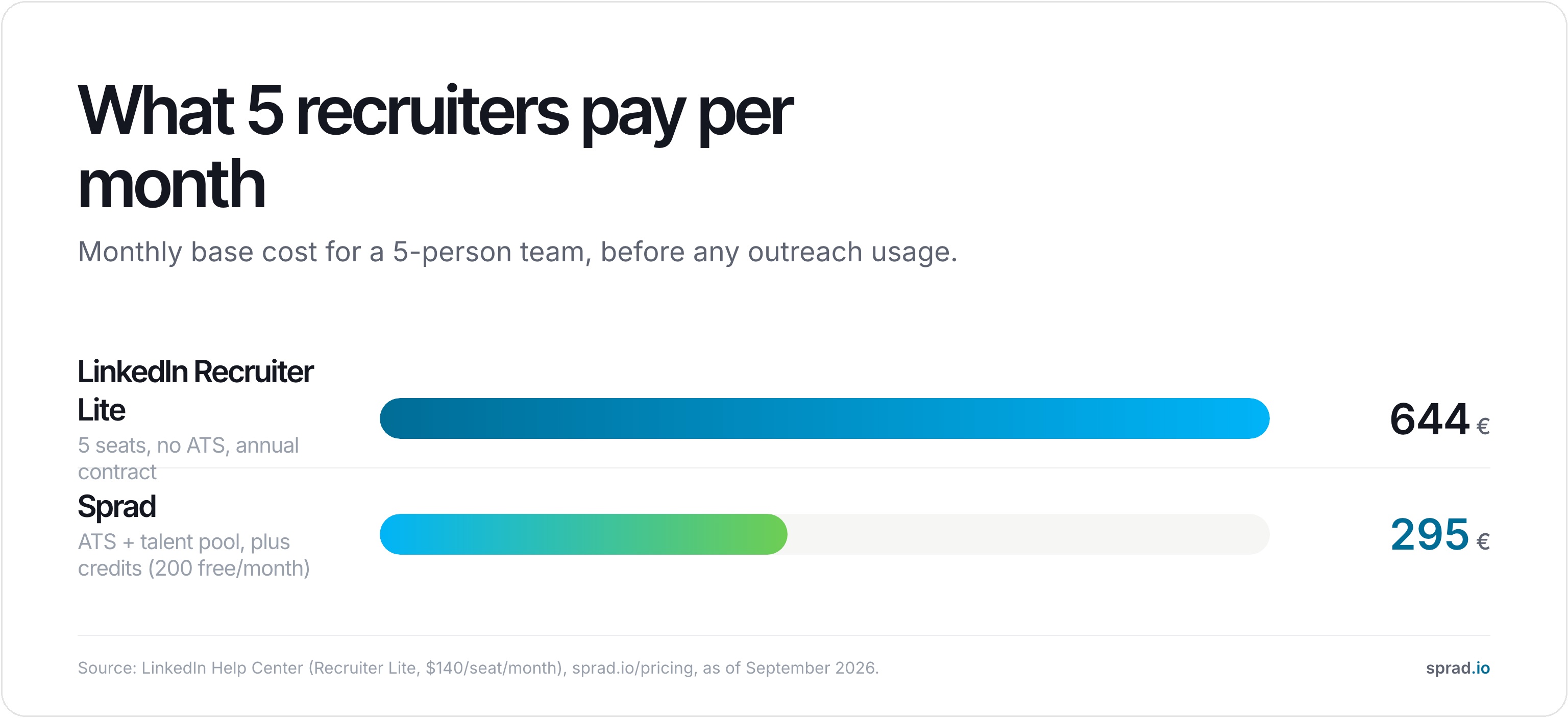
Five recruiters on LinkedIn Recruiter Lite costs 5 × $140 = $700/month ($8,400/year, about €7,730) — the ceiling of what the self-serve tier supports, with no ATS included. The same five recruiters on Sprad pay 295 €/month as a flat base (3,540 €/year) for ATS and talent pool combined, then spend credits only on searches, outreach and interviews that actually happen — with 200 free credits per account every month. For a team that isn't running outreach every single day, the difference isn't marginal.
At 15 recruiters, LinkedIn Recruiter Lite is no longer an option at all — the seat cap forces a move to Corporate, priced individually and reportedly landing around $10,000-$12,960 per seat per year after the 2026 renewal increase (source). Fifteen seats at that rate come to roughly $165,000/year. The same 15 recruiters on Sprad pay 885 €/month as a flat base (10,620 €/year), plus usage — a gap that widens rather than narrows as a team grows, because LinkedIn's per-seat price has no volume relief below the enterprise tier.
Who should pick which — and who should use both
- A boutique agency building a durable network across many searches: Sprad's owned pool and usage-based pricing fit better long-term.
- An in-house team doing a single, urgent enterprise search with an existing ATS already in place: LinkedIn Recruiter Professional's established integrations may be the faster path for that one hire.
- An agency that wants both: nothing stops a team from keeping a LinkedIn Recruiter Lite seat for warm outreach on well-known roles while running broader, pool-building searches through Sprad — the two aren't mutually exclusive, and several agencies run exactly that mix during a transition period.
For agencies still weighing other tools, our LinkedIn Recruiter alternatives guide covers six options side by side, including hireEZ and SeekOut.
FAQ
Is Sprad a full replacement for LinkedIn Recruiter?
For search reach and outreach, largely yes — Sprad searches over a billion profiles including LinkedIn-scale data. What it doesn't replace is LinkedIn's own network-trust effect and its 20+ established enterprise ATS integrations at the Professional tier.
Is Sprad cheaper than LinkedIn Recruiter?
For most team sizes, yes. Five recruiters cost 3,540 €/year on Sprad's base fee against $8,400/year on LinkedIn Recruiter Lite, before any outreach usage — and Sprad has no annual lock-in.
Does Sprad have InMail?
No. Sprad's outreach agent currently works through LinkedIn as its contact channel, similar in spirit to InMail, rather than a native LinkedIn feature.
Can an agency use both tools together?
Yes. Some agencies keep a LinkedIn Recruiter seat for warm, network-driven outreach while using Sprad for broader external search and building a permanent talent pool.
Does Sprad support German-language, DACH-focused sourcing?
Yes — Sprad is EU-hosted with a German interface, built with DACH agencies as a core audience, unlike LinkedIn Recruiter's global, non-DACH-specific pricing.
Which tool is faster to get started with for one urgent search?
LinkedIn Recruiter, if the agency already has an active seat and an ATS integration in place — there's no pool to build. Sprad takes slightly longer to reach full value because part of its advantage compounds as the agency's own talent pool grows over repeated searches.
The switch itself
Moving from LinkedIn Recruiter to Sprad isn't a data migration so much as a fresh start: LinkedIn doesn't offer a real export of the candidates you found there, so the existing LinkedIn pool can't come along either way — Sprad's talent pool starts at zero and grows with every new search. An agency with a legacy Xing or spreadsheet database from earlier years, by contrast, can import and enrich that history for free, which speeds up the first weeks if contact data from other sources already exists.
The bottom line
LinkedIn Recruiter wins on raw network trust and on being the fastest path for a single, urgent search inside an existing enterprise ATS. Sprad wins for any agency that wants the candidates it finds to stay its own — searchable across a billion-plus profiles, in one workspace, without an annual contract or a seat cap. Start free with 200 credits a month, no credit card required, at sprad.io/industry/recruitment-agencies.
Jürgen Ulbrich
Jürgen Ulbrich has more than a decade of experience in developing and leading high-performing teams and companies. As an expert in employee referral programs as well as feedback and performance processes, Jürgen has helped over 100 organizations optimize their talent acquisition and development strategies.