Bullhorn suits agencies already running on its 300+ integrations that can absorb custom pricing for AI features; Loxo suits US-focused agencies that want a built-in 1.2-billion-profile database and accept a higher, AI-inclusive seat price. Neither gives you external search and a talent pool that survives cancellation in one affordable plan — that gap is where a third option, Sprad, sits. Figures below are current as of September 2026.
Bullhorn vs. Loxo at a glance
Bullhorn is the legacy full-stack platform with hundreds of integrations but AI features locked behind a custom quote. Loxo is a self-contained "talent intelligence platform" built around its own candidate database, priced higher but with AI included from its second tier. Sprad adds what both are missing: requirement-based external search combined with a talent pool that stays with the agency.
| Criterion | Bullhorn | Loxo | Sprad |
|---|---|---|---|
| Starting price | $99/user/mo (Starter), $165/mo (Core) | $149/user/mo (Core, annual only), $199/mo (Professional) | €59/recruiter/mo (ATS + talent pool), plus pay-per-use credits |
| Search beyond your own database | Boolean "AI Search" only on Pro/Max (custom quote) | Native semantic search across Loxo's own 1.2B-profile database (Professional+) | Requirement search across 1B+ external profiles plus your own pool, 2 credits per matching profile |
| Talent pool / data portability | Candidate records exportable, no dedicated re-engagement layer | Self-updating profiles, but they live inside Loxo's own database, not a portable pool | Candidates opt in and keep their own profile updated; pool stays with you after cancellation |
| AI matching | Add-on, Pro/Max tier only, custom priced | Semantic Talent Graph search, included from Professional ($199/mo) | Full-profile scoring against your own written criteria, with reasoning per criterion |
| Outreach channels | Email sidebar (Core+); sequences not publicly documented | Email automation included, but with documented deliverability and outage issues | LinkedIn outreach agent (2,000 credits/mo); no email channel in sourcing today |
| CRM depth | Full client CRM (Pro/Max) | ATS/CRM core, no dedicated client-side BD tooling documented | Client context profile that feeds AI search; full sales CRM is in beta |
| DACH / German | English UI; SOC 2/GDPR, US-based | English UI only, US-focused, no German interface | EU-hosted, German-speaking support |
| Migration / onboarding | Established but reportedly slow onboarding for large setups; implementation fees "running into the thousands" | Chrome extension speeds candidate import; mobile app documented as "terrible" | Free import of old databases (CSV, spreadsheets) |

Where the two actually differ
Pricing model: one gate, one inclusion
Bullhorn's AI search, automation and analytics sit behind a custom-quoted Pro or Max tier — the cheaper Starter ($99/user/mo) and Core ($165/user/mo) plans don't include them, according to Bullhorn's pricing page (full breakdown: Bullhorn pricing explained). Loxo takes the opposite approach: its Professional plan bundles AI-powered semantic search for a fixed $199/user/month, no negotiation needed — but only on annual billing, with no public monthly option, per Loxo's own site (details: Loxo pricing explained).
What a 5- and 15-recruiter team actually pays
Seat prices only tell half the story once a team scales past one or two users. Here's the same headcounts multiplied out, using each vendor's own published per-seat price, before any usage-based spend:
| Plan | 5 recruiters/month | 15 recruiters/month |
|---|---|---|
| Bullhorn Starter ($99/user, no AI) | $495 | $1,485 |
| Bullhorn Core ($165/user, no AI) | $825 | $2,475 |
| Loxo Core ($149/user, annual only, no AI) | $745 | $2,235 |
| Loxo Professional ($199/user, annual, AI included) | $995 | $2,985 |
| Sprad (€59/recruiter, ATS + pool, base only) | €295 | €885 |
Two things the table doesn't show matter as much as the totals. Bullhorn's and Loxo's per-seat prices apply to every recruiter whether they run one search that month or fifty — a 15-recruiter Loxo Professional team pays $2,985/month even in a quiet month with few open reqs. Sprad's base fee covers the ATS and pool regardless of activity, but search, outreach and interview spend is metered separately and only lands when someone actually runs it, so €885/month can be the whole bill in a slow month. And neither Bullhorn's AI tier nor Loxo's AI-included Professional plan is optional if a team wants search beyond Boolean keywords — the cheaper Starter/Core rows above don't include it at all.
Sourcing depth: Boolean search vs. a bundled database
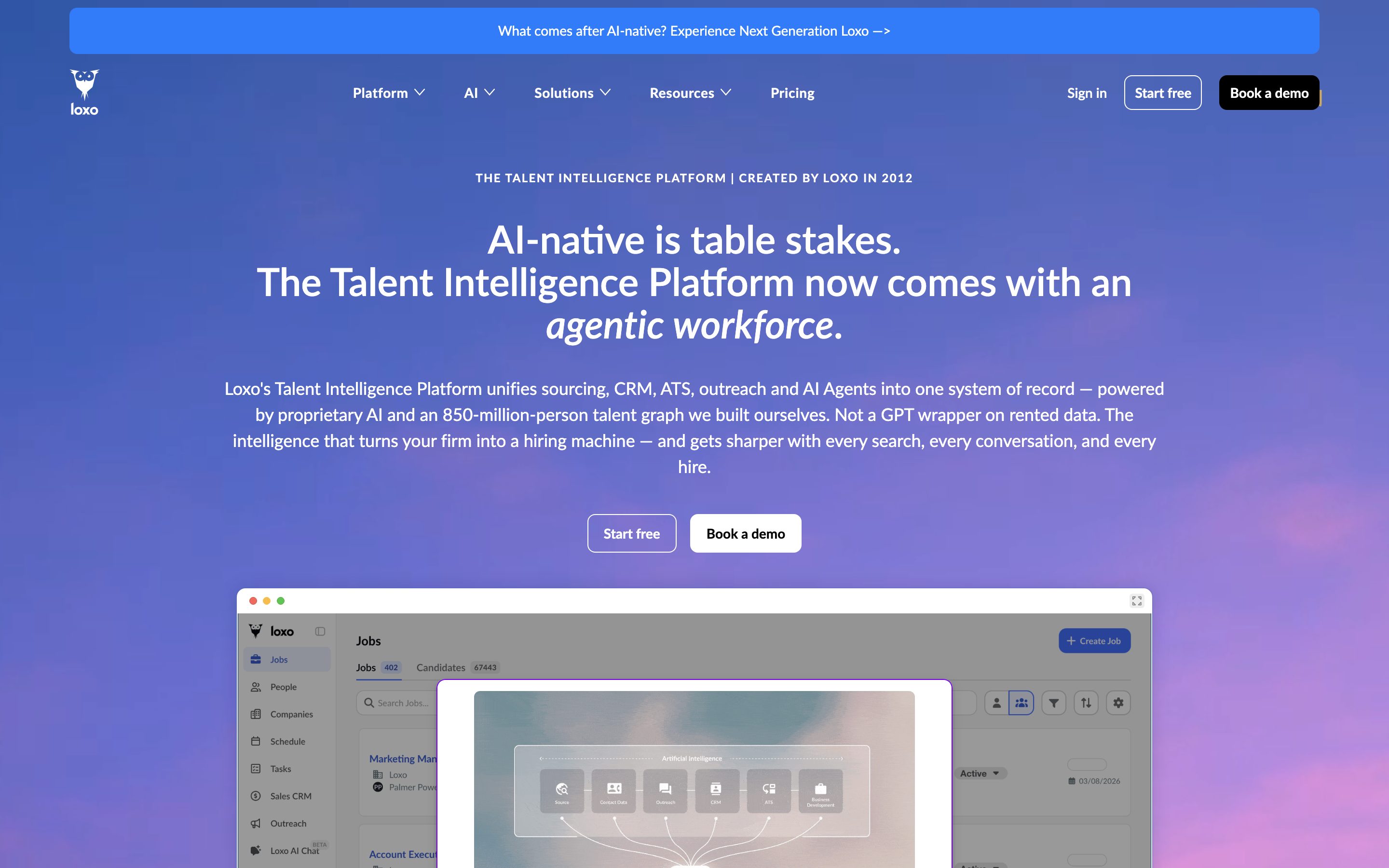
Loxo's core differentiator is Loxo Source, a proprietary 1.2-billion-profile database with self-updating candidate records, so agencies don't need a separate enrichment partner for external sourcing. Neither tool reads a written requirement against full candidate profiles the way a dedicated matching engine does — Loxo widens the pool you search, Bullhorn mostly organizes the pool you already have.
Reviews and user experience
Loxo rates higher on both major review sites: G2 4.6/5 (168 reviews) and Capterra 4.6/5 (126-134 reviews), against Bullhorn's G2 4.2/5 (1,242 reviews) and Capterra 4.0/5 (1,023 reviews, Value for Money only 3.7/5). Loxo's own reviewers still flag real problems: email automation outages, deliverability issues, and a mobile app several call "terrible." Bullhorn's complaints run toward legacy UX, slow support, and add-on costs that add up fast at scale.
Strengths that fall outside this comparison
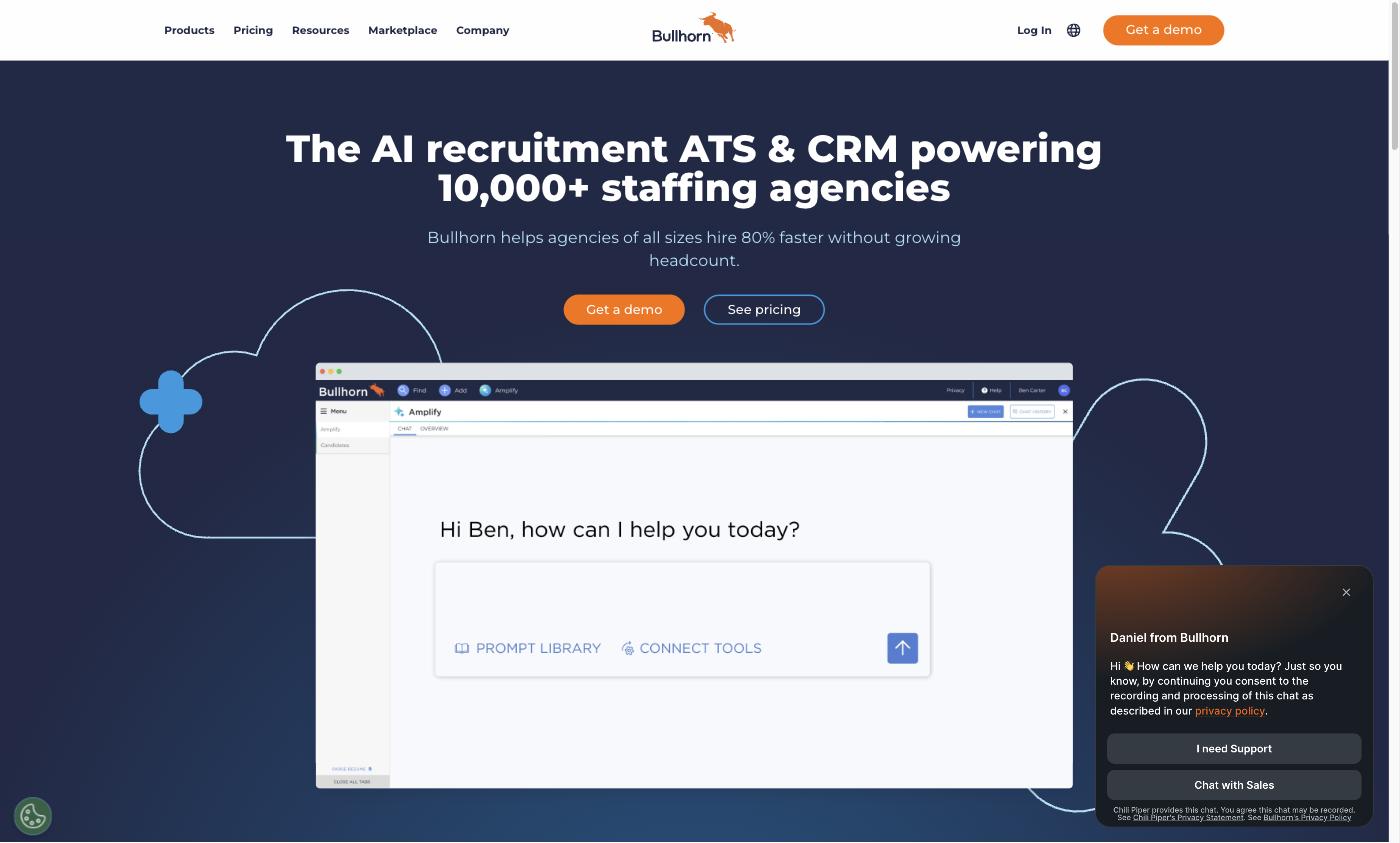
Each tool has a strength the other doesn't try to match. Bullhorn's Middle Office layer — shift scheduling, time capture, timesheet approval and rate cards — plus its 360 tier's payroll, invoicing and VMS integrations serve staffing firms billing contingent placements; neither Loxo nor Sprad touches that layer.
Loxo's reviewers, in turn, credit its Chrome extension with cutting candidate research time roughly in half, since sourcing lives inside the same database as the ATS.
Who each tool actually fits
Bullhorn's 300+ integrations and Heidrick & Struggles backing suit large, established agencies (500+ recruiters) with complex workflows, contractor payroll and VMS billing, who can negotiate custom AI pricing. Loxo fits mid-sized US agencies (roughly 20-200 recruiters) that want one tool with a genuinely large external database baked in and don't mind annual-only billing. Neither is built for a DACH agency, and neither includes voice or video candidate screening — a gap covered separately in Sprad's own comparison against Bullhorn.
The third option: Sprad
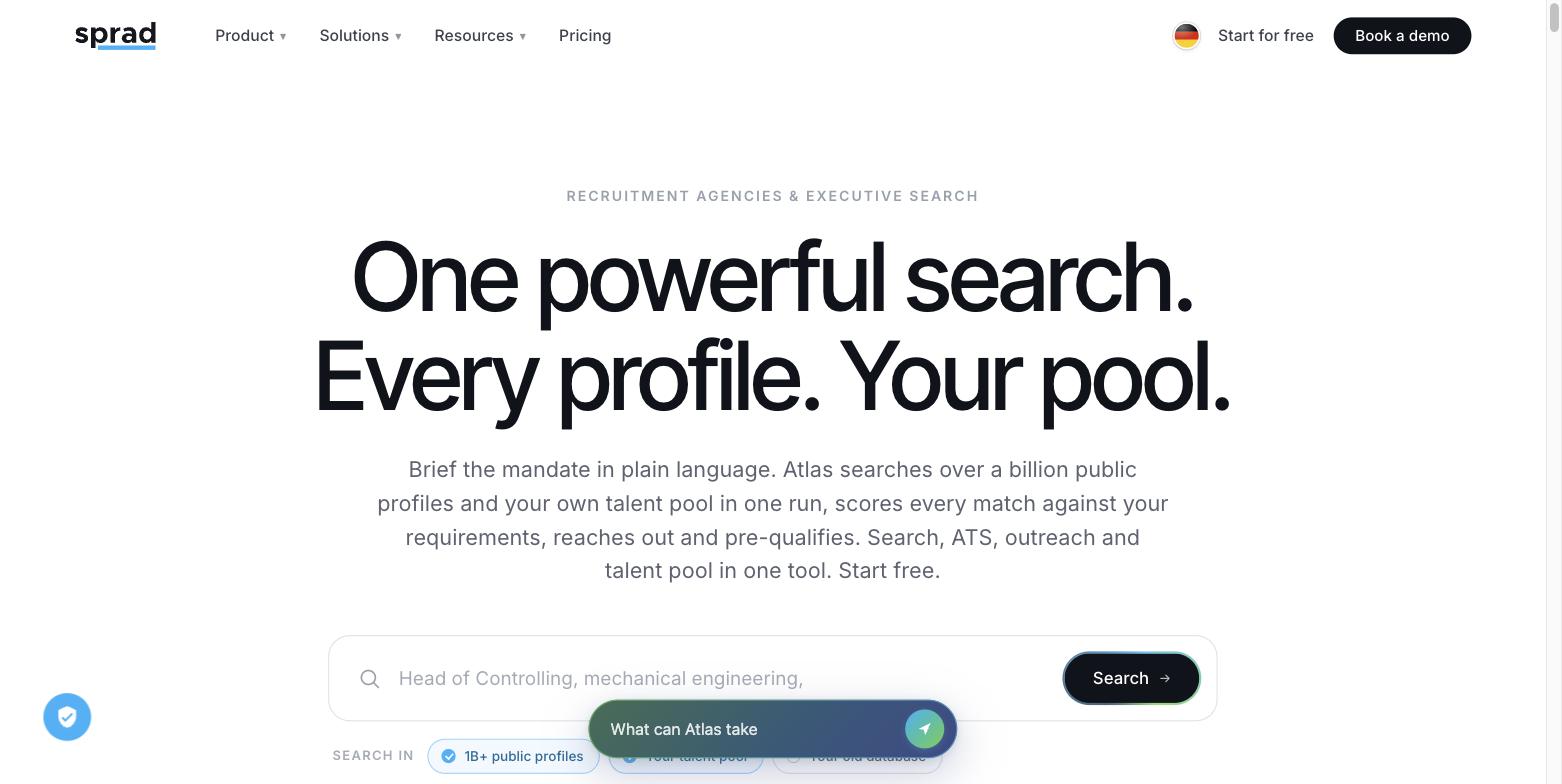
Instead of Boolean keyword matching or a single proprietary database, Sprad reads full candidate profiles against your own written requirements across 1B+ external profiles plus your internal pool in one search, scoring each match with a stated reason. In a benchmark run on 15 August 2026 across three real roles, Atlas surfaced 38% of the matches other tools found combined, against 9% for the next-best tool — see the full benchmark.
When Loxo's database is the better call
Loxo's bundled database is a genuinely different bet than Sprad's requirement search, and for some agencies it's the right one. A search firm running a dozen open reqs at once, each needing repeated re-searches as briefs shift, pays one flat seat price under Loxo Professional no matter how many searches that generates in a month — Sprad's per-profile credit metering (2 credits per matching profile, up to 100 per run) means a high-volume month can add up, even if a slow month costs less. Loxo Source has also been built and refreshed inside one platform over more than a decade; Sprad's external search instead runs live against a third-party source at query time rather than a database Sprad owns and curates itself. And Loxo's search starts from filters and existing candidate records with no separate writing step, while Sprad's requirement search needs a written brief per role before it returns a ranked shortlist — a few minutes of setup that pays off in match quality but is still a different first step. For a mid-sized US search firm running constant, high-volume outreach across many roles at once, that trade-off can genuinely favor Loxo over Sprad's usage-based model.
Which one fits your agency?
- Large, established agency already deep in Bullhorn's integrations: the switching cost usually outweighs the add-on pricing pain — negotiate the Pro/Max quote rather than migrating.
- US-based, mid-sized agency that wants one big external database with AI search included: Loxo's Professional plan is built for exactly that, if annual billing and a US-only interface aren't a problem.
- Agency whose real bottleneck is finding candidates neither tool's own database contains, or that needs voice/video screening: that's what a third comparison and Sprad's requirement search are built for.
- DACH-based agency: neither Bullhorn nor Loxo offers a German interface; Sprad is EU-hosted with German-speaking support.
FAQ
Is Bullhorn or Loxo cheaper?
Bullhorn's Starter tier ($99/user/month) is cheaper on paper than Loxo's Core plan ($149/user/month, annual only), but Bullhorn's AI features require the separately-quoted Pro or Max tier, while Loxo includes AI search in its $199/month Professional plan.
Does Loxo have a built-in candidate database?
Yes — Loxo Source is a proprietary database of roughly 1.2 billion profiles, searchable natively inside the platform without a separate enrichment integration, according to Loxo's own site.
Which tool has better reviews, Bullhorn or Loxo?
Loxo rates higher on both G2 (4.6/5) and Capterra (4.6/5) than Bullhorn (4.2/5 and 4.0/5 respectively), though Loxo reviewers still cite email automation and mobile issues.
Does either tool work well for a DACH agency?
No. Both Bullhorn and Loxo run English-only interfaces, and Loxo is explicitly US-focused. Sprad is EU-hosted with German-speaking support.
Can I migrate candidate data from Bullhorn or Loxo to Sprad?
Yes — Sprad imports existing databases (CSV exports, spreadsheets) for free, so agencies moving off either tool keep their candidate history.
Does Sprad have a database as large as Loxo's 1.2 billion profiles?
Sprad searches more than a billion external profiles through a third-party source, combined with your own pool in a single run — it does not claim to own that external database the way Loxo owns Loxo Source.
Does Bullhorn or Loxo offer payroll and contracting features?
Bullhorn does — its Middle Office layer covers shift scheduling, time capture and rate cards, and its 360 tier adds Time & Expense, gross pay and invoicing, plus VMS integrations for billing enterprise clients on contingent placements. Loxo and Sprad don't include payroll, contracting or VMS integrations today.
A third path worth testing before you commit
Cancel LinkedIn Recruiter or an ATS contract tomorrow, and the candidate pool built inside it usually leaves with the subscription. Sprad's pricing is built around the opposite idea: your network becomes a talent pool that stays with your agency, searchable across more than a billion external profiles in the same workspace as your ATS, screening and outreach — starting with 200 free credits a month and no credit card. See what that looks like for your team size at sprad.io/industry/recruitment-agencies.
Jürgen Ulbrich
Jürgen Ulbrich has more than a decade of experience in developing and leading high-performing teams and companies. As an expert in employee referral programs as well as feedback and performance processes, Jürgen has helped over 100 organizations optimize their talent acquisition and development strategies.