Bullhorn's published pricing starts at $99 per user per month for the Starter plan, rising to $165 for Core — both billed monthly with no visible annual discount, as of September 2026 according to Bullhorn's own pricing page. AI search, automation and analytics aren't included at either of those levels: they sit behind the Pro and Max tiers, both quoted only after a sales call.
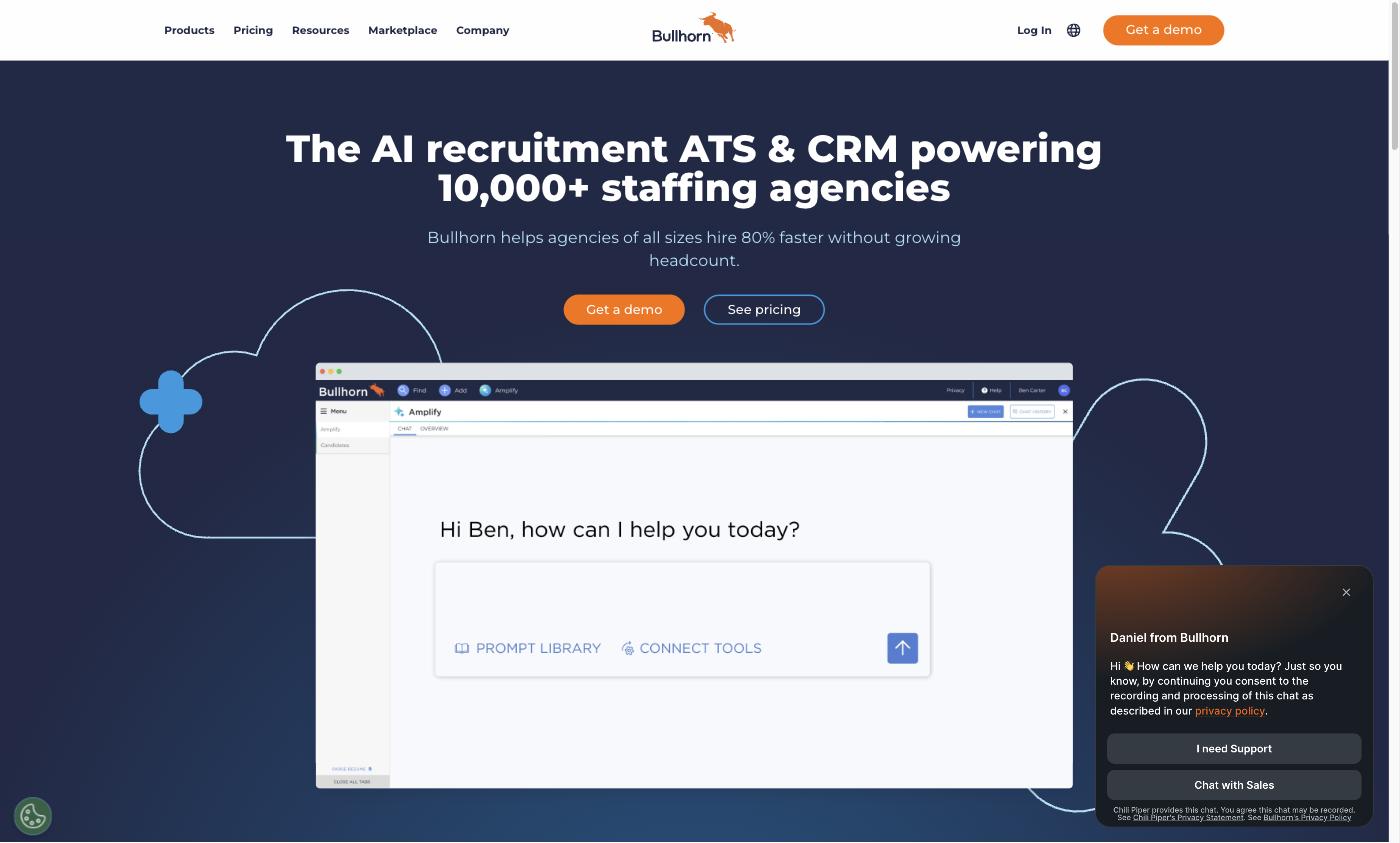
Bullhorn's four plans, in full
Bullhorn sells four tiers. Only the bottom two carry a public price; the top two are "talk to us."
| Plan | Price | What's included |
|---|---|---|
| Starter | $99/user/mo (~91 €) | ATS, resume parsing, client management, job posting, career portal, standard support |
| Core | $165/user/mo (~152 €) | Everything in Starter, plus the 300+ partner App Marketplace, custom fields, LinkedIn integration, email sidebar |
| Pro | Custom quote | Everything in Core, plus AI search & match, Amplify chat LLM, data enrichment, automations, call transcription, analytics, a dedicated account manager |
| Max | Custom quote | Everything in Pro, plus agentic workflows, omni-channel outreach, autonomous screening, a website chatbot |
The line between Core and Pro is the one that matters most: everything that looks like AI on Bullhorn's marketing pages, from search to automation to analytics, lives above that line. A recruiter on Starter or Core is running a resume database with email sync, not an AI-assisted ATS.
One thing worth flagging for anyone still comparing quotes from an older source: some directories (an OMR Reviews listing dated August 2022, for instance) still show Bullhorn's previous tier names — Team, Corporate, Enterprise, Enterprise Plus. Bullhorn has since renamed its lineup to Starter/Core/Pro/Max. If a price you find anywhere is attached to one of the old names, treat it as stale.
What the plan price doesn't cover
- The AI jump to Pro or Max. Since Bullhorn doesn't publish Pro or Max pricing, there's no way to budget the AI features in advance — the only way to find out what they cost is a sales conversation, and the price is negotiated per account.
- The automation add-on, even below Pro. Bullhorn Automation (built on the Herefish platform Bullhorn acquired) isn't bundled into Starter or Core. It isn't published on the pricing page either, but third-party cost estimates put it at roughly $750/month (about 690 €) as a flat fee — not scaled per seat, which means it costs a 5-person team proportionally far more per recruiter than a 25-person one.
- Enrichment add-ons. Data enrichment sits inside Pro/Max rather than being priced separately, but agencies commonly still pair Bullhorn with a third-party tool like Kaspr or Lusha for contact enrichment, which is its own line item outside Bullhorn entirely.
- Implementation fees — and nobody agrees on the range. Capterra reviewers describe onboarding costs "running into the thousands," while public cost-tracking estimates elsewhere range anywhere from roughly $1,000 to $50,000+ (about 920 € to 46,000+ €) depending on migration complexity and team size. The spread itself is the honest answer: Bullhorn doesn't publish a number, so nobody outside a live quote actually knows.
- Annual price increases at renewal. The same Capterra reviews cite yearly price indexation applied at contract renewal; public estimates elsewhere put the typical increase at around 20% — a detail that doesn't show up anywhere on the public pricing page.
- No self-serve free trial at any tier; access starts through a sales conversation, and neither a minimum term nor a minimum seat count is visible on the pricing page itself.
What 5 and 15 recruiters really pay
A team of 5, on Starter
Five recruiters on Starter cost 5 × $99 = $495/month, or $5,940/year (about 5,460 € at the 0.92 conversion rate). Moving the same team to Core, still without any AI features, comes to 5 × $165 = $825/month, or $9,900/year (about 9,110 €). Add Pro for AI search or automation, and the number becomes whatever Bullhorn quotes — there's no published figure to plan around.
A team of 15, on Core
Fifteen recruiters on Core scale linearly to 15 × $165 = $2,475/month, or $29,700/year (about 27,320 €). On Starter it's 15 × $99 = $1,485/month, or $17,820/year (about 16,400 €). Neither number includes implementation fees or the AI tier, and neither includes what a third-party enrichment tool would add if the agency wants to fill gaps Bullhorn's base plans don't cover.
What Core actually costs once you add automation
Take the same 5-person team on Core and add the ~$750/month automation add-on that gets them closest to what Bullhorn's marketing pages show: 5 × $165 + $750 = $1,575/month, or $18,900/year (about 17,390 €) — a real per-recruiter cost of $315/month, nearly double the $165 sticker price on the plan page. That gap between the advertised per-seat price and what a team actually pays once it wants the automation shown in Bullhorn's own screenshots is the number most calculators skip.

Is Bullhorn worth it?
For a large, established agency that's already built its workflows around Bullhorn's ecosystem — 300+ integrations, payroll and contract modules through the Heidrick & Struggles network, staff who know the interface — the switching cost of leaving is often higher than the cost of staying, even at custom Pro/Max pricing. G2 reviewers consistently praise the breadth of integrations and the analytics once an agency is on Pro or Max, and Bullhorn holds a solid 4.2 out of 5 across 1,242 reviews there — see the full breakdown of what reviewers say in our Bullhorn reviews roundup.
The same G2 reviews also describe a legacy interface: slow load times, dense screens and a steep onboarding curve for new hires. None of that changes with a bigger budget — Pro and Max add AI and automation on top of the same underlying platform, not a rebuilt one.
Where the value case gets weaker is for a smaller or mid-size agency evaluating Bullhorn fresh in 2026. Capterra's own category breakdown rates Bullhorn's Value for Money at only 3.7 out of 5, well below its Ease of Use (4.1) and Customer Service (4.0) scores — a gap that usually means the price and the perceived output are out of step. If the AI features Bullhorn advertises are the reason to buy, the actual cost of those features is unknown until a sales rep names a number.
A cheaper way to the same job
Sprad: pay per seat, then only for what happens
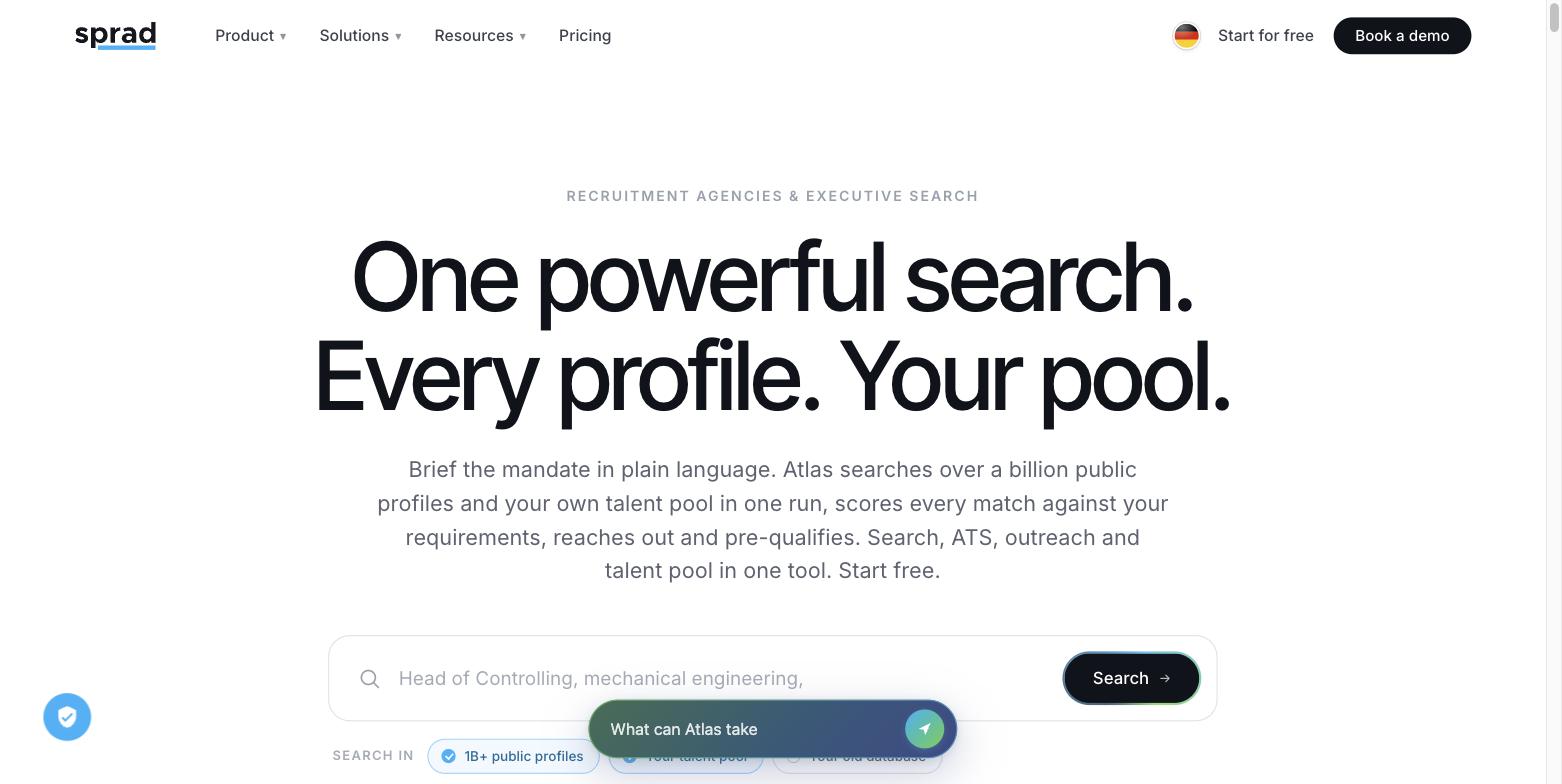
A 5-recruiter team pays 295 €/month as its base (3,540 €/year); a 15-recruiter team pays 885 €/month (10,620 €/year). AI-assisted search across Sprad's pool of 1B+ profiles isn't a separate tier behind a sales call: it's billed at 2 credits per profile that passes the check (at most 100 credits a run), with a full application review costing about 3 credits.
In a benchmark run on 3 real roles across 3 markets on 15 August 2026, Sprad's search surfaced 38% of the matches other tools found combined, against 9% for the next-best tool — see the full sourcing benchmark. Full numbers for your team size: sprad.io/industry/recruitment-agencies.
Two more options worth a look
If the goal is simply escaping Bullhorn's Starter/Core AI gap, Loxo bundles AI-driven sourcing and a self-updating talent graph into its own pricing from the start rather than gating it behind a custom quote — worth reading in detail if AI search is the deciding feature. Vincere is closer to Bullhorn's own positioning (established ATS/CRM for staffing and recruitment firms) and is a more direct like-for-like comparison for agencies that specifically want to stay in Bullhorn's category rather than move to a sourcing-first tool.
FAQ
How much does Bullhorn cost per recruiter?
$99/user/month on Starter, $165/user/month on Core, both billed monthly, as of September 2026. Pro and Max are custom-quoted and not published.
Does Bullhorn charge extra for AI features?
Yes. AI search and matching, the Amplify chat assistant, automations and analytics are only available on the Pro and Max tiers, both priced individually per account rather than listed publicly.
How much does the Bullhorn Automation add-on cost?
Bullhorn doesn't publish a price for it, but third-party estimates put it at roughly $750/month as a flat fee, not scaled per seat — which makes it proportionally far more expensive for a small team than a large one.
Is there a free trial for Bullhorn?
Bullhorn doesn't publish a self-serve trial length on its pricing page; access starts through a sales conversation.
Why is Bullhorn's Value for Money score lower than its other ratings?
Capterra reviewers rate Bullhorn's Value for Money at 3.7 out of 5, noticeably below its Ease of Use (4.1) and Customer Service (4.0) scores, largely due to add-on costs and implementation fees that sit outside the published per-seat price.
What's the cheapest real alternative to Bullhorn?
Sprad's 59 €/month base plus pay-per-use credits usually costs less overall than Bullhorn Core, especially once Bullhorn's implementation fees and any Pro/Max quote are factored in, because a Sprad team only pays for searches and interviews that actually happen.
Does Bullhorn offer DACH or German pricing?
No. Bullhorn's published pricing is in US dollars with no DACH-specific plan or German-language pricing page.
The bigger question behind the price tag
A per-seat price only tells half the story if the tool you're comparing gates its AI features behind a second, unpublished price. Cancel a Bullhorn contract, and the resume database, integrations and workflows built around it stay with Bullhorn's system, not with the agency. Sprad's model is built around the opposite idea: your network becomes a talent pool that stays yours, searchable across more than a billion external profiles in the same workspace as your ATS, screening and outreach, starting with 200 free credits a month and no credit card. See how it compares for your team: sprad.io/industry/recruitment-agencies. For a closer look at how the two tools stack up feature by feature, read Sprad vs. Bullhorn.
Jürgen Ulbrich
Jürgen Ulbrich has more than a decade of experience in developing and leading high-performing teams and companies. As an expert in employee referral programs as well as feedback and performance processes, Jürgen has helped over 100 organizations optimize their talent acquisition and development strategies.