To hire production workers in Germany, advertise where shift workers already spend time, on Instagram and Facebook, and let them apply by WhatsApp instead of writing a CV. Manufacturing is shrinking overall, yet plants still struggle to fill shift jobs because commute, shift pattern or certificates do not fit. This guide covers the market figures, how to build an ad, five screening questions and budget examples for one to five roles. As of October 2026.
The market in numbers
The Federal Statistical Office reports about 5.4 million people employed in German manufacturing in the third quarter of 2025, 120,300 or 2.2 % fewer than a year earlier. In the automotive industry alone the decline was 48,700 jobs. That sounds like an employer's market, but it is not: job cuts hit particular sites and trades, while other plants keep recruiting for the same shifts, often in the same region.

For your plant this means two things. First, there are people in the market who know production work and are now looking at a new employer, but they rarely check job boards actively. Second, you compete in the feed with every other plant in the region. Pay alone rarely sets you apart: since January 2026 the statutory minimum wage is €13.90 per hour, and many plants pay above it. Shift pattern, commute, permanent contract and premiums are what people compare.
Where your candidates are
Production staff work in two or three shifts, rarely sit at a desk during the day and do not write cover letters. Three routes beat a classic job listing:
- Feed ads on Instagram and Facebook. They reach people who are not looking but react to a better offer. Meta handles job ads in its special ad category “employment”, where targeting options are restricted: age, gender and postcode cannot be selected. Check the current rules in the Meta help centre before you plan.
- WhatsApp instead of forms. A short chat on the phone replaces the application portal. How frontline candidates behave is explained in frontline recruiting by phone and WhatsApp; whether outreach is permitted is covered in contacting candidates via WhatsApp.
- The location as an argument. Name the shift times, the transit link and the parking in the ad. More on volume roles in recruiting in logistics and production.
The ad: an example for a machine operator
A good feed ad answers four questions in three seconds: what, where, when, how much. Avoid “attractive salary” and be specific. This invented template shows the structure:
Machine operator (m/f/d), two-shift system, Stuttgart region
Fixed shift plan, early or late, no weekend work. Hourly pay from €[amount] plus shift premiums, permanent contract from day one. Bus stop at the gate, free parking. No experience with our machines? We train you in two weeks. Apply in 60 seconds by WhatsApp, no CV.
The pattern: one line for role and shift, one for reliability, one for pay, one for the commute, one for how to apply. A real photo of your hall beats stock imagery. Whether helpers or skilled workers are the right target decides the wording: “no experience needed” for helper roles, named machines and certificates for skilled roles.
Pre-screening: five questions before anyone spends time
An applicant who has heard nothing after two days has usually applied elsewhere. A Talent Agent therefore asks five questions immediately, around the clock, via WhatsApp, phone or web:

Your production manager then sees only people who match shift, site and qualification, and the team lead stops phoning applicants who never fit. How to screen blue-collar and white-collar applicants differently is explained in blue-collar screening, the sector view is on the manufacturing industry page.
Sprad Social Recruiting for production
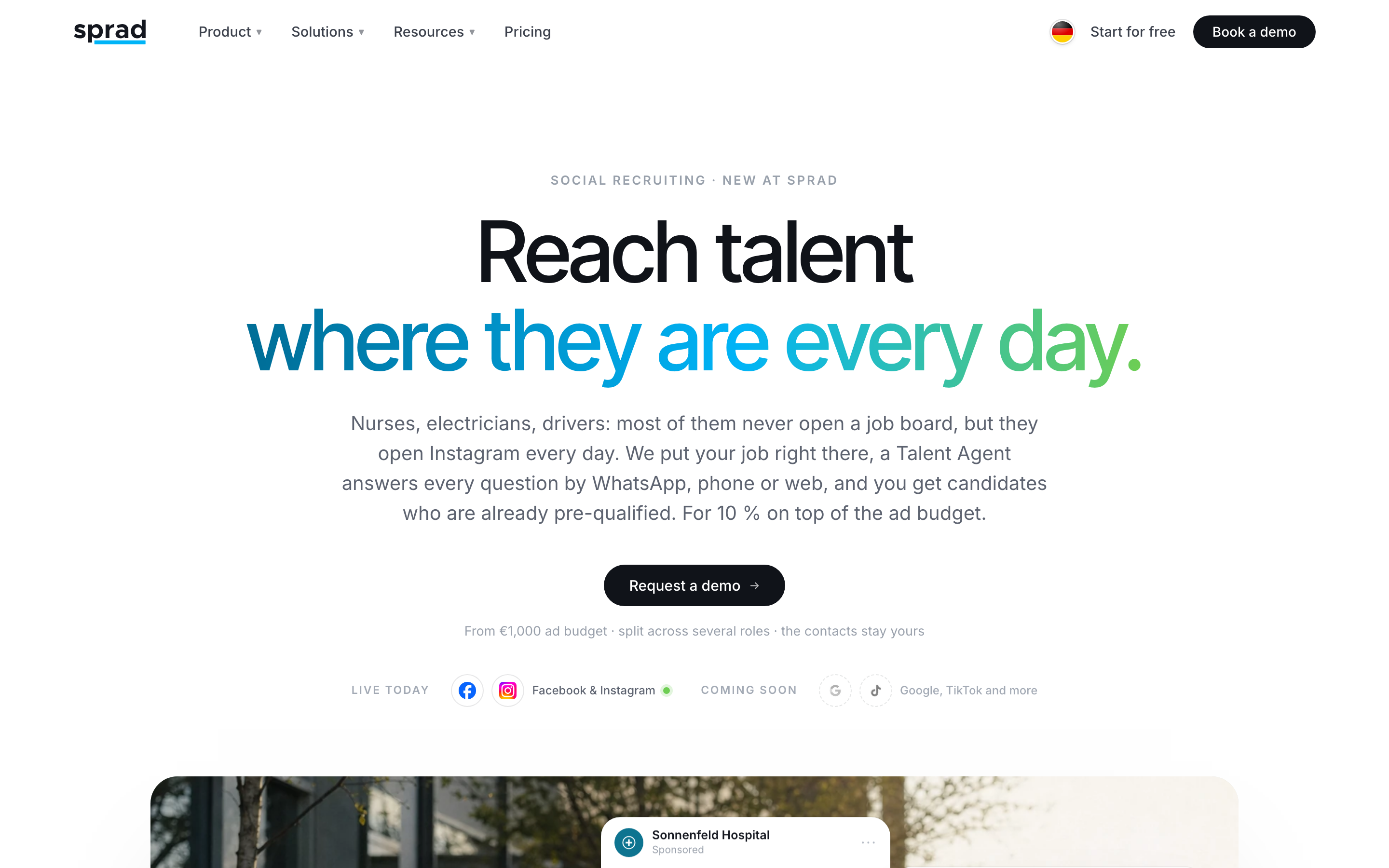
Sprad Social Recruiting runs job ads on Instagram and Facebook, where production staff, drivers and other frontline workers spend time every day. An AI talent agent pre-screens every applicant via WhatsApp, phone or web. Every applicant lands in your company's own talent pool. In production this pays off twice: someone who does not fit today but could join after the summer shutdown stays in your pool instead of disappearing on a platform.
Budget example
Sprad charges ad spend plus 10 %, from a €1,000 budget that can be split across roles. Three months is the recommended run. The figures are pure arithmetic, not a promise of applicants:
| Example | Ad spend (3 months) | 10 % fee | Total |
|---|---|---|---|
| Mid-sized plant, 1 operator role | €1,000 | €100 | €1,100 |
| Plant with 3 roles (early, late, night shift) | €3,000 | €300 | €3,300 |
| Site ramping up a new line, 5 roles | €5,000 | €500 | €5,500 |
How many applications this produces depends on region, ad and shift. As a US reference, the Boostpoint 2026 benchmark reports a median of $13.88 per application on Meta campaigns, which does not apply to German plants. Divide your budget by your own cost per qualified applicant to estimate the number of conversations. The budget tool on the product page gives a guide value, never a guarantee.
Regions: what to watch
Plants are local employers and travel time decides. Plan ads for a radius around the site (Meta requires a minimum radius for job ads):
- Stuttgart region: dense supplier landscape, many plants hire for the same skills, so shift model and premiums stand out.
- Munich and Ingolstadt: high living costs, so commuter support or housing help is an argument.
- Rhine-Ruhr: short distances between employers, so state what is different about yours: fixed shifts, training.
- Lower Saxony (Wolfsburg, Hanover): automotive-shaped, with job cuts at some sites, which makes people open to a stable offer.
- Leipzig and Halle: newer plants and logistics sites, where night shifts deserve their own offer.
These are starting points, not measured values. Only your campaign shows which message works.
Frequently asked questions
How do I find production workers quickly?
Run a feed ad on Instagram and Facebook that states shift, pay and commute, let people apply by WhatsApp without a CV and reply the same day.
What does social media recruiting for production cost?
With Sprad you pay ad spend plus 10 %, from a €1,000 budget that can be split across roles. For a comparison with a job board see StepStone costs and prices.
Does it work when the industry is cutting jobs?
Yes, in some respects it helps: the Federal Statistical Office counts 120,300 fewer manufacturing jobs year on year, so experienced people are available. They rarely search actively, which is why a feed ad reaches them better than a listing.
Which certificates should I ask for?
Only those the job needs, for example forklift authorisation or a welding certificate. Ask during pre-screening and offer training where possible. This is not legal advice.
Can I message production candidates on WhatsApp?
People who contact you after seeing your ad have started the conversation themselves. Proactive outreach is subject to stricter rules, see WhatsApp and the law.
Sprad Social Recruiting at a glance
Sprad Social Recruiting runs job ads on Instagram and Facebook, where nurses, tradespeople, drivers and other frontline workers spend time every day. An AI talent agent pre-screens every applicant via WhatsApp, phone or web. Every applicant lands in the employer's own talent pool, so the relationships stay with the employer instead of a platform. Pricing is ad spend plus 10 %, from a €1,000 budget that can be split across roles. See how Sprad Social Recruiting works.
Jürgen Ulbrich
Jürgen Ulbrich has more than a decade of experience in developing and leading high-performing teams and companies. As an expert in employee referral programs as well as feedback and performance processes, Jürgen has helped over 100 organizations optimize their talent acquisition and development strategies.